Flight pricing is bloody bonkers. Two people can sit next to each other on exactly the same flight, in exactly the same cabin, eating the same airline food but having paid wildly different prices for the privilege. Book on a Tuesday instead of Friday, fly a week later, catch a temporary fare drop or simply get lucky, and suddenly a £700 flight costs £450.
There are already plenty of tools designed to help make sense of this madness but RatePunk approaches the problem a little differently…
Rather than primarily being somewhere you go to search Manchester to Bangkok, 12–26 January, RatePunk is a subscription service that goes looking for unusually cheap flights and brings the deals to you.
Which raises an obvious question; is RatePunk actually finding bargains worth paying to hear about, or could we uncover much the same thing ourselves with Google Flights, Skyscanner and a bit of patience?
That’s what we’re going to find out.
Disclosure: RatePunk provided The Broke Backpacker with access to the service so we could test it for this review. As always, that doesn’t guarantee them a positive verdict.
What Is RatePunk?

The Broke Backpacker is supported by you. Clicking through our links may earn us a small affiliate commission, and that's what allows us to keep producing free content 🙂 Learn more.
RatePunk is a European Union based travel-tech company that began developing its travel products back in 2020. Today, its flight service is available through a web dashboard and mobile app (which they highly recommend using) with deals and personalised alerts also delivered by email or push notification.
The most important thing to understand is what RatePunk isn’t.
RatePunk isn’t really a traditional flight search engine. Instead of repeatedly searching for a particular journey, you give it your departure airport and preferences and let it look for unusually good fares.
Think of it as reversing the normal flight-search process. Instead of telling a search engine where and when I want to go, you’re essentially asking RatePunk where can I go cheaply from here?
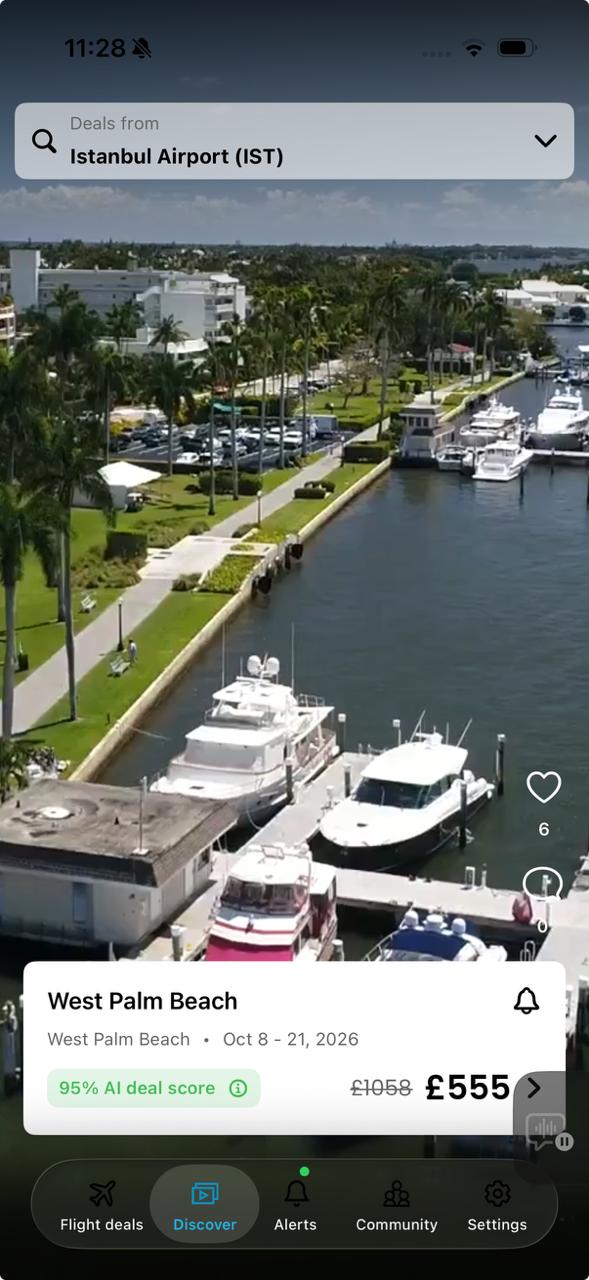
That’s an important distinction. If you’ve already decided that you need to fly from Manchester to Bangkok on 14 January and return exactly two weeks later, I’d still expect to spend some time on the usual flight-search tools. RatePunk makes more immediate sense for flexible travellers who are willing to let a genuinely good fare help decide where — and sometimes when — they travel.
And yes, the flight-deal service is a paid subscription. At the time of writing, RatePunks subscriptions start at $23.99. Check the renewal price carefully: introductory pricing doesn’t necessarily continue into subsequent years.
RatePunk says its system scans around 150 million flight deals per day. That’s an impressive-sounding number, but it’s RatePunk’s own figure rather than one we’ve independently verified (personally I usually lose count at anything over 110 million ;0).
How Does RatePunk Work?
RatePunk’s basic proposition is pretty simple: tell it where you’re willing to fly from, give it some idea of the trips you’re interested in, and let its system do the tedious fare-watching for you.
When something interesting appears, you can either find it while browsing RatePunk or have the deal brought to your attention through an alert.
Setting Up RatePunk
Getting started begins with choosing your home airport. Standard membership currently includes one departure airport, while Premium allows you to monitor multiple airports. As a Northern English boy, I used Manchester.
This is worth testing rather than simply repeating RatePunk’s claims about speedy setup. More importantly, I’d pay attention to how much control it actually gives us. Can we specify regions, dates and budgets sufficiently well to prevent the dashboard filling up with “deals” we’d never realistically book?
Once you’re set up, RatePunk starts surfacing fares from your chosen airport and can send new opportunities through email or push notifications.
Browsing Flight Deals
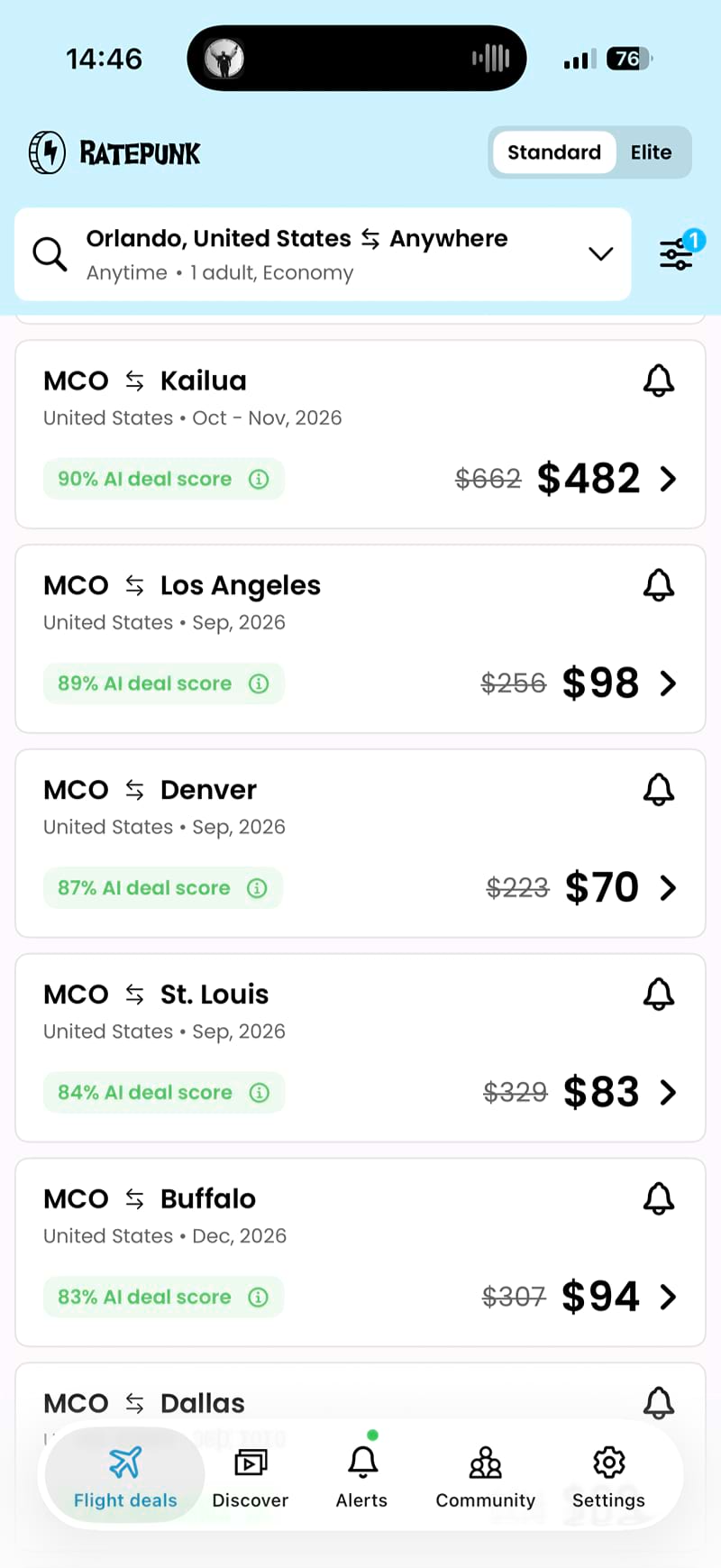
Here’s something that wasn’t immediately obvious to me from RatePunk’s public-facing website: you don’t simply subscribe and then sit around waiting for an email.
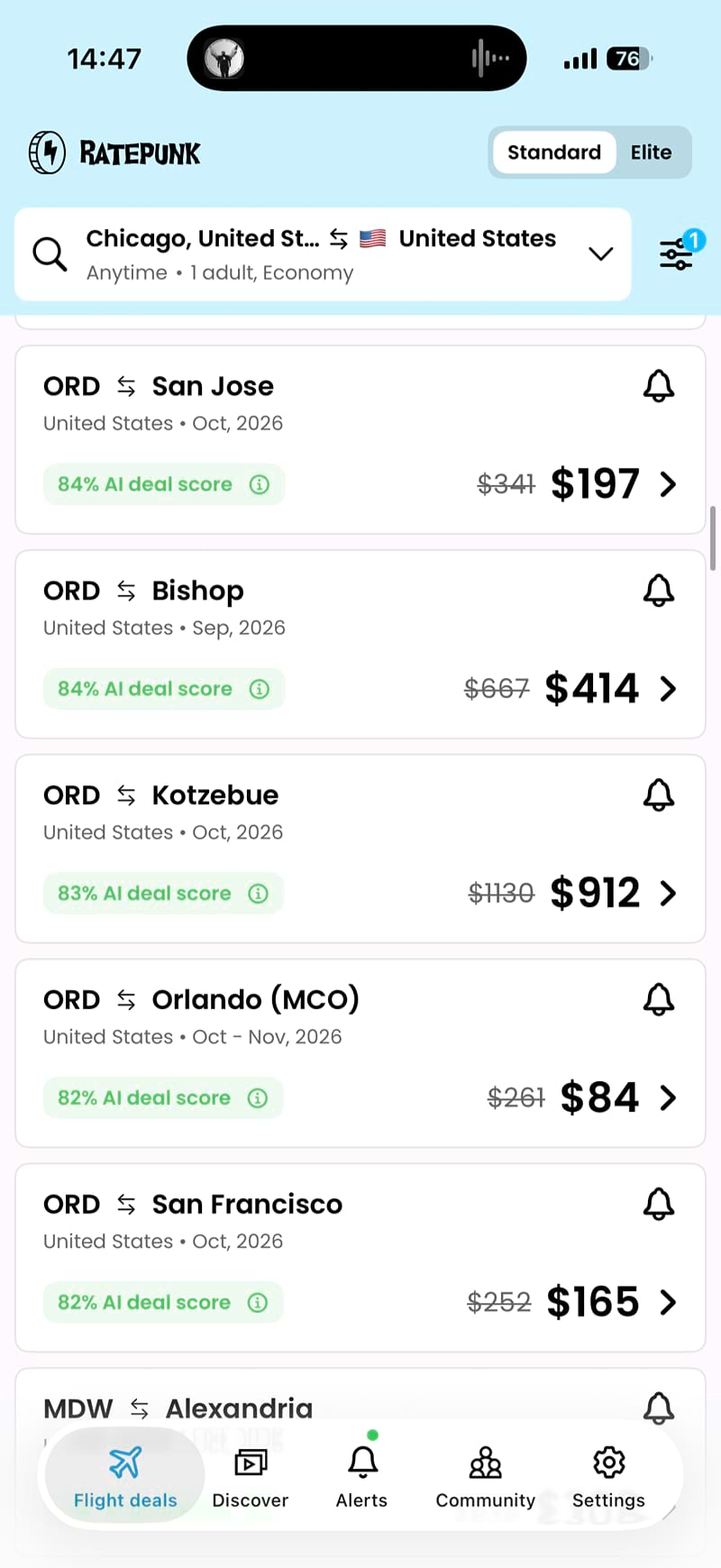
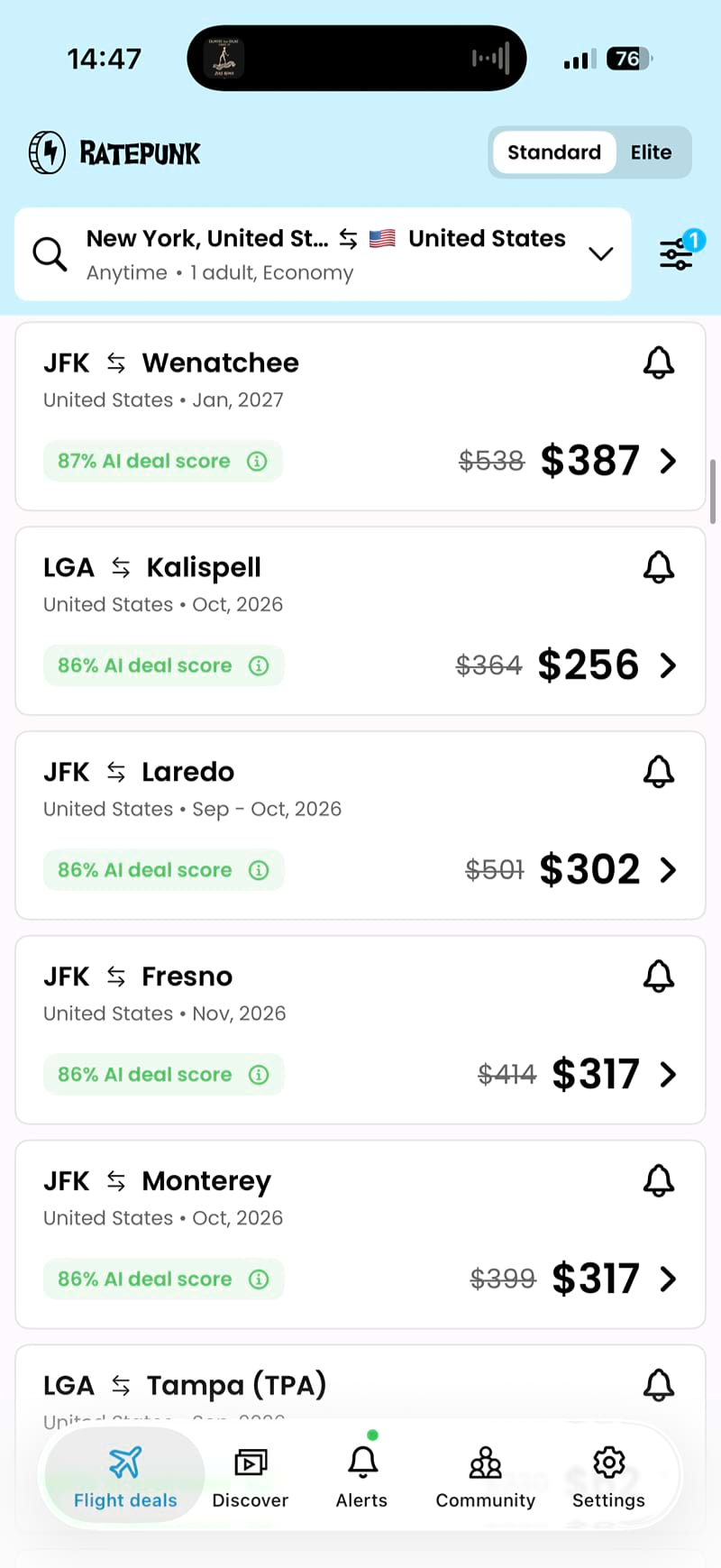
Subscribers also get a dashboard where they can browse the flight deals RatePunk has already found. That makes the service considerably more useful for somebody thinking, “I’ve got a week free next month. Let’s see where I can go cheaply”.
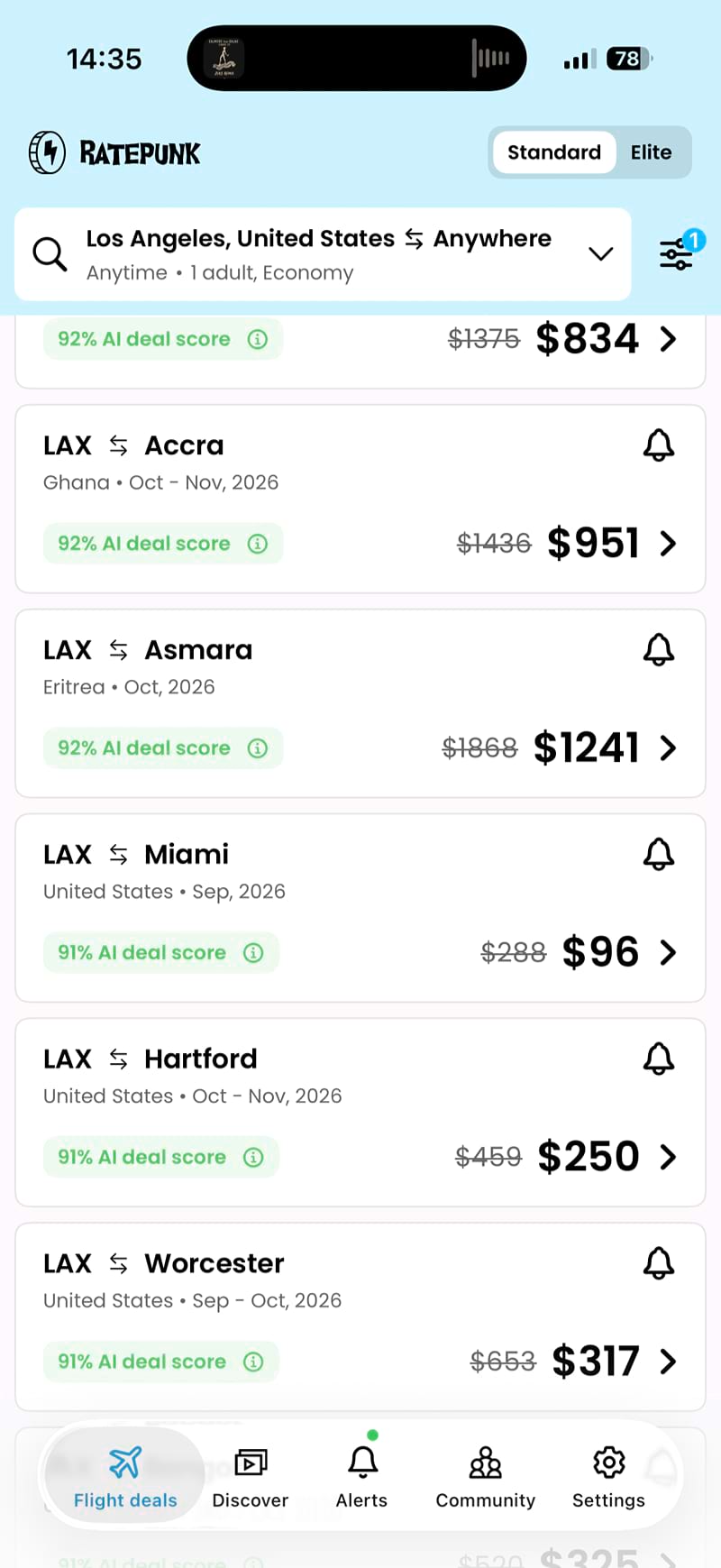
Deals can be assessed using RatePunk’s Deal Score, while the service is designed to surface everything from short-haul breaks to long-haul trips and last-minute opportunities.
But there’s still an important distinction between searching flights and browsing deals.
That’s going to matter when deciding who RatePunk is actually for. A great deal-discovery tool isn’t necessarily a replacement for Google Flights or Skyscanner — and it doesn’t need to be.
What Is the RatePunk AI Deal Score?
This is arguably RatePunk’s most interesting feature.
Every flight deal is given a score out of 100 designed to answer a deceptively difficult question; is this actually a good flight to book?
The distinction matters because cheap and good value aren’t necessarily the same thing. A £250 flight to New York sounds great until you realise it leaves at an ungodly hour, involves two connections and turns what should be an eight-hour journey into a 23-hour expedition.
RatePunk says its Deal Score combines price intelligence with factors affecting the quality of the itinerary. That includes comparing the current fare against what its system considers a normal price for the route, but also considers things such as the airline, number and quality of connections and departure and arrival times.
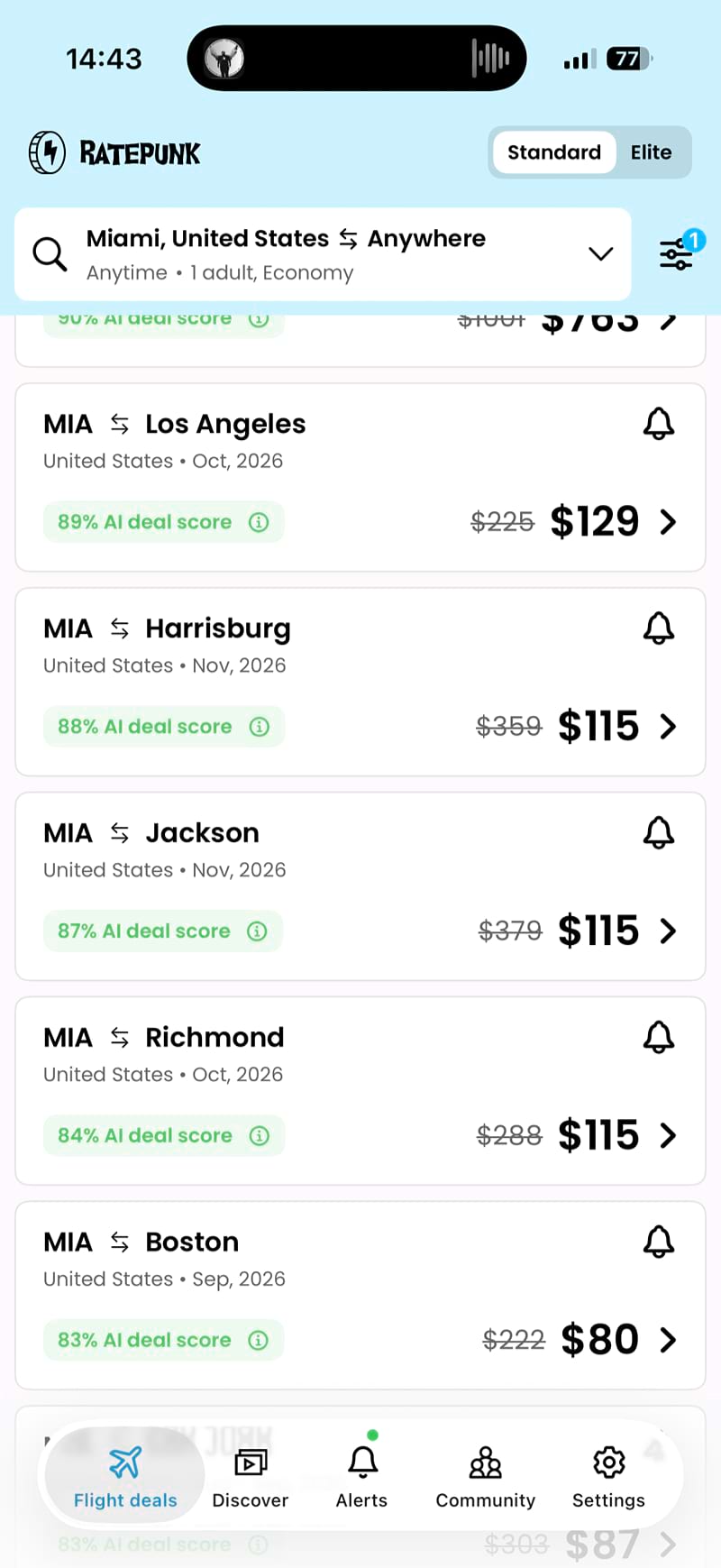
The current scale runs from 0–39 for below average, 40–64 average, 65–74 good, 75–89 exceptional and 90–100 for what RatePunk calls a “Unicorn” fare. RatePunk’s help centre uses a slightly simplified classification, so I’d treat the numbers as RatePunk’s own assessment rather than some industry-standard measure of flight value.
It’s a neat idea. Anyone who has spotted a £430 return flight to somewhere they’ve never been before and wondered “is that actually cheap?” can probably see the appeal.
But the score is only useful if we can trust it.
An 85/100 badge doesn’t make a flight a bargain simply because RatePunk says it does. So for our test, we’re going to take some of the deals RatePunk rates highly and independently search the same routes and dates elsewhere.
That’s where this RatePunk review gets interesting.
We Put RatePunk’s Flight Deals to the Test
| Departure | Destination | Date | RP Price | SS Price | GF Flights |
|---|---|---|---|---|---|
| Manchester | Barcelona | Oct 7 -15 | £30 | £30 | £30 |
| Berlin BD | Istanbul IST | Oct 7 – 15 | £153 | £148 | £148 |
| New York JFK | LA LAX | Nov 1 – 15 | £301 | £338 | £338 |
| Sydney SYD | Tokyo HND | Oct 19 – 26 | £479 | £479 | £466 |
As you can see, when we set our own testing criteria, Ratepunk did not generally fare much better than the other sites.
So then we let RatePunks “Today’s Deals” feature guide us.
| Departure | Destination | Date | RP Price | SS Price | GF Flights |
|---|---|---|---|---|---|
| Sydney SYD | Palm Spring | Oct 22 – Nov 7 | £952 | £900 | £602 |
| Manchester | Hurghada | Dec 7 Dec 19 | £120 | £122 | £253 |
| New York JFK | Madrid | Feb 1 Feb 9 | £224 | £222 | £226 |
| Istanbul IST | Benglaru | Sep 25 – 29 | £321 | £319 | £315 |
As you can see, even here we managed to find similar prices elsewhere and in the case of Sudney to Palm Springs, found a much better deal on Google Flights.
RatePunk Alerts — Are They Actually Useful?
One of RatePunk’s biggest potential benefits is that it can remove the need to obsessively check flight prices yourself. Turn on alerts, tell it what you’re interested in, and theoretically you can get on with your life until a genuinely interesting fare appears.
In practice, our experience was a bit more mixed….
I turned alerts on and indicated the routes I was interested in, but didn’t receive any useful or particularly interesting notifications for those routes during the testing period.
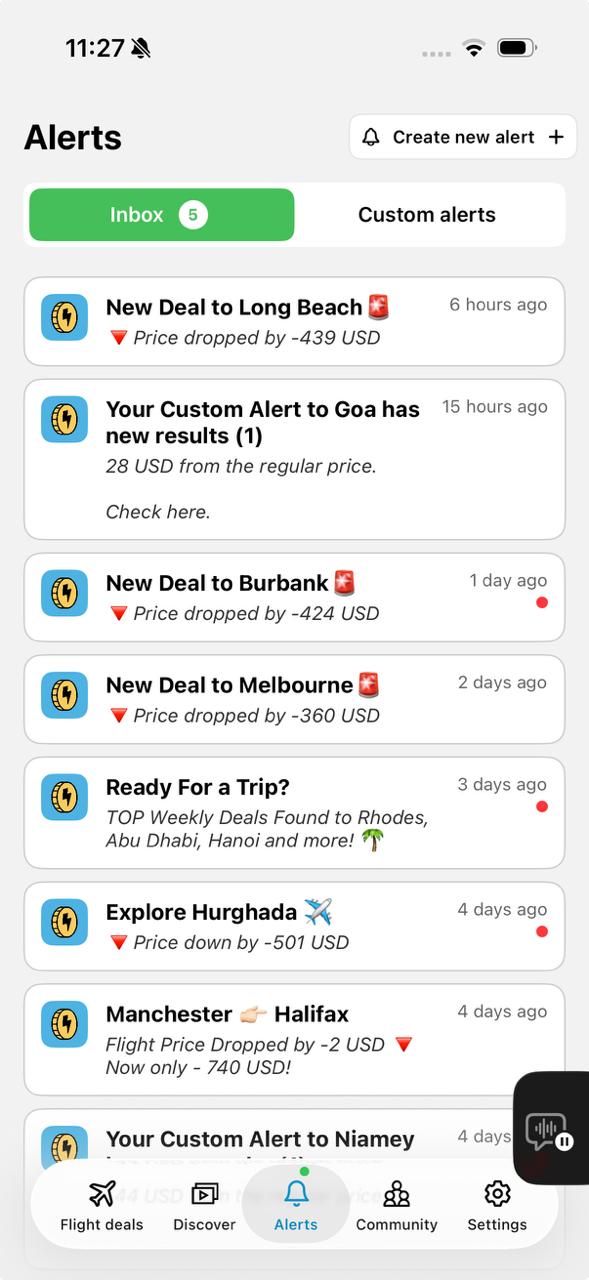
For example, for Manchester – Halifax, Canada the alert suggested it had found a whopping £2 US saving – but when I clicked through the deal had already gone.
Another alert for Manchester – Tbilisi found a genuinely good price – £180 return, BUT it meant leaving on December 5th, arriving 24 hours later (a direct flight would take 4 hours…) and then returning on the 8th. So a truly pointless and slightly harrowing trip all in all. That said, when I searched for this flight on Google Flights and Skyscanner, it was £100 more.
What I did receive was a steady stream of alerts for other, seemingly random flight deals.
Manchester – Burbank £424 – I had no idea where Burbank is but apparently its near to Los Angeles so this looks like a great deal for a return flight.
Manchester – Melbourne £310 DIRECT. Now that is a genuinely good deal and I would have had 2 weeks in Australia in October. Lovely stuff. Note that when I tried to find this exact flight on Skyscanner AND Google Flights, neither came up with it. The best deal I found was, £725 for a return flight with very long layover.
Some of these fares were interesting in their own right, and there’s definitely value here for travellers whose attitude is essentially “I’m flexible — show me somewhere cheap.” But that’s quite different from monitoring a particular journey and telling me when its price drops.
So far, RatePunk’s alerts have felt more like deal inspiration than personalised fare tracking. That’s potentially very useful, but if you’re hoping RatePunk will stop you repeatedly checking the price of a specific upcoming trip, our testing hasn’t demonstrated that yet.
How Much Does RatePunk Cost?
RatePunk currently offers two main flight-deal plans. Standard costs $23.99 for the first 12 months and includes economy deals, email alerts and one departure airport. Premium costs $47.99 for the first year, adding premium-cabin deals and custom notifications.
These are introductory prices, though. Subscriptions automatically renew unless cancelled, and RatePunk says renewals are charged at the rate applicable at the time. So check the renewal price rather than assuming your first-year deal will continue.
There’s no free trial, although initial purchases come with a 14-day money-back guarantee. You can cancel through your account, while refunds must be requested separately. Importantly, renewal payments are generally non-refundable.
But the more interesting calculation isn’t whether RatePunk can theoretically save you $200 on a flight. It’s whether it routinely finds opportunities you wouldn’t otherwise have spotted.
If Google Flights would have shown you exactly the same £350 fare when you searched anyway, RatePunk hasn’t really “saved” you £200. Its value lies in finding and flagging that £350 opportunity before you knew to look for it.
And that’s ultimately what we’re paying to test….
RatePunk vs Google Flights and Skyscanner
RatePunk inevitably gets compared with Google Flights and Skyscanner, but after using it, I’m not convinced that’s quite the right comparison AT ALL. They overlap, but they’re designed to solve quite different problems.
- Google Flights is excellent when you broadly know where or when you want to travel. Its date grid, price graph and tracking tools make it easy to experiment with dates, compare airlines and work out whether waiting might make sense.
- Skyscanner goes further into exploration. You can search flexible dates, whole months or even set your destination to “Everywhere”, while its comparison engine includes a huge range of airlines and online travel agencies. It’s particularly useful when you’re prepared to play around with dates and destinations yourself.
- RatePunk is more passive. Its proposition is essentially: I’m flexible, so tell me when something unusually good appears.
That distinction matters. If I need to fly from Manchester to Bangkok next February, I’d probably start with Google Flights and/or Skyscanner. If I simply know I want a cheap long-haul adventure sometime this winter, RatePunk potentially becomes much more interesting.
And these tools don’t need to be mutually exclusive.
In fact, after testing RatePunk, my preferred approach would be:
Discover with RatePunk. Verify with Google Flights. Book directly with the airline where practical.
RatePunk can do the legwork of spotting an opportunity. Google Flights can help establish whether the fare really is competitive and whether changing the dates improves it further. And if the price difference is negligible, booking directly with the airline can make changes, cancellations and disruption considerably easier to deal with.
That’s a more realistic use of RatePunk than expecting it to replace every other flight-search tool and travel app you already use.
What We Like About RatePunk
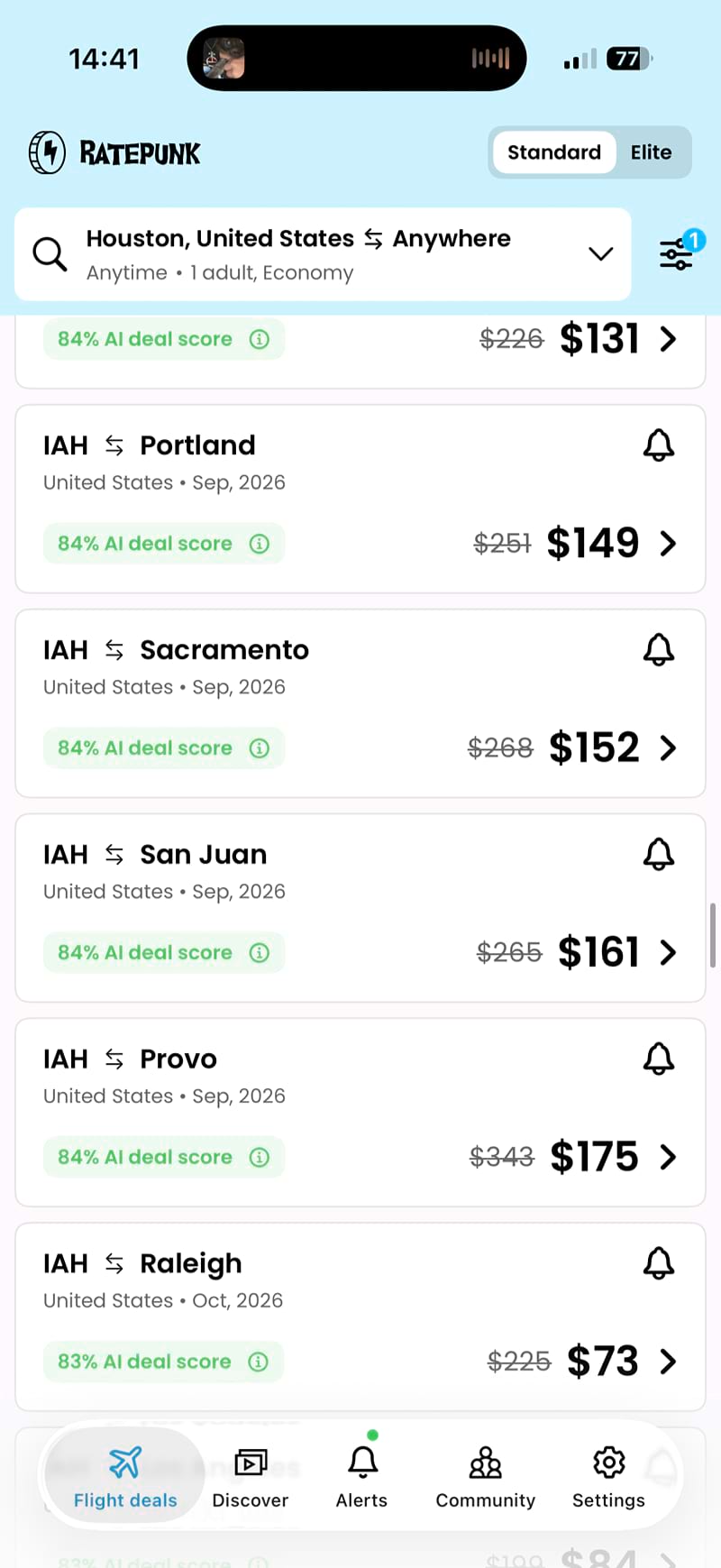
The most important positive from our testing is simple; RatePunk found some genuinely good fares that I couldn’t replicate on either Google Flights or Skyscanner. That’s ultimately what we’re paying it to do, and it proves there’s more going on here than simply repackaging deals you could find in 30 seconds elsewhere.
I also really like the inspiration element. RatePunk works particularly well when you want to travel but aren’t completely wedded to a destination. Seeing an unusually cheap fare to somewhere you hadn’t considered can be enough to pique your interest and turn it into your next trip.
The Deal Score helps here too. Rather than screaming CHEAP FLIGHT!, RatePunk attempts to put the price into context and account for the quality of the itinerary.
For flexible travellers especially, that’s the appeal; less searching, more discovering.
What We Don’t Like About RatePunk
RatePunk hasn’t been nearly as impressive when I’ve wanted help with specific routes or trips I actually intend to take. I indicated the flights and routes I was interested in, but RatePunk didn’t turn up much of use. Meanwhile, the alerts kept coming for destinations I hadn’t asked for.
I also noticed increased battery drain while running the app with alerts enabled. I can’t definitively pin that on RatePunk, but it was noticeable enough during testing to mention.
Then there’s the subscription itself. RatePunk can uncover excellent fares, but I’m not all that convinced that most people really need to pay for another travel service. Its value drops considerably if you take one or two trips a year with fixed dates and destinations.
The sweet spot feels narrower – frequent, highly flexible travellers who are genuinely prepared to book somewhere unexpected when the right fare appears. Travel bloggers, digital nomads and serial weekend-break hunters may get their money’s worth. Plenty of ordinary holidaymakers probably won’t.
Who Is RatePunk Best For?
After testing RatePunk, I think flexibility is the deciding factor.
If you’re a backpacker, digital nomad or frequent traveller who can move dates around, and is genuinely open to going somewhere you hadn’t previously considered, RatePunk makes a lot of sense.
The same applies if you live within reach of several airports and can jump on an exceptional fare when one appears.
In other words, RatePunk suits the kind of traveller who thinks “where can I go cheaply?” rather than “how cheaply can I get to this particular place on these particular dates?”
That’s also why I can see it working particularly well for travel bloggers and other people who travel frequently without always knowing where they’re going next.
It’s much harder to justify for somebody taking one or two holidays per year, especially if you’re restricted by school holidays, annual leave or fixed destinations. If you’re already religiously tracking specific flights through Google Flights, there’s potentially even less value.
There’s another variable we’re still testing: your departure airport. A service built around discovering exceptional fares could be far more useful when you’re monitoring London, or Manchester or another major hub than somewhere like Leeds Bradford with fewer routes.
We’ll be looking at that before reaching our final verdict.
And remember: RatePunk finds the opportunity. It doesn’t operate the flight or sell you the ticket itself.
Is RatePunk Legit?
Yes, RatePunk is a legitimate travel-tech service rather than some mysterious flight-deal website. It’s operated by UAB Yard Venture, a registered Lithuanian company, and has established apps on both Apple’s App Store and Google Play. It is rated 4.2 stars on TrustPilot which comments basically expressing similar sentiments to those shared by us here.
That doesn’t mean you should subscribe without reading the small print. RatePunk is a recurring subscription, and its terms state that memberships automatically renew unless cancelled. There are also user complaints concerning renewals, add-on charges and cancellation/refund experiences, alongside plenty of positive reviews.
So, RatePunk is legit but do understand exactly what you’re buying, what extras you’ve selected and when your subscription renews.
Its also worth emphasising here that you don’t actually buy your ticket from RatePunk. That means that if someone goes wrong, or you need to make a change to your itinerary they cannot help you. That’s not unusual in of itself, in fact its exactly the same with Skyscanner and GoogleFlights.
RatePunk Review: Final Verdict
So, would I actually pay for RatePunk?
In the right circumstances, yes. During testing, RatePunk found some genuinely impressive fares, including deals I couldn’t replicate when I searched the same trips on Google Flights and Skyscanner. More importantly, it showed me destinations and opportunities I probably wouldn’t have thought to search for in the first place.
That’s where I think its real value lies.
RatePunk isn’t a magic portal to cheaper flights, and I wouldn’t buy it simply to monitor one specific annual holiday. I was also underwhelmed by the alerts for routes I’d actually indicated an interest in.
But for frequent, flexible travellers, the proposition is much stronger. If you’re willing to let a great fare determine where you go next, even one unexpected find could justify the relatively modest first-year fee.
My approach would be simple: discover with RatePunk, verify with Google Flights, and book directly with the airline where practical.
Ultimately, don’t expect RatePunk to always find the cheapest flight. Pay for it if you value having unusually cheap flights find you.