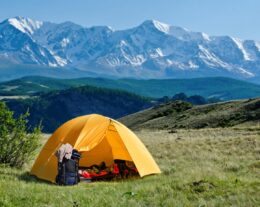
Budget travel has always been about finding ways to make your money go further. Cheap flights, overnight buses, hostel dorms and questionable street food are all part of the quintessential backpacking experience. But what if one of the oldest tricks in the book has been hiding in plain sight all along?
We are of course talking about camping.
Now, we’re not suggesting you lug a three-person tent around Southeast Asia or pitch up in the middle of Barcelona. For most backpacking trips, hostels are still the obvious choice. But in the right destinations, swapping a dorm bed for a patch of grass can save you a small fortune.
And with accommodation prices continuing to squeeze travel budgets, it’s worth considering whether sleeping under the stars might be the ultimate budget travel hack.

Why Camping Deserves a Place in the Budget Traveller’s Toolkit
Hostels are the backbone of budget travel, and for good reason. They’re sociable, convenient and generally cheaper than hotels. But in truth they’re not always all that cheap anymore.
In popular European destinations, a dorm bed can easily cost €30–€50 a night during peak season. Multiply that by a couple of weeks and suddenly a sizable chunk of your travel budget has disappeared before you’ve even bought a beer. And that’s for an 8 man dorm where you may struggle to get more than an hour’s quality rest.
Camping offers an alternative.
Across much of Europe, established campsites offer pitches for considerably less than the price of a hostel bed, particularly if you’re travelling as a couple or group and splitting the cost. Of course, camping isn’t always free, and it isn’t always cheaper. Some coastal campsites charge a bloody premium in summer, while others add separate fees for each person, tent and vehicle.
But choose your destinations carefully and the savings can be substantial.
Lets examine this;
Where Camping Can Actually Save You Money

Not every destination lends itself to camping. In fact, for much of Asia and Latin America, cheap guesthouses and hostels make carrying camping equipment more trouble than it’s worth.
However, there are a few places where camping really comes into its own.
Europe: The Budget Traveller’s Camping Playground
Europe is arguably the sweet spot for combining backpacking and camping.
Countries like France, Germany, Slovenia and Croatia have extensive campsite networks, often with showers, kitchens and other useful facilities all at reasonable prices. Camping can be particularly appealing in expensive destinations such as Switzerland, where even basic accommodation can seriously dent your budget.
It’s also a fantastic option for exploring national parks, lakes and smaller towns where hostels are few and far between.
Scandinavia: Where Nature Opens Up
Norway, Sweden and Finland are famously expensive places to travel, but they’re also home to some of Europe’s most accessible outdoor experiences thanks to a rich and deep camping culture.
Thanks to various rights of public access, responsible wild camping is permitted in many natural areas, subject to local restrictions. Of course, it’s better in summer as even the shoulder seasons tend to be seriously chilly – so unless you have winter camping gear, it might be a frigid night.
Road Trips and National Parks
Camping really shines when you’re travelling through rural areas. Whether you’re road-tripping around Scotland, exploring the Balkans or hiking through the Alps, campsites can provide affordable accommodation close to the places you’ve actually come to see.
Unlike with city hostels, you’re not necessarily paying extra for the privilege of being somewhere beautiful.
How Much Can Camping Actually Save?
Let’s look at a hypothetical two-week European trip.
| Accommodation | Cost per night | 14 nights |
|---|---|---|
| Hostel dorm bed | €35 | €490 |
| Campsite pitch (solo) | €18 | €252 |
| Campsite pitch (split between two) | €24 total | €168 per person |
The Broke Backpacker is supported by you. Clicking through our links may earn us a small affiliate commission, and that's what allows us to keep producing free content 🙂 Learn more.
That’s a potential saving of €238 for a solo traveller, or €322 per person for a couple sharing a pitch, compared with the hostel example. These are of course illustrative figures rather than guaranteed prices, and don’t include camping equipment, transport or additional campsite charges.
Nevertheless, if you’re travelling for several weeks, those savings could pay for a few extra adventures. Or, you know, quite a lot of beer.
What Camping Gear Do You Actually Need?
Here’s where things get interesting and maybe a bit complicated.
If you’re only camping for a couple of nights, buying a load of expensive equipment probably defeats the purpose altogether. But if you’re planning an extended European adventure, a basic camping setup can pay for itself surprisingly quickly.
The essentials are fairly straightforward:
- A tent: Lightweight enough to carry, weather-resistant and easy to pitch. You don’t need an expedition-grade shelter for a summer campsite.
- Sleeping bag: Choose something appropriate for the temperatures you’re expecting that packs up nicely.
- Sleeping mat: Trust us, sleeping directly on the ground gets old very quickly.
- Head torch: Essential for midnight toilet trips and finding your way around after dark.
- Basic cooking equipment: Optional, but potentially another money-saver if you’re staying somewhere without kitchen facilities.
If you’re travelling by car or splitting equipment between friends, weight becomes much less of a concern and you can enjoy a much more luxurious standard of camping.
There are plenty of affordable camping tents for budget-friendly adventures that make more sense for occasional trips than investing hundreds in specialist backpacking equipment. The trick is buying for the kind of camping you’ll actually be doing, rather than preparing for an imaginary expedition across Antarctic
When Camping Isn’t Worth It
Let’s be absolutely clear here. Camping isn’t automatically the cheapest or smartest option.
If you’re travelling between major cities using public transport, carrying a tent and sleeping bag can become a massive nuisance. Campsites are often outside city centres, meaning additional transport costs and wasted time.
Likewise, if you’re backpacking through Thailand, Vietnam or India, inexpensive guesthouses often make much more sense – and personally I’d be loath to sleep on the ground with so many snakes abound. Urg.
Weather matters too. A cheap campsite stops feeling like a bargain when you’re spending three consecutive days soaking wet or freezing cold.
And of course remember that the equipment does have an upfront cost. If you’re only planning one or two nights outdoors, you might be better off sticking with a hostel.
Final Thoughts: Think Beyond the Dorm Room
Camping won’t replace hostels, and nor should it. Half the magic of backpacking comes from the people you meet in dorm rooms, communal kitchens and hostel bars.
But budget travel has never been about following one particular formula. Sometimes the smartest move is booking a cheap dorm. Other times it’s catching an overnight train, staying with friends or pitching a tent beside a lake.
What I say is the next time you’re planning a European adventure, road trip or national park escape, don’t automatically reach for the hostel booking sites.
Find out how YOU can support the site.
We’re a big site with a big team and this job isn’t always easy. But we do it because we love it – we love providing epic and free content. We love the knowledge that our content keeps you adventuring. We don’t ask for money, but if you’d like to find out how you can help the site in more organic ways, click the button below.
Thank you for your support 🙂
And for transparency’s sake, please know that some of the links in our content are affiliate links. That means that if you book your accommodation, buy your gear, or sort your insurance through our link, we earn a small commission (at no extra cost to you). That said, we only link to the gear we trust and never recommend services we don’t believe are up to scratch. Again, thank you!