When looking back at the golden age of Silk Road and other long trails, the same themes often come up. These journeys were undertaken solo in many cases, and on foot for a lot of it. Then, we have the lack of technology and a shared goal – a route we knew others take. That’s not just about safety, but about stumbling across others who may be undergoing the same difficult experience as you, who share the same goal.
It’s difficult to find the modern-day equivalent of this, but Camino de Santiago is perhaps our best bet. The route is a lengthy adventure with spiritual undertones. It’s much, much safer than walking the Silk Road today, but it still has a religious and cultural weight to it.
It’s also accessible – and this is important for the modern person who struggles to put down their phone. It’s a great way to decouple yourself from your phone because the signage and waymaking is so clear.
For solo travellers, and for those strapped for cash, Camino and its hostels along the way is an affordable journey that is perfect for solo backpackers.
The Broke Backpacker is supported by you. Clicking through our links may earn us a small affiliate commission, and that's what allows us to keep producing free content 🙂 Learn more.
Why Camino is ideal for Solo Travellers
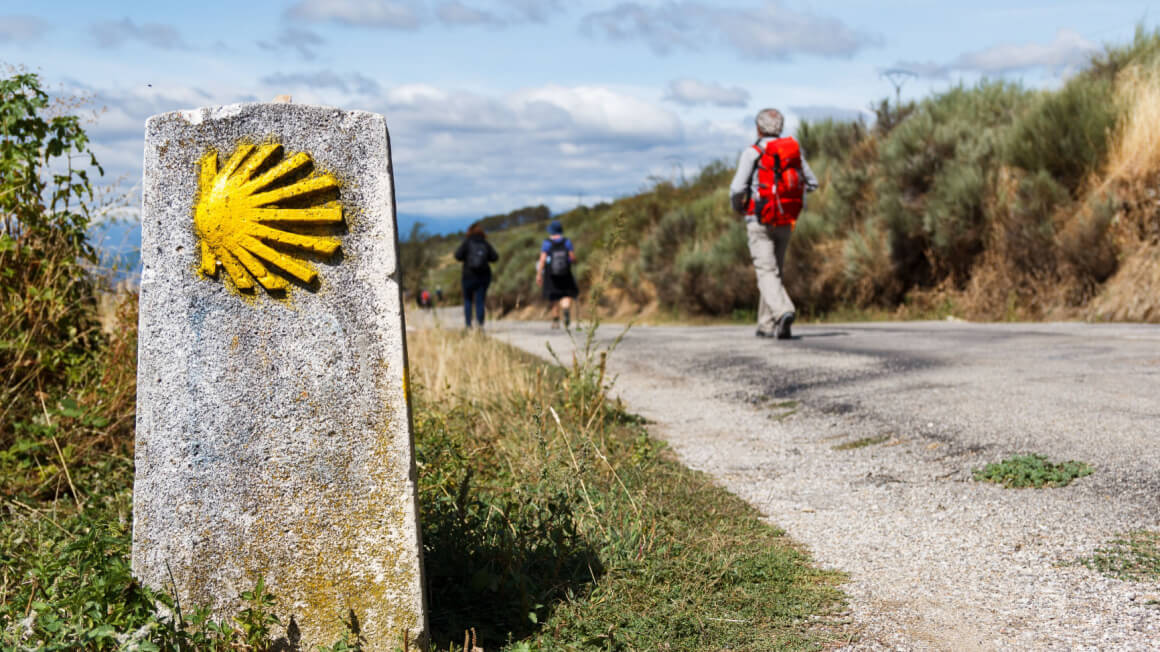
Let’s start with the headline truth about Camino: it’s one of the safest and best-organised long-distance trails in the world. That’s unequivocal. If Google Maps bailed on us because of some server errors, this is one of the few long-distance trails in the world where you wouldn’t really panic. You’d just keep on following the yellow arrows, and towns would begin to render in the distance.
Walking solo doesn’t mean being alone of course, especially on a route as popular as Camino. Albergues (pilgrim hostels) have a built-in social ecosystem where everyone arrives equally sweaty and dazed, which turns out to be a great basis for friendship. You will share meals and laundry lines, and often head out in the morning with your new friends.
Then there are the locals who have been welcoming pilgrims for centuries. They will point you in the right direction before you even realise you’re lost. They might come out and offer unsolicited (but often excellent) weather predictions, or even hand you fruit from a garden. But, let’s not forget. You came alone, and if you are looking for solitude, it’s quite easy to keep to yourself. You have the choice, and others won’t be offended if you tell them you are going to walk alone tomorrow.
Walking on a Shoestring Budget
Walking the Camino routes is absurdly cheap. In fact, it would be difficult to have a holiday in the Balkans for less.
The reason for this is that the albergues’ prices are kept down – they’re often as low as 5 or 10 euros a night, which isn’t far off a coffee in Vienna or Oslo. Plus, Donativo hostels (donation-based) allow you to contribute what you can. Don’t treat them like a free ride, but equally, make use of their low cost.
So, at no more than 100 euros per week (sometimes half that), your shelter is sorted. Next up is food, which is surprisingly straightforward. Bars serve coffee and tortillas at pilgrim-friendly prices – they know their audience – while supermarkets provide everything needed for a picnic. Spanish supermarkets are fantastic, with some of the freshest tomatoes and fruit you can find. It’s not uncommon to see locals put slices of tomato and serrano on a bollo and splash some olive oil on top.
Transport is free, while water is bottled whether you’re on the road or not. Spending only on food and shelter, your budget is what connects you to the more primitive and human experience of just surviving a journey.
The Mental Journey
There’s something very disarming about long days spent walking. Without the usual distractions of group chats and deadlines, your mind eventually stops fidgeting.
At first, you’ll think about practical things like your feet or where you’re going to get your next meal from. Then it’s whether that cloud looks suspiciously rainy. But give it a day or two, and your inner monologue shifts. You’re comfortable knowing that there will be a town soon with some food, and that it doesn’t really matter if it does rain – you can’t control it, and you have waterproofs.
This is when ideas begin to surface and old worries get re-examined. The steady rhythm of boots on dirt becomes active meditation, and this mindfulness leads to an appreciation of the present. The smells, the architecture, the nature. The taste of dinner becomes more vibrant and appreciated.
Of course, it’s no picnic or walk in the park (actually, it is often both of these things). Several days in, you can get fatigued. Your feet hurt, and doubt starts to creep in. Somewhere along the line, you realise you’ve become a slightly different version of yourself – someone more grounded and patient with the world.
These challenging moments are when transformations and growth occur. It doesn’t happen in a dramatic cinematic flash, but in the quiet moments.
Planning your Solo Camino
- Choose your route wisely. The three main routes are Francés (popular), Portugués (gentle & coastal), and Primitivo (harder & rugged).
- Gear matters, but not too much. You need a well-fitting backpack, broken-in shoes, and quick-dry clothes. But beyond those, it’s just a matter of having medicine, water and food. Stay light.
- Train lightly. While a few long walks beforehand are helpful, the journey itself will build your fitness, so peak condition is not required to start. You can take rest days.
- Get your pilgrim passport. This booklet is necessary to stay in albergues and must be stamped twice daily to receive the Compostela certificate.
While many walk entirely independently, first-timers sometimes want help. Services like Viajes Camino de Santiago can organise your Camino adventure by booking accommodation and providing a route. This is ideal for those who want to focus purely on walking rather than coordinating the finer details.
A New Kind of Adventure
The Camino is more than a cheap holiday, because you’re betting on it changing who you are. It’s the perfect time to spend a week or two on the road, in nature, mixing with other like-minded people. For often 10-15 euros a day, you can sustain yourself on a journey from France to the great Santiago de Compostela.