So you snagged the cheapest Ryanair flight to Paris that exists to find yourself bleary-eyed, sleep-deprived, and thoroughly confused. Instead of the usual passport stamp from an immigration officer, a machine has taken a scan of your passport, fingerprints and snapped a picture that you would pay good money to never see the light of day.
Have you missed a trick? Or has the lack of sleep accidentally smuggled you into the country?
Fear not – no crimes have been committed today. It’s the Schengen Zone in play. If you’re gallivanting around Europe this summer, it’s worth knowing about. Brexit has changed the game for British passport holders, and talks of ’90 days’ and zone rules can make anything Schengen-related feel mildly confusing.
I’ll demystify anything and all you need to know about the Schengen Zone, from the countries included in it, how long you can stay and all the post-Brexit updates you need to be in the loop on.
If you don’t want your European adventure to end at border control, then I suggest you lock in now 😉
What Is the Schengen Zone?
The Euro Summer has officially commenced. You land in Spain to get a head start on your tan. Then, after a couple of days, you jump on a train to France, before busing your way through Belgium, and ending up wandering the streets of Amsterdam at 2 am, slightly stoned, and on the hunt for frites. Throughout all of this, you haven’t had to show your passport at any border crossing once.
What kind of witchcraft is this? Well, it’s the Schengen Zone at play.
In layman’s terms, the Schengen Area is a huge travel zone in Europe where internal border checks between participating countries have been removed. This means that once you enter the area, you can usually move freely between countries without having to go through the ball-ache of immigration checks each time you cross a border.
The agreement was signed in 1985 aboard the MS Princesse Marie-Astrid. At the time, it was docked on the Moselle River near Schengen, a tiny village straddling the borders of France, Germany and Luxembourg (and home to some cracking wine).
The Broke Backpacker is supported by you. Clicking through our links may earn us a small affiliate commission, and that's what allows us to keep producing free content 🙂 Learn more.
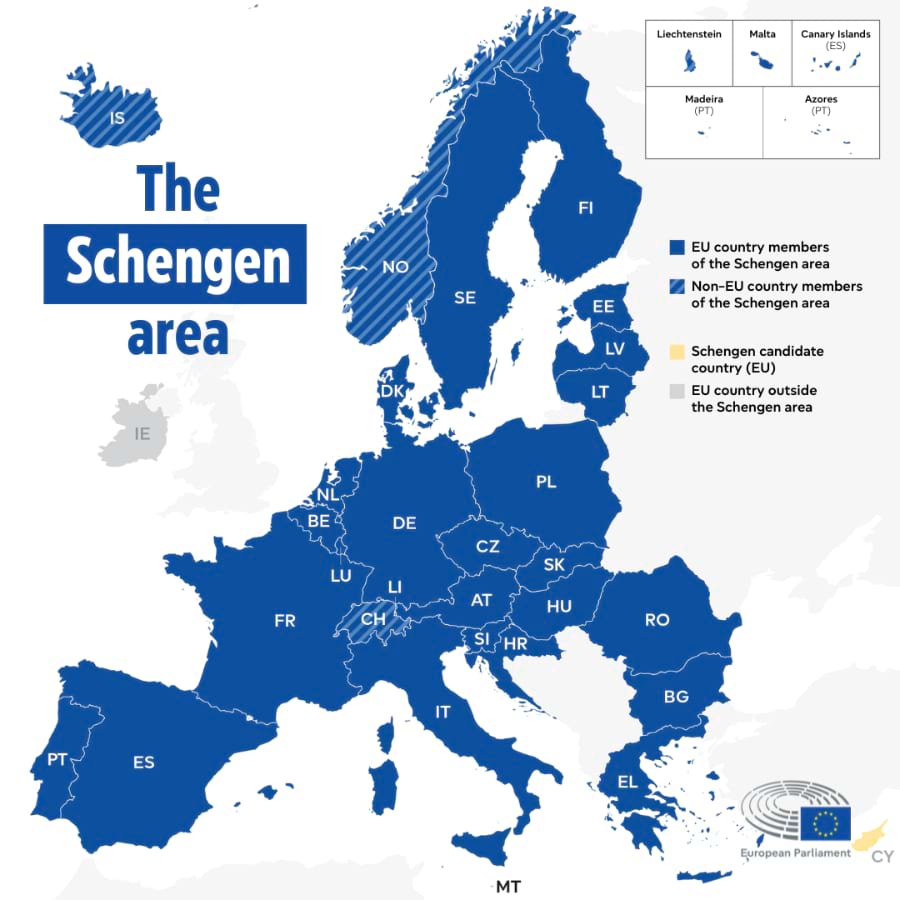
One thing that trips most people up: the Schengen Area and the EU are not the same thing. But, alas, they are not. In fact, not all EU countries are part of the Schengen Area. And just to confuse things, not all Schengen countries are in the EU!
Ireland, for example, is in the EU but not in the Schengen Area. Cyprus is also still outside the Schengen Area for now, while Iceland, Norway, Switzerland, and Liechtenstein are all part of the Schengen agreement despite not being EU members.
Not confusing at all, right?
Here are the full Schengen countries at the time of writing:
- Austria
- Belgium
- Bulgaria
- Croatia
- Czech Republic
- Denmark
- Estonia
- Finland
- France
- Germany
- Greece
- Hungary
- Iceland
- Italy
- Latvia
- Liechtenstein
- Lithuania
- Luxembourg
- Malta
- Netherlands
- Norway
- Poland
- Portugal
- Romania
- Slovakia
- Slovenia
- Spain
- Sweden
- Switzerland
There are also a few tiny European micro-states that are effectively inside the Schengen Area even though they’re not official members. They include Monaco, San Marino, and Vatican City – all of which you can wander into without going through a full border checkpoint.
Does Schengen Affect UK Travellers?
Although the UK is not in the EU now, Schengen still affects UK travellers. Surprisingly, even before Brexit, the UK was never actually part of the Schengen Zone. British travellers have always needed to flash their passports when entering mainland Europe. That said, while the UK was still in the EU, British citizens enjoyed freedom of movement rights, which made travelling, living, and working around Europe ridiculously easy. However, all that changed after Brexit. Boo!!!
As of 2026, UK passport holders are now treated as ‘third-country nationals’ by the Schengen Area. This might sound dramatic…almost derogatory indeed. But it basically means Brits are now subject to the same entry rules as travellers from countries like the USA, Canada, or Australia.
In practical terms, this means a few things.
- You’ll usually be expected to join the queue for non-EU passport holders at airports and border crossings
- Your time inside the Schengen Area is now limited by the famous 90/180-day Schengen rule
- New border systems, such as biometric checks and digital entry records, now apply to British travellers too
Thankfully, UK travellers can still visit France, Italy, Greece, Spain, Portugal, and the rest of the Schengen countries without applying for a visa for short trips. You can actually stay for up to 90 days within any rolling 180-day period for the purposes of tourism, family visits, business meetings, or backpacking adventures.
So for classic interrailing trips? You’re still fine. Just keep an eye on how long you do it for.
That said, one important exception is Ireland. At present, travel between the UK and Ireland remains completely separate from Schengen thanks to the long-standing Common Travel Area agreement. Essentially, this entitles UK citizens to continue travelling freely to Ireland without visas, ETIAS authorisation, or Schengen-style time limits.

Photo Nic Hilditch-Short
The 90/180-Day Rule Explained
The 90/180-day Schengen rule seems to melt the brains of many backpackers. At first, it sounds fairly simple to grasp. You can stay in the Schengen Area for 90 days within any 180-day period. But the important point is that it uses a rolling window and not a calendar year.
In other words, every single day, immigration systems look backwards for 180 days from today to determine how long you’ve spent inside Schengen countries during that period.
Crucially, every calendar day you are physically inside the Schengen Area counts as a full day. Even if you arrive at 11.30 pm or leave at 6.30 am, your entry and exit days both count.
Unlike what many travellers think, leaving the Schengen Area does not reset the clock. Unfortunately, you can’t spend 90 days in Europe, then quickly pop over to the UK for a weekend, before coming straight back for another 90-day period. Ah, those were the days…
Here’s a simple example for you to follow. Say you spend:
- 30 days in Spain during April
- 45 days in Italy during June
That gives you a total of 75 Schengen days used within the previous 180 days. That means you have only 15 days left before hitting the limit.
Thankfully, time spent outside the Schengen Area does not count toward your total. That’s why many travellers plan visits to countries such as the UK, Ireland, Albania, Serbia, Montenegro, Bosnia and Herzegovina, and Turkey as part of their itineraries. All are outside the Schengen Zone.
If this is all sounding a little too complicated and you want someone to figure out how many days you’ve got of your allowance yet, you can use the EU’s official Schengen calculator.
Oh, and trust me when I say, you do not want to stay for more than 90 days. Fines, deportation orders, future entry bans, and awkward airport interrogations are all very real possibilities. I’ll break it down below.
What Happens If You Overstay?
A few years ago, some travellers could get away with accidental overstays because border systems across Europe were still pretty patchy. However, that’s virtually impossible to do now.
Thanks to the new Entry/Exit System (EES), Schengen countries digitally record every entry and exit made by non-EU travellers. Your passport gets scanned, and your biometrics are linked to your travel history, which makes it easy for the system to automatically track how many days you’ve spent inside the Schengen Area.

Photo: Nic Hilditch-Short
If you overstay your allowed time, the consequences can be pretty serious. Depending on the country and the length of the overstay, penalties can include anything from fines of between €200 and over €10,000 in severe cases, and immediate deportation at your own expense to being banned from re-entering the entire Schengen Area for anywhere from one to five years. And losing privileges to Euro Summer would absolutely suck.
You should be aware that your details can also be flagged in the Schengen Information System, which is shared across all 29 member countries. Therefore, if you get caught overstaying in Greece, don’t expect Spain or Germany to turn a blind eye. It’s aaaaaaall connected now.
Perhaps most crucially, any indiscretions can make it harder to obtain future travel authorisations. An overstay record may affect future ETIAS applications and lead to additional questioning at borders for years afterwards. Don’t say I didn’t warn ya!
Border officers should give you a little grace if flights get cancelled or a natural disaster happens. However, the days of casually ‘resetting’ your visa and starting back from zero are basically over </3
The New Digital Border – EES and What It Means for You
If you’ve travelled around Europe before, you’ll know that back in the day, border guards did, on occasion, take a very relaxed attitude towards glancing at your passport.
However, that has changed now, thanks to the introduction of the new Entry/Exit System. Usually shortened to EES, it is the new digital border-control system being implemented across the Schengen Area. It replaces the old passport stamp system for non-EU travellers and instead collates a fully digital record of your movements in and out of Europe.
The EES officially began rolling out across Schengen countries from October 2025. It was officially completed in April 2026 and is now operational at border crossings in all 29 participating nations.
On your first trip into the Schengen Area, you’ll need to complete a quick biometric registration. This includes:
- A facial scan
- Digital fingerprints
- Passport details linked to your travel record
There’s no fee for this, and the registration stays valid for three years. The whole thing is designed to track exactly how long non-EU visitors spend inside the Schengen Area and automatically detect overstays.
One thing I’ll say from experience is that you should allow extra time at the border on your first visit. The UK government and major travel operators have already warned travellers that first-time EES registration can add around two to three minutes per passenger. That doesn’t sound especially terrible until you realise there are 300 people ahead of you at the Port of Dover on a busy Saturday afternoon in August!
It’s plausible given the teething issues EES has already caused at borders that occasional bottlenecks should be expected during peak travel periods. Basically, the system needs time to bed itself in.
There’s also an important catch for dual nationals because if you hold both British and EU citizenship, you are exempt from EES and ETIAS only when travelling on your EU passport. If you try to use your British passport, the system will treat you exactly the same as any other non-EU traveller.
Do You Need a Schengen Visa?
Short answer: probably not. If you’re a UK, US, Australian, Canadian, or New Zealand passport holder planning a trip of under 90 days, you can rock up to Europe without applying for a visa in advance. Tourism, backpacking, visiting mates, eating your bodyweight in pasta in Italy – it’s all covered under visa-free entry.
A Schengen visa only enters the picture if you want to do something beyond a standard short-stay trip:
- Stay longer than 90 days in any 180-day period
- Work legally in Europe
- Study long-term
- Move to a Schengen country temporarily
Think of it this way: visa-free entry is the tourist lane. A Schengen visa is the paperwork you need when you’re trying to do something more permanent or structured than just travelling through.
So to put it plainly: no visa needed for a standard backpacking trip. If your plans go beyond that, you’ll need to look into a Schengen visa specific to your situation. And since rules can vary depending on your nationality and what you’re planning, it’s always worth running your details through the EU’s official visa checker before booking flights or quitting your job to become a beach bum in the Algarve.

Photo: @amandaadraper
Something worth having on your radar for future trips: ETIAS. Short for European Travel Information and Authorisation System, it’s an online pre-travel registration that visa-exempt visitors — including Brits, Americans, Australians, and Canadians — will need to complete before heading to Europe.
Think of it like the US ESTA. It’s not a visa. It won’t change how long you can stay or what you’re allowed to do while you’re there. It’s purely a security screening step that happens before you travel. A Schengen visa, on the other hand, is an actual legal permission to stay in the Schengen Area for longer periods or specific purposes like work or study. For now, ETIAS hasn’t launched yet, with 2027 looking like the most realistic start date, so there’s nothing you need to do before your next trip.
Common Myths & FAQs
Have a few more burning questions or still a little unsure on the exact rules and terms of the Schengen Zone? I’ve got you covered.
The Schengen Zone in Summary: Key Rules Every Traveller Should Know
The term ‘Euro Summer’ is hot shit at the moment. And for good reason. Where else in the world can you cross borders in an afternoon just by hopping on a train for a couple of hours? Even with the extra faff Brexit lobbed at British travellers post-Brexit, getting around Europe remains one of the great bucket list regions in the world.
The good news is that none of that has fundamentally changed. You can still bounce between the beaches of Greece, the ski towns of Austria, and the suspiciously cheap watering holes of Prague without needing a visa. You just need to pay a bit more attention to the rulebook than you used to.
If you take nothing else from this guide, take these two things:
- Keep track of your Schengen days. The 90/180-day rule is now monitored digitally through EES, which means overstaying is no longer something you can sneakily get away with. It will catch up with you.
- Know what’s coming. ETIAS – Europe’s new pre-travel authorisation system – hasn’t launched yet, but it will, most likely sometime in 2027. When it does, you’ll need to register online before you travel. It’s quick, cheap, and nowhere near as painful as it sounds. Just don’t get caught off guard.