China is one of the most fascinating countries on Earth to travel through. One day you’re exploring imperial palaces in Beijing, the next you’re eating street food in Chongqing, hiking sacred mountains in Sichuan, or wandering through ancient water towns outside Shanghai.
But after spending several weeks travelling across China recently, one thing became very clear to me: modern China runs on smartphones like nowhere else on earth.
Your phone isn’t just for checking Instagram or messaging friends back home. It’s how you’ll translate menus, book attractions, navigate sprawling train stations, order taxis, find restaurants, and sometimes even access information that would normally be a Google search away. Heck, its even the ONLY option for paying for things much of the time. In many situations, being offline in China is more inconvenient than it is in almost any other country.
That’s why choosing the right China SIM card or eSIM (or both…) is more important than ever. While local Chinese networks generally offer excellent coverage and fast speeds, China’s internet restrictions add another layer of complexity. Some SIM cards make it easy to access the apps and websites you use every day, while others can leave you scrambling for workarounds.
In this guide, we’ll break down the best SIM cards and eSIMs for China, compare prices and coverage, explain what works behind the Great Firewall, and help you choose the right option for your trip.

GigSky China
- Price > $0 for 100MB trial SIM

4S China
- Price > From $3.99

Sim Local China
- Price > From $4.96

The Broke Backpacker is supported by you. Clicking through our links may earn us a small affiliate commission, and that's what allows us to keep producing free content 🙂 Learn more.
Why Buy a SIM Card For China?
Having an internet connection is so helpful when visiting many countries around the world. But in China, it is absolutely, 100% essential.
With a complicated language and different alphabet to many western countries, translation apps are so helpful here. Not only that, pretty much everything in China needs an app to operate including paying (Via Alipay/WeChat), ordering in restraints (via Meituan) and of course the usual stuff like getting a cab.
Ideally you want to be online and ready to go the moment you land and there are ways you can do this which we will tell you tell you all about.
Buying a SIM Card For China – Things To Consider

There are a lot of different options when it comes to buying a SIM card. And of course, everyone is different. Consider these options when buying a SIM card for China;
Get an eSIM and a Regular Sim
For most travellers, an eSIM is now the easiest way to stay connected in China. You can purchase and install it before departure, activate it as soon as you land, and avoid the hassle of finding a mobile phone shop after a long flight.
Many travel eSIMs also have another major advantage – they often bypass the Great Firewall of China and allow access to Google, Gmail, WhatsApp, Instagram, Facebook and other services that are normally restricted inside China, without requiring a separate VPN. We will talk about the Firewall and VPN’s further in this post.
That said, a local Chinese SIM card still has its place. If you’re staying for an extended period, need a Chinese phone number (which you do for a number of different things) or plan to use local services that require SMS verification, a traditional SIM can be a better option. Local SIMs can also offer better value for heavy data users spending several weeks or months in the country.
In reality, many experienced travellers now use a combination of both. A travel eSIM provides instant connectivity and unrestricted internet access, while a local Chinese SIM can be useful for accessing services that require a domestic phone number.
For most short-term visitors, however, an eSIM is the simplest and most convenient choice.
On my recent trip, I found that an eSIM was sufficient for around 95% of my needs. However, a handful of apps and services still expected a Chinese phone number, (verifying WeChat, using the power bank rental machines) so most travellers WILL benefit from carrying both.

Price
- Don’t just compare headline prices—check exactly what is included.
- Unlimited plans often come with speed restrictions after a certain amount of usage.
- Make sure any top-up rates are reasonable if you run out of data.
- If you plan to use a laptop or tablet, confirm that hotspotting is allowed.
Data Allowance
- For most travellers, data matters far more than calls or texts.
- China is an incredibly app-driven destination. You’ll likely use maps, translators, ride-hailing apps, booking platforms and mobile payments every day.
- Expect to use more data than you do at home, especially if you’re relying on translation tools and navigation.
- Heavy users, remote workers and digital nomads should consider unlimited plans or larger data packages.
Coverage and Reliability
- China’s major cities generally enjoy excellent mobile coverage, but performance can vary in rural areas, mountain regions and remote provinces.
- If your itinerary includes destinations such as Tibet, western Sichuan, Xinjiang or other off-the-beaten-path areas, check coverage maps before purchasing.
- Most travellers will be well served by networks using China Mobile, China Unicom or China Telecom infrastructure.
Validity and Activation
- Make sure the plan lasts for your entire trip.
- Some SIM cards expire after a fixed number of days regardless of how much data you have left.
- eSIMs are often the most convenient option as they can be installed before departure and activated on arrival.
- If you expect to return to China regularly, look for plans that allow easy reactivation or long-term account retention.
Where To Buy a SIM Card For China
You can buy a SIM card for China in a few different ways. But there are certain things to be aware of if buying locally.
The three major mobile operators in China are China Telecom, China Unicom, and China Mobile.
eSIM
By far the easiest way to get online in China is by purchasing an eSIM online before you travel. You don’t have to struggle without data trying to find a SIM card retailer, simply activate it on arrival. We already said that they usually get around the Firewall by having a built in VPN.
It’s not always the cheapest option, but you are going to save a lot of time trying to find a SIM and working out the various packages on the ground.
An eSIM is just like a normal SIM but without a physical product. You just download it onto your phone and it gives you access to your new data plan.
The only downside is that not all phones are compatible. Before purchasing, make sure that your device is eSIM-compatible and that your phone is unlocked.

A new country, a new contract, a new piece of plastic – booooring. Instead, buy an eSIM!
GigSky eSIMs work just like an app: you download it, pick your plan, and BOOM! You’re connected the minute you land. It’s that easy.
Read about how eSIMs work or click below to see one of the top eSIM providers on the market and ditch the plastic.
Grab an eSIM!In The Airport
You can buy a SIM card when you arrive in China at Beijing airport or Shanghai airport. This is an easy option and means you can get connected straight away without having to find a local phone shop.
Most of the airport staff should be able to speak English and can help you get set up. But there isn’t much choice available and plans are at a premium here due to the convenient location.
Also consider what time you will be arriving at the airport. The SIM card vendors often hang around just before you get to the taxi ranks in arrivals, but many won’t be working in the middle of the night.
Personally, I suggest you pick up a Chinese SIM and add the lowest amount of credit you can as soon as you land.
At a Store
Local phone stores are usually the cheapest place to get a local SIM card for the country you are visiting. But there are still things you need to be careful with.
Although China Mobile has the best coverage throughout China, their 3G service usually isn’t compatible with phones purchased outside of China. This makes it incredibly inconvenient as outside of the cities with 4G coverage you’ll only have access to the very slow 2G service.
China Unicom is the most compatible with foreign phones. For 69 RMB you can get 10 GB of nationwide data and 500 minutes of outgoing nationwide calls (valid for 30 days).
Of course, there’s also the fact that you will have to translate the deals if buying in person. In many touristy areas, there may be signs in English, but it can be hit and miss and depends on where you are. We tried it in a few stores in Beijing before getting any any success as the attendant in one simply could not be bothered to deal with us!!
There are also many ID requirements, as previously mentioned, so make sure to have all of your documents with you when buying a SIM at a store in China.
Getting Online in China: The VPN Reality

Before we go further, there’s something you need to understand that goes beyond SIM cards, and that’s the Great Firewall.
China blocks a huge number of Western apps and websites. That list includes Google Search, Gmail, Google Maps, YouTube, Instagram, Facebook, WhatsApp, X (Twitter), Netflix, and most major news outlets. You’ll still have internet via your SIM, but without a VPN, it’s heavily filtered internet.
The good news: VPN use in China exists in a legal grey area. Or, while technically restricted, enforcement primarily targets Chinese citizens and businesses, not tourists. Millions of visitors use them every trip without issue.
That said, Chinese authorities do conduct random phone searches during which police may ask visitors to delete VPN apps from their devices, so it’s worth being discreet. This is especially true if you’re travelling to Xinjiang, where there are documented cases of forced app removals and police interviews for VPN use.
My advice is to install your VPN before you fly. Once you’re in China, the VPN websites themselves are blocked — meaning you won’t be able to download the app, create an account, or pay for your subscription from mainland China.
Which VPN should you use?
Not all VPNs work in China. In fact, most don’t. The Great Firewall is the most sophisticated censorship system in the world, and many popular services that claim to work simply don’t hold up against it. Based on the most recent ground-level testing from inside mainland China, these are the ones that consistently perform:
- Astrill — Astrill leads with the highest consistent success rate in ground-level testing. Its StealthVPN protocol is specifically designed to mimic regular internet traffic, making it particularly resistant to detection. It’s pricier, but the most reliable option for longer stays or anyone who can’t afford to be offline.
- ExpressVPN — The most popular VPN among travellers to China. It’s reliable enough for casual use, easy to set up, and has responsive customer support. A solid choice for short trips.
- Surfshark — The best budget option, using Camouflage Mode to bypass the firewall. Performance is less consistent than the two above but it’s worth considering if you’re cost-conscious. I had this and it worked.
Also. note that a lot of China eSIM packages come with a VPN pre-installed. I used KnowRoaming and it did the job beautifully.
Paying for Things in China: Setting Up WeChat Pay and Alipay
Your SIM card gets you connected. But to actually function in China, you need to get your head around mobile payments, because cash and foreign cards will frequently let you down.
China runs on QR codes. Street food stalls, taxis, supermarkets, even the person selling you bottled water on a corner usually expect you to scan a code and pay through an app. Foreign cards (Visa, Mastercard) are usually accepted in high-end hotels and tourist restaurants, but far less in small local places. Mobile payments are the norm even for very small expenses, so walking around with only a foreign card can be limiting.
The two apps you need are Alipay and WeChat Pay. The great news is that both now work for foreign visitors; you do not need a Chinese bank account, you do not need to be a resident, and you do not need a local Chinese SIM card.
Set these up before you leave home. You’ll need your home SIM to receive SMS verification codes from your bank. Once you’re in China, that process gets more complicated.
Best China SIM Card Providers
Comparing price, coverage, data, and convenience, these are our recommended SIMs for a trip to China.
KnowRoaming

If you’re looking for a hassle-free way to stay connected in China, KnowRoaming is one of the strongest options on the market. The company has been providing international connectivity solutions for years and offers eSIM plans covering destinations all over the world, including mainland China.
I used KnowRoaming on my most recent trip through China and found it reliable throughout my journey. From navigating Beijing’s subway system and booking DiDi rides to translating menus and researching attractions on the go, the service performed exactly as I needed it to. Setup was straightforward, activation was quick, and I was connected within minutes of arriving.
While there are plenty of China eSIM providers available these days, KnowRoaming remains one of our favourite choices thanks to its ease of use, dependable performance, and traveller-friendly approach.
GigSky

GigSky is one of those eSIM providers that quietly gets things right with few silly gimmicks. It’s a US-based company with serious global reach, offering mobile data in 190+ countries through partnerships with major international networks. In real terms, that means you can land, switch on your phone, and be online in minutes — no airport SIM stalls, no language barrier panic, and no getting rinsed by roaming fees.
Where GigSky really shines is reliability. The plans are clearly priced, the coverage is genuinely global, and the connection is stable enough for maps, bookings, uploads, and the occasional “work-from-anywhere” moment. It’s not trying to be flashy or gimmicky.
For long trips, multi-country itineraries, or anyone who’s been burned by sketchy local SIMs before, GigSky is a solid, no-drama choice that earns its reputation on the road.
4S

Heads up: 4S eSIM is still a relatively new player. We’re actively road-testing it over the coming months and will keep this page updated as we go.
4S eSIM is a newer name in the eSIM space, and one that’s only just starting to pop up on travellers’ radars. They’re positioning themselves as a straightforward, travel-first data provider, offering eSIM plans for a growing list of countries at competitive prices. Setup is the familiar QR-code process, and everything runs through a clean, no-nonsense platform — which, at the very least, suggests they understand what travellers actually want: quick access, clear pricing, and no friction at the airport.
So far, our experience with 4S eSIM has been quietly promising. Coverage has been solid in testing, speeds have held up for everyday travel use (maps, messaging, bookings), and there haven’t been any nasty surprises hidden in the fine print. It’s still early days, and we’ll be continuing to test 4S eSIM over the coming months across different destinations, but the signs are good.
If they keep building coverage and maintain this level of reliability, 4S eSIM could end up being a strong alternative to the more established players.
And check this, readers can bag 15% off all sale items using the code TBB at checkout!!!!
Holafly

Holafly has earned itself a strong reputation in the world of travel eSIMs thanks to its simplicity, reliability, and truly unlimited data plans for many destinations. What really sets Holafly apart is peace of mind: their focus on unlimited plans means you don’t have to worry about running out of data mid-trip, whether you’re navigating city streets, booking transport, or streaming on the go. For frequent travelers or those heading to multiple countries, Holafly also offers convenient regional and global plans.
Yes, Holafly tends to be a bit pricier compared to some budget-focused competitors, but it’s a classic case of getting what you pay for here. You’re not just buying data —you’re buying a hassle-free, dependable connection that works the moment you land, backed by 24/7 customer support ready to help in multiple languages.
I have often used cheaper providers, but I have rarely used better.
SimOptions
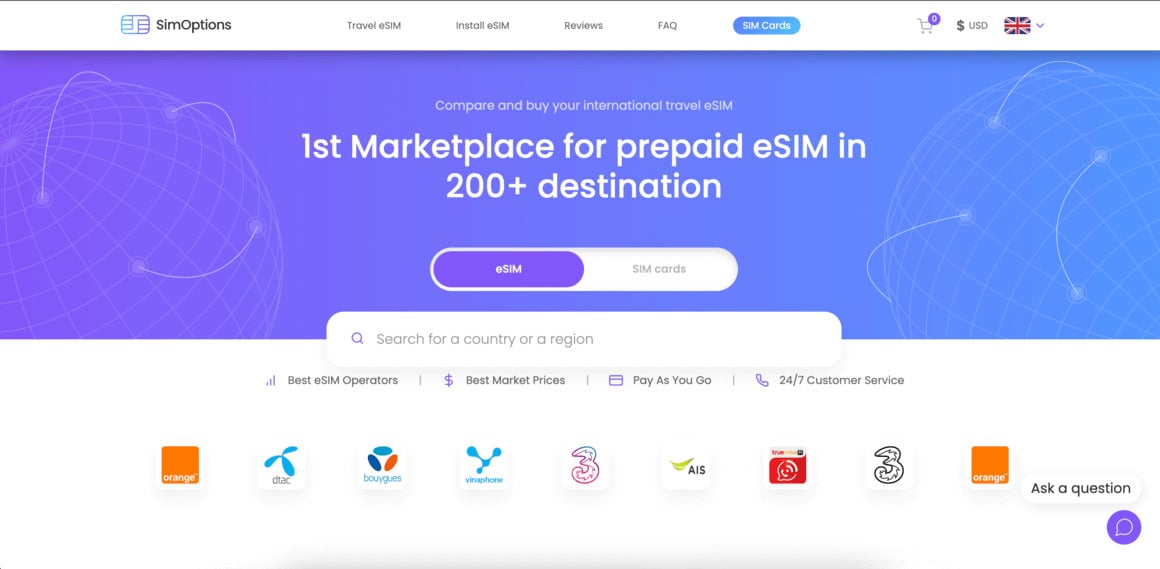
SimOptions is a reputable global marketplace that specialises in offering high-quality prepaid eSIMs for travellers in over 200 destinations worldwide. The platform has been dedicated to providing the best possible eSIM and international SIM options at the most competitive rates for travellers since 2018. They rigorously test and select eSIMs to ensure that you receive the best connectivity and service wherever you travel.
As well as effectively acting as a broker from a number of the best eSIM providers, SimOptions also offer their own eSIM products too.
Basically, SimOptions is kind of like a market comparison website for helping you find the best SIM for your travels. You simply type in your destination and they bring up the different eSIM options from a wide number of prospective providers and suppliers
Sim Local
Irish based Sim Local specialise in providing eSIM services, primarily targeted at global travellers to help them stay connected without incurring expensive roaming charges. Based in Dublin and London, Sim Local sells local SIM cards and eSIM profiles through their retail outlets, vending machines, and online platforms.
Sim Local offers a variety of eSIM plans that can be activated instantly and are designed to provide a convenient and secure way to stay connected in numerous countries. Their services are beneficial for those who travel frequently, as they provide the option to switch between multiple eSIM profiles on a single device, depending on the user’s location and needs.
They also offer pretty comprehensive customer support and a range of payment options, including Visa, Mastercard, Apple Pay, and Google Pay, all processed securely via Stripe.
Final Thoughts on Getting a SIM Card For China

China is such a fantastic country to visit. There is just so much to see and do here, make sure that you stay connected and don’t miss out on anything.
We hope this guide has helped you to choose the right SIM card for your trip to China. Let us know how you get on in the comments. We always love to hear from you!