Learning a language before visiting a country is one of those things that sounds great until you actually try to fit it into your life, and get it “done” in the 6 weeks between booking and boarding your one way flight.
We’ve all been there. You download an app. You diligently spend ten minutes a day telling a cartoon owl that the woman eats an apple. Maybe you even buy a grammar book or petite phrase book that slots into your top pocket. Then, a month or two later, somebody actually speaks to you in your supposedly “new” language and your brain immediately leaves the building.
There is simply no substitute for learning a fresh idioma by actually speaking to another human being.
Which is precisely where Preply comes in. Preply is an online tutoring platform built around live, one-to-one lessons. While it covers a range of subjects, language learning is very much its bread and butter, connecting students with tutors teaching everything from Spanish and French to Japanese, Arabic and Korean (over 9o languages in total). And that is what we are going to talk about today.
For travellers in particular, the proposition is interesting. Instead of completing generic lessons designed for millions of users, you can find somebody who speaks the language you actually want to learn and work directly on the things you need it for.
We’ve been testing Preply to see how the whole process works, what you actually get for your money and, most importantly, whether online tutoring is a worthwhile way to learn a language.
So, should you give it a go?
Let’s take a look.
What Is Preply?
The Broke Backpacker is supported by you. Clicking through our links may earn us a small affiliate commission, and that's what allows us to keep producing free content 🙂 Learn more.
Preply is essentially a marketplace for finding online tutors.
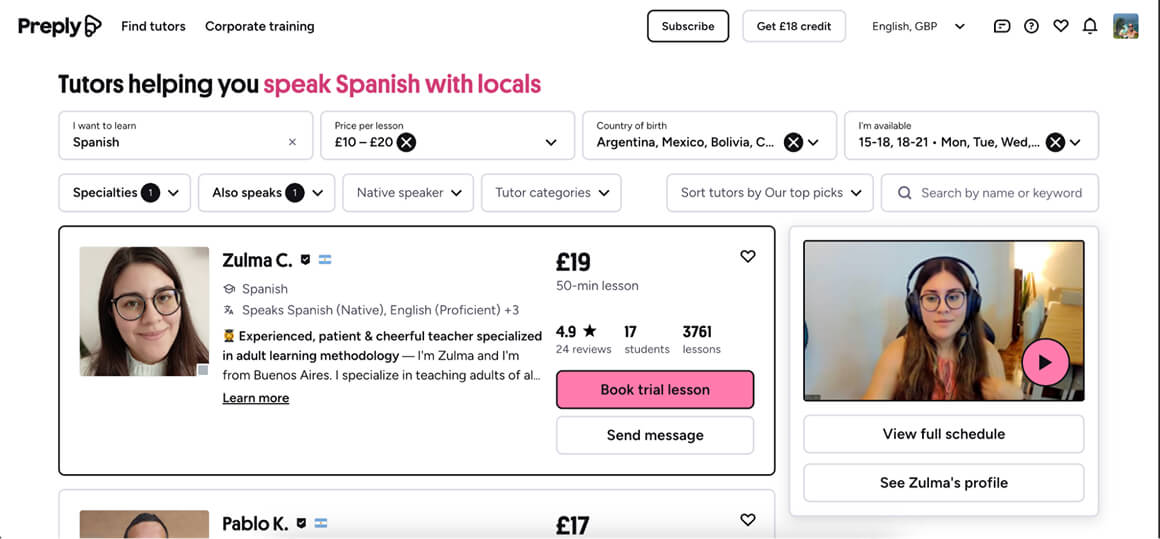
Rather than simply being assigned a teacher, you browse the available tutors yourself. Each tutor has a profile containing information about their background, teaching experience, languages spoken, specialisms, availability and pricing.
There are also introductory videos, which are surprisingly useful.
Qualifications obviously matter, but of course teaching is intensely personal. Like with choosing a therapist, somebody can have an impressive collection of certificates and still be completely wrong for you. Watching a tutor introduce themselves gives you at least some sense of their personality, communication style and how comfortable you might feel spending several hours talking to them.
And there are a LOT of tutors to choose from.
That choice is one of Preply’s biggest strengths although initially it can also feel like one of its weaknesses (if you are short on time/attention). Fortunately, the onboarding questions and profile search tools allow you to narrow things down according to factors such as price, availability, tutor background and specialisms.
Once you’ve found somebody promising, you can book a trial lesson before deciding whether you want to continue learning with them.
So How Does Preply Work?!

Image: Nic Hilditch-Short
The basic process is pretty straightforward.
First, choose what you want to learn and tell Preply a little about your goals and existing ability. You can then browse tutors who match what you’re looking for.
This is where I’d recommend spending some time rather than simply booking the first highly rated tutor you see.
Think about why you’re learning.
If you’re heading backpacking around Latin America in three months, conversational Spanish (LATAM rather than Castiliano) and listening comprehension may be vastly more useful than obsessing over written grammar. (Take it from me, English is NOT widely spoken in South America so it is imperative that you get as comfortable with ordering food, negotiating bus tickets and haggling with taxi drivers as quickly as possible.)
If you’re moving to Germany for work, you might want somebody comfortable teaching professional German.
If you’ve been studying French for years but freeze whenever a Parisian asks you a question, look for somebody who emphasises conversation.
The platform makes this kind of distinction possible in a way that standardised language apps generally do not.
After selecting your tutor, you book a lesson for an available time. Lessons take place online through Preply’s own classroom environment, so there’s no need to arrange separate Zoom calls or swap personal contact details. Keeping things on the platform reduces hassle and keeps things safe.
From there, the experience becomes much more about the tutor-student relationship than Preply itself and that’s a very important distinction.
Preply provides the infrastructure. The tutor provides the teaching.
Our Experience Using Preply
Ok so getting started with Preply is certainly more involved than downloading a language app, but that’s partly the point.
You’re choosing an actual teacher – a human one.
I started by plugging in my budget, my availability, and filtering for tutors who also spoke English (a non-negotiable in my early, fumbling stage). Since I’m learning Spanish with South America in mind, I also filtered by tutors based in that region rather than those who only teach Castilian.
From there, it didn’t take long to find someone worth trying. Individual profiles contain enough information to make meaningful comparisons rather than simply presenting an endless wall of names.
I quickly noted that tutors based in the UK, Europe or the US were charging substantially more than ones based in other parts of the world. For example, one UK based Spanish tutor was asking for £44 per 50 minute lesson vs one based in Ecuador asking for £19 per 45 minute lesson.
I ended up going with Ana, a tutor who described herself as engaging and structured, specialised in beginner Spanish, was roughly my age, and seemed like she’d handle my casual butchering of her native language with some degree of patience.
What immediately became apparent, however, was how different a live lesson feels from app-based language learning. There is nowhere to hide.
An app will happily let you tap multiple-choice answers until you eventually get something right. A human tutor can ask you a question you weren’t expecting, wait for an answer and immediately identify where you’re struggling.
That’s considerably more demanding. It taxed the brain more, asks for concentration and crucially…
…This is considerably closer to what happens when you actually travel.
I won’t pretend I wasn’t nervous going into my first trial. I had no idea what level my tutor was expecting, how patient she’d be with my glacial response times, or how badly I was about to embarrass myself.
Turns out, not badly at all.
She kicked things off by telling me a bit about herself and her teaching background. It turned out that she also loved to travel, which gave us a commonality that made me like her immediately.
We went through my current Spanish level (which was pitiful, to say the least) and why I wanted to learn. I told her about South America, the countries I was planning to visit, and my desire to get to a decent enough level of Spanish to hold a good conversation with locals.
From there she shared her screen and walked me through a set of personalised resources she’d already put together: vocab lists, YouTube channels, music recommendations for building an ear for the language in my own time. By the end, we even had a brief conversation in Spanish introducing ourselves.
For the first time, learning Spanish felt like something with a shape to it rather than a vague ambition I kept deferring. After the lesson, she sent me the resources so I could go through them in my own time – something that I wasn’t expecting from a trial.
All in all, it wasn’t as awkward as I thought it would be. It felt unnatural to speak Spanish to someone else after a lifetime of ten-minute chunks on an app at a time, but I never once felt silly for making mistakes or not knowing the answer to a question. Ana was genuinely engaging and patient in a way that has propelled my motivation to actually start locking in with my Spanish for the first time…ever? By the end, I was already thinking about booking the next one.
I wasn’t a sceptic going in, but I surprised myself. One trial lesson and Spanish stopped feeling like this distant, theoretical thing I’d get around to eventually. All of a sudden, I had a roadmap of tangible things I could tackle to learn Spanish. Turns out all it took was an actual face-to-face conversation with someone.
Why I Think Preply Makes Particular Sense for Travellers
This is where Preply gets particularly interesting for us.
The Broke Backpacker has always been and will always be about actually getting out into the world, and language remains one of the single best tools you can carry.
You don’t need fluency but being able to order food, negotiate transport, understand numbers, ask directions and exchange a few pleasantries can fundamentally change the texture of a trip. Learn a little more and suddenly you’re having conversations with people you’d otherwise never have been able to speak to. Perhaps above all though, it gives you that extra push of confidence to actually go and explore rather than stick to the safe, tried and tested travel itineraries.
A private tutor also lets you be shamelessly practical.
Well, find a Mexican tutor and ask to practise ordering food, understanding bus stations, buying market goods and dealing with numbers in Mexican Spanish.
Moving to France for the winter?
Spend a lesson working through the kinds of conversations you’re actually likely to encounter.
Planning a long trip through Japan?
Tell your tutor exactly that.
This is much harder to achieve with a rigid course designed to teach everybody the same vocabulary in the same order. It’s why I personally hit hard and solid walls with Rosetta Stone and Duolingo. Which brings us nicely to the next section…
Preply vs Language Learning Apps
I don’t necessarily see Preply and apps like Duolingo or Babbel as direct competitors because they do very different jobs.
Apps are excellent at lowering the barrier to entry. They’re always sitting on your phone, they’re relatively inexpensive and they’re particularly useful for building vocabulary or squeezing ten minutes of practice into a commute or a cheeky toilet session.
What they’re not particularly good at recreating is the mild panic of another human being waiting for you to finish a sentence, that mild panic matters much.
Apps and Preply aren’t really competing for the same thing. They do different jobs.
Real conversations are messy. People have accents, they speak quickly and they phrase things differently from your textbook. Then you forget words, you misunderstand questions and yet you have to somehow keep the conversation moving.
One-to-one tuition forces you to practise that skill.
For me, it wasn’t a case of using Preply because I had outgrown apps. It was a case of actually taking my Spanish learning seriously for the first time.
Not only was it the financial investment that forced me to lock in, but having a tutor unlocked a new level of accountability that apps could never give me. Hats off to the people who take their streak on that bird app very, very personally, but I’ve never been motivated that way.
At the end of the day, it’s all about what will make the act of learning a language part of your everyday, habitual routine. Apps weren’t doing it for me, so I looked into Preply.
Personally, I’d use the two together rather than choosing one or the other: an app for frequent vocabulary practice and a tutor for speaking, correction and structured progression. I would also recommend checking out The Michel Thomas method if you are learning French or Spanish (gives you the backbone of the language in 10 hours).
How Much Does Preply Cost?
Well there isn’t one standard Preply lesson price. Tutors set their own rates, so the amount you pay depends heavily on the language, teacher, experience level and type of tuition you’re looking for.
That creates an interesting trade-off.
You can search within your budget, which makes private tutoring accessible at a range of price points. But I’d resist automatically sorting by cheapest.
A £10 lesson that doesn’t suit your learning style is worse value than a £20 lesson that does.
Instead, establish roughly what you’re prepared to spend each month and compare tutors within that range.
Also remember that Preply’s model is built around ongoing learning rather than treating it as a directory where you occasionally buy an isolated lesson. Check the current subscription, cancellation and rescheduling terms carefully before committing, particularly if your schedule changes frequently.
I paid £16.50 for my trial lesson. Two days later, out of pure nosiness, I clicked back on my tutor’s profile and clocked that she’d bumped her rate up to £22. I asked a friend who teaches on Preply why this may be. It’s all supply and demand – if they’ve got an insanely busy month with lots of new students, they’re only happy to take more on if they pay a good price. In a quiet month, they’ll happily take less. That made me rethink that more expensive = not necessarily a better teacher.
Plus, it all goes back to teaching style. I want someone laid-back and patient enough to deal with my terrible pronunciation. I also tend to gravitate towards tutors similar in age who I can essentially talk with like a mate rather than someone marking my homework. Those tutors may charge less than a more conventionally formal tutor who specialises in teaching professional Spanish, which suits me fine.
It’s not to say one is a worse tutor than the other. Hey, the brand new tutor on the platform charging rock-bottom prices to get their foot in the door might end up being the perfect tutor for you. Filter by budget, sure, but once you’ve got a shortlist, focus on teaching style and whether you can actually picture yourself improving with this person. That’s the thing that’s going to keep you showing up.
Not feeling your tutor after the trial? Well, Preply lets you have another two trials, completely free of charge, so you’ve got another couple of shots at finding your happily ever after. Going into my trial knowing this completely eased the pressure of HAVING to like my tutor, or feeling as though I was financially put out if it didn’t work out. Preply understands that finding the right tutor is personal, so I really appreciate this feature of the platform.
What I Like About Preply
The biggest selling point is choice.
You’re not simply choosing “Spanish lessons.” You’re choosing the actual person who is going to teach you Spanish.
That allows you to consider price, accent, availability, personality, experience and teaching specialisms simultaneously.
I also like the ability to build lessons around a tangible goal.
See, “I want to improve my Spanish” is vague.
Whereas “I’m travelling through Colombia in four months and want to be able to have basic conversations” gives a good tutor something useful to work with.
The one-to-one format also creates accountability. When another person is expecting you to turn up and has spent time teaching you, skipping a lesson feels rather different from ignoring another push notification from an app.
One thing I didn’t realise about Preply before my trial is that it’s a subscription-based model rather than paying as you go. This threw me initially, but ultimately I think it’s a win-win for both student and tutor. If there’s one thing I know about myself, it’s that without a recurring lesson locked in the diary, my Spanish practice would go the same way as every language app I’ve ever downloaded. Opened twice, then forgotten about entirely.
You can choose from one lesson a week all the way up to five, so it’s really all about how much time, money and effort you want to put into it. Plus, a subscription model actually helps you build a proper relationship with your tutor. Confidence in a language comes from the same person hearing you fumble through the same phrase week after week until it stops being embarrassing. That doesn’t happen if you’re booking sporadically whenever the mood strikes.
What Could Be Better?
The sheer number of tutors can make choosing one surprisingly time-consuming.
Profiles, ratings, videos and filters certainly help, but ultimately tutor marketplaces involve some trial and error. The person with the strongest qualifications isn’t necessarily the person you’ll learn best with.
There’s also a more fundamental limitation: the quality of your experience inevitably depends heavily on the individual tutor, and that’s the flipside of having so much choice, and why it’s important to take your time looking through tutor profiles.
Preply can provide the classroom, scheduling system and tutor marketplace, but it can’t make every teacher equally suited to every student and can’t assure that your tutor won’t simply be having a bad day, or suffering from burn out.
And compared with self-guided language apps, regular private tuition is inevitably a much bigger financial commitment.
For somebody who casually fancies learning a few Italian phrases, that may be overkill.
For somebody with a concrete goal, it makes considerably more sense.
Who Is Preply Best For?
OK so I’d particularly consider using Preply if you;
- Are preparing for a trip and want practical conversational skills.
- Have already learned some vocabulary but struggle to actually speak.
- Want individual feedback rather than automated corrections.
- Need language skills for work, relocation or study.
- Prefer having somebody keep you accountable.
- Want lessons tailored around your interests rather than a fixed curriculum.
On the other hand, complete beginners who aren’t yet sure whether they’ll stick with a language might be better starting with a cheap or free app before paying for regular private lessons. There is already a wealth of knowledge that exists online to get you to a certain level before having to financially commit to a tutor.
Likewise, independent learners primarily interested in reading and vocabulary may not get as much value from one-to-one tuition.
The value is strongest when you actually want to communicate.
Ultimately, there’s a ceiling on what flashcards and apps can do for you. At some point, the only thing that moves the needle is sitting across from a native speaker and actually talking. That’s where Preply comes in. Before that point? You’re better off doing the groundwork yourself.
Tips for Choosing a Preply Tutor

Don’t choose your tutor based solely on ratings.
Rather, start with your actual objective and work backwards.
If you’re learning for travel, look for tutors who mention conversational teaching. If pronunciation matters, listen carefully to profile videos. If you’re nervous about speaking, look for somebody whose teaching style seems relaxed and encouraging.
It’s all about who you think you’ll progress with. Personally, I don’t feel like I want to be marked as though I’m in an exam whenever I’m speaking. The more comfortable I am, the more willing I am to make mistakes and be corrected on them without feeling stupid. Plus, what’s the point in learning Spanish if my tutor won’t teach me the swear words I need when I lose a game of pool to my new Colombian mate?!
Availability matters more than you might initially think too.
The perfect tutor is considerably less perfect if their only free slots are 5:30am your time.
I’d shortlist a few candidates, watch their videos, read their profiles properly and then use the trial lesson to assess something much harder to quantify: whether you actually enjoy talking to them.
Because if you’re going to spend the next three to six months speaking to somebody every Tuesday & Thursday evening, the chemistry has to be there.
Is Preply Legit?
The short answer is a rock hard solid Yes. Preply is an established online tutoring marketplace rather than some mysterious language-learning scheme cooked up last Tuesday.
But it’s important to understand what you’re buying.
You’re using a platform to find and learn from an independent tutor. Your experience therefore isn’t going to be identical to somebody else’s Preply experience.
That’s why I’d pay less attention to sweeping claims that “Preply is amazing” or “Preply is terrible” and more attention to whether the platform makes it easy to find the right tutor for you.
Preply is just the middleman in it all.
Preply Review: Final Verdict

Still with us? Read this far? By Golly, you could have learned a whole new language in this time! But, thanks for staying tuned for Freeborn’s Final Thought. It is this;
Language apps have their place.
I’ve used them. You’ve probably used them too. They’re convenient, inexpensive and infinitely preferable to doing nothing.
But eventually somebody has to open their mouth.
If your goal is actually communicating in another language, there comes a point where vocabulary drills and multiple-choice exercises stop being enough.
That’s where Preply sheee—iiinnees.
The platform gives you access to a huge range of tutors, enough filtering tools to find somebody suited to your goals and packs in the flexibility to learn remotely. More importantly, one-to-one tuition can be adapted around what you genuinely need rather than forcing you through a generic syllabus about fat, brown cats eating small, round apples.
The trade-off is that the experience is only as good as the tutor-student match, and regular lessons require more money and commitment than casually opening an app.
For travellers, though, I think the proposition is particularly strong.
Tell a good tutor where you’re going, what you’re doing and which situations you’re worried about. Then spend your lessons practising those situations with an actual human being.
You still might completely butcher your first conversation when you arrive. But at least it won’t be the first time somebody has answered back.
Happy learning.
Find out how YOU can support the site.
We’re a big site with a big team and this job isn’t always easy. But we do it because we love it – we love providing epic and free content. We love the knowledge that our content keeps you adventuring. We don’t ask for money, but if you’d like to find out how you can help the site in more organic ways, click the button below.
Thank you for your support 🙂
And for transparency’s sake, please know that some of the links in our content are affiliate links. That means that if you book your accommodation, buy your gear, or sort your insurance through our link, we earn a small commission (at no extra cost to you). That said, we only link to the gear we trust and never recommend services we don’t believe are up to scratch. Again, thank you!