Planning a trip to Vietnam is one hell of an adventure. From insanely delicious street food and bustling cities to stunning landscapes and rich cultural experiences, Vietnam has it all!
Think vibrant, buzzing streets in Hanoi and peaceful rice paddies in Sapa in the north, to tropical beaches in Danang in the central region. Then there’s the hot and humid south of Vietnam with cities like Ho Chi Minh City (formerly Saigon), Vung Tao, and Mui Nei.
One thing that’s often overlooked is arranging a SIM card for Vietnam. It might not seem important, but it can greatly enhance your travel experience and make for smoother sailing. You can access your maps applications, use them for the local Grab ride-hailing service, and for translation tools.
While getting a local SIM card might not seem necessary, I couldn’t recommend it more. From getting lost to communication breakdowns with locals or staff, you never know when you’ll need your phone to be in working order. Plus, your home SIM might not work super well with roaming, AND it can get super expensive.
Luckily, I’ve created this epic guide to getting a SIM card in Vietnam so that you have one thing less to worry about.
So let’s get cracking!

GigSky
- Price > $0 for 100MB trial SIM

4S
- Price > From $3.99

Holafly
- Price > $6.90

Photo: @taya.travels
The Broke Backpacker is supported by you. Clicking through our links may earn us a small affiliate commission, and that's what allows us to keep producing free content 🙂 Learn more.
Why Buy a SIM Card For Vietnam?
Right, now I’ve touched on it briefly, but you’re probably still thinking to yourself, “Why should I get a SIM card for Vietnam?”. Let me tell you everything you need to know.
I’m going to go ahead and say it – buying a local SIM card when travelling to Vietnam is one of the smartest travel decisions. In today’s modern world of travel, a smartphone is one of the most essential pieces of equipment. It’s your map, it’s your DJ, it’s your translator, it’s your camera, and it’s even your travel companion.

It helps you to navigate chaotic streets and small alleyways, and you can also share your experiences on social media. Heck, you can also use it to meet like-minded travellers on social media and arrange hot dates through Tinder and Hinge.
Now, your native SIM card very well might work, but it can also end up being a costly mistake. International roaming charges are often sky-high, and network reception isn’t actually guaranteed. Even if your provider works in Vietnam, you could still face unexpected cutoffs, poor coverage, and limited speeds.
At the end of the day, a local SIM card in Vietnam is cheap, easy to set up, and available right at the airport. That being said, they’re generally cheaper at corner stores and even local travel agents. Providers like Viettel and Mobifone offer great data packages that’ll keep you connected wherever you go. For me, it just gives one the safety, freedom, and convenience that every modern traveller needs.
Buying a SIM Card For Vietnam – Things To Consider
Let’s face it, we’re all different and unique in our own ways. And this means our needs and wants are all completely different when it comes to travel and how we travel. Picking a SIM card for Vietnam depends on many variables, and these need to be considered thoroughly before deciding.
Let’s take a look at some of the most important considerations below:
Price
Sigh, price. Probably the most obvious factor and the thing that we’re all the most sensitive to. If you’re anything like me, you love a good deal and hate being ripped off, especially when you travel. There’s nothing worse than that sinking feeling, knowing you’ve paid way more than you should’ve for something.
At the end of the day, the holy grail is to nab yourself the most data and talk time for the lowest price. Again, seems obvious, right? But remember, cheap isn’t always best, as some network providers catch you out when you want to top up after running out of data.
Always do proper research, read the fine print, and ask questions. The more you know, the less people can bullshit you. Simple. Also, Vietnam isn’t too expensive; you’re probably debating over a couple of bucks.
Data
The next thing that’s crucial to pay attention to is the data offering. Always find out how much data you’re actually getting for the price you’re paying and how long it’s valid for.
As I mentioned briefly above, network providers can and do get a little sneaky. They offer cheap initial packages, knowing very well that you’ll run out. When it comes time to top up, either you can’t or they slot you with expensive top-up fees.
I’d advise monitoring your daily data usage back home for a month or two before you travel. You can easily see how much you use on a daily basis and then factor in how much you’ll probably use when travelling. Remember, it’s likely to be more than what you use back home, given that you’ll be using your phone a lot more for navigating, translating, etc.
If you’re motorbiking in Vietnam, chances are you’ll be listening to music and jamming maps all day and that EATS data. Always see exactly how much it costs to top up data or minutes before committing to a SIM card for Vietnam.

Image: Nic Hilditch-Short
Coverage
Coverage is one of the most important considerations (in my humble opinion). It’s the difference between being connected all the time without any troubles and having shoddy coverage that comes and goes. Depending on where you stay in Vietnam and how remote it is depends on how much you’ll need to consider this.
In Vietnam, not all mobile networks are created equal, and I’ll let you in on a little secret. Viettel is owned by the Vietnamese Ministry of National Defence and thus, offers coverage pretty much every nook and cranny of the country. But more about them later.
At the end of the day, you’ll need to work out your itinerary and where exactly you’re going to be travelling. You can then decide which network provider is going to best suit your movements for where you’ll be staying.
Most providers work perfectly well in the cities but can sometimes fail miserably in the countryside and rural areas. And remember, a cheap SIM that doesn’t work is useless – don’t find that out the hard way.
Vietnam has plenty of mountainous areas, especially in the north, and the islands of Halong Bay can also prove to be a network “blind spot”. Bear this in mind when choosing a SIM card provider; chances are you’ll be wanting to get to these remote, beautiful places in Vietnam.
Overall, the network coverage in Vietnam is pretty great, with 4G as the minimum and 5G expanding constantly. So you can rest assured knowing you’ll have fast internet throughout the country, depending on the network provider you choose.

Bureaucracy
How easy is it to get a SIM card in Vietnam as a tourist? Incredibly, Vietnam is safe and well set up for tourists! The process is as easy as buying a delicious Banh Mi from the side of the road, and you really shouldn’t come across any major issues.
The only document you’ll need, as with most countries, is your passport, as Vietnam has a mandatory SIM registration law. And then, of course, you’ll need cash or your credit card. Some small stores will only take cash, though, and Vietnam is still largely a very cash-driven society.
But you can also grab a SIM at the airport, at cellphone stores like The Gioi Di Dong. Or even some convenience stores like 7-Eleven, Circle K, and VinMart, which will take all major bank cards.
Expiration
The final thing to consider before buying yourself a Vietnamese SIM card is whether it expires or has an infinite lifespan. Some SIM cards will expire after a certain time frame, say 30 or 60 days, and cannot be extended, while others last for years. Always check with the place where you buy your SIM card as to how long it lasts.
The last thing you want is to buy a SIM card thinking it lasts indefinitely, only to find out it expires a week before your trip ends. That’s a pretty frustrating scenario that can be easily avoided. Check your dates and how many days you’ll be in the country, and then get the SIM that best suits your trip.
If you plan on returning to Vietnam one day in the not-so-distant future, get yourself a SIM that lasts indefinitely. It just makes sense.

A new country, a new contract, a new piece of plastic – booooring. Instead, buy an eSIM!
GigSky eSIMs work just like an app: you download it, pick your plan, and BOOM! You’re connected the minute you land. It’s that easy.
Read about how eSIMs work or click below to see one of the top eSIM providers on the market and ditch the plastic.
Grab an eSIM!Where To Buy a SIM Card For Vietnam
Right, now it’s on to where to buy yourself a SIM card in Vietnam. As I mentioned previously, it’s pretty easy to get a Vietnamese SIM card, and the process is anything but painful. Here are the most popular spots to get yourself a SIM in Vietnam:
eSim
First up, I think it’s important to talk about an eSIM, although it’s not a physical place to grab a SIM card. ESIMs are revolutionising the way we stay connected and are definitely the way forward for travellers.
With the “buy before you fly” convenience, you can seamlessly purchase and activate data plans before you even touch down. This removes the need of having to go sim hunting when you arrive, so your adventure can start straight away. Basically, it’s fast, flexible, and ensures you’re connected from the moment you land.
You also don’t need to do any physical SIM swapping, and you can store multiple profiles, switching between them at your leisure. This makes it great for frequent flyers and those hopping between various countries on a regular basis.
It’s also environmentally friendly as there is no plastic waste from single-use SIM cards. David Attenborough will be proud of you, and the turtles will be happy!
The downside, unfortunately, is that not all phones are compatible with eSIM technology. While most modern smartphones do support eSIM technology, you should always check that your phone is compatible.
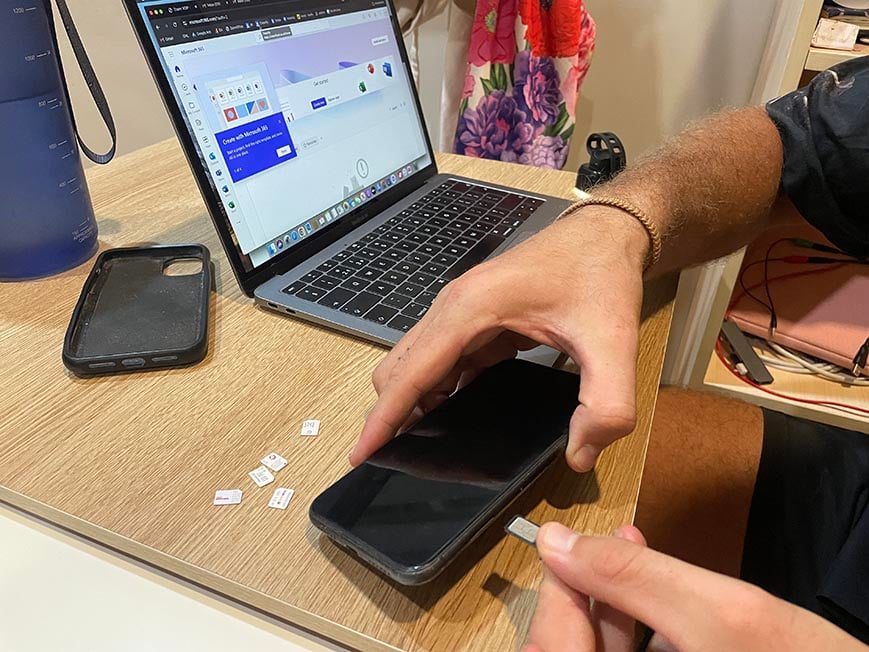
Photo: @danielle_wyatt
In the Airport
One of the most convenient places to get a SIM card in Vietnam is at the airport as soon as you land. The major airports in Ho Chi Minh City, Danang, and Hanoi have kiosks where you can grab a SIM on your way in. You’re connected as soon as you step out of the terminal; however, with convenience often comes cost.
Obviously, the upside here is that you’re connected straight away without any delays and airport staff all speak decent English, so communication isn’t an issue. I have found that there can be a bit of a language barrier in Vietnam, so this can be a safe choice. Side note – teaching English in Vietnam is big business.
The downside is that there often isn’t much choice in terms of packages available, and they can be expensive. This is kind of a lose-lose situation in my opinion. Alternatively, hop on a city bus or taxi or use the airport Wi-Fi to get a Grab into the city. Simply sorting your SIM out then is my personal recommendation.
At Noi Bai International Airport in Hanoi, you can expect to pay around $2.70 to $5.20 for Viettel data packages. They range between 30GB (1GB/day) and 150GB (5GB/day) for these packages, valid for 30 days. At Tan Son Nhat International Airport in Ho Chi Minh City, a Viettel tourist plan (5GB/day for seven days) is around $8.
At a Store
The easiest and most affordable place to get a Vietnamese SIM card is at a store, hands down. There are a number of different places where you can grab one, and they’re easy to find and pretty much all over the cities.
The Gioi Di Dong is a well-known cellphone and electronics store that you’ll come across all over Vietnam. They offer SIM cards and will set them up for you in no time. Travel agencies will also stock SIM cards, and you can easily get a tourist SIM for your trip. The staff generally speak good English, and I’ll often kill two birds with one stone while booking a bus or making other travel arrangements.
Some local stores like VinMart, Circle K, and 7-Eleven will also stock SIM cards, but sometimes the language barrier can be a bit of an issue.
You can typically expect to pay around $2 – $3 for a basic SIM plan from carriers like Viettel, Vinaphone, and MobiFone. The Viettel tourist sim, for example, will cost between $4 for 20 minutes and 1GB of data and $19 for 100 minutes and 5GB of data.

Photo: Nic Hilditch-Short
Online
Buying a SIM card for Vietnam online isn’t possible unless you go the eSIM route. Vietnamese SIM cards require passport registration, and this is only possible at local stores, cellphone and electronics shops, or at the airports.
The only way to arrange a form of SIM card online is an eSIM, whereby you can arrange everything prior to landing. There’s no need for a physical SIM card swap, and you also don’t need to go through the passport registration process.
Best Vietnamese SIM Card Providers
There are plenty of options available for Vietnamese SIM cards, so let’s take a look at some of the best ones below:
GigSky

GigSky is one of those eSIM providers that quietly gets things right with few silly gimmicks. It’s a US-based company with serious global reach, offering mobile data in 190+ countries through partnerships with major international networks. In real terms, that means you can land, switch on your phone, and be online in minutes — no airport SIM stalls, no language barrier panic, and no getting rinsed by roaming fees.
Where GigSky really shines is reliability. The plans are clearly priced, the coverage is genuinely global, and the connection is stable enough for maps, bookings, uploads, and the occasional “work-from-anywhere” moment. It’s not trying to be flashy or gimmicky.
For long trips, multi-country itineraries, or anyone who’s been burned by sketchy local SIMs before, GigSky is a solid, no-drama choice that earns its reputation on the road.
4S

Heads up: 4S eSIM is still a relatively new player. We’re actively road-testing it over the coming months and will keep this page updated as we go.
4S eSIM is a newer name in the eSIM space, and one that’s only just starting to pop up on travellers’ radars. They’re positioning themselves as a straightforward, travel-first data provider, offering eSIM plans for a growing list of countries at competitive prices. Setup is the familiar QR-code process, and everything runs through a clean, no-nonsense platform — which, at the very least, suggests they understand what travellers actually want: quick access, clear pricing, and no friction at the airport.
So far, our experience with 4S eSIM has been quietly promising. Coverage has been solid in testing, speeds have held up for everyday travel use (maps, messaging, bookings), and there haven’t been any nasty surprises hidden in the fine print. It’s still early days, and we’ll be continuing to test 4S eSIM over the coming months across different destinations, but the signs are good.
If they keep building coverage and maintain this level of reliability, 4S eSIM could end up being a strong alternative to the more established players.
And check this, readers can bag 15% off all sale items using the code TBB at checkout!!!!
HolaFly

Holafly is an alternative eSIM option for travellers visiting Vietnam. Again, no physical SIM card is required, and you can get instant data access with its simple activation. There are a number of affordable plans that offer unlimited high-speed data at different prices depending on the number of days you choose.
For Vietnam, you can get:
- Unlimited data, 1-day, $6.90
- Unlimited data, 7-days, $29.90
- Unlimited data, 21-days, $63.90
- Unlimited data, 30-days, $74.90
Viettel
Viettel is Vietnam’s largest mobile network provider, owned by the Ministry of National Defence. So, basically, the army owns it, and with that comes extensive 4G and 5G coverage around the country. You can pretty much get a connection in every corner of the country, so it’s an excellent choice for travellers.
Options for tourist SIM packages:
- TOUR60: 5GB data, unlimited domestic calls, valid for 15 days, $2.30
- TOUR100: unlimited data, 20 minutes on-network domestic calls, 20 minutes international calls, valid for 30 days, $3.90
- TOUR200: unlimited data, 100-minute domestic calls, 20-minute international calls, valid for 30 days, $7.70
MobiFone
MobiFone is one of Vietnam’s leading mobile network providers, considered to be one of the top three network providers in the country. They offer a variety of tourist SIM packages that are designed to be flexible to suit travellers’ needs.
Options for tourist SIM packages:
- Happy Tourist Data: 3GB data, no calls, valid for 30 days, $7.70
- Happy Tourist Voice & Data: 3GB data, domestic calls included, valid for 30 days, $11.60
- 6GB plan, 60 domestic minutes, 30 international minutes, valid for 30 days, $9.70
- 10GB plan, no calls, valid for 30 days, $7.70
Vinaphone
The final mobile network provider that supplies SIM cards in Vietnam is Vinaphone. They’re also one of the top three providers, offering reliable coverage and competitive pricing. This makes them another popular choice for tourists visiting the country.
Options for tourist SIM packages:
- Unlimited* 4G data for 7 days, $9
- Unlimited* 4G data for 15 days, $11
- Unlimited* 4G data for 30 days, $13
- * “Unlimited” refers to 1GB of high-speed data per day, after which speeds may be reduced
What Is The Best SIM card in Vietnam For Tourists?
| Provider/Package | Price (Basic Sim) | Top Ups Allowed? | Expiration |
|---|---|---|---|
| JetPac | $4 | Y | 4 days |
| Nomad | $6 | Y | 7 days |
| HolaFly | $6.90 | Y | 1 day |
| Viettel | $2.30 | 15 days | |
| MobiFone | $7.70 | 30 days | |
| Vinaphone | $9 | 7 days |
Final Thoughts on Getting a SIM Card For Vietnam
Vietnam is truly a destination that should be on every traveller’s radar. With its rich history, vibrant street life, stunning landscapes, and incredible food, there’s something here for everyone. The mix of tradition and modern energy creates an unforgettable travel experience, and the warm, welcoming locals also make it even more special.
To make the most of your trip, though, getting a SIM card for Vietnam is a smart move. It’ll keep you connected for navigation, translations, bookings, and those spontaneous travel moments. Whether you’re in bustling Hanoi, relaxing in Da Nang, or exploring the Mekong Delta, staying online will make things smoother and safer.
Whichever option you go for, whether it’s an eSIM like HolaFly or Nomad, or a local SIM from Viettel, MobiFone, or Vinaphone, I’d love to hear your thoughts. Your feedback helps others in the travel community, and that’s what it’s all about – sharing the journey and paying it forward.
For now, happy travels!

Image: Nic Hilditch-Short