Chewy, smokey, salty, to the mildly terrifying: trust me, if it’s being sold on the side of the road, chances are, it’s been in my mouth! Hey, get your mind out of the gutter and back onto street matters.
I’ve eaten at over 200 street stalls across Southeast Asia, from Hanoi to Bangkok to a roadside warung somewhere outside Ubud that I could never find again on a map. Not as a bucket list exercise, and not as a food tour with a clipboard. I ate because I was hungry, because locals were eating there, and because after enough meals you start to notice things that no guidebook ever mentions.
This isn’t a list of the best dishes or the most Instagrammable bowls of noodles. You can find that anywhere. This is the tips, tricks and mistakes to avoid to master the fine art that is street food in South East Asia. The rules nobody writes down because everyone local already knows them. And soon you, fellow foodie, will adopt that same wisdom.
Let’s chow down.
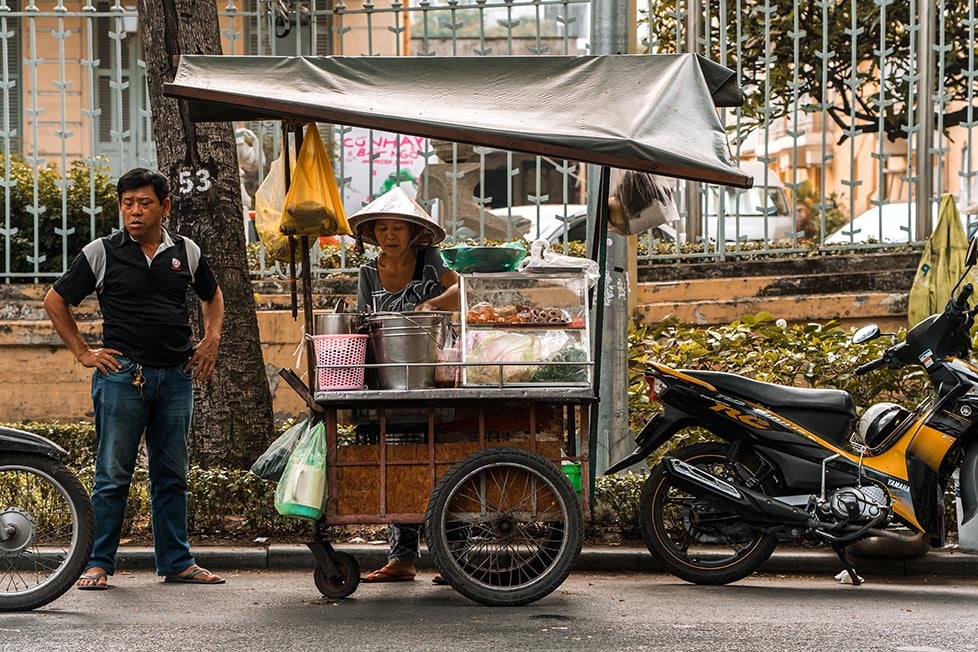
Image: Nic Hilditch-Short
What Guidebooks Get Right and What They Miss
Guidebooks are not useless. That needs saying. If you’ve never been to Vietnam and someone tells you to try banh mi, that’s a good starting point. The famous markets get famous for a reason. The dishes that feature in every roundup usually show up because they’re genuinely good, and knowing what to look for before you land is worth something.
But guidebooks are written at a remove, and that remove shows up in specific ways.
They’ll tell you what to eat. They rarely tell you when. Street food in Southeast Asia runs on schedules that don’t seem obvious at first glance. The best noodle spot in the neighbourhood might close by 9 am because the cook sold out. The satay cart doesn’t appear until after dark. The market that the guidebook says ‘opens daily’ technically does, but the real vendors pack up by 7 am, and what’s left by 10 am is mostly for tourists who slept in. Time it wrong and you get a disappointing version of the thing you came for, a street food blue-ballsed moment, if you will.
They focus on markets. Locals eat at neither the tourist market nor the night market, rubbing shoulder to shoulder with the souvenir stalls. They eat at the cart outside their building, the shophouse around the corner, the place with four plastic stools and a handwritten sign in a script you can’t read. These spots don’t have names, don’t have TripAdvisor pages, and don’t appear in any roundup. They’re the ones you stumble into, or don’t.
None of this is a criticism of the writers. It’s a limitation of the format. A 400-page guide to Southeast Asia can’t do stall-level granularity across eight countries. It’s a great starting point, but it certainly won’t hold your hand throughout the whole process.
And I won’t try to do the same. It’s more like field notes from someone who ate enough meals roadside whilst backpacking in Southeast Asia to start noticing what the good ones had in common.
Country-by-Country Street Food Field Notes
Street food culture isn’t a singular entity. It’s big, wide and massively varies depending on where you are. How it goes in Thailand might get you some weird looks in Cambodia. I’ll give you the 411, country by country.
Thailand
Thailand is an absolute MECCA for street food, and a great place to dip your toe in for the first time. The street food infrastructure is more developed here than almost anywhere else in the region. Carts are consistent, turnover is high, and enough vendors in tourist-adjacent areas have been feeding confused foreigners for long enough that the ordering process is forgiving. It’s a good place to build confidence before countries where the margin for error feels tighter.
Every region brings its own personality to the pavement.
Travel north, and you’re in khao soi territory: a creamy, coconut milk curry broth over egg noodles, topped with crispy fried noodles that shatter when you get to them. It’s my favourite meal in the world, and if you try anything from this list, let it be this.
Head south and the curries turn brighter, built on turmeric and chilli and whatever came off the boat that morning. Even Bangkok, nowhere near a coast or a border, pulls it all together: a single soi might offer southern-style kanom jeen next to Chiang Mai sausage. Basically, you can’t go wrong with Thai food, its worldy!
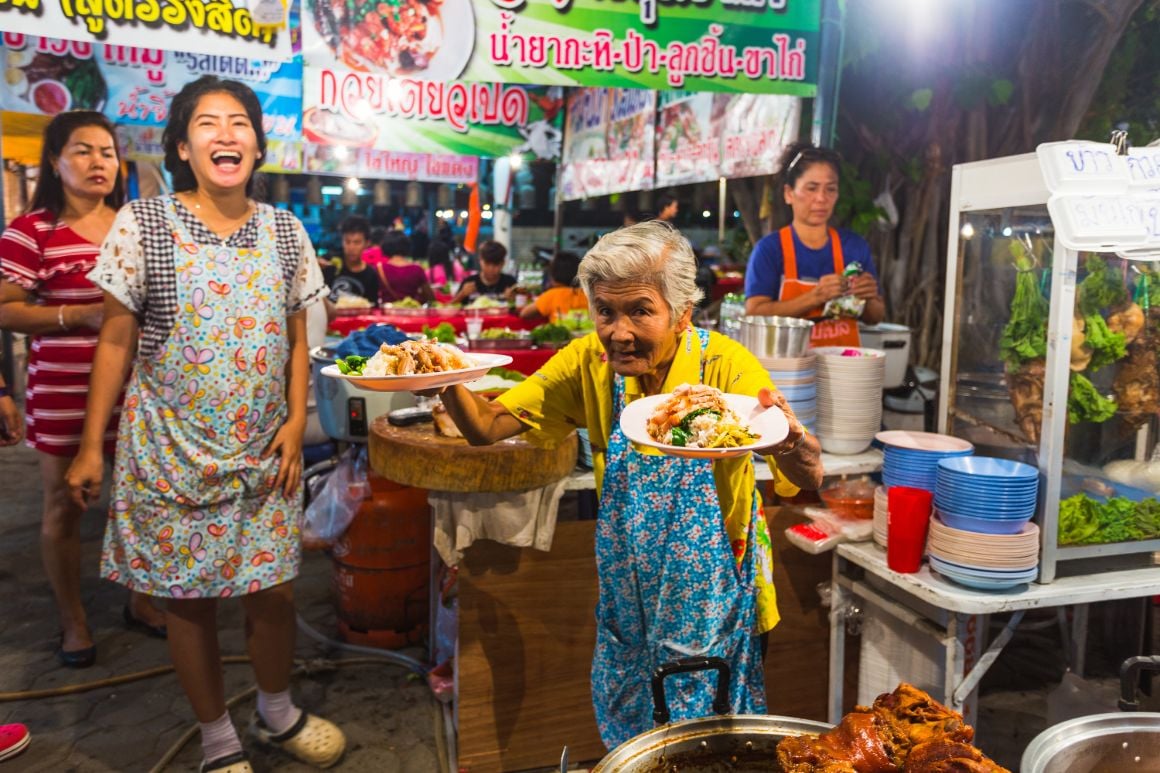
- Where the best eating happened: Dotted all over Bangkok. Some spots have made names for themselves, so much so that they even bear a Michelin Bib sticker proudly on their cart, whilst others are best found by following where locals mill around come lunchtime. You really cannot get it wrong with street food in the capital.
- What guidebooks miss: Timing, almost entirely. Thailand’s street food scene is shift-based in a way that isn’t obvious until you’ve missed a few things: the cart that’s legendary at 7 am is a locked metal box by noon, and the satay vendor who’s worth crossing town for doesn’t appear until after dark. Morning, lunch, and evening are often completely different vendors in completely different locations. No one vendor runs on the same universal hours either. That is to say, if one catches your eye, don’t assume it’ll be open later or even the next day.
- The lesson Thailand taught me: Early on, cast wide. Street food is too good to only eat once or twice. Later, when something clicks, go back. The locals eating street food every day aren’t hunting for new experiences. They’re going back to the same two or three spots because those spots are reliable, fast, and exactly right for the time of day.
Singapore
Singapore has more Michelin Guide spots than anywhere else in the world, which is one way of saying you’re in for a treat.
The improvised chaos of a Hanoi alley or a Laos market isn’t here. Instead: Hawker culture started in the 1800s, when Singapore became a thriving port city and waves of immigrants arrived from China, India, Malaysia, Indonesia and beyond. It got so densely packed by the 1960s that the government regulated it all and relocated them into purpose-built centres, and today it runs to over 6,000 stalls across more than 110 hawker centres. The street part is gone. The actual street food stayed.
It hasn’t lost the essence of what street food is about or who it serves: everyone. Hawker centres are radically democratic spaces, where construction workers, office employees, expats, retirees and tourists all sit at the same tables, eating the same food. No reservation system or fancy dress code.
Nothing hits the spot more than a cold cane juice after battling through Singapore’s humidity. This country is a melting pot of cultures, and its food is no different. Char kway teow, laksa, and Hainanese chicken rice are the dishes that come up in every Singapore conversation and are a solid basis to start on, but don’t be scared to go for the less photogenic dishes like rojak, a local salad dish at some of the lesser known centres. There are some real hidden gems to discover in this city when it comes to food.
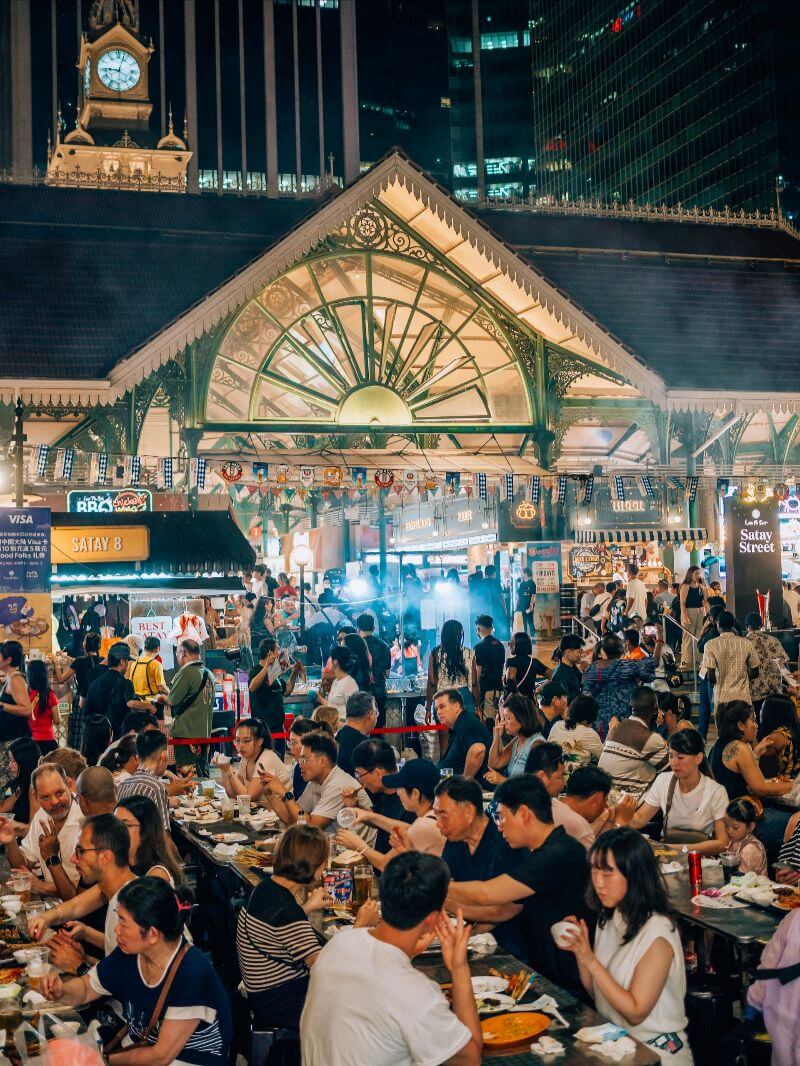
- Where the best eating happens: Away from the tourist-facing centres. Maxwell Food Centre in Chinatown is the one every guidebook sends you to, and it is a solid choice. But it’s also the one every tourist ends up at, and people miss out on the centres further out where the more interesting eating happens. Centres further from the tourist throngs, like Geylang Serai Market, feel super local and carry food you won’t find as authentically elsewhere in the city. Tiong Bahru Market, in one of Singapore’s oldest residential neighbourhoods, is the one worth the detour: calmer, more neighbourhood weekend than tourist pilgrimage, and a place you can actually sit and eat without feeling rushed.
- What guidebooks miss: Many of the best stalls sell out rather than close at a set time, so peak hours of 11:30 to 13:00 and 18:00 to 20:00 are both the most atmospheric and the most likely to leave you queueing for something that’s just run out. Go slightly before or after and you’ll have more choice and shorter waits.
- The lesson Singapore taught me: Government regulation and formalisation doesn’t kill a food culture if the food is good enough. The hawker centre system stripped out the romance of the street stall, put everything under fluorescent lights and made you return your tray. The food survived anyway, because the cooks were the same people, cooking the same things, for the same neighbours. Structure follows culture, not the other way around.
Vietnam
Life in Vietnam seems centred around eating roadside. If you’re trying to get by on even $10 a day, Vietnam is the place to do it. Even the iconic red stools spilling out onto the pavement often belong to street vendors and more conventional brick-and-mortar establishments alike. Pho and Bahn Mi are the obvious options, but dig a little deeper, and you’ll be invited into the sensory world of smoky meats in bun cha and crispy rice pancakes stuffed with pork and shrimp in bahn xeo.
The first thing to understand is that Vietnam isn’t one food culture. The north is subtle and restrained, influenced by cooler temperatures and historical proximity to China. The central region runs hot and bold. The south is sweeter, more open, shaped by Khmer, Chinese, and Cham cooking traditions. A bowl of pho exists across all three regions and tastes meaningfully different in each. Travelling the country north to south (as I’ve done solo on a few occasions) and eating the same dishes as you go is one of the more instructive things you can do with a two-week trip.
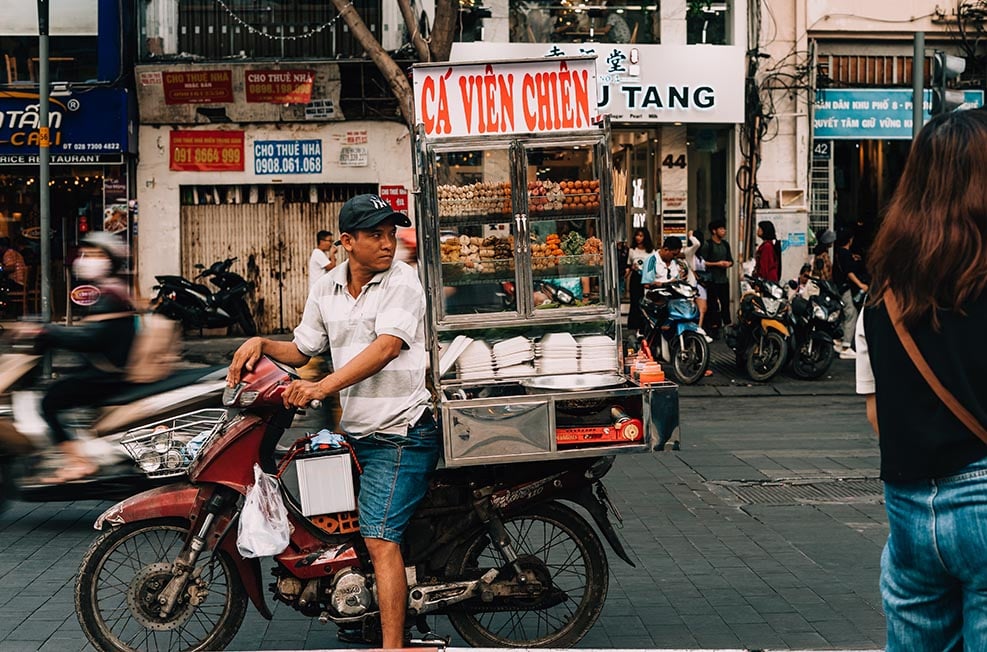
Image: Nic Hilditch-Short
- Where the best eating happened: Hanoi takes it for me, always. These pokey streets could keep you entertained and well fed for weeks, with locals lining the streets from early morning till well after dark. Well-loved by Anthony Bourdain, which is all you need to know in itself.
- What guidebooks miss: The regional specificity is acknowledged but rarely made actionable. Dishes vary depending on the region, and how you eat them changes with it. In Hanoi, don’t reach for the condiment plate before tasting the broth. Northern pho is built around a clean, delicate stock that doesn’t need doctoring. In the south, the herb pile and sauces are part of the dish.
- The lesson Vietnam taught me: Some dishes only make sense where they come from. Cao lau exists because of the water and ash from specific local wells in Hoi An. Bun cha is a Hanoi lunch dish eaten at a specific time of day. You can find versions of both elsewhere, but you’re eating a copy of a thing rather than the thing itself. Vietnam more than anywhere else made the case for eating in place, on time, in the right city. Which might just be why it’s one of the best countries for food, period.
Indonesia
Indonesia is a sprawling country of over 17,000 islands with a dizzying array of landscapes, cultures, and languages. Its food follows the same logic. You’d be a fool to assume that ‘Indonesian food’ is a single, unified cuisine when it’s actually an umbrella term for diverse culinary traditions. Padang cuisine from West Sumatra runs on rich, spicy rendang and coconut-heavy curries. Javanese food leans sweeter, built on palm sugar and sweet soy sauce. Balinese dishes switch things up completely, shaped by Hindu tradition rather than the halal constraints that govern most of the archipelago. Arriving expecting one Indonesian cuisine is the same mistake as expecting Italian food and French food to taste the same simply because they’re both European.
The street food infrastructure is as varied as the food it serves. There are two main formats: mobile vendors who move through residential areas announcing their presence, and stationed vendors who set up on a busy corner under a small tarp with a few plastic chairs. Warungs are the small permanent stalls, whilst kaki lima are the mobile carts that appear on street corners, especially in the evenings. What’s the difference? Well, the kaki lima system often means a vendor specialising in one dish, perfected and repeated daily, while a warung might run a broader menu of rotating dishes.
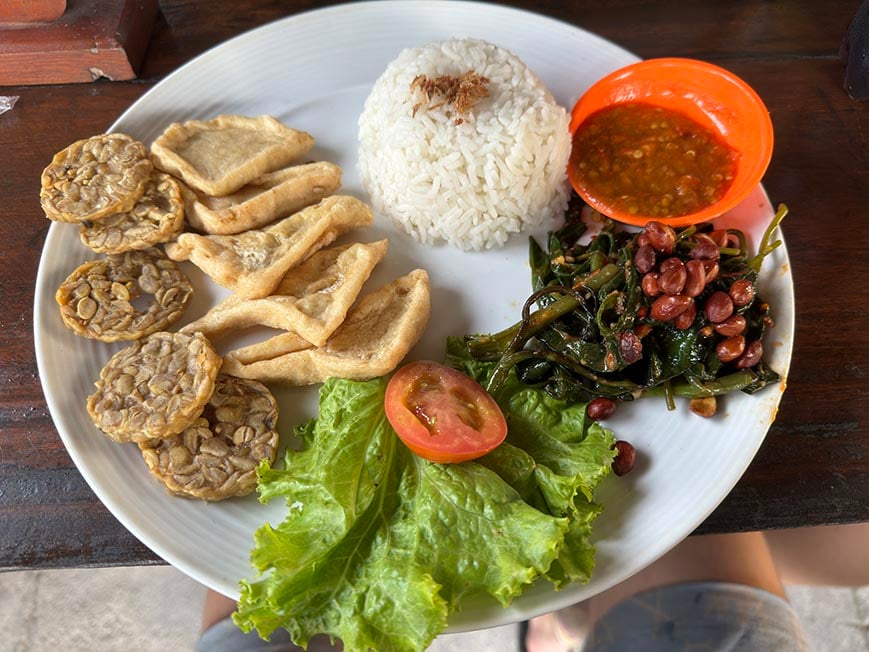
Nasi goreng and satay are the two you’ve probably already heard about, and for good reason. If you want to delve deeper into street food culture here, gorengan is a great fried snack covering tempeh, tofu, and banana fritters for a midday pick-me-up. Soto is a clear, turmeric-based broth soup, usually built on chicken or beef, that exists in some version in nearly every region of Indonesia under the same name but with a different recipe each time. Definitely worth trying a couple to compare your experience of each in different regions as you’re travelling around the country.
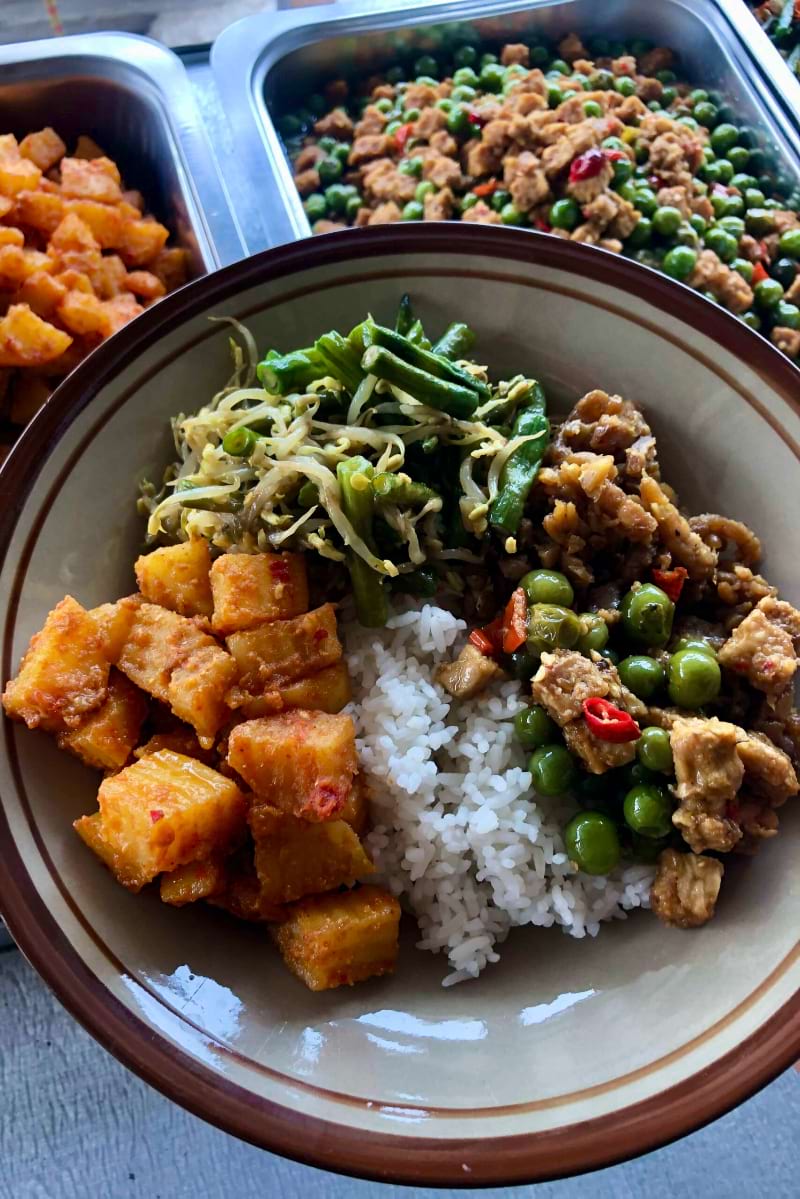
Photo: @mariajstorey
- Where the best eating happened: Yogyakarta for Javanese street food in its most concentrated form, and the lesser-known pockets of Bali for real local-style warungs whipping up a mean nasi goreng. Jakarta has to be given an honourable mention simply because the city pulls people in from every region of the country, so a single street can carry Padang food, Manado food, and East Javanese snacks side by side.
- What guidebooks miss: That regional differences shape how you’ll eat entirely. Most coverage lists “Indonesian dishes” as a single flattened menu: nasi goreng, satay, rendang, done. First-time visitors often assume Indonesian food is one unified cuisine when it’s really an umbrella term for distinct regional traditions, and that even single dishes will taste massively different depending on where you’re ordering from (and that’s half the fun).
- The lesson Indonesia taught me: The setup tells you what to expect before the food does. A cart with no stools means standing, fast, and probably fried. A stall with seats means cooked to order and a few minutes’ wait.
Malaysia
Malaysia’s street food is less about a fusion of food cultures and more about an overlap. The country’s complex history and ethnic mix produced a food culture shaped by Malay, Chinese, and Indian communities. Then came the British, Dutch, and Portuguese colonial influences alongside dishes borrowed from Thailand and Indonesia. What that actually means at street level is that the same city can have a Malay sambal stall, a Chinese noodle cart, and an Indian Muslim roti shop within shouting distance of each other, each one cooking from a completely different tradition without any pressure to blend.
Hawker culture here shares roots with Singapore’s, but Malaysia’s version stayed more dispersed: pavement stalls, night markets, and proper hawker centres all coexist, rather than the street getting folded entirely into one government-run format.
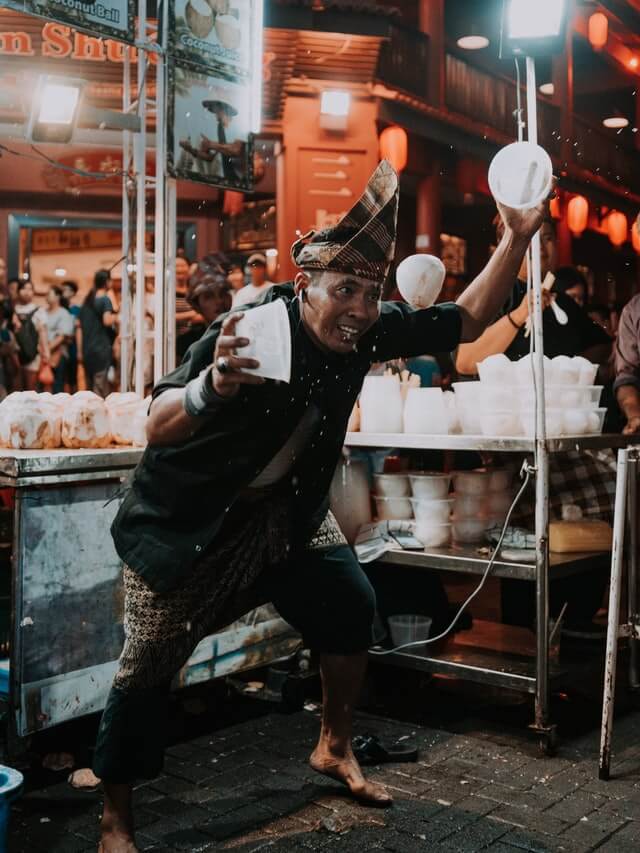
- Where the best eating happened: Kuala Lumpur, purely for the variety alone. Jalan Alor is the obvious starting point, packed with stalls running Chinese-style noodles, Malay rice dishes, seafood, and satay within a few hundred metres of each other, but there are plenty of other places to visit.
- What guidebooks miss: The decline of the humble street food cart itself. Kuala Lumpur’s own city planning authority has listed hawker areas, alongside markets and food courts, among the sites it considers ripe for redevelopment, which means some of the stalls in a guidebook today may simply not be there by the time it’s reprinted. Street food culture in KL is rapidly evolving because of these changes, and who knows what form it’ll exist in five or ten years time.
- The lesson Malaysia taught me: Diversity doesn’t have to mean blending. Malaysia never pushed its Malay, Chinese, and Indian food traditions into one unified national cuisine. Each one kept its own techniques, its own stalls, its own version of what counts as a proper meal, sitting a few feet apart from each other without needing to become the same thing. Why have a fusion where you can have the best of all worlds side by side?!
The Philippines
Much like Indonesia, the Philippines is the country in this list where the street food scene changes most obviously depending on which island you’re travelling to. Fly from Manila to Cebu and the food completely switches up, not just in name but in identity.
Cebu is built around lechon, whole roasted pig with crispy skin, slow-roasted over an open flame and so well seasoned it’s often eaten without sauce at all. Move south to Bacolod and the signature shifts again, to chicken inasal, skewered and grilled chicken basted in something closer to the coconut vinegar marinades of the Visayas than the soy-and-banana-catsup version found further north. Iloilo, with its closeness to the sea, has its street food centred around whatever the catch is that morning.
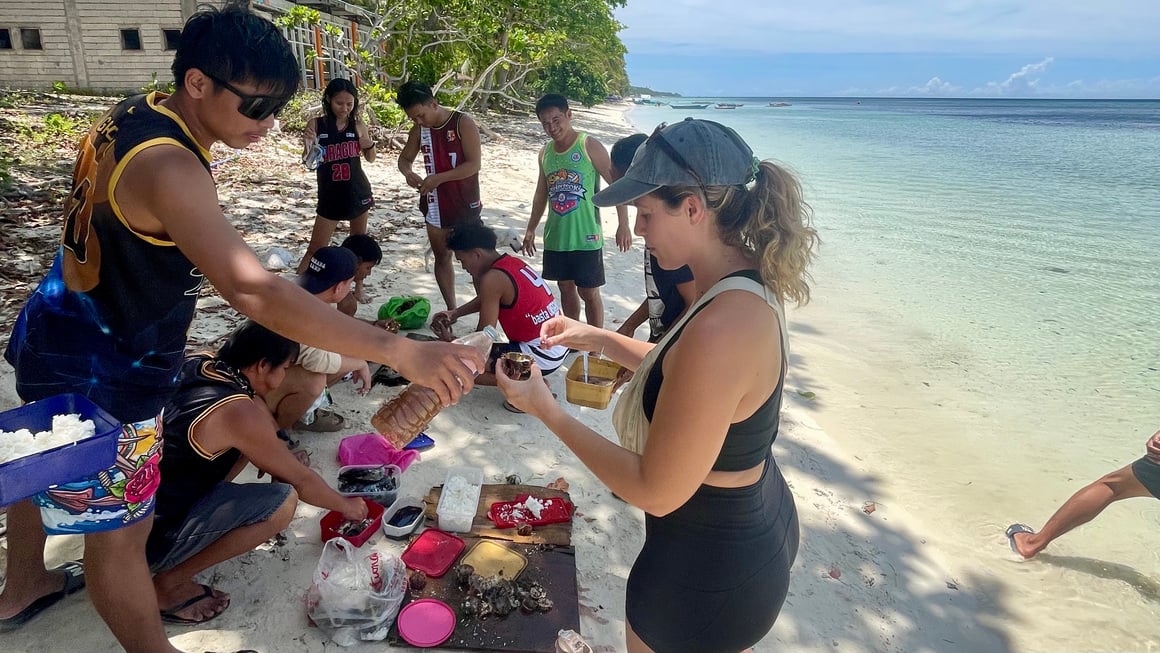
Photo: @danielle_wyatt
- Where the best eating happened: Pampanga, dubbed the country’s culinary capital, is the birthplace of sisig, one of the country’s most iconic dishes. Anthony Bourdain built a whole segment of his show around the city, which is everything you need to know in itself.
- What guidebooks miss: There’s a real, slightly competitive distinction within a single isawan between sauces: a sweet brown sauce paired with spicy vinegar at one stall, a purely vinegar-based dip at the one nearby, and regulars often have a preference between the two. Try ’em both for yourself to figure out where you sit on the sweet/sour debate.
- The lesson the Philippines taught me: A dish’s name is usually a place, not just a recipe, and that place tells you what the dish should contain. Batchoy should have pork innards. Pancit malabon should have oysters. You’d be mistaken to order one dish across the country and always expect the same.
Laos
Laos doesn’t get the street food coverage that Thailand and Vietnam do – it’s a more low-key event than anything to do with quality. The country’s food culture leans on morning markets packed with foraged herbs, wild game, and unusual Mekong River ingredients. All on evening street food stalls that converge onto kerbsides as dusk falls, from grilled meat-on-a-stick to local sweets.
Your fun fact of the day is that Laos eats more sticky rice than anywhere else in the world. So, safe to say, you’ll be seeing it a lot on the roadside. Pair it with sai oua, a Lao sausage of minced pork mixed with lemongrass, kaffir lime leaf, galangal, and chilli, or any other BBQ’d meat that takes your fancy. River life also shows up constantly on the plate. Whole fish stuffed with lemongrass and herbs, wrapped in banana leaf and grilled until soft, is a regular sight, alongside shrimp, clams, and snails pulled straight from the Mekong and cooked simply enough that the ingredient itself is the main event.
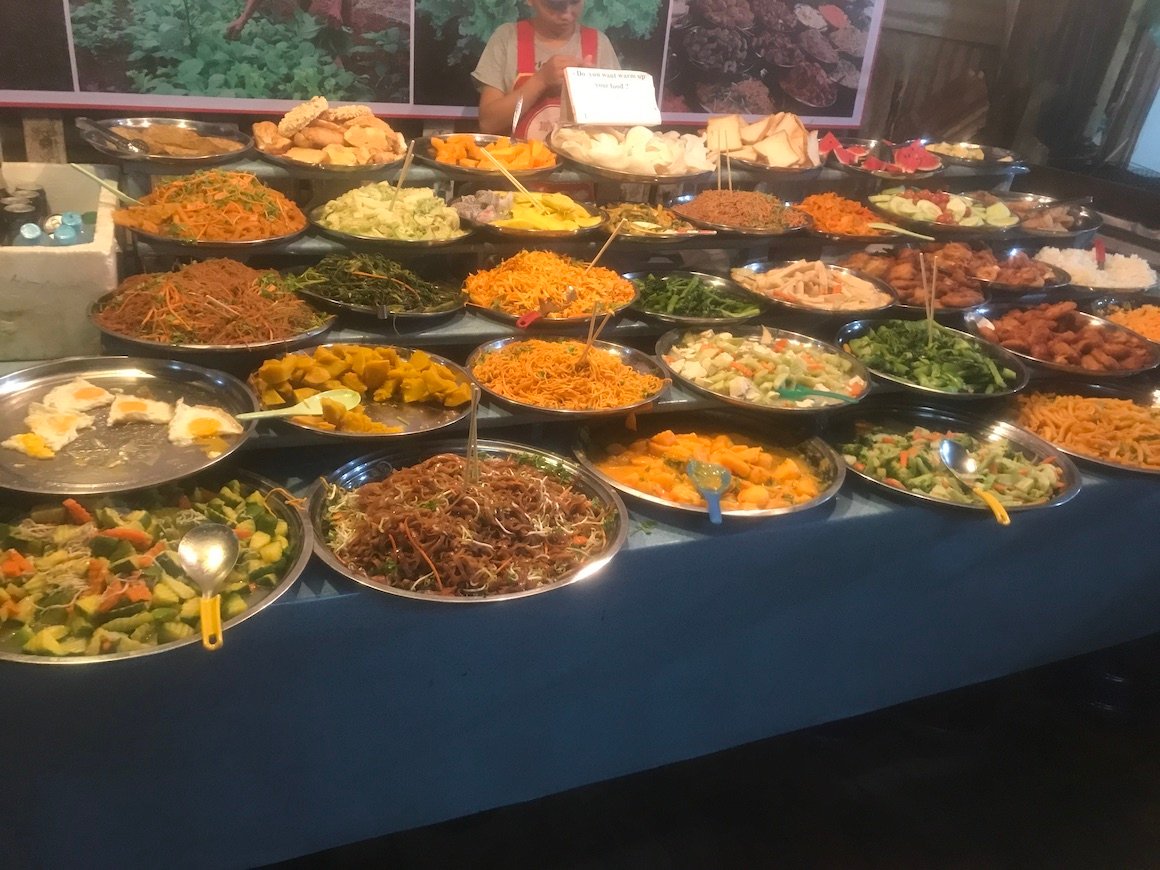
Photo: Samantha Shea
- Where the best eating happened: I loved Luang Prabang night market during my time in Laos. It’s mostly tourist-centred, but serves as a great starting point to dive into more adventurous parts of Laos’ street food culture. Instead of your usual fried noodles and pancakes, get your teeth into the grilled meat. It’s served whole rather than trimmed for visitors who get squeamish about offal or fat. If you want to know what people actually eat rather than the version adjusted for tourists, that’s where to look.
- What guidebooks miss: That locals love to haggle – and food is no exception. It may feel cheeky, but a bit of friendly back and forth on the price of a meal is standard practice here, so don’t take the listed price as gospel!
- The lesson Laos taught me: Sticky rice is life. Lao people refer to themselves as luk khao niew, children of sticky rice, and it’s eaten by hand, with the rice itself doing the work that cutlery does elsewhere: scooping up sauce, soaking up the char from grilled meat, holding a meal together.
Myanmar
Street food in Myanmar isn’t treated as a lesser version of home cooking. It’s considered a normal, essential part of how people eat day to day. Regardless of income, you can expect to have at least one of your meals in Myanmar roadside style. Its cuisine is a weird and wonderful mishmash of Indian, Chinese and Thai influence. One of my fave dishes, Ohn No Khauk Sw, is essentially a Burmese Khao Soi. Whatever the differences, it feels like a warm hug. The laphet thoke, a fermented tea leaf salad with peanuts and fried beans, is also a big winner in my book.
Street food in Myanmar runs through stalls and markets that operate from early morning to late at night, depending on the dish. Mohinga, the fish noodle soup considered the national dish, is the big morning one. Locals eat it standing up, fast, before heading to work. Grilled meat and skewers, along with noodle dishes like Shan noodles and nan gyi thoke, dominate later in the day, and night markets pick up once the daytime stalls close.
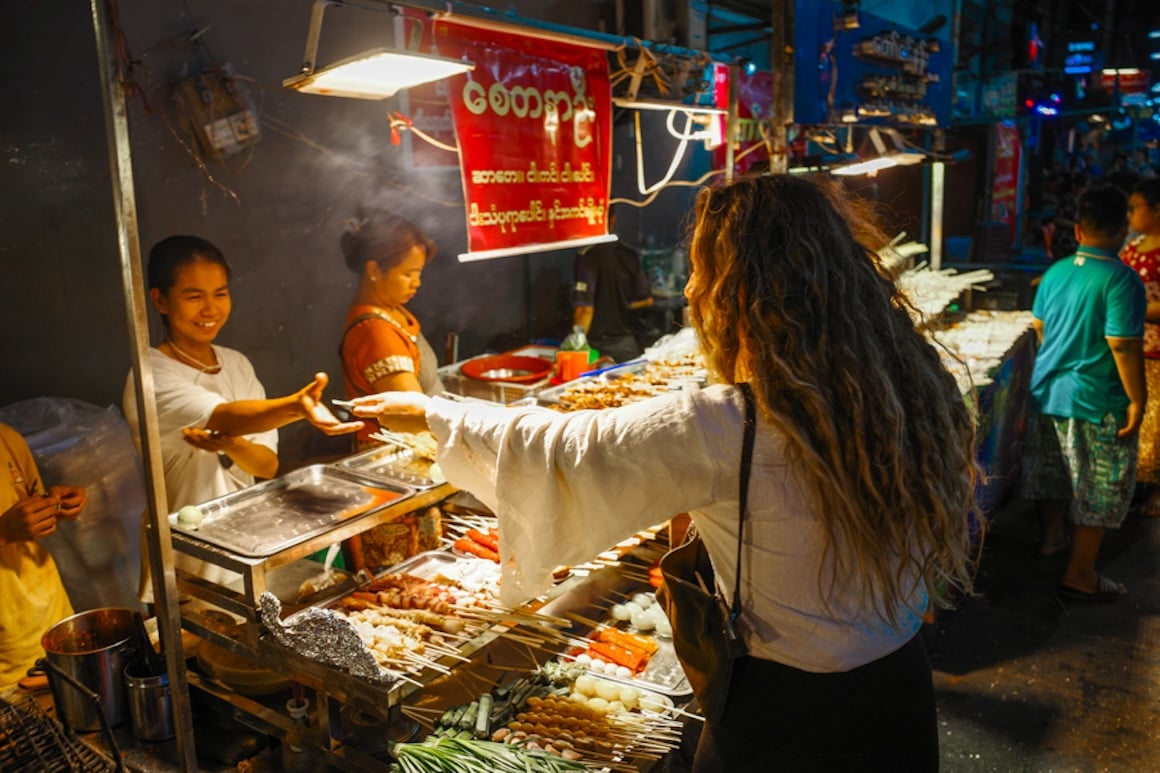
Photo: @audyscala
- Where the best eating happened: 19th Street in Yangon’s Chinatown, known for its barbecue stalls, grilled skewers, and cold beer running into the evening. I basically spent my trip either here, or dreaming of here!
- What guidebooks miss: Food costs in Myanmar have risen sharply since 2021, with the price of a typical diet nearly tripling between mid-2020 and early 2024. A guide written even a couple of years ago may list prices that no longer hold, and what still looks remarkably cheap to a visitor converting from a stronger currency reflects a much higher cost to the person actually paying in kyat day to day.
- The lesson Myanmar taught me: Despite the recent increases, affordability and quality aren’t in tension here. A bowl of noodles or a plate of snacks often costs only a few dollars or less, cooked fresh in front of you using simple ingredients, and that price has never been treated locally as a marker of lesser food. The cheapest option on the street and the most trusted one are often exactly the same stall.
Cambodia
Most visitors pass through Cambodia having just come from Thailand or Vietnam, and would be wrong to think that street food is same-same here. There are no sprawling night markets with overhead lighting and forty variations of familiar dishes. Breakfast in Phnom Penh begins at 5 am. Tuk-tuks honk, smoke rises from woks, plastic stools spill onto the pavement. The scene is messier, quieter, and runs on a much earlier clock than most backpackers are keeping.
The BBQ culture here is wicked. Vendors sell fish, chicken, and pork, where you select your meat raw from the hook and it gets cooked in front of you. It’s an evening thing, not a lunchtime thing, and the process can seem somewhat daunting for someone who’s never done it before. Top tip for Cambodia: watch what other people order and do the same – you just gotta fake it till you make it.
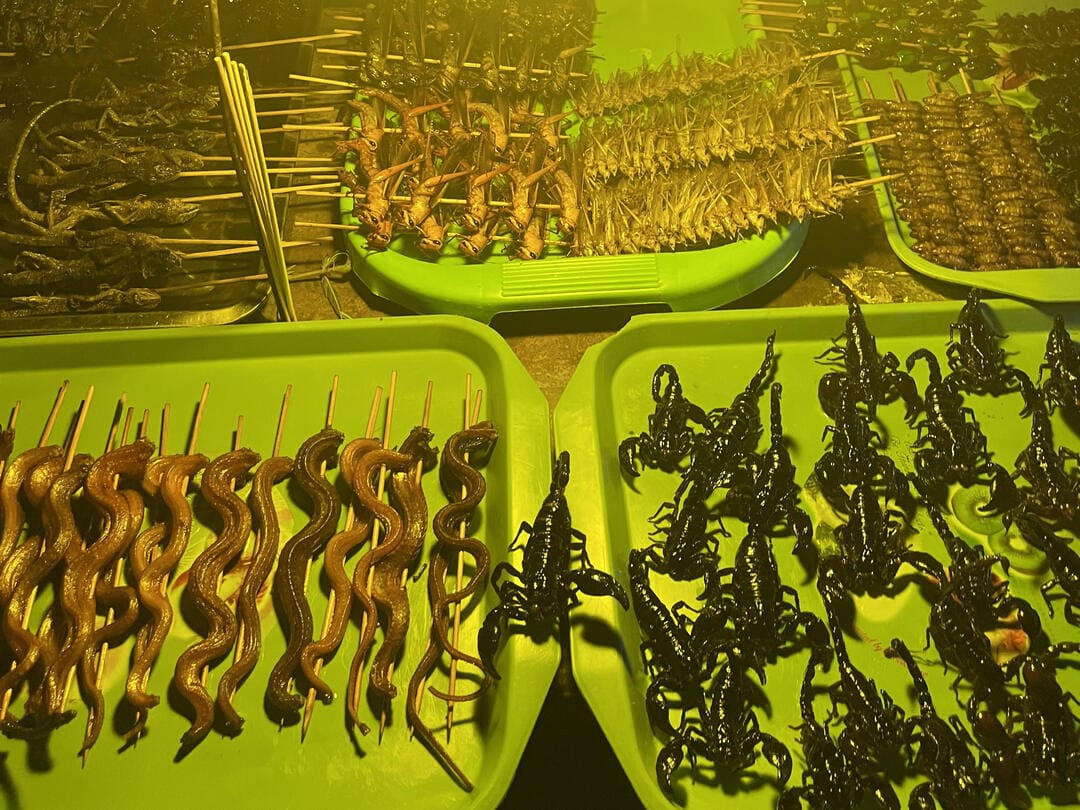
Photo: @taya.travels
- Where the best eating happened: In Siem Reap, the riverside stalls north of the old market skew local, while the stalls south of the police post at the bridge are more tourist-facing. Both offer banging food; it just depends on how adventurous you want to lean.
- What guidebooks miss: That fish amok, the country’s national dish, isn’t actually eaten by the locals. It exists primarily in tourist restaurants, sweetened and smoothed out for outside palates and offers little insight into how the locals ACTUALLY eat. The more challenging flavours that Cambodians actually love (the bitter, sour, salty, and pungent notes) are found roadside, not in the restaurants catered to tourists.
- The lesson Cambodia taught me: That street food doesn’t have to be an event like it is in other Asian countries. Street food can be so quiet and unassuming that it blends into a city’s background, yet remains so integral to keeping people fuelled. Getting involved in it gives you an insight into food made for locals, not tourists.
The Patterns I Noticed Across All 11 Countries
As wide and varied as you’ll find street food to be when backpacking South East Asia, there are a couple of threads that weave ’em together. Knowing them before you go will keep you pretty clued up to the whole region, and will make street food make a hell of a lot more sense to you.
Most Street Food is Time-Specific
Thailand’s boat noodle carts disappear by mid-morning. Cambodia’s bai sach chrouk is gone before lunch, and all the decent bun cha places in Hanoi are wrapped up by the afternoon. Across nearly every country in this list, the same pattern repeated: a dish that’s exceptional at 7 am can be a different, lesser version of itself by 7 pm. Guidebooks describe what to eat far more often than they describe when, and that gap is responsible for more disappointing meals than bad luck ever is.
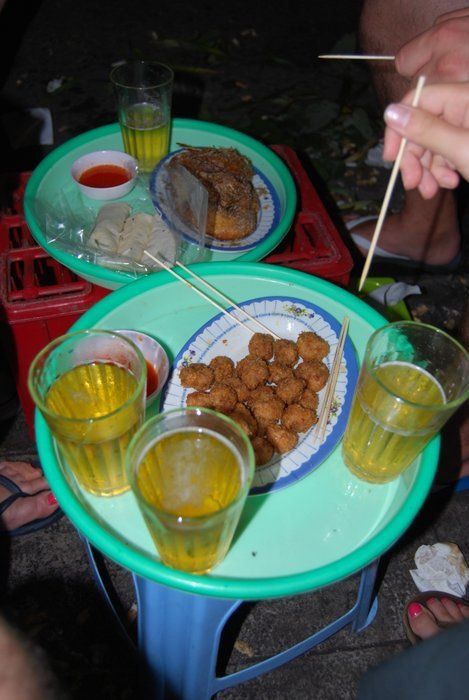
Photo: Sasha Savinov
My honest take: this is the single most useful thing I learned doing this. Knowing the name is great, but knowing the window it’s eaten in is just as important.
One Dish Can Vary Massively Depending on Where You Order It
The same dish name can mean genuinely different food depending on which region of a country you’re in. Laksa in Penang is a sour, tamarind-based fish broth. Laksa in Kuala Lumpur is a rich, coconut curry soup. They share a name and almost nothing else. The same thing happens with pho between Hanoi and Saigon, hokkien mee between Penang and KL, pancit across a dozen regions of the Philippines, satay from one Indonesian island to the next. Order by name alone and you’re trusting that name to mean the same thing everywhere, when it usually doesn’t.
To me, this is half the fun. Collect the same dish across different regions like Pokémon cards. Compare, contrast and note why something takes top spot for you. I love me a bit of food journalism on the hunt for the best street food in the world.
Street Food is Rarely Treated as the Lesser Option
In Myanmar, food is a communal affair, meaning food cooked at home or sold on the street is often synonymous. In the Philippines, a construction worker and an office worker eat the same plate from the same carinderia. In Singapore, the hawker centre is a space where everyone is at the same table, eating from the same stalls. The assumption a lot of visitors arrive with, that street food is what you eat when you can’t afford a restaurant, doesn’t hold up against how the people actually living there treat it.
This was the pattern that shifted my own thinking the most. Cheap and lesser are not the same thing, and some of the best food I’ve ever had in South East Asia has come from an unassuming roadside stall. For budget backpackers, street food is the win-win, baby.
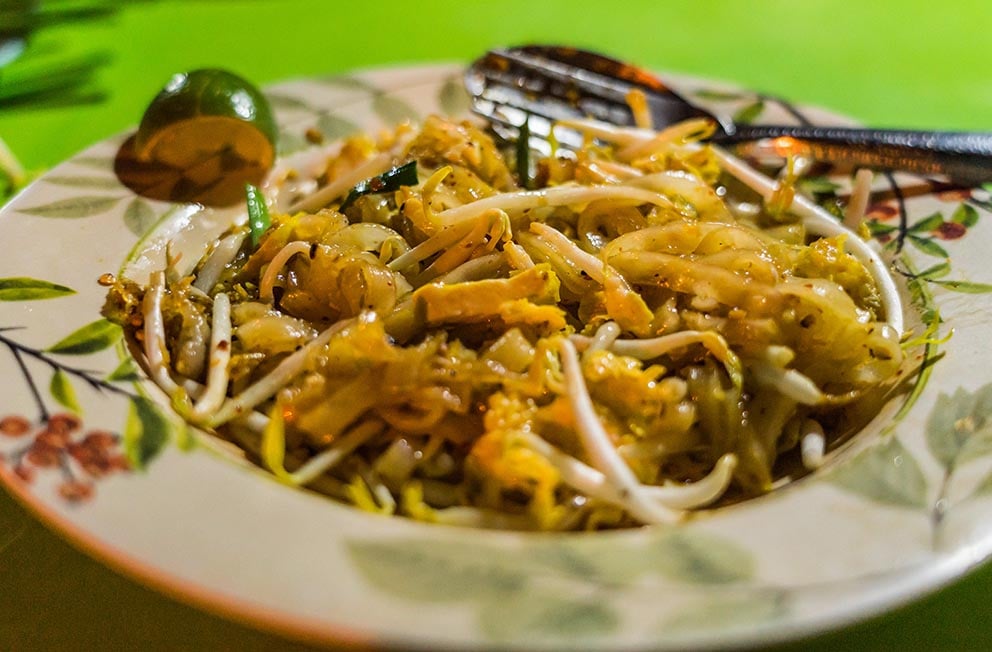
Image: Nic Hilditch-Short
The Queue Is Doing the Quality Control for You
Across every country in this list, the most reliable signal of a good stall isn’t a hygiene rating, a guidebook mention, or a TripAdvisor review. It’s whether locals are eating there. A busy stall with high turnover means the food is being cooked and sold quickly, ingredients aren’t sitting, and the people who eat there every day have given it their stamp of approval. If you’re standing in front of two identical carts, this alone should be your deciding factor.
The Cheapest Option and the Best Option Are Often the Same Stall
In the Philippines, Myanmar, Laos, and Cambodia especially, the stall charging the least is frequently the one that’s been doing one thing the longest. Price in Southeast Asian street food rarely signals quality the way it might in a Western restaurant context. The vendor charging more is often doing so because they’re in a tourist area, not because the food is better.
The Mistakes I Made So You Don’t Have To
Only eating at the famous markets
Look, the famous spots are popular for a reason and serve as a great starting point if you’re nervy about street food. But eating exclusively at that is a mistake in Southeast Asia! The queue tells you more than the reputation does. Look for where the locals are – that’ll indicate whether that stall with a queue is genuine or all hype.
I ordered from too many all-purpose menus
You should run away screaming in the other direction from a stall with forty options. The vendors worth finding have usually spent years or decades making one or two things properly. Early on I kept gravitating toward the longer menu because it felt safer, more to choose from, less chance of getting something I didn’t want. What I was actually doing was avoiding the stalls that knew what they were doing in favour of the ones that were hedging. The shorter the menu, the more seriously I’d now take it.
I assumed spicy meant the same thing everywhere
It doesn’t. In Thailand, I can handle most spicy dishes that are thrown my way, but I’ve been fighting for my life in warungs in Indonesia. How spice is served to you changes too. In Thailand, spice is cooked into the dish. In Cambodia, chilli arrives on the side, and you’re in charge of it entirely. In Indonesia, the sambal on the table is a different condiment in every region. I spent the first few weeks treating ‘spicy’ as a fixed, universal category and got caught out repeatedly. It’s a moving target that shifts every time you cross a border, and sometimes within the same country.
I didn’t always watch the stall before ordering
The best thing you can do before sitting down at a stall you don’t know is stand back for two minutes and watch. What’s coming out of the kitchen. Whether ingredients are being cooked fresh or sitting pre-made in trays. Whether locals are eating there or whether it’s running on tourist foot traffic alone. Whether the vendor looks like they’ve been doing this for thirty years or whether the whole operation looks temporary. Two minutes of watching tells you more than any guidebook entry, as it’s your up-to-date, boots-on-the-ground indicator of whether you’re in for the best meal or your life or a stinker.
I sometimes chose comfort over curiosity
There’s a version of eating your way through Southeast Asia where you find the one dish that works, the pad thai or the pho or the nasi goreng, and you eat it everywhere because it’s reliable and you know what you’re getting. I did this. It’s understandable. After a long travel day and a stomach that’s had a hard week, going with what you’re familiar with is the easy option.
But the dishes I remember most from this trip are almost all the ones I ordered without knowing what they were, at stalls I almost didn’t stop at, in cities where I didn’t have my food itinerary curated down to a T. The best eating often comes with getting out of your comfort zone and trying flavours and textures that probably don’t even exist at home.
The Real Lesson Wasn’t the Food
A big reason why I travel is for food. But when I think about it, it’s not solely to do with foreign flavour combos that make my stomach sing (though it’s a big part of it).
Food is one of the clearest insights into a country’s culture, its people and its communities. Street food even more so. When you stumble upon that local market, that street vendor serving workers on their lunch break, you’re granted access into real local life, which can teach more than any temple ever could.
Food is the most honest thing a place has to offer, and you miss so much of it if you only stick to the restaurants catered to tourists. You’re just there, probably on a plastic stool, eating what people eat, at the time they eat it, in the place they eat it. Trying to eat what, where and how the locals eat is one of the clearest things that distinguishes the tourists from the travellers.
The other thing, the one I didn’t expect: how much of this was about the people eating alongside me rather than the food in front of me. A carinderia table in Manila where nobody spoke the same language but the meal was still shared. A Cambodian market stall where the ordering system was entirely opaque and someone at the next table just instinctively helped. Street food is communal by design, not by accident. The stall is small, the tables are shared, and the whole format assumes you’re willing to sit next to a stranger and eat. After 200+ stalls, I think that assumption is the point. The food gets you to the table. What happens at the table is the actual experience.
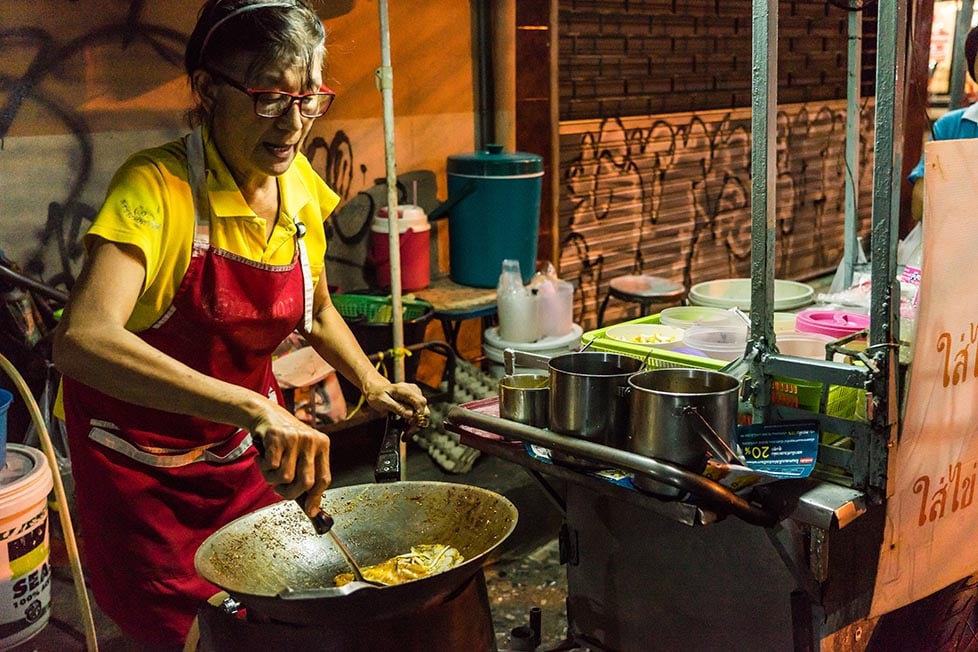
Image: Nic Hilditch-Short