In terms of backpacking, Thailand was my first love. She was my first country on my year-long trip around Southeast Asia, the one I kept returning back to, and the country I now live in. So, trust me, when it comes to Thailand, I know ball.
When I meet backpackers on their first visit to Thailand, recalling excitedly their plans to tackle the country in ten days, a small part of me shrivels up and dies. It’s not to say that I’m vehemently against quick-paced travel (though in the idealised version of the world in my head, everyone would travel for 10 months of the year), it’s just that whistle-stopping through a country so big and diverse seems like SUCH a disservice to it.
This won’t be a guide telling you to not bother if you have less than a month, more so a resource to refer back to so you can be crafty with your time. What you want to see, when you want to go and how much time you have to do it all massively impact the kind of itinerary that suits you. And unless you’ve got all the time in the world like a broke backpacker fucking around and finding out, you do kind of want to get it right the first time.

Photo: @taya.travels
The Broke Backpacker is supported by you. Clicking through our links may earn us a small affiliate commission, and that's what allows us to keep producing free content 🙂 Learn more.
- How Many Days Do You Need in Thailand?
- Treat These Itineraries as Building Blocks, Not Gospel
- Before You Build a Thailand Itinerary, Choose Your Trip Style
- Thailand Routes I Would Not Recommend for Short Trips
- Itinerary One: Bangkok and the Gulf Islands
- Itinerary Two: Bangkok and the Andaman Sea Islands
- Itinerary Three: Northern Delights Edition
- Getting around Thailand
- When to Visit Thailand for These Itineraries
- Mistakes I’d avoid when planning a Thailand itinerary
- What I’d book in advance vs leave flexible
- My honest advice before you lock in your route
How Many Days Do You Need in Thailand?
Personally, I’d say anything under 10 days, and you’re better off saving your annual leave for another year. Thailand is a big country, and flogging yourself around the whole thing in a week just means a jam-packed itinerary that’ll only leave you exhausted with little idea of what Thailand is really like and how it feels. You have to slow down to experience it!
10 to 14 days is the minimum I’d put aside, and even then you have to be selective. That’s enough time to properly explore one region, whether that’s the north around Chiang Mai, the Gulf islands like Koh Tao and Koh Phangan, or the Andaman side with Phuket, Krabi and the gems further south. Trying to squeeze in more than one of these in under two weeks means you’ll spend half your trip on buses and boats, realising how long it actually takes to cross to different parts of the country.
Two weeks plus and things open up a bit. Now you can start combining the southern islands, both the Gulf and Andaman coasts, or pair one coastline with a chunk of the north. You’ll still need to be a bit ruthless with your route, but you’ve got room to breathe, and most importantly, slow down enough to take it all in.
Three weeks is where Thailand starts to feel balanced. This is the first trip length where you can genuinely tackle a bit of everything: decent time in Bangkok, a proper stretch up north, and island time down south, without it feeling like a box-ticking exercise. You’ll come away with a real sense of the country’s breadth rather than a snapshot of one corner of it.
Four weeks or more is the sweet spot if you want to see it all without rushing. I did my first trip over two months and didn’t skip a thing, nor did I have to pick up the pace to fit it in, and I’m a fairly slow traveller by nature.
If you don’t have that kind of time up your sleeve, don’t panic and don’t try to cram the whole country into a fortnight. Short Thailand trips work best when you pick one region and commit to it, rather than stretching yourself thin trying to hit Bangkok, the islands, and the north all in one go. A whistle-stop tour of everywhere ends up being a proper look at nowhere… well, that’s my advice for Thailand anyway!
| Trip length | Best for | What you can realistically do | What to avoid | My honest take |
|---|---|---|---|---|
| 10–14 days | One region only | Deep dive into the north, the Gulf islands, or the Andaman coast | Trying to mix north and south, or islands on both coasts | This is the floor, not the target. Pick one area and actually enjoy it |
| 2–3 weeks | Combining one coastline with the north, or both southern coasts | A relaxed pace across two regions with a couple of buffer days for delays | Long travel days when a domestic flight can cut time | Solid trip length if you’re not fussed about seeing absolutely everything |
| 3 weeks | Bangkok, the north, and the islands together | A proper spread across the whole country without feeling rushed | Fast-tracking through each stop just to say you’ve been | This is where Thailand starts to click into place |
| 4+ weeks | Seeing the whole country at a slower pace | Everywhere on your list, with room for detours, rest days, and plans changing | Overplanning every single day before you land | The sweet spot. I did this over two months and never once felt like I was racing the clock |
Treat These Itineraries as Building Blocks, Not Gospel
Every route in this guide is built for two weeks, and every one of them assumes you’re short on time. If you’re not, treat them as LEGO blocks rather than a finished plan. Each one covers a self-contained slice of the country, so if you’ve got the time to spare, bolt on a second block, or even a third, rather than picking just one.
Fancy the Gulf islands but also want a taste of the north? Combine the Bangkok and Gulf Islands route with the Northern Delights one, dropping the second Bangkok stint since you’ll already be passing back through. Want the full spread, Bangkok, both coasts, and the north? All three slot together; you’ll just want closer to six weeks to do it without rushing any of them.
The stops are built to connect too, so mixing and matching isn’t a stretch. Krabi and Phuket both have direct flights up to Chiang Mai, and Chiang Rai sits close enough to the Laos border if you fancy carrying on rather than looping back to Bangkok. Treat these as a starting point, not a fixed set of options, and build the trip that actually matches how much time you’ve got.
Before You Build a Thailand Itinerary, Choose Your Trip Style
Before you start copying some route you found online, stop and ask yourself what you actually want out of this trip, because your itinerary should suit YOU and not some random folk online (myself included).
If you’re after street food stalls in Bangkok, temple hopping, and market wandering, an itinerary stacked with island hopping and diving stops is going to leave you disappointed on both fronts. Same goes for a backpacker route versus a honeymoon route: one is built around hostels, night buses, and meeting people, the other around comfort, privacy, and not spending six hours crammed into a minivan. Trying to follow one when you want a different side of Thailand will only leave you high and dry.
Trip length matters here too. A 10- to 14-day route has no room for long transfers. Every day you spend on a bus or a ferry instead of actually being somewhere is a precious day not used exploring, so keep your route tight and stick to one region: the north, the Gulf islands, or the Andaman coast, not a combination.
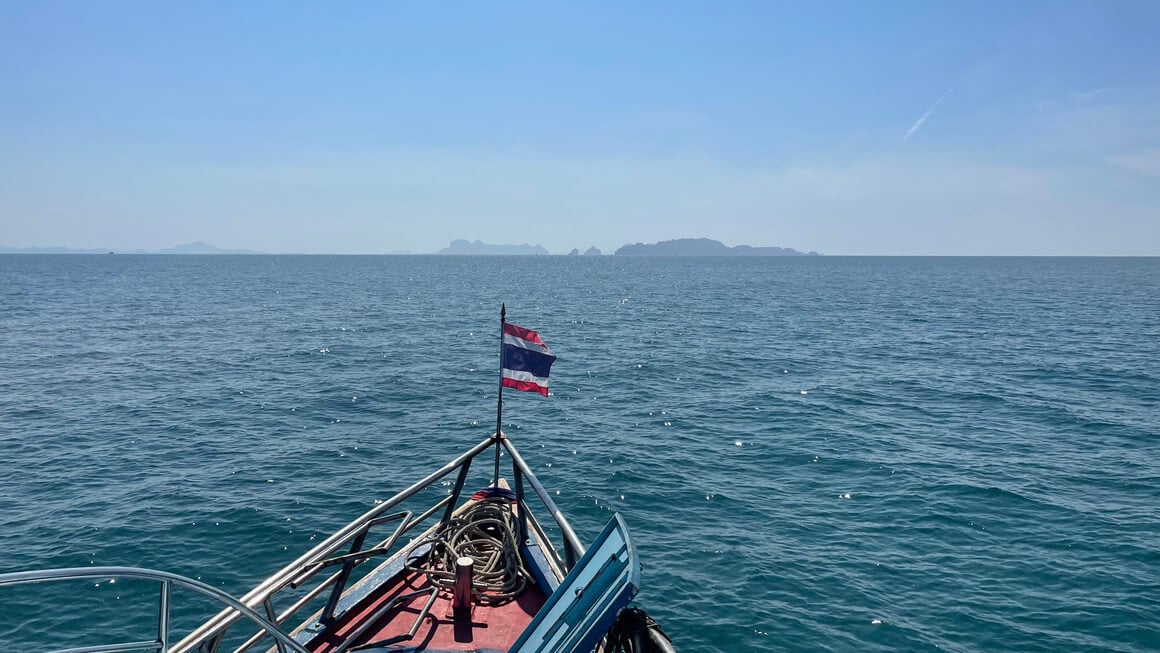
Photo: @danielle_wyatt
At two to three weeks, you’ve got a bit more room to play with. This is where you can pair one coastline with a stretch up north, but it’s still not the time to try both coasts plus the north in one go. Pick your combination and commit, and accept you might have to sprinkle some domestic flights in there rather than doing the more budget-friendly alternatives just to really maximise time.
Once you’re at three weeks or more, you’ve got room to bring in some real variety, mixing north, south, and Bangkok into one trip. But even then, there are limits. More time doesn’t mean you should fill every single day with a new location. Build in a few slow days, or you’ll land home more tired than when you left.
| Trip style | Best route type | Good for | Not ideal if | My quick advice |
|---|---|---|---|---|
| First-time Thailand | Bangkok plus one region (north or south) | Getting a proper taste of the country without overcommitting | You want to go deep rather than see a bit of everything | Don’t try to cram in the whole country on your first go, save some for a return trip |
| Beach trip | One coastline, Gulf or Andaman | Diving, island hopping, and settling into slow beach life | You’re short on time and try to cover both coasts | Pick one coast and stick to it, hopping between the two eats days you’ll wish you had back |
| Food and city trip | Bangkok, Chiang Mai, and other food-focused hubs | Street food, markets, and cooking classes | You’re craving beaches or jungle treks alongside it | Keep this one urban-focused, the food scene deserves proper time, not a rushed detour |
| Culture and temples | Bangkok, Chiang Mai, Ayutthaya, Sukhothai | Temple hopping, history, and slower cultural immersion | You want a party atmosphere or heavy nightlife | Give yourself more time than you think at each site, rushing temples defeats the point of going |
| Backpacker route | Flexible, hostel-to-hostel across one or two regions | Meeting people, keeping costs down, staying adaptable | You want fixed plans or a bit more comfort and privacy | Leave your route loose, some of the best stops come from tips picked up along the way |
Thailand Routes I Would Not Recommend for Short Trips
Some routes look great in theory before you quickly realise how unsustainable they are when you’re living them. Here’s what to steer clear of if you’re working with 10 to 14 days.
- Bangkok, Chiang Mai, and any southern island in 10 days. Three regions in ten days means you’re basically living out of your daypack on buses, flights, and ferries, with barely a night or two to settle anywhere.
- Bangkok, Pai, Chiang Mai, and the islands in 12 days. Pai alone deserves a few unrushed days, and tacking islands onto a northern loop like this usually means an internal flight or a very long travel day squeezed in somewhere it doesn’t fit.
- Flying somewhere for one night just because it’s famous. If a place is worth the flight, it’s worth more than a single night.
- Planning a beach day right before an international flight, with no buffer. Ferries get cancelled, flights get delayed, and traffic to the airport is never as quick as Google Maps promises. Build in a spare day before you fly out, always.
Thailand is easy to get around, but easy never means quick here. Distances can be huge, flights delayed, and traffic can chew through half a day without you doing anything except getting from A to B. Short itineraries should account for this and keep moving to an absolute minimum, especially the long journeys hopping from one part of the country to the other.
Itinerary One: Bangkok and the Gulf Islands
This is the route I’d point most first-time backpackers towards if they’ve got a fortnight to play with. Bangkok, Koh Tao, Koh Phangan, and Koh Samui, with at least three nights in each spot to actually settle and get a feel for the place.
Bangkok gives you the easiest international access of anywhere in the country, so it makes sense as your entry and exit point. From there you’re getting culture, street food, markets, and nightlife before heading south into a proper island run: diving in Koh Tao, the infamous full moon scene in Koh Phangan, and a bit more of a polished holiday in Koh Samui. It avoids burning your whole trip on domestic flights, and it works whether this is your first time in Thailand or your fifth.
Why This Route Works
Transport is easy peasy here. You’ve got choices at every stage: flying, sleeper train, or the classic bus-and-ferry combo, so you can shape the trip around your budget rather than being stuck with one option.
It’s also a forgiving route for first-timers. You’re not trying to juggle multiple regions or squeeze in the north, so there’s less pressure and far less time lost to transfers.
On timing, this route works best in the dry season, roughly December to March, when the Gulf islands (Koh Tao, Koh Phangan, Koh Samui) see the least rain. If you’re travelling outside that window, keep an eye on the forecast, as the Gulf and Andaman coasts have opposite wet seasons. If your dates land badly for the Gulf side, the Andaman islands (Krabi, Koh Lanta, Koh Phi Phi) might suit your timing better instead.
Stop 1: Bangkok
Despite Bangkok’s reputation for chaos, your first few nights in Thailand are actually about easing in before you start jumping to different parts of the country. Bangkok is all about temples, street food, markets, and nightlife all within reach of each other. It’s the ideal place to shake off the jet lag before heading south to the islands.
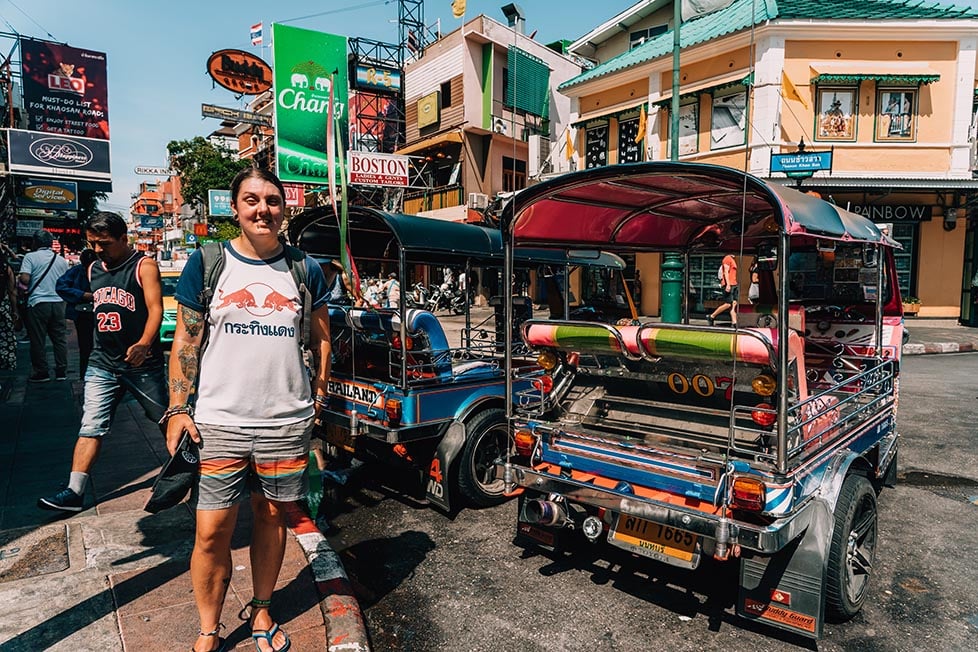
Image: Nic Hilditch-Short
Highlights
- Wat Arun and the Grand Palace, for the temple and history fix most first-timers will want to tick off
- Chatuchak Weekend Market, if your dates line up, for the biggest market in Bangkok and hours upon hours of shopping and people watching
- A river boat ride along the Chao Phraya, a cool way to see a different side of the city
- Khao San Road, for a taste of the classic backpacker scene, even if it’s just for one night
Food & Drink
- Pad kra pao at any streetside stall, though Jay Fai’s is the famous (and pricier) version if you fancy queuing for it
- Chinatown (Yaowarat) for an evening of stall-hopping and some of the best street food in the city
- Try a rooftop bar for one night if your budget stretches; the skyline view is worth the splurge
- Or Tor Kor Market, a step up from the usual street stalls and a good spot for fruit, som tam, and mango sticky rice
Best Areas to Explore
- Old Town, for temples, palaces, and the river
- Sukhumvit, for a more modern mix of bars, malls, and nightlife
- Chinatown, for the mix of food, history, culture and shopping
Where to Stay
- Budget: Once Again Hostel near Khao San Road
- Mid-range: Mangkon Hostel – a clean and comfortable hotel right off of Chinatown. My fave location I’ve stayed in for sure.
- Luxury: Riverside hotels along the Chao Phraya like Chatrium Hotel Riverside Bangkok
Quick Tips
- Keep your first day light. Don’t plan temples straight off a long-haul flight; your body will thank you for the buffer
- Book a hostel or hotel close to a BTS or MRT station, as it’s arguably the easiest way to get around the city without constantly relying on motorbike taxis.
- Dress modestly for temple visits with shoulders and knees covered
- Traffic in Bangkok can be brutal, so build in more time than Google Maps suggests for any cross-city trip
Stop 2: Koh Samui
After Bangkok’s pace, Koh Samui is your first taste of island life, easy to reach, well set up for tourists, and a good base before heading to the quieter islands further along the route. It’s a great place to visit as your first stop after the capital.
You can either fly straight into Koh Samui if you’re super tight on time and are willing to drop some $$$. If not, you can either jump on a bus/overnight train down the country and hop on a ferry from the mainland to reach Koh Samui or any of the other Gulf islands your heart desires.
If you are tight on time, or want to cut your itinerary down further to really slow down the pace and lean into island time, I’d drop Koh Samui more than any other island. It’s the most developed of the Gulf Islands and very much gives off holidaymaker vibes rather than a scrappy backpacker stop. Great if you want bougie hotels and restaurants, less so if you’re more fussed about adventuring.
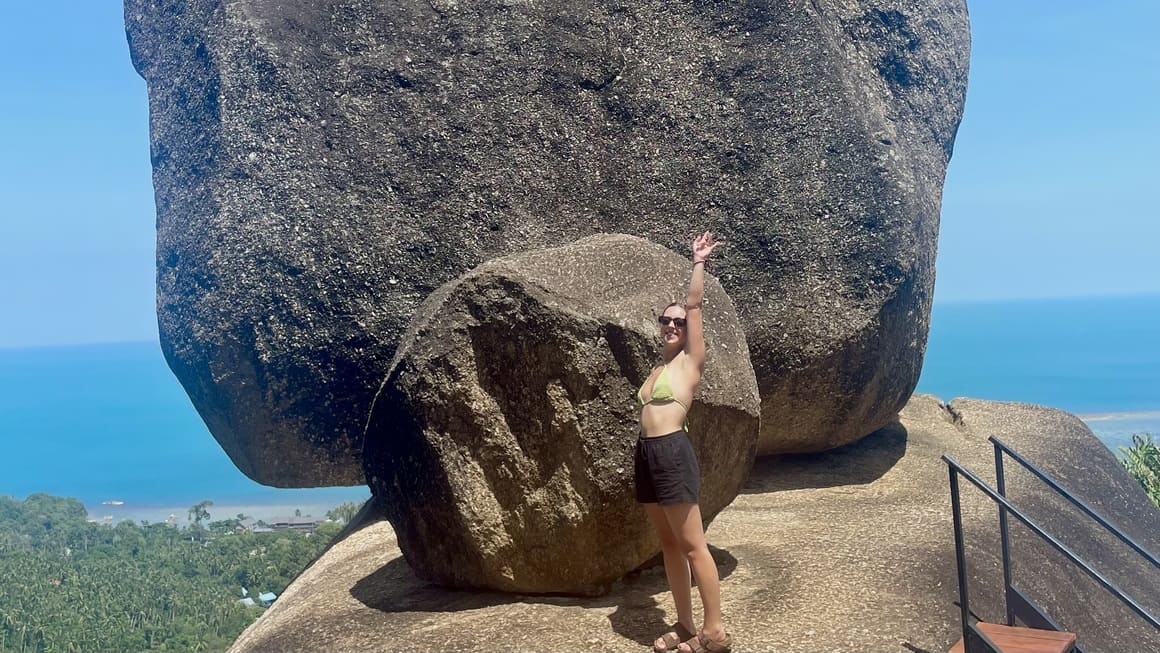
Photo: @taya.travels
Highlights
- Big Buddha Temple (Wat Phra Yai) is a well-needed dose of culture in between beach hopping
- Fisherman’s Village in Bophut, for a wander through old wooden shophouses turned into bars and restaurants
- Secret Buddha Garden, a strange and brilliant hillside spot with statues tucked into the jungle
- A day trip to Ang Thong Marine Park, if you fancy some proper island-hopping and snorkelling before the smaller islands
Food & Drink
- Grilled seafood at Fisherman’s Village night market, right by the beach
- Khao soi or khao man gai from one of the local (non-touristy) stalls inland, away from the beach road prices
- Fresh fruit shakes from any roadside stall, an island staple to keep you going in the heat
Best Areas to Explore
- Chaweng, for the busiest beach, bars, and nightlife
- Bophut and Fisherman’s Village, for a quieter, more charming base
Where to Stay
- Budget: Lub d Koh Samui Chaweng Beach – one of the swankiest hostels I’ve ever checked into
- Mid-range: Peace Garden Resort
- Luxury: beachfront resorts like Villa Nalinnadda Petite Hotel & Spa
Quick Tips
- Hire a scooter if you’re comfortable riding one; it’s the best way to explore the island
- Chaweng gets loud at night, so pick Bophut or Lamai if you want more sleep
- Fisherman’s Village night market runs every night in high season from 6 pm – I urge you to factor in time for it at least one night!
Stop 3: Koh Phangan
When you hear Koh Phangan, ‘full moon’ is never far behind it – but this island is so much more than its party reputation. Sure, you’ve got nightlife, but there are also quiet little nooks of coastline, waterfalls and temples to explore. Koh Phangan also has a bit of a hippy name for itself, so this island is a great place to tap into your spiritual side or experience a yoga retreat.
If you want to avoid the full moon crowds completely, you’ll find the island pretty much empties out a couple of days after full moon is done for the month. Accommodation prices drop, and it feels like way more of a rugged spot to explore than the slightly unhinged backpacker spot it becomes for a couple of days a month. Personally, I also prefer Koh Phangan over Phuket, any day of the week!

Photo: @amandaadraper
Highlights
- Full Moon Party at Haad Rin, if your dates line up, the one you’ve almost certainly heard about before landing in Thailand
- Bottle Beach, a boat-or-hike-only beach that trades the crowds for a proper slice of quiet
- Wat Phu Khao Kaew (Panoramic Buddha), a lesser-visited temple with some of the best sunset views on the island
- Phaeng Waterfall, a solid jungle trek if you fancy a break from beach days
- Amsterdam Bar for sunset, a cliffside spot that’s become a bit of a local institution
Food & Drink
- Thong Sala’s day market, for the widest spread of cheap Thai food away from the tourist strip
- Grilled seafood along Haad Rin or Haad Yao, a proper beachside classic
- Bucket cocktails along Haad Rin, more of a must-do experience than a bog-standard recommendation
Best Areas to Explore
- Haad Rin, for the party scene and beach bars
- Haad Salad or Haad Yao, for a quieter, more laid-back base
Where to Stay
- Budget: There are tons of wicked hostels in Koh Phangan. Hideout Hostel is one of my favourites.
- Mid-range: a sweet little beach guesthouse like V-View Beach Resort
- Luxury: Dewshore Resort
Quick Tips
- If you’re here for Full Moon, book accommodation AS SOON AS you know the dates for when you’ll be here. Finding digs over Full Moon party week is like gold dust the closer to the date you get, plus you’ll have to fork out a pretty penny for it
- Old shoes over sandals for the party itself; the beach gets messy, and glass isn’t unheard of
- Hire a scooter if you can; the island’s hilly and spread out, and you’ll want to reach the quieter beaches and waterfalls
Stop Four: Koh Tao
Now, this is where things get sticky. And I mean in the sense of booking for two nights and accidentally staying for two weeks. If you’re on a tight schedule, be wary of Koh Tao – she’s a little trickster – always doing what she can to make you stay longer. Calm diving, vibrant sunsets, and that one last dreamy dinner on the beach that’ll spark the discussion of extending for one more day…
Koh Tao is mostly known for being an absolute diving mecca. People get certified here as it’s one of the cheapest places in the world to do so, and the fun diving is pretty bloody good too. I’d stick to sites further from the island like Southwest Pinnacle, Chumpon and the famed Sail Rock to really see the island’s best bits. But let’s be honest, it’s one of the most stunning places in Thailand, so you can’t really go wrong!

Photo: @taya.travels
Highlights
- Dive, dive and more diving
- Boogie the night away at the Jungle Party
- Visit Nang Yuang island
- Go on a snorkelling tour – it’s a great way of visiting those harder-to-reach beaches if you don’t drive a scooter
Food & Drink
- Penang curry at Mama Tams
- 995 Duck
- Sunset dinner at Barracuda on the Beach
Best Areas to Explore
- Sairee for the main strip
- Chalok and the beaches on the southwest coast
Where to Stay
- Budget: Wonderland Jungle Hostel – my favourite hostel in the world
- Mid-range: Island Dive Club on Sairee Beach
- Luxury: Dusit Buncha for some seriously insane views of Nang Yuang and the Gulf of Thailand
Quick Tips
- Taxis are probably more expensive than on any of the other islands, but the roads are TOUGH – only rent a bike if you know what you’re doing
- Beach hop as much as you can; there are so many little gems to discover
- Try and catch every sunset – they are magical if the weather is in your favour
Stop Five: Onward Travel
It’s time to leave the islands and head back to the mainland to either get up to Bangkok or for another itinerary block. It’s been real. If you’re heading to Bangkok, you have a couple of different options here.
- Short on time: Get the ferry to Koh Samui/Surat Thani/Chumpon. Fly from any airport. Flights from Surat Thani tend to be the cheapest and most frequent.
- Short on money: Get the good ol ferry+bus combo. This option takes about 9/10 hours in the day, so load up on snacks and have stuff downloaded to keep you entertained.
- Short on time AND money: Now this is actually the longest of the options, but because you’ll be doing it overnight, you’ll be saving a night in accommodation, and you’ll make it to Bangkok relatively bright and early. Night ferries leave at 9 pm, and your bus will drop you into Bangkok by 1 pm (vs the earliest of 8:30 pm by doing the same journey in the day). Good if you have any onward travel in the evening that you’re trying to make.
Following another itinerary after this one? Here’s how to get there:
- Itinerary Two: Andaman Sea islands. The boat + minibus packages are your best friend here, and 12Go is the best place to look for them. They pretty much include transfers from any Gulf island to any Andaman island.
- Itinerary Three: Northern Delights. You can fly direct up to Chiang Mai from Koh Samui or Chumphon and Surat Thani (on the mainland).
Itinerary Two: Bangkok and the Andaman Sea Islands
This route swaps the Gulf side for the Andaman coast, taking in Bangkok, Phuket, Koh Phi Phi, and Krabi. It’s a solid alternative if your dates don’t suit the Gulf islands’ wet season, or if you just fancy the Andaman’s scenery over the Gulf’s. Very much the same vibe as the itinerary above: a start in Bangkok before island hopping.
Why This Route Works
This itinerary is even better for those shorter on time, as domestic flights are even easier from here. Start or end in either Phuket or Krabi, and you can fly up to Bangkok with ease; you won’t even need to get a ferry to get you started like you would on the other coast.
If you want to minimise long travel days whilst still living your island hopping dreams, I’d go for this itinerary over the first. The ferries in between stay the same, but getting to and from Bangkok is a lot less agg. If you’re carrying on to the other coast or up north, this factor holds less weight in deciding.
On timing, this route works best in the dry season, roughly November to April, when the Andaman coast sees the least rain. If your dates fall outside that window, keep an eye on the forecast, as the Gulf and Andaman coasts run on opposite wet seasons. If the timing doesn’t suit the Andaman side, the Gulf islands might work better for your dates instead. Just check when the best time to visit Thailand is according to your trip.
Stop One: Bangkok
Nothing changes here; ease yourself into it like you would in the itinerary above.
Stop Two: Phuket
From Bangkok, fly down to Phuket. Flights are cheap and plentiful and really the default way to get down – I wouldn’t bother with a bus in this case: it’s a 12-hour bus for $45, or you can snag a one-hour flight for as little as $35…you do the math.
Phuket itself isn’t the most mind-blowing of islands, but it’s Thailand’s largest, and it comes with the infrastructure to match. You’ve got oodles of places to stay, restaurants to eat at, and it’s big enough to keep you occupied. Like Koh Samui, it’s more holidaymaker than backpacker vibes, but there are certainly little gems if you’re willing to scope them out.
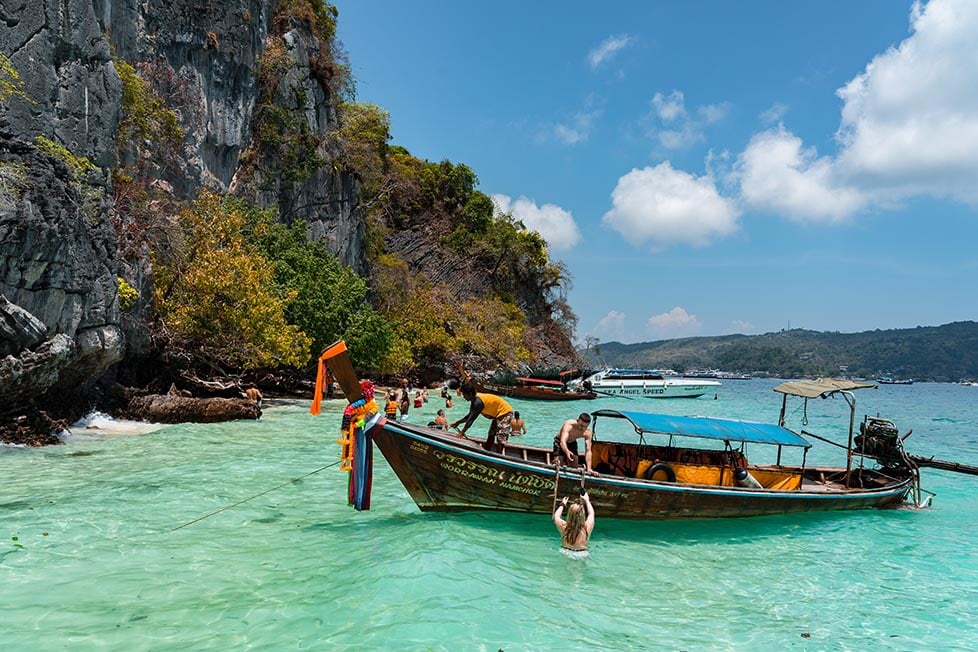
Image: Nic Hilditch-Short
Highlights
- Old Phuket Town, for Sino-Portuguese architecture, street art, and a proper break from beach life
- Big Buddha, a hilltop temple with some of the best views on the island
- Wat Chalong, the island’s most important temple and worth the visit even if you’re not templed out yet
- A day trip to Phang Nga Bay, for limestone cliffs and James Bond Island if you fancy getting out on the water early
Food & Drink
- Phuket Old Town’s street food stalls, especially around the Sunday Walking Street market if your dates line up
- Mee hokkien (Phuket-style stir-fried noodles), a local dish worth seeking out rather than skipping for the usual pad thai
- Fresh seafood along Rawai, where local fishing boats sell straight to the beachfront restaurants
Best Areas to Explore
- Patong, for the busiest beach, bars, and nightlife
- Old Phuket Town, for a quieter, more characterful base with better food
Where to Stay
- Budget: hostels around Patong like Lub d Phuket Patong
- Mid-range: Sugar Ohana Poshtel in Kata
- Luxury: a beachfront resort like Twinpalms Surin Beach Phuket
Quick Tips
- Patong gets loud and a bit seedy at night, so pick Phuket Town or Kata if you want a calmer base
- Motorbike taxis through Grab and Bolt are cheap and plentiful – rely on them if you’re not too confident on driving a bike yourself
- Phuket International Airport sits a fair way north of the main beaches, so factor in an hour or more for transfers depending on where you’re staying
Stop Three: Phi Phi
Koh Phi Phi is the postcard version of the Andaman coast, the kind of scenery that made this stretch of Thailand famous in the first place. It’s a fraction of the size of Phuket, with no cars or roads to speak of, though Tonsai Village itself feels tightly packed for such a small island. This stop is about slowing down, getting out on the water, and taking in the limestone cliffs that surround it.

Photo: @taya.travels
Highlights
- Maya Bay, the beach made famous by The Beach, is a must-visit (just try and get there as soon as the national park opens to beat the crowds)
- Viewpoint 2, a steep climb but the best panoramic shot of Phi Phi Don’s twin bays
- Watching fire shows on the beach come dark and partaking in a bucket or two (or three)
Food & Drink
- Fresh seafood barbecues along Tonsai Beach, a proper Phi Phi evening ritual
- Reggae Bar for a drink with a view over the bay, especially around sunset
- Garlic 1992 for some of the best Thai food I’ve had in the country
Best Areas to Explore
- Tonsai Village, the main hub for bars, shops, and restaurants
- Long Beach, a quieter stretch a short walk or boat ride from the main village
Where to Stay
- Budget: for some actual sleep, avoid the party hostels and stay in a quieter spot like Voyagers Hostel
- Mid-range: Phi Phi Indigo Hotel
- Luxury: resorts on the quieter side of Phi Phi Don, like Centara Villas Phi Phi Island
Quick Tips
- Boats to Maya Bay now run on restricted hours and closed days as part of the conservation effort; check the current schedule before planning your visit
- There are no roads or cars on Phi Phi, so be prepared to walk everywhere!
- Tonsai gets pretty rowdy at night with backpackers flooding the beach with buckets in hand. If that’s not your jam, pick Long Beach for quieter evenings
- It gets BUSY during peak season, and as the island is so small, you can feel it. If you don’t fancy wading through crowds, consider coming during the shoulder season
Stop Four: Krabi
Krabi is your last stop, and although it’s actually part of mainland Thailand, you won’t sacrifice views and some stunning beaches. Unlike Phi Phi, Krabi is less about big nights out and more about the scenery itself: sheer limestone karsts rising straight out of turquoise water, longtail boats lined up on the sand, and jungle pressing right up against the coast.
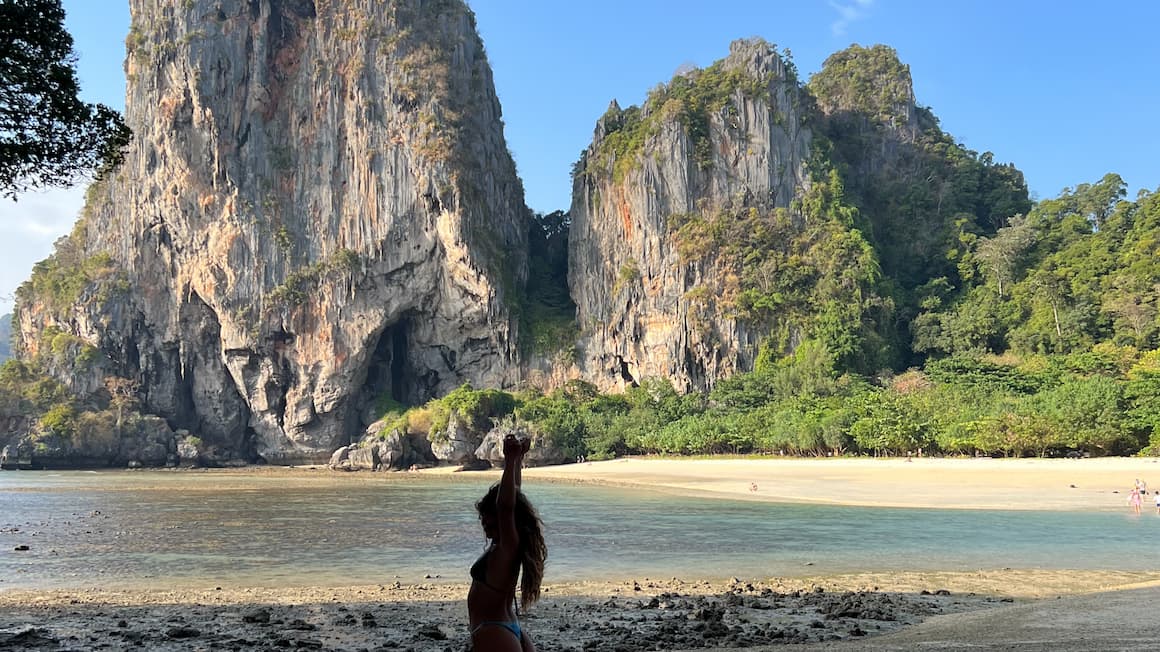
Photo: @amandaadraper
Highlights
- Railay Beach, only reachable by boat despite technically being on the mainland, known for its truly insane beaches and dramatic cliffs
- Tiger Cave Temple (Wat Tham Sua), a steep climb up over a thousand steps for one of the best views in the province
- Emerald Pool and Blue Pool in Khao Phra Bang Khram, a jungle day trip for a swim in strikingly clear turquoise water
Food & Drink
- Ao Nang’s night market, for cheap, solid Thai street food away from the beachfront restaurant prices
- Food from any Indian restaurant. A rogue suggestion on paper, but Krabi’s huge Indian population means getting some of the best Indian food I’ve ever had, proving to be a worthwhile hiatus from the usual Thai grub
- Roti stalls scattered around Ao Nang, a good cheap breakfast or a classic stop off walking home from a night out
Best Areas to Explore
- Ao Nang, for the easiest access to restaurants, bars, and day trips
- Railay, for a quieter, more scenic base if you don’t mind the boat transfer each way
Where to Stay
- Budget: K-Bunk AoNang Center – my favourite rowdy backpacker hostel <3
- Mid-range: Loma Place aonang krabi
- Luxury: resorts in Railay like Railay Phutawan Resort
Quick Tips
- Long-tail boat prices to Railay from Ao Nang are usually fixed, and double-check the last one for the day (although there are worse places to get stranded)
- Rock climbing courses here are some of the most affordable in the world, worth trying even if you’ve never climbed before
- The journey to get up to Tiger Cave Temple is SPICY. I’m talking 1,237 steps in no shade, so bring plenty of water and start early
Stop Five: Onward Travel
The journey back to Bangkok is waaaay easier than its Gulf counterpart as there are many more airports sprinkled around. Even if you veered off course and ended up in Koh Lanta or kicking about in Phi Phi, so long as you make your way to Krabi or Phuket, you can get a cheap flight to Bangkok from here.
- The broke backpacker option: From Krabi, an overnight bus starts from about $18 for a 14-hour journey. These seats do recline, but they won’t get you fully horizontal as you would be in Vietnam. Fine if you can sleep anywhere or last-minute flights have jumped up too much, but hardly the epitome of comfort.
- The quick and easy: This is one of the rare occasions where I’d say flights > overland travel. Flights start from as little as $18 and will get you up to Bangkok in an hour.
- For big groups: If you’re travelling with the gang, you might consider booking a private shuttle up to Bangkok. They’ll pick you straight up from the pier and will drop you straight to your door in Bangkok. It’s still a good 11/12 hour journey, but split between a big group doesn’t work out to be too much for private travel.
Following another itinerary after this one? Here’s how to get there:
- Itinerary One: Gulf Islands. Again, this journey will involve a boat + minibus package. Just pop your A and B onto 12Go and peruse your options from there.
- Itinerary Three: Northern Delights. You can fly direct up to Chiang Mai from Krabi or Phuket, so you can skip another stint in Bangkok if you want to.
Carrying on your travels?
If this is just one LEGO block that makes up the foundation of your Thailand trip, chances are you’ll either be heading over to the Gulf islands or up north.
- To Koh Samui/Koh Phangan/Koh Tao: From Krabi, hop in a minivan over to Surat Thani before boarding a ferry to your island of choice
- To Chiang Mai: Both Krabi and Phuket have direct flights up to Chiang Mai, though they run slightly cheaper from Phuket. If you have time to kill, you can always fly or get a bus up to Bangkok, spend a few days in the capital, and then head up to Chiang Mai. But, personally, if you’ve already seen Bangkok, I’d opt to slash travel time and fly straight to Chiang Mai.
Itinerary Three: Northern Delights Edition
Care little for beach bumming for two weeks? Would you rather sink your teeth into mountains instead? Thailand really is the best of both worlds, as it does both well beautifully.
This route takes you through the north of Thailand, covering Chiang Mai, Pai, and Chiang Rai. It’s a solid pick if temples, mountains, and a slower pace appeal more than beach time, and two weeks gives you enough room to actually settle into each stop rather than rushing the north’s winding roads.
Why This Route Works
The north moves at a different pace to Bangkok or down south, and this route reflects that by maximising real R&R time. You get culture and food in Bangkok, mountains and a proper slowdown in Pai, and temple after temple in Chiang Mai and Chiang Rai (can you tell we’re in Chiang territory now?!)
Transport between the northern stops is easy enough too; minivans and buses run regularly between Chiang Mai, Pai, and Chiang Rai, so you’re not relying on flights once you’re up there. If you really want to raise your mum’s blood pressure, you can rent a bike in Chiang Mai and work your way through the whole region on your own two wheels.
This is also a good option outside of peak beach season, or if you’ve done the islands before and want a different side of the country this time round. Worth noting the north gets noticeably cooler at night from November to February, and burning season (typically February to April) brings smoke haze that can affect visibility and air quality, which is a time of year I’d personally avoid travelling in.
Stop One: Chiang Mai
There are a couple of ways to get up to Chiang Mai from Bangkok. You can always fly if you’re short on time, get an overnight bus if you’re short on money, but my favourite way to make the journey has to be by sleeper train.
It requires a little more planning as they sell out in advance, but if you can snag a bunk (DON’T make the mistake of buying a ticket in a non-sleeper class), then it really is the coolest experience. By morning, you’ve woken to rolling green hills and a more rural side of the country that feels a million miles away from the city you departed from.
Chiang Mai is the cultural heart of the north, and despite being the biggest city after Bangkok, the change of pace is stark. My favourite thing to do here is walk around the old city, spotting temples and finding my new favourite coffee shop. The live music scene is also insane, and come evening you’ll hear some form of jazz floating down the streets.
The old city’s ringed by ancient walls and a moat, packed with temples, and surrounded by mountains that make it an easy base for day trips before you head further north to Pai. You can really pack in as many or as few activities as you like in the city; both work.
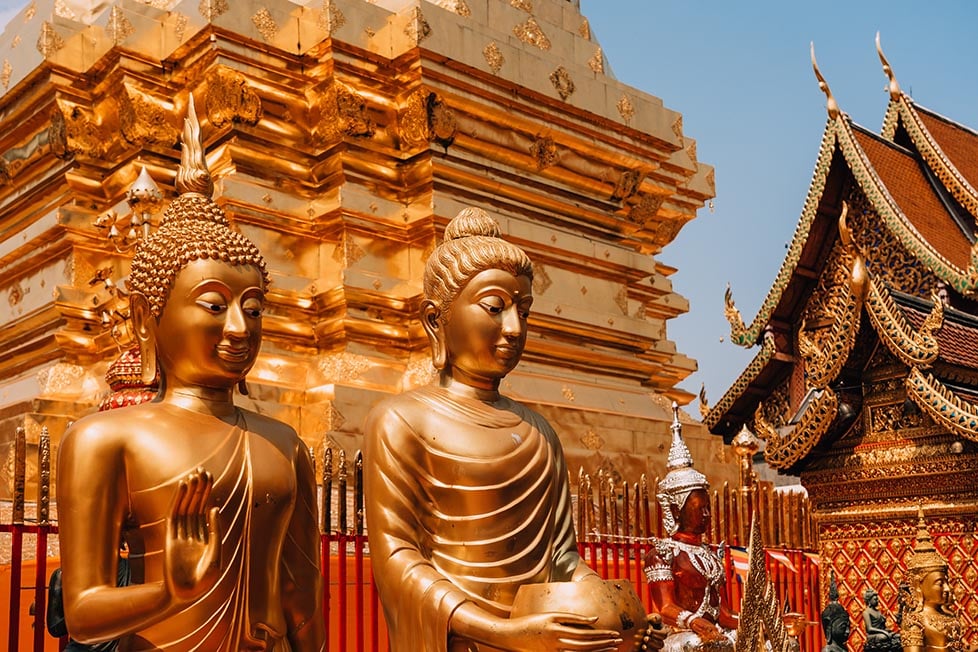
Image: Nic Hilditch-Short
Highlights
- Old City temple hopping: Wat Chedi Luang and Wat Phra Singh are the standouts if you’re short on time
- Sunday Walking Street market, if your dates line up, for handicrafts, food stalls, and the old city at its liveliest
- An ethical elephant sanctuary day trip; look for places that focus on observation rather than riding or bathing shows
- A Thai cooking class – what better place to do one than in the birthplace of Khao Soi?!
Food & Drink
- GORGE on Khao soi. It’s the north’s signature curry noodle dish and my death-row meal. Seriously. Take my word for it.
- Chiang Mai Gate night market, for cheap eats and a good spread of northern Thai dishes
- Cafe Hope around Nimman area if you fancy a break from street food with better coffee and a cool crowd
Best Areas to Explore
- The Old City, for temples, hostels, and easy walking access to most sights
- Nimman, for cafes, bars, and a younger, more modern feel
Where to Stay
- Budget: Stamps Backpackers Chiang Mai is one of my favourite hostels in the city, super social and wicked dorm setups
- Mid-range: Unique lil guesthouses like Baba Pim Villa
- Luxury: Unique stays like this cottage with a pool
Quick Tips
- Songthaews (red trucks) are the cheapest way to get around; flag one down and confirm the price before getting in
- The old city is compact enough to walk; save the scooter or songthaew for day trips further out
- Bargaining is expected at the Night Bazaar and Sunday Walking Street, but food stalls and small local shops usually have fixed prices
Stop Two: Pai
There’s only one way into Pai: 762 bends on a road from Chiang Mai. If you get travel sick like me, dose up on motion sickness pills like your life depends on it. If you’re adventurous enough, the ride on a bike is pretty bloody cool, but it should only be attempted if you have a fair bit of experience under your belt.
Much like Koh Tao, you have to be wary in Pai. The infamous ‘Pai hole’ is not to be underestimated; one day you’re checking into your hostel with three nights booked, and you’ll blink and two weeks would’ve passed. It’s VERY easy to slow down here, with the mountains as your backdrop and a hippy dippy attitude amongst backpackers that spreads like wildfire.
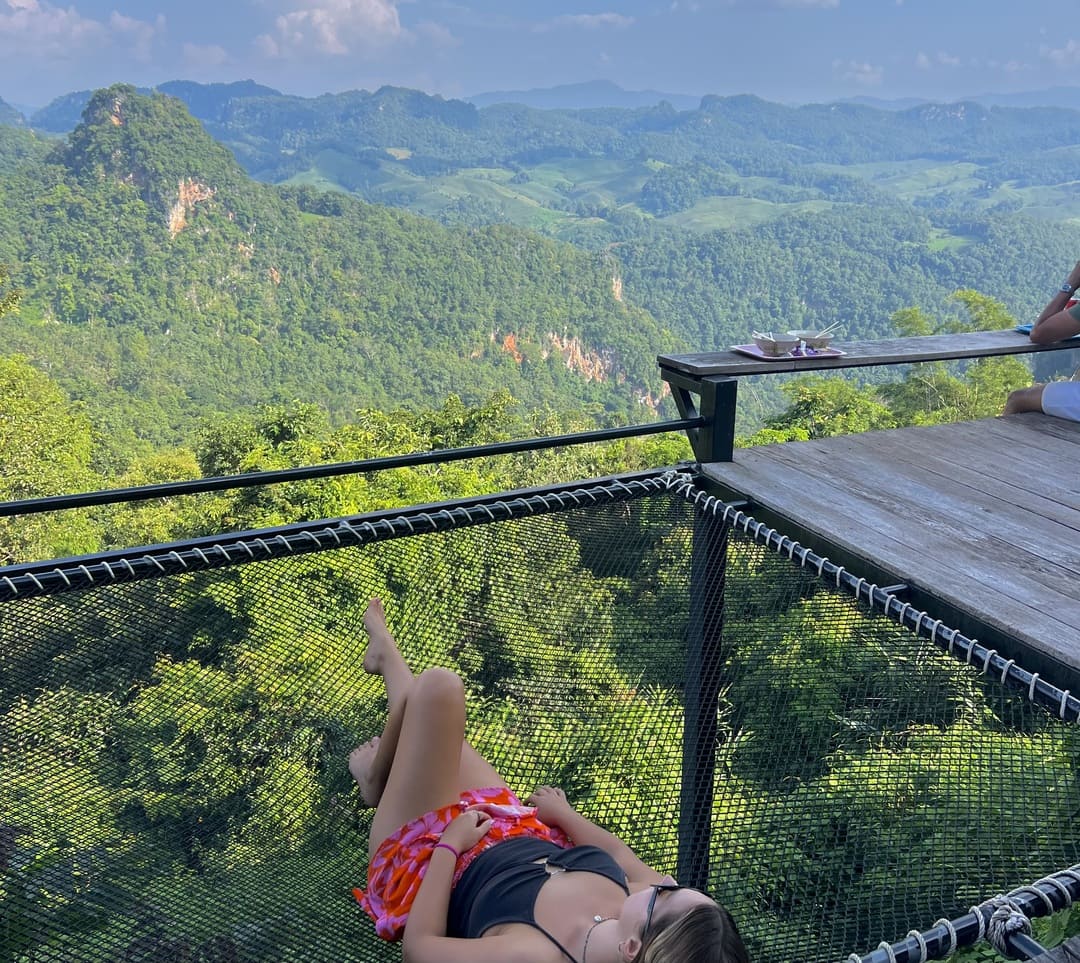
Photo: @taya.travels
Highlights
- Watching the sunset from Pai Canyon, a network of narrow ridges best walked around sunset for the light over the surrounding hills
- Pai Walking Street is the heart of the town come dark, with a night market running most evenings with food stalls, crafts, and live music spilling out of the bars
- Day trips to the hot springs, big Buddha, and all the way up to the Myanmar border are all worth your time
- Finding a good hammock with mountain views, rolling a joint and staying firmly put for the afternoon
Food & Drink
- Pai’s night market on Walking Street, for the widest choice of cheap eats in one place
- We’re still in Khao Soi territory here, so keep the bowls of broth coming
- Vegan cafes like Earth Tone and Ganita Cafe
Best Areas to Explore
- Pai town centre, walkable and small enough to cover on foot
- The surrounding countryside, best explored by scooter for waterfalls and viewpoints
Where to Stay
- Budget: Nolo Hub Pai – one of the best hostels I’ve ever stayed in and one I’ll always return to <3
- Mid-range: Baan Aew Pai
- Luxury: resorts like The Oia Pai Resort with valley views on the edge of town
Quick Tips
- The rainy season turns some of the dirt roads to the waterfalls and viewpoints muddy and harder to reach by scooter; sharing a 4×4 taxi between other backpackers is the safest option whilst keeping costs down
- The town’s small enough that most guesthouses and cafes are a short walk from each other; you likely won’t need transport within town itself
- Get out into town and get a feel for the live music scene here; it’s just as alive as Chiang Mai on a much smaller level
Stop Three: Chiang Rai
Chiang Rai is the last stop before you loop back to Bangkok or head into Laos, and it’s a different flavour of temple town to Chiang Mai. The city itself is quieter and less touristy, but it’s home to some of the most striking modern temple architecture in the country, alongside easy access to the Golden Triangle if you want to see where Thailand, Laos, and Myanmar meet.
Chiang Rai is where you really temple hop till you drop. Some are, admittedly, a little touristy, but are breathtaking nonetheless. I really enjoyed the brief climb up to the Temple of Mercy with sweeping views of the city below. You don’t need to dedicate as many days here as you would with Chiang Mai or Pai. It serves more as a stop en route to Laos or to get a healthy dose of culture and temples if Chiang Mai didn’t scratch that itch for you already.
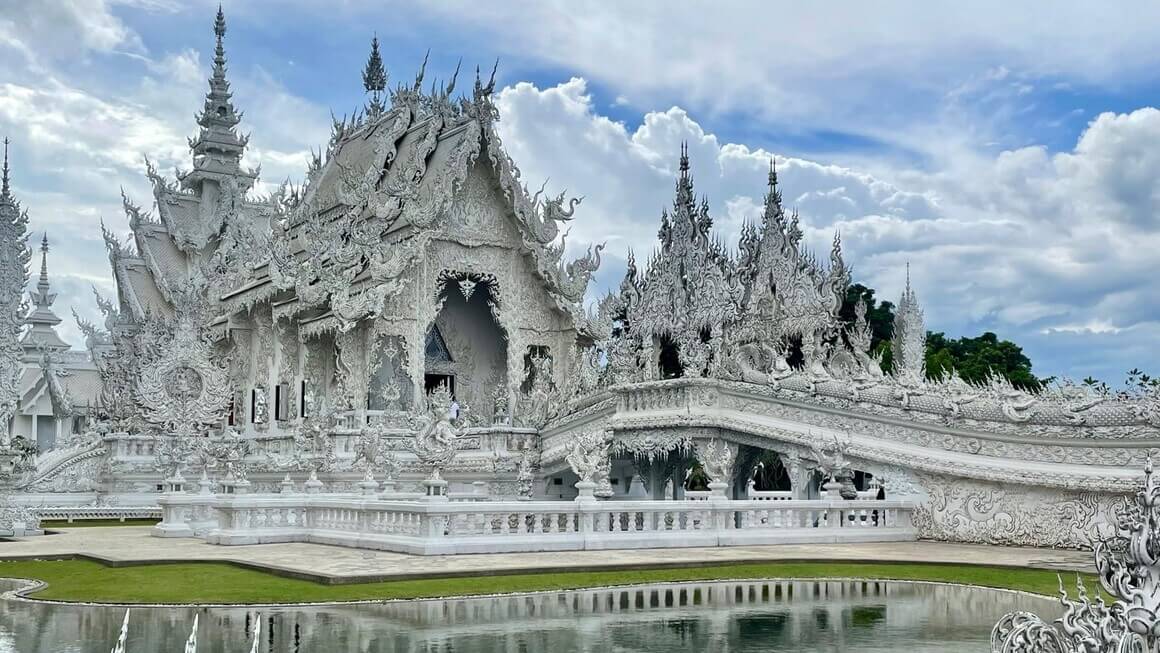
Highlights
- Temple hopping is the aim of the game here. Wat Rong Khun (the White Temple) and Wat Rong Suea Ten (the Blue Temple) are the usual heavy hitters
- Baan Dam Museum (the Black House), artist Thawan Duchanee’s sprawling collection of dark, unsettling buildings and artefacts, worth a couple of hours
- A day trip to the Golden Triangle, where Thailand, Laos, and Myanmar meet along the Mekong, plus the small Opium Hall museum nearby
Food & Drink
- Chiang Rai’s night bazaar, for cheap eats and live music most evenings
- Northern Thai dishes like sai ua (herb-packed sausage) and nam prik noom, found at local restaurants rather than the ones for tourists
- Doi Chaang or Doi Tung coffee, both grown in the surrounding hills and worth trying at a local cafe
Best Areas to Explore
- Chiang Rai city centre, for the night bazaar, temples within walking distance, and budget guesthouses
- The surrounding countryside, best covered on a day tour or hired scooter for the White Temple, Blue Temple, and Black House, which are spread outside the centre
Where to Stay
- Budget: Mercy Hostel was a solid hostel I stayed in before exiting to Laos
- Mid-range: Shinophat’s House
- Luxury: a unique stay like Nakaraj Princess Chiang Rai
Quick Tips
- The temples here are spread out; book a day tour or hire a scooter rather than relying on songthaews to cover the White Temple, Blue Temple, and Black House in one day
- The White Temple gets busy with tour groups by mid-morning; arrive at opening if you want photos without crowds
- Chiang Rai’s slower pace means fewer late-night options than Chiang Mai; don’t expect much beyond the night bazaar once it packs up
Stop Five: Onward Travel
It’s time to crawl out of that Pai hole and enter back into reality. If you are heading back to Bangkok, I’ll give you a couple of different options, but I’ll also cover all other potential onward travel below.
- Short on time: Flights from either Chiang Rai or Chiang Mai are cheap and plentiful. Booking in advance maximises your chances of snagging a good deal.
- Short on money: The night bus is your girl here. It takes about 12 hours from Chiang Rai, 10 and a bit from Chiang Mai. It takes a while, but you get to save a night on accommodation in the process.
- Short on experiences: The sleeper train is my favourite way of doing this journey. Not only do you get to save a night of accommodation, but you sleep a hell of a lot better than a sleeper bus with epic views. Book this one in advance,
Following another itinerary after this one? Here’s how to get there:
- Itinerary One: Gulf Islands. You can fly direct up to Phuket from both Chiang Mai and Chiang Rai. If you’re heading to Krabi, Chiang Mai is your only direct flight, unless you’re happy to stop off in Bangkok from Chiang Rai.
- Itinerary Two: Andaman Sea Islands. If you want to fly direct, you’ll only be able to do so to Koh Samui from Chiang Mai, but, to be honest, tickets are pretty eye-watering. For the sake of a couple of hours, I’d accept doing a short layover in Bangkok and flying to either Surat Thani or Chumphon on the mainland and taking a final boat to your chosen first island.
- Laos: Most people end up heading into Luang Prabang, Laos from northern Thailand as it’s so close. You can fly or go overland via bus, but my favourite way by far is to take the slow boat. You can do it DIY by heading straight to the Thai border, or book it in either Chiang Mai or Chiang Rai and get picked up from there so save yourself the headache.
Getting around Thailand
Flights
Thailand is a big country, and as such, flights definitely play their part in getting you around. Domestic flights are the fastest way to cover big distances, and worth it whenever you’re short on time. Bangkok to Chiang Mai takes about an hour in the air, compared to 10 to 14 hours on the train, so if you’re working with a tight schedule, flying buys you back a full day or more.
Saying that, flights can often be deceptively time-consuming. Especially so if you’re getting from an island to Bangkok, say, because getting from ports to airports and waiting around for a flight often adds up to take just as much time as a boat + bus combo. In this instance, it’s worth checking out both options and seeing what works for you.
Airport choice in Bangkok trips up more travellers than you’d think. Suvarnabhumi (BKK) handles most international flights and full-service airlines, while Don Mueang (DMK) is the hub for budget carriers and a lot of domestic routes. They’re on opposite sides of the city, so check which one you’re flying into or out of before you book anything; mixing them up can turn a short connection into an impromptu scramble across town.
Sleeper Trains
Time aside, sometimes flights don’t win as the best option simply because it’s the boring option! The Bangkok to Chiang Mai overnight sleeper train is a proper backpacker rite of passage, and one worth doing at least once if you’ve got the time to spare. You board in the evening, sleep through most of the journey, and wake up in the mountains the next morning, saving a night’s accommodation in the process.
If you’re not heading up north but still want to experience a sleeper train, Bangkok to Surat Thani is also a popular option. It’s slower than flying by a wide margin though, so treat it as an experience to build your schedule around, not a quick way to get from A to B.

Minibuses and Boats
Big distances aside, you’ll find that minibuses and boats will do the rest of the heavy lifting. This makes the most sense when crossing from one side of the coast to the other, as flights will only re-route you up to Bangkok before coming back down south. You’d be mistaken for thinking that these travel days don’t take as long as getting up to Bangkok or the north, though; you should still factor in a full travel day to get from A to B.
Boats between islands will be the shortest travel days you’ll come across in Thailand, but even then you shouldn’t pack out a full itinerary around them. Boats can be delayed, take longer in choppy conditions and getting from the port to your accommodation can often be a faff. In short: take travel days for what they are – for travel. Once you’re there, the rest of your day is for dumping your stuff and having a reckie at your next stop, not a full day tour.
Bangkok (and more specifically, its traffic)
You might have already been told about Bangkok and its traffic. Don’t underestimate it – it can wreck a tight schedule fast. What looks like a 20-minute cross-city trip on a map can turn into over an hour once you’re stuck in it, so build in a buffer for anything time-sensitive, especially airport transfers.
When to Visit Thailand for These Itineraries
There isn’t one universal rainy/dry season in Thailand, which is perfect because you can always at least try and avoid the rain. When the Gulf of Thailand is having its monsoon, the Andaman Sea side is in its dry season and vice versa.
November to February
November to February is the easiest window for a first Thailand trip. Bangkok and Chiang Mai are at their most comfortable, the Andaman coast is dry, and most of the country is easy to plan around without much risk of a rained-out day. It’s also peak season, so expect higher prices and busier attractions to go with the better weather. As sweaty as I always find Bangkok, the times I’ve visited in January have always been a dream – it’s the closest you’ll get to not feeling like a perpetual puddle of sweat in the capital.
March to May
March to May is when things heat up, especially in Bangkok and the north, where temperatures regularly climb past 35C. Chiang Mai also deals with the burning season through this stretch, roughly February to April, which brings smoke haze that can affect air quality and views. The islands are more forgiving in this window, but as someone who can’t hack heat very well, it still feels like hell on earth during this period. I’ve spent the last two years in Thailand during this period, and you never get used to the relentless heat and humidity that smacks you in the face when you step outside every day.

June to October
June to October splits by coast. The Andaman side (Phuket, Krabi, Phi Phi) is in its wettest months, so expect frequent rain and rougher seas. The Gulf islands (Koh Samui, Koh Phangan, Koh Tao) stay largely dry until October, giving you the more reliable option if your route runs through this window. Either window can still work if you’re flexible: showers tend to be short and heavy rather than all-day washouts, and prices drop noticeably. The trade-off is less predictability, so this suits travellers who can roll with a change of plans over those chasing guaranteed sunshine, and it’s worth checking which coast’s rainy season lines up with your dates before you commit to a route.
Year-round routes
Bangkok and Chiang Mai are more forgiving across the calendar than a beach-heavy trip, since neither depends on sea conditions or ferry schedules the way island routes do. They’re not immune to the weather, expect heat in the hot season and rain in the wet one, but a culture-focused route has more flexibility on timing than one built around island hopping.
Festivals
Festivals are worth building into your dates deliberately rather than stumbling into by accident. Songkran, Thailand’s water festival and New Year celebration, runs nationally from 13 to 15 April, and is my favourite time to be in Thailand. With such a surge of people coming to celebrate, expect accommodation prices to be bumped up, transport to be busy, and some businesses changing their hours or closing altogether. If you’re travelling during it, book well ahead and expect a livelier, more chaotic version of your itinerary than usual.
Mistakes I’d avoid when planning a Thailand itinerary
- Trying to fit Bangkok, Chiang Mai, and multiple islands into one trip under 10 days. I’ve seen people attempt this, and it never ends well; you’ll spend more time in transit than at any actual destination, and come home more exhausted than when you left. If you can’t get past that 10 to 14 day floor, pick one region properly rather than trying to squeeze the whole country in.
- Treating travel days like full sightseeing days. If you’ve got a long bus ride, ferry crossing, or flight connection planned, the rest of the day should be for chilling TF out.
- Staying only one night in every place. In my opinion, this is the WORST way to travel. Your trip will feel more like a checklist than a holiday. You spend half your time packing, unpacking, and getting your bearings, and barely any of it actually enjoying where you are.
- Flying south for one rushed beach day. If a place is worth the flight, it’s worth more than a single day. Otherwise you’re paying good money for a destination you’ll barely register.
- Choosing the wrong island coast for the season. The Andaman and Gulf don’t share a weather calendar, so check which coast is dry before you commit, not after you’ve booked flights and found yourself stuck indoors during a downpour.
- Adding Pai to a short itinerary without understanding the travel time. The road up from Chiang Mai has over 700 bends and takes a few hours each way. It’s a brilliant stop, but not one to squeeze in if you’re already tight on days.
- Planning temple days during the hottest part of the afternoon. Most major temples are best visited early morning, both for the light and to dodge the worst of the heat.
What I’d book in advance vs leave flexible
Book in Advance
- Your first night in Bangkok, so you’ve got somewhere sorted straight off a long flight rather than sorting it out jet-lagged at the airport
- Domestic flights, especially on short itineraries, prices climb the closer you get to the date, and seats on popular routes do sell out
- The overnight train, if you’re using it, sleeper berths on the Bangkok to Chiang Mai route can sell out weeks or even months ahead in high season
- Popular island stays during high season, accommodation on Koh Phangan, Koh Samui, and Koh Tao fills up fast from November to February
- Accommodation over Christmas, New Year, Songkran, or the Full Moon Party period – all four throw a real spanner in the works when it comes to prices and availability.
Leave Flexible
- Most of your accommodation and travel – you might like some islands more than others, and nothing sucks more than having to leave somewhere you love prematurely because you’re NBO (next boat out)
- Time in Bangkok. The city is a beast and best explored neighbourhood by neighbourhood, rather than traipsing to and from every corner of the city. Add more days than you’d think you need.
- Weather-dependent island tours, snorkelling trips, and boat days are easily rescheduled if the forecast turns, so book these once you’re on the ground rather than months out
- Backup plans for rainy days: keep a shortlist of indoor options, museums, cooking classes, cafes, so a washout afternoon doesn’t derail the day
If You Are Visiting Thailand for the First Time
Bangkok plus Chiang Mai is the strongest route for a first-timer after culture and food. You get the capital’s temples, markets, and street food scene, then a slower, more historic pace up north with the old city, its own temples, and easy day trips into the surrounding hills.
If you really want to prioritise beach time, adding Phuket/Krabi/Koh Samui are the easiest spots to do so as they all have an airport. Make sure you carve out at least a week down south, as anything less feels more like a whistle-stop tour than something you can really appreciate.
If You Mainly Want Beaches
Bangkok plus one beach region is the shape to build around here. A couple of nights in Bangkok to ease in, then the bulk of your trip on one coast, possibly both if you really have the time to dedicate.
Which island or region you pick comes down to season, budget, and what kind of beach trip you’re after. Whichever you choose, don’t try to island-hop too much on a short trip. Ferries eat more time than they look like they will on paper – I’d aim for a minimum of three nights on whatever islands you decide on.

Photo: @taya.travels
If You Hate Rushing
Bangkok plus Chiang Mai, or Bangkok plus one beach region, both work well if you’d rather take things slowly than tick off ground. Either combination gives you two distinct sides of the country without forcing constant movement between them.
The rule of thumb here is two regions, not three or four. Trying to cover the north, the south, and Bangkok all properly on a trip built for a relaxed pace usually means giving up the relaxed part. Pick one pairing, settle into it, and save the rest of the country for next time. Of course, if you hate rushing but you have time to kill, you can have your cake and eat it – just expect to dedicate at least 6 weeks for all corners of the country at the very minimum.
My honest advice before you lock in your route
Thailand rewards slower planning more than most people expect going in. It’s tempting to build a route around every name you’ve heard of, but the trip that actually works is the one built around what you skip, not what you cram in. Trust me, you’ll find a spot that you’ll absolutely fall in love with and will be glad that you built wiggle room into your itinerary so you can stick around for longer than planned.
Give Bangkok more than a rushed arrival night. It’s easy to treat it as a stopover before the ‘real’ trip starts, but Bangkok is SO much more than a transit stop. It’s one of the coolest cities in the world, and it deserves a proper few days rather than a jet-lagged evening and an early flight out.
Chiang Mai is worth it too, but only if you give it enough time to actually settle into. Rush it, and you’ll leave with a vague impression of temples and traffic. Slow down, and you’ll get the old city, the food, and the surrounding hills properly.
For the islands, pick one coast and stay put unless you’ve actually got the time to do more. Hopping between islands eats days you didn’t budget for, and a shorter trip spent mostly on ferries isn’t much of a beach holiday.
All of these itineraries work perfectly for a short amount of time, but don’t forget that they’re just building blocks for a longer trip if you have time on your side. I managed to do all three LEGO blocks, fit neatly together for a mega Thailand itinerary, but it’s only because I had time on my side. And it’s okay if you don’t; it’s just another excuse to come back after all.
At the end of it, the best itinerary isn’t the one with the most famous stops ticked off. It’s the one that feels good while you’re actually living it, so plan for that over trying to emulate a highlight reel. Thailand works in mysterious ways and will reward those who slow down enough to notice its quirks.