Everybody loves water right? Even if you don’t think you do, believe me your body absolutely adores the stuff. Personally, I drink litres and lites of the stuff each and every day and could even drink a tree under the table (obviously the table would be a metal one…)
And if you’re here, it’s presumably because you love water too but more specifically, cos you’re looking for the best-filtered water bottle that money can buy. Good call.
A semi-decent filtration water bottle may be a life saver when out on a hike and will even take the edge off tap water when you’re at home. But if you’re looking for a filtered water bottle for sustained travel, prolonged backpacking, and serious survival activities then a semi-decent bottle just won’t cut it. You need the best.
Over the years, myself and other TBB team members have tried and drank-dried well over 25 different filtered water bottles.
In this post we are going to share our experience and look at the very best filtered water bottles for travel, camping, hiking and surviving that money can buy you in 2026.
Quick Answer: The Best Filtered Water Bottles
The Broke Backpacker is supported by you. Clicking through our links may earn us a small affiliate commission, and that's what allows us to keep producing free content 🙂 Learn more.
The Best Filtered Water Bottles – Editors Pick
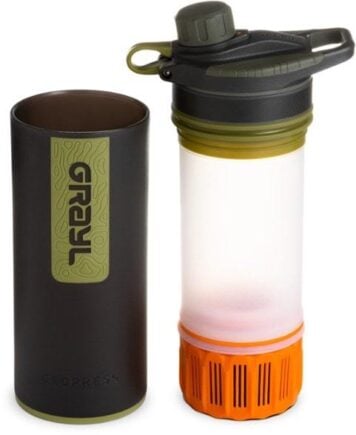
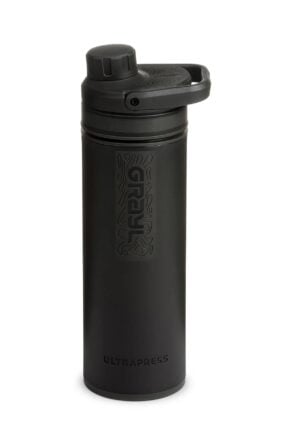
Grayl Ultrapress Purifier Bottle
- Price > $99.95 / £74.99
- Size > 24 fl oz (710 ml)
Best Of The Rest
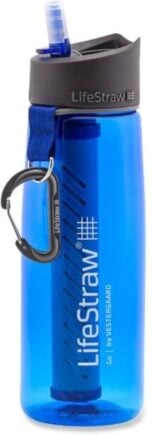
LifeStraw Go Water Bottle
- Price > $44.95 / £33.73
- Size > 22 fl oz (651 ml)
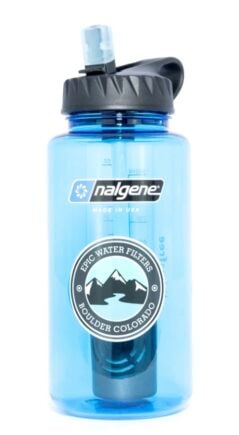
Epic Water Filters Epic Nalgene OG
- Price > $60 / £45
- Size > 32 fl oz (946 ml)
Grayl Ultralight Purifier Bottle
- Price > $89.95 / £67.46
- Size > 16.9 fl oz (499.8 ml)
Seychelle Extreme Water Filter Bottle
- Price > $45.95 / £34.46
- Size > 28 fl oz (828 ml)
Clearly Filtered No.1 Filtered Water Bottle
- Price > $65 / £48.74
- Size > 20 fl oz (591.5 ml)
Escape Glass Filtered Water Bottle
- Price > $79.95 / £60.35
- Size > 32 fl oz (946 ml)
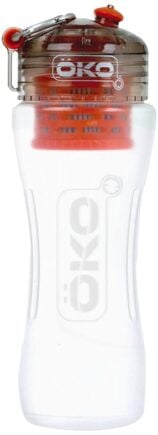
OKO H2O Advanced Filtration Water Bottle
- Price > $39.95 / £30.15
- Size > 34 fl oz (1 Liter)
Who Needs a Filtered Water Bottle?
First things first; not everybody needs a filtered water bottle.
If your travels consist mainly of city breaks and trips through countries with reliably safe tap water, I’d probably stick with a decent reusable bottle. Filtered bottles are heavier, more expensive, require replacement cartridges and, depending on the design, can make something as simple as taking a drink surprisingly laborious.
But the equation changes pretty quickly once you start travelling somewhere with questionable drinking water. If you’re backpacking through countries where tap water isn’t reliably potable, heading into remote areas, camping, hiking or filling up from natural water sources, being able to treat your own water becomes seriously useful. It can also dramatically reduce the number of plastic bottles you end up buying along the way.
I’d particularly consider one if you’re:
- Backpacking extensively through developing regions
- Hiking or camping and relying on rivers, lakes or streams
- Travelling somewhere with unreliable water infrastructure
- Heading on expeditions or into genuinely remote areas
- Trying to reduce your reliance on bottled water
- The sort of traveller who inevitably ends up somewhere they weren’t planning to go
For a two-week holiday around Western Europe? Probably unnecessary. For six months backpacking across multiple continents, trekking in the mountains and disappearing off-grid occasionally? I’d absolutely want some method of treating water in my backpack.
How Do Filtered Water Bottles Actually Work?
Despite all getting lumped together as “filtered water bottles”, they don’t necessarily work in the same way.
Many use a hollow-fibre membrane containing incredibly small pores. Water can pass through these pores while larger contaminants such as bacteria and protozoan parasites are physically trapped. Some bottles supplement this with activated carbon, which can reduce certain chemicals and improve unpleasant tastes and smells. Other systems use UV treatment, while more sophisticated purifier bottles combine multiple technologies.
How the water gets through the filter varies too. Some bottles require you to suck water through the filter as you drink, which is simple and lightweight but can seriously restrict the flow rate. Others use gravity, squeezing or pumping. Grayl takes another approach entirely: you physically press the purifier through the water first and then drink the already-treated water normally.
That’s not a minor difference. Having travelled with bottles that filter every mouthful as you drink it, I’d now pay almost as much attention to how a bottle delivers the water as I would to what its filter removes. The world’s greatest filter isn’t much use if you get so pissed off with drinking through it that you stop using the bloody thing.
What Will a Filtered Bottle Remove – And Are They Foolproof?
This is where you need to pay attention because “filtered” does not automatically mean “safe from everything.”
Different technologies deal with different contaminants. Protozoa such as Giardia and Cryptosporidium are relatively large and comparatively easy to filter. Bacteria are smaller, while viruses are smaller again and can pass through many conventional portable microfilters. The CDC specifically warns that portable filters vary considerably in what they remove and that travellers need to check the specifications of the individual product.
Then there are chemical contaminants and heavy metals, which are a different problem altogether. A filter designed to remove microorganisms doesn’t automatically remove lead, arsenic, pesticides or other chemical contaminants. Activated carbon can reduce certain chemicals, while other contaminants require different treatment technologies. Again, you need to know what your particular filter is actually certified or designed to remove.
And no, none of this is completely foolproof. Filters have finite lifespans, can become clogged and need to be used and maintained correctly. Water that is extremely cloudy or chemically contaminated presents additional problems, and simply owning a filtration bottle doesn’t magically make every disgusting puddle on Earth drinkable. The CDC’s advice where water safety is uncertain is particularly cautious: boiling remains the best method for killing germs, while filtering followed by disinfection provides another robust approach.
The takeaway is pretty simple: know what you’re buying and know what you’re drinking. There’s an enormous difference between filtering otherwise potable hotel tap water to improve the taste and scooping water out of a stagnant ditch somewhere in the Himalayas. Match the filtration system to the actual risks of your trip rather than assuming that a picture of a mountain on the packaging makes you invincible.
The Best Filtered Water Bottles
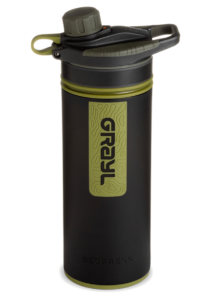
1. Grayl Geopress Purifier Bottle – Best Overall Filtered Water Bottle
- Price: $99.95 / £74.99
- Capacity: 24 oz = 710 ml = 0.71 liter
- Weight: = 450 g = 0.45 kg = 15.9 oz
- Diameter (at base): 3.4 in = 8.6 cm = 86.36 mm
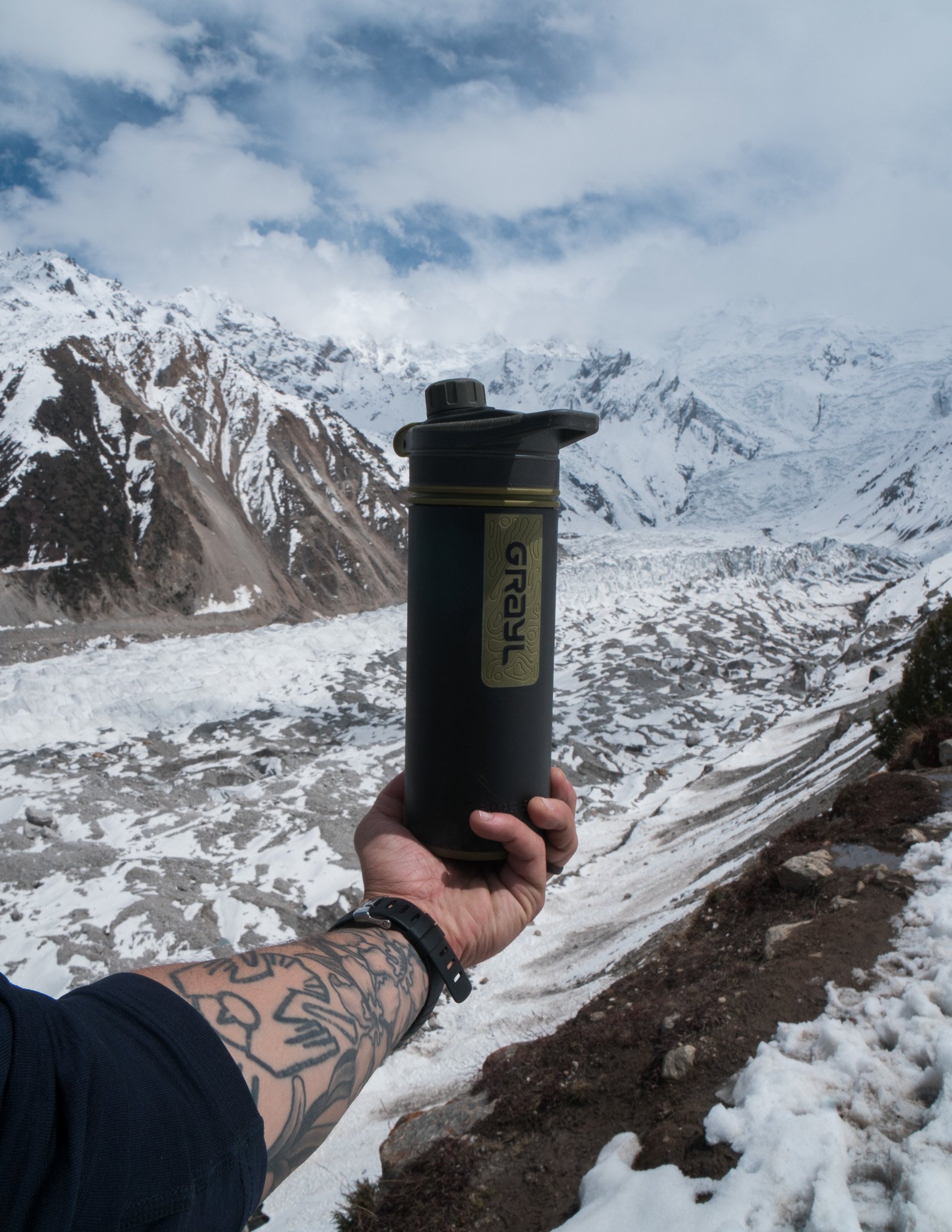
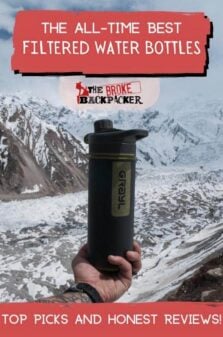
This is it: the “whoa, mama” choice. If you want the best filtered water bottle for serious travel, you could probably give up on the rest of my extremely well-written and meticulously researched article and just buy the Grayl GeoPress. It’s expensive, relatively heavy and a little over-engineered for a weekend in Paris, but when access to genuinely safe drinking water matters, this is the bottle I’d want in my backpack.
The big difference is how the Grayl actually filters water. Rather than forcing you to suck every mouthful through a restrictive filter, you fill the outer sleeve and physically press the purifier down, a bit like an AeroPress in reverse. Around 8 seconds of effort later, you’ve got purified water sitting there ready to drink normally. Having recently used filtered bottles that made every sip feel like hard work, I massively prefer this system.
And the filtration itself is serious business. The Grayl isn’t just designed to deal with the usual bacteria, protozoa and particulates; its purifier cartridge also targets viruses, chemicals and heavy metals. That’s the distinction that makes it particularly interesting for adventurous travellers heading somewhere where the water supply is genuinely questionable, rather than somebody who simply wants their hotel tap water to taste a bit nicer.
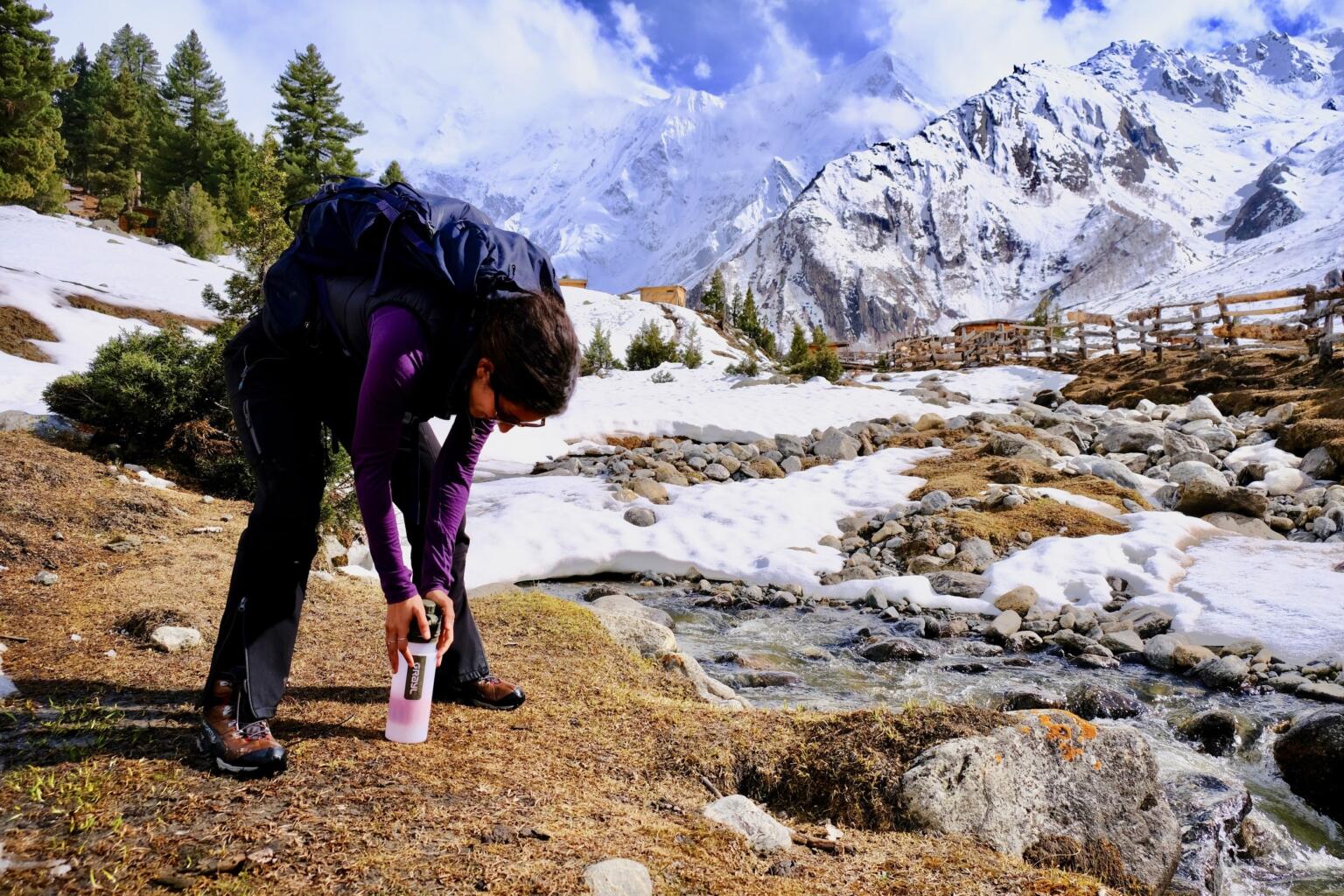
There are compromises. At roughly 710 ml (24 oz) capacity and 450 g (15.9 oz), the GeoPress is considerably heavier than a normal reusable bottle, replacement cartridges add to the long-term cost, and the initial price puts it firmly at the premium end of the market. But we’ve put Grayl purifiers through their paces on proper expeditions, including trekking in Pakistan’s Karakoram, and they’ve repeatedly delivered. For casual travel, it’s probably overkill. For places where getting the water question wrong can ruin your entire trip, it’s worth the investment.
Actually, if you’re super-serious about your water filtering, I would urge you to have a look at our in-depth review. the hold-up? You were looking for the best filtered water bottle for travel, hiking and anything else, right? Well, this is it!
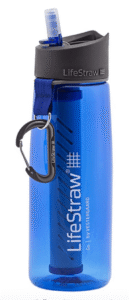
2. LifeStraw Go Water Bottle – Runner-Up for Best Overall Filtered Water Bottle
- Price: $44.95 / £33.73
- Capacity: 22 oz = 650.62 ml = 0.65 liter
- Weight: = 247 g = 0.25 kg = 8.71 oz
- Diameter (at base): 9.4 x 2.8 in = 23.88 x 7.11 cm = 238.76 x 71.12 mm
The LifeStraw Go is probably one of the best-known filtered water bottles out there, and on paper, it makes a lot of sense. Its filtration system is designed to remove bacteria, parasites and microplastics from questionable water sources, making it a potentially excellent companion for hiking, backpacking and travelling somewhere where you can’t necessarily trust what comes out of the tap.
However, after actually travelling with a LifeStraw bottle, I found one pretty major problem; drinking from the bloody thing was hard work. Because you’re pulling water through the filter as you drink, the flow rate is noticeably slower than a normal bottle. Mine reached the point where getting a decent mouthful felt like an unnecessary workout, and that’s a surprisingly big deal when this is something you’re supposed to use several times every day and use espeially when out hiking, or in hot tropical climates.
I also found it unexpectedly annoying at airports. Even when the bottle itself was emptied before security, the filter retains some moisture internally and the whole assembly repeatedly attracted attention at airport checks. It wasn’t a serious problem and filtered bottles aren’t prohibited, but it does mean I was getting flagged every time. Having to explain or pull out your water bottle every time gets old pretty quickly when you’re travelling regularly.
Ultimately, the LifeStraw Go makes most sense when water safety is genuinely a concern. If you’re heading into the backcountry, travelling somewhere with questionable tap water or want an emergency filtration option in your pack, its drawbacks may be completely worthwhile. But for ordinary travel through places with safe drinking water, I’d personally choose a normal reusable bottle and carry a separate filtration system when necessary. The LifeStraw does its job — I just didn’t particularly enjoy drinking from it.
3. Epic Water Filters Epic Nalgene OG -Best Cheap Filtered Water Bottle
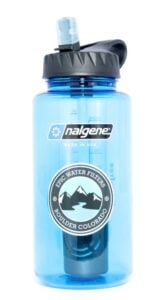
- Price: $60 / £45
- Capacity: 32 oz = 946.35 ml = 0.95 liter
- Weight: = 290 g = 0.29 kg = 10.2 oz
- Diameter : 3.5 in = 8.89 cm = 89 mm
We have all probably owned a Nalgene at some point. This Epic Nalgene OG filter bottle by Epic Walter Filters takes the same classic bottle we all enjoy up a few notches by adding the cleverly designed water filter element. Practical, easy to use, and very importantly – this bottle won’t break the bank either.
The Epic Nalgene OG uses their patented Everyday Filter system – and as the name implies – it is intended for everyday use. Like any filter bottle, the filter does not have an endless life span and the filter will need to be replaced after roughly 75 gallons (285 liters). Speaking from experience – I typically end up filtering 3-4 liters (0.79 – 1.06 gal) of water per day when I am traveling or backpacking so one filter can get me through almost two months on the road or in the mountains.
For the best budget option for hikers and backpackers on this list – The Epic Water Filters Epic Nalgene OG is a truly excellent product!
If you are going to be in countries with ultra-sketchy water sources, keep in mind the Epic Nalgene OG is not a complete purifier.
4. Grayl Ultralight Water Purifier Bottle – Best Ultralight Filtered Water Bottle
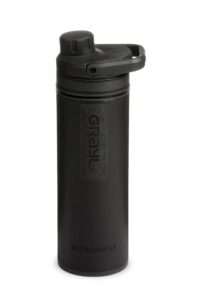
- Price: $89.95 / £67.46
- Capacity: 16.9 oz = 499.8 ml = 0.5 liter
- Weight: = 354.37 g = 0.35 kg = 12.5 oz
- Diameter (at base): 2.95 in = 7.5 cm = 74.93 mm
I told you Grayl bottles made the list twice. This is Grayl’s ultralight option for all the gram-counting fiends. It’s smaller than the Geopress holding only 16.9 fl oz (500 mL) and weighing in at 12.5 oz (354 g).
That’s about your only difference though because all of the high-quality badittude of the Geopress still carries over. The Grayl Ultralight still filters out all the terrible beasties, it’s still made of high-quality materials, and it still kicks ass.
It comes in at a lower price than the Geopress and doesn’t hurt as much if you drop it on your toe. Its lower weight and smaller frame make this the best filtered bottle for hiking and anything outdoors where the bulky choice doesn’t cut it.
The only real negative is you have to fill it up twice as much… but, oh well. You can’t have your cake and eat it too!
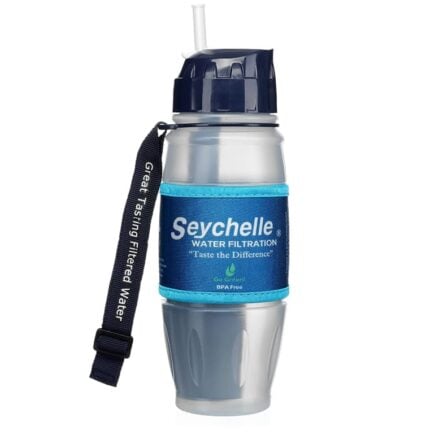
5. Seychelle Extreme Water Filter Bottle – Best Filtered Water Bottle for Extreme Conditions
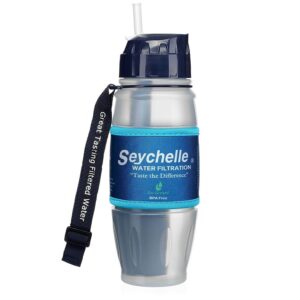
- Price: $45.95 / £34.46
- Capacity: 28 oz = 828.06 ml = 0.83 liter
- Weight: = 816 g = 0.82 kg = 28.8 oz
- Diameter (at base): 3.5 in = 8.9 cm = 88.9 mm
When I say extreme conditions, I’m mean extreme conditions. The Seychelle water filtration bottle does it all. It does your bacteria, your viruses, your protozoa, your radiological contaminants… wait, what?
Yup! On top of all the other much-needed protection, you have the extra layer against biohazards with the Seychelle water filter bottle. This one is for you, Chernobyl Exclusion Zone spelunkers.
The Seychelle Extreme Water Bottle even filters out fluoride. It really is the one-stop-shop for all your water purification needs.
The downside is the design; I mean, just look at the thing. You’d think a high-tech filtration bottle that filters out radioactive contaminants would look less like the bottle I took to school when I was seven. It’s clunky and unwieldy and coming in at 28 fl oz (828 mL) just makes it a bit more chunky than necessary.
But, I suppose, the ability to still drink clean water after the nuclear fallout crisis inevitably arrives and we’re all driving super-charged dune buggies across apocalyptic wastes is worth the added bulk.
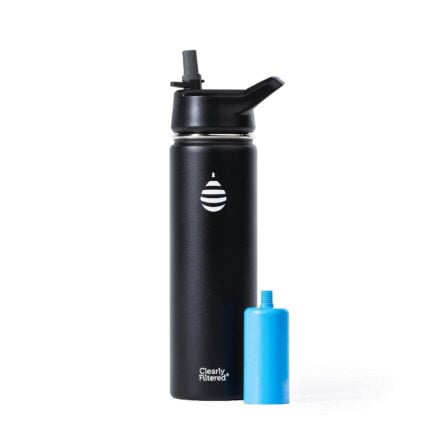
6. Clearly Filtered No.1 Filtered Water Bottle – Best Stainless Steel Filtered Water Bottle
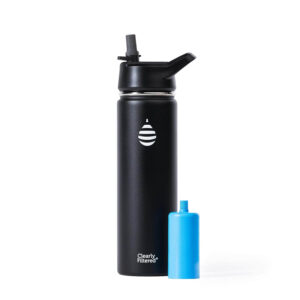
- Price: $65 / £48.74
- Capacity: 20 oz = 591.47 ml = 0.59 liter
- Weight: = 589.67 g = 0.59 kg = 20.8 oz
- Diameter (at base): 2.9 in = 7.37 cm = 73.66 mm
If life was a Jackie Chan movie where you partook in a series of increasingly zany fights using household objects as weapons, then this would be the bottle to bitchslap some generic henchman with.
It’s stainless steel: that means you’re going to have a seriously difficult time breaking it no matter how many Himalayan mountains you drop it off! That also means that the bottle has some insulation to keep your water refreshingly cool (or heart-meltingly warm) while you adventure.
The Clearly Filtered also filters out all the nasties (with a disclaimer): viruses, bacteria, and metals begone! It’s even a water bottle that filters fluoride!
So what’s not so awesome? Well, its construction just isn’t as tight as many of the other entries on this list. It doesn’t feel as well put-together as a lot of other water filter drinking bottles with the lid having some noticeable threading difficulties.
Regardless, if a stainless steel filter water bottle is your preference, the Clearly Filtered is one of the better ones out there. It’s one of the best-insulated filter water bottles you’ll find that also covers you for all the murderous organisms that are out to ruin your lactose tolerance.
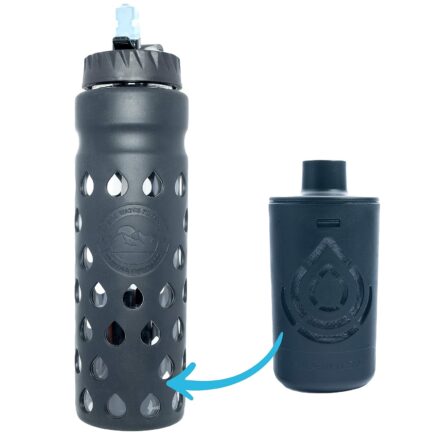
7. Escape Glass Filtered Water Bottle – Best Glass Filtered Water Bottle
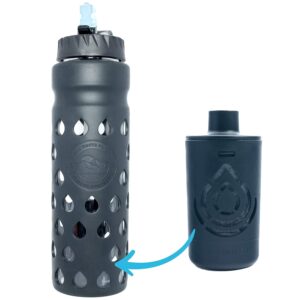
- Price: $79.95 / £60.35
- Capacity: 32 oz = 946 ml = 0.95 liter
- Weight: = 820 g = 0.82 kg = 28.8 oz
- Diameter (at base): 3.5 in = 8.9 cm = 88.9 mm
Now, mind you, I don’t know why you’d want a glass filter bottle for travelling. If we were graphing drops off Himalayan mountaintops survived by filtered water bottles, then the Escape Bottle would certainly come last.
But, it’s still a good filtration bottle that comes with all the bells and whistles you’ve come to expect from the best water purifier bottles. Replaceable filter that protects you from the whole shebang (BUT (and here’s that disclaimer), not with the stock filter; you have to buy the Outdoor filter separately), and it comes in a silicone sleeve (to counter that whole ‘made of glass’ thing). It also feels fancier to drink from because everybody knows that drinking from glass tastes better.
It is worth noting that both the Escape and Outback bottles (they’re made by the same dudes) are a hard purchase to justify. I’ve included them here for the folks who don’t want plastic but the hard truth is that for nearly the same price you could be purchasing a Grayl Geopress (the premium option), or one of the other cheaper purifier bottles on this list, and it would be a much better purchase all-round.
Still, if you’re after a glass filtered water bottle, this the choice for you.
8. OKO H2O Advanced Filtration Bottle – Best 1 Litre (34 fl oz) Filtered Water Bottle
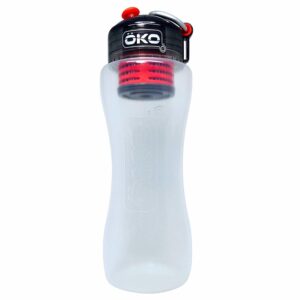
- Price: $39.95 / £30.15
- Capacity: 34 oz = 1006 ml = 1 liter
- Weight: = 240 g = 0.24 kg = 8.47 oz
- Diameter (at base): 3.5 in = 8.89 cm = 88.9 mm
Oh, so 700 ml wasn’t enough? And 800 ml wasn’t enough? The 500 ml ultralight water bottle definitely wasn’t enough then…
Well, ok, this is for you… you thirsty son-of-a-bitch.
The OKO H2O is made from NASA technology which means that you’re basically an astronaut with one of these. It’s got all you need: durable Tritan plastic (yep, back to plastic) and a filter that covers you for the worst-of-the-worst (although only reduces chemicals, fluoride, and metals present).
It’s also pretty damn lightweight for the size! It comes in at 8.47 oz (240 grams) which is good because, given its volume, you’ll probably be hanging it off your pack or belt.
Oh, on that, you don’t have to get the Papa Bear size; it comes in a Mama Bear and Baby Bear size too. That means it gets even lighter making this another good filtered water bottle for hiking and long walks into the wild.

Now, you could spend a fat chunk of $$$ on the WRONG present for someone. Wrong size hiking boots, wrong fit backpack, wrong shape sleeping bag… As any adventurer will tell you, gear is a personal choice.
So give the adventurer in your life the gift of convenience: buy them an REI Co-op gift card! REI is The Broke Backpacker’s retailer of choice for ALL things outdoors, and an REI gift card is the perfect present you can buy from them. And then you won’t have to keep the receipt. 😉
Buy on REI!Frequently Asked Questions on Water Purifier Bottles
- Do filtered water bottles filter out beneficial minerals?
Nope, you’ll be still getting all your nutrients. That said, if you’re travelling somewhere water needs a filter, it’s a good idea to drink water with the electrolyte powder added on occasion just to ensure your body is still getting the best. - Are filtered water bottles dishwasher-safe?
Some are, some aren’t. But, like, seriously… that’s a really dumb question. Like, just wash it by hand, dude. When did washing the dishes go outta vogue…? - How do I clean my filtered bottle?
Again, weird question. Soap and water, man… c’mon. - Is a filtration bottle refrigerator-safe?
The fridge is fine but I’d advise against sticking it in the freezer. Those filters are fancy tech! - How do I know when my filter needs replacing?
It can vary from filter to filter but eventually, your flow rate will slow to a crawl or stop entirely. In the case of the Grayl bottles, the pumping process will have slowed dramatically.
FAQ about the Best Filtered Water Bottles
Still have some questions? No problem! We’ve listed and answered the most commonly asked questions below. Here’s what people usually want to know:

Our GREATEST Travel Secrets…
Pop your email here & get the original Broke Backpacker Bible for FREE.
Final Thoughts on Buying a Filtered Water Bottle for Travel
Let’s start with the bit that shouldn’t really be up for debate: travel with a reusable water bottle. Buying endless single-use plastic bottles as you bounce around the world is expensive, wasteful and, frankly, pretty unnecessary in 2026.
But does that mean everybody needs a filtered water bottle? Not necessarily. If you’re travelling around countries with reliably safe tap water, a good old-fashioned reusable bottle is lighter, cheaper and usually much nicer to actually drink from. Having now travelled with filtration bottles myself, I can tell you that filters introduce their own compromises – slower flow rates, extra weight, replacement cartridges and occasionally some unwanted attention going through airport security.
Where filtered bottles come into their own is when your travels get a little more adventurous. Across huge parts of the world, drinking straight from the tap remains inadvisable, while hiking and expedition travel can leave you dependent on streams, wells and other questionable water sources. Without some form of purification, you can easily find yourself buying bottled water every day anyway – somewhat defeating the environmental point of carrying a reusable bottle in the first place.
That’s why I still think a good filtered water bottle is one of the smartest investments for serious travellers. Just buy one that matches the way you actually travel. You don’t necessarily need an expedition-grade purifier for a European city break, but if you’re heading off-grid, travelling long-term or regularly visiting places where the water is questionable, proper filtration can save money, cut plastic waste and potentially save you from several deeply unpleasant days spent within sprinting distance of a toilet.
So, no, I’m not going to call you a dillweed if you don’t buy one. But if your adventures regularly take you beyond reliably drinkable tap water, I’d absolutely make room for one in the backpack. Take nothing but photographs, leave nothing but footprints – and preferably don’t leave behind 47 empty plastic bottles either.





Luuuv your Attitude!
Great info.
Just letting you know that Epic Water is now including a everywhere filter with their Escape bottles.