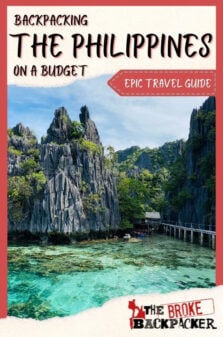
With seven thousand islands to explore, backpacking the Philippines is a different experience from travelling around the rest of South East Asia. The Philippines is a vast country stretching across the North Pacific Ocean; a land of pirates and smugglers, ancient tribes and mysterious jungles, active volcanoes and chocolate hills, epic parties, and uninhabited islands. In short: the Philippines is freaking magical to traverse.
Cheap beer, beautiful beaches, adrenaline pumping activities and some of the most friendly, genuine, people in all of Asia; the Philippines truly captured my heart. I made some incredible friends in the Philippines and I have to say, it is one of the easiest countries in the world to travel around as the locals are so friendly.
I got off my latest trip to the Philippines in 2025 and covered a surprising amount of ground in that time. From Palawan, Cebu all the way to Siargao, I’ve had some pretty epic highs, surprising lows and lived to tell the tale.
So amigos, this comprehensive guide to backpacking the Philippines gives you everything that you could possibly need to ace this country and have the time of your life. Let’s dive in.
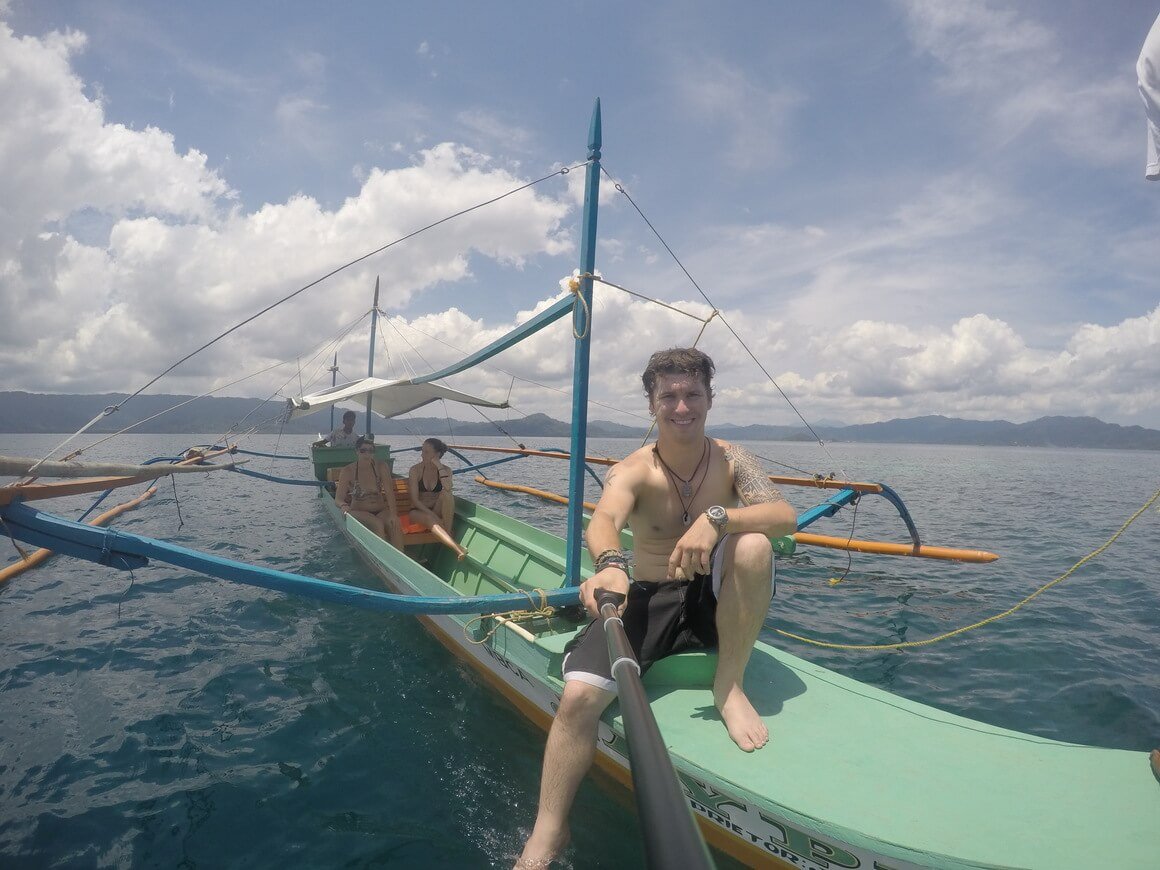
Photo: Will Hatton
The Broke Backpacker is supported by you. Clicking through our links may earn us a small affiliate commission, and that's what allows us to keep producing free content 🙂 Learn more.
Philippines in 60 Seconds
- Best island to start with: Siquijor
- Best 2-week route: Coron, El Nido, Puerto Princesca, Balabac
- Best 3-week route: Siquijor, Pangalo/Bohol, Moaboal, Coron, El Nido, Port Barton, Puertp Princesa
- Best 1-month route: La Union, Moalboal, Malapascua, Panglao, Siquijor, Siargao
- Daily budget reality: $40-50 a day
- Biggest first-timer mistake: Booking flights last minute!!!
- When to book ahead: In high season and holidays like Christmas and Easter
- Best time to visit: December to February
- Biggest safety risk: (traffic + motorbikes…) Weather can get extreme fast here. Keep up to date with storm and typhoon warnings.
- Budget killer #1: Not having accommodation and travel booked in advance
- Budget killer #2: Travelling in high season
- Budget killer #3: Eating only Western food
- Must-have app: Grab
Is the Philippines Worth Backpacking?
Abso-bloody-lutely. What I loved most about the Philippines is knowing you can spend your lifetime here and never truly see it all. With thousands of islands to choose from, you’ve got beaches, diving, hiking, mountains and pockets of culture to explore that don’t even know exist yet!
Saying that, my trip through the Philippines wasn’t always easy sailing (quite literally). Getting from A to B was sometimes a headache to work out, not to mention the costs involved for last-minute travel when unforeseen circumstances like weather change your plans unexpectedly.
Who will love it:
- Beach bums.
- Those willing to travel to get off the beaten path.
- Diving fanatics.
- Culture junkies. The warmth and hospitality of Filipinos is unmatched!
- Those who share a die-hard love of karaoke <3
Who might not:
- Those wanting to avoid long travel days.
- Ultra budget backpackers looking to spend a little dolla as poss!
- Dog lovers. Seeing the state of some of the street dogs here really broke my heart.
- Those not a fan of crowds but only stick to the tourist hotspots.
- Foodies (potentially controversial, I know…but Filipino food was my least favourite in SEA).
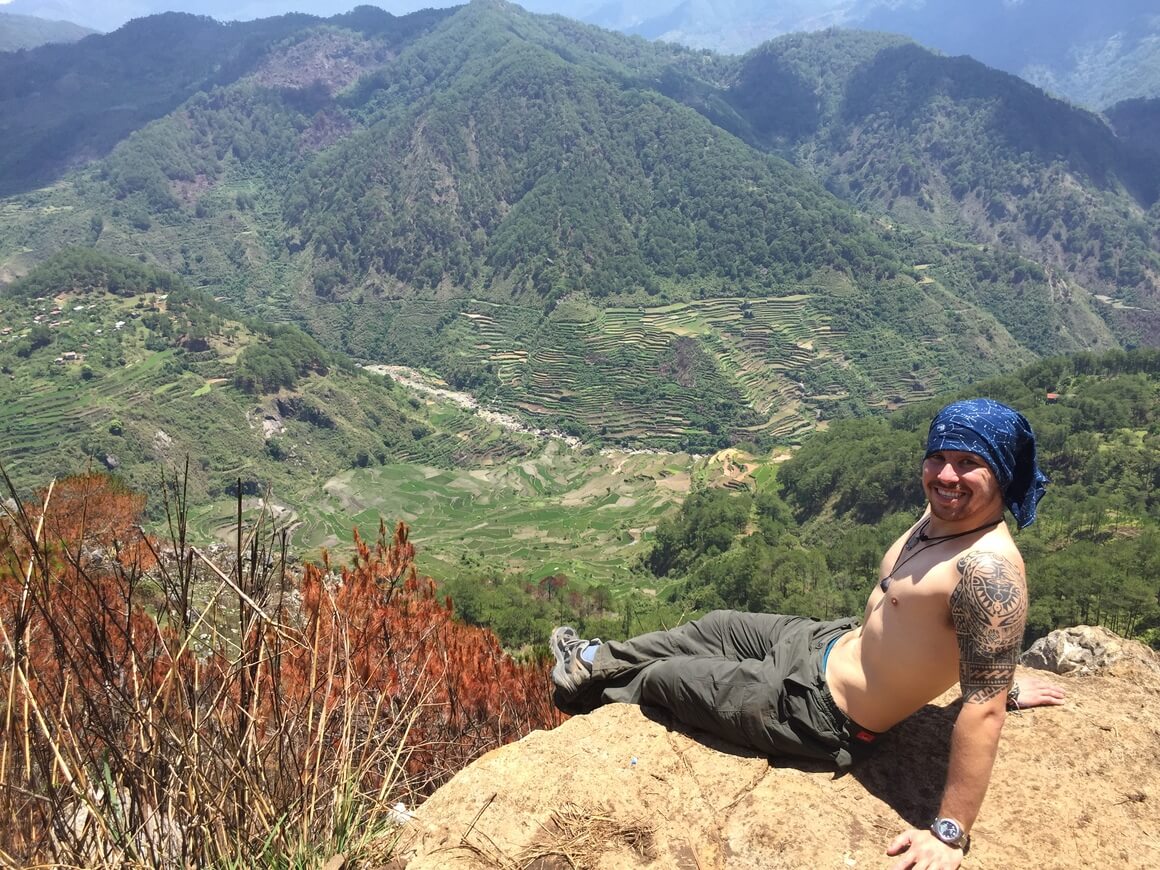
Photo: Will Hatton
- Backpacking the Philippines Routes & Itineraries
- The ULTIMATE Philippines Tour
- Backpacking Costs in the Philippines
- Best Places to Visit in the Philippines
- Getting Off the Beaten Path in the Philippines
- Top Things to Do in the Philippines
- Accommodation in the Philippines
- The Best Time to Travel to the Philippines
- Safety, Scams & Common Backpacker Mistakes
- How To Get Into The Philippines
- How To Get Around the Philippines
- Culture, Food & What to Expect From Locals
- What to Pack for the Philippines
- Working, Volunteering & Long-Term Travel
- What’s New for Philippines Backpacking Trips
- What I’d Do Differently Next Time
There’s no right way to backpack the Philippines – there are just too many islands to have a clear cookie-cutter itinerary everyone follows. SAYING THAT, these itineraries are a good place to start if you feel a little in over your head. Use them as a basis for your research and add and remove places as you wish amigos!
10-Day Travel Itinerary
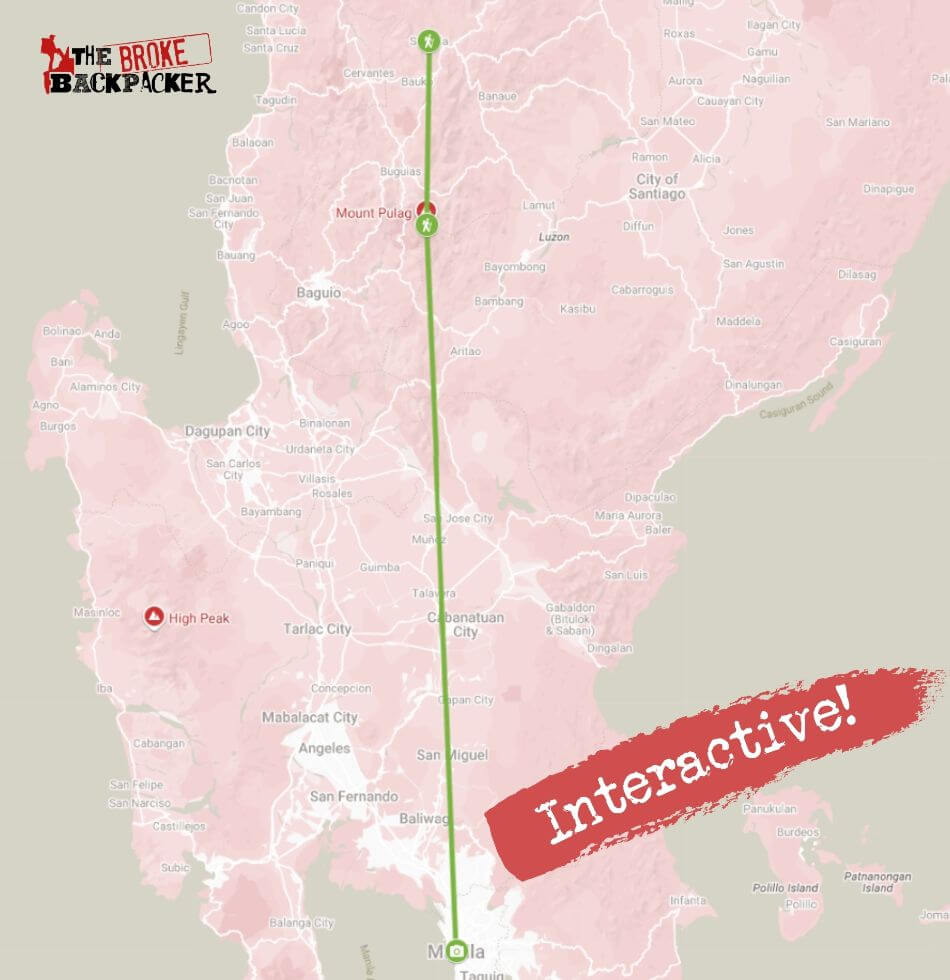
While most people head south for Palawan, consider this adventurous 10-day itinerary if you’re in search of mountains rather than island hopping.
- Stop 1 – Manila. Start your trip to the Philippines by staying in the capital, Manila. It’s an urban metropolis that many backpackers can’t get their head around, so many choose to head straight from the airport.
- Stop 2 – Mt Pulag. From Manila, you can take a six-hour bus journey to the legendary Mt Pulag and the truly stunning sea of clouds. Not quite a mountain, the trek to the summit is typically done over two days and is very, very easy.
- Stop 3 – Sagada. Next up, you’ll be taking a four-hour bus journey towards some non-stop adventure. Go hiking and camping in the hills, try your hand at rock climbing, visit Bokong Falls or the eerie hanging coffins – a local tradition. For even more of an adrenaline rush, make sure to go caving and spelunking in the surrounding caves.
3-Week Travel Itinerary
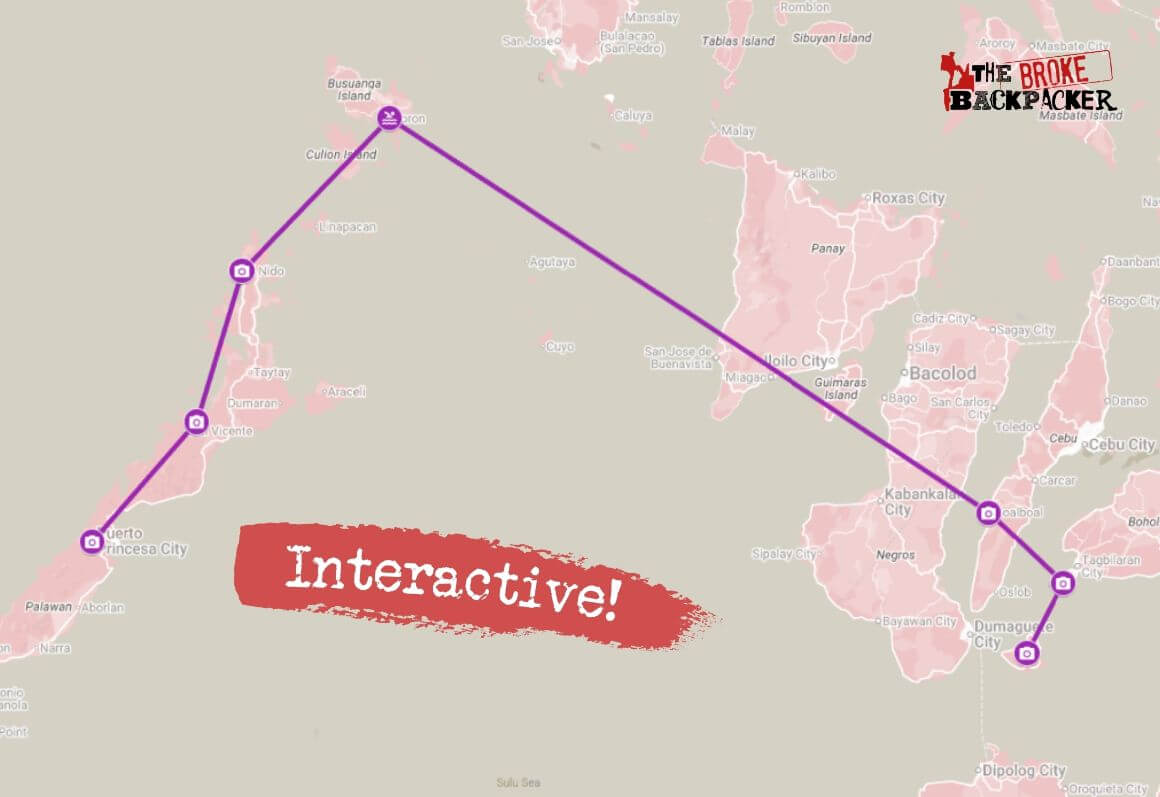
Buckle up, this was my personal itinerary so I’m biased towards it, of course. I’m a slower traveller so I took my sweet time, but if you only have three weeks, feel free to go full steam ahead! If this seems too heavy on the stops, you can get rid of Moalboal as it requires the most to-ing and fro-ing from Cebu.
- Stop 1 – Siquijor. Get here by flying to either Cebu and getting a bus and ferry or forking out a little extra to fly to Dumaguete and getting a shorter ferry. Siquijor is a MAGICAL island, so much so that resident TBB editor Dani spent over a month here. I don’t blame her.
- Stop 2 – Panglao/Bohol. Get the ferry over to Bohol and either stay here or take a jeepney over to Panglao to continue the beach vibes. You’ve got the famous chocolate hills, waterfalls, and tarsiers to discover in Bohol. Meanwhile, backpacking in Pangalo means beach bum life with the occasional sprinkle of snorkelling and diving.
- Stop 3 – Moalboal. Get the ferry up to Cebu, then take a bus down to Moalboal. Famous for the sardine run, you’ll have the chance to be enveloped by literal thousands of sardines just a few metres from the shore.
- Stop 4 – Coron. Head back up to Cebu and fly to Coron. The region is famous for its WWII wreck diving. If that doesn’t fully satiate your diving appetite, take a day or two to explore the nearby Apo Reef as well. You can also check out other islands off the beaten path, like Culion Island and Busuanga Island. From what I’ve heard, it’s one of the most beautiful places in Philippines with nothing but huts, crazy beaches and diving.
- Stop 5 – El Nido. From Coron, you can either embark on a three-day expedition to El Nido or take the bog standard ferry that takes a couple hours. My favourite place in Palawan, island hopping is the aim of the game here. If you’re not on a boat most of the time in El Nido, you’re doing something wrong.
- Stop 6 – Port Barton. This is where you’ll get a glimpse into true local living in Palawan. Hop on a boat tour and visit sandbanks, snorkel along reefs and drink a tad too much rum.
- Stop 7 – Puerto Princesa. This is the final stop </3 You’ll either fly to Manila or you can linger and go on a tour to explore the underground rivers in the region. It’s one of the seven wonders of the natural world. Pretty cool, huh?
1 Month Travel Itinerary
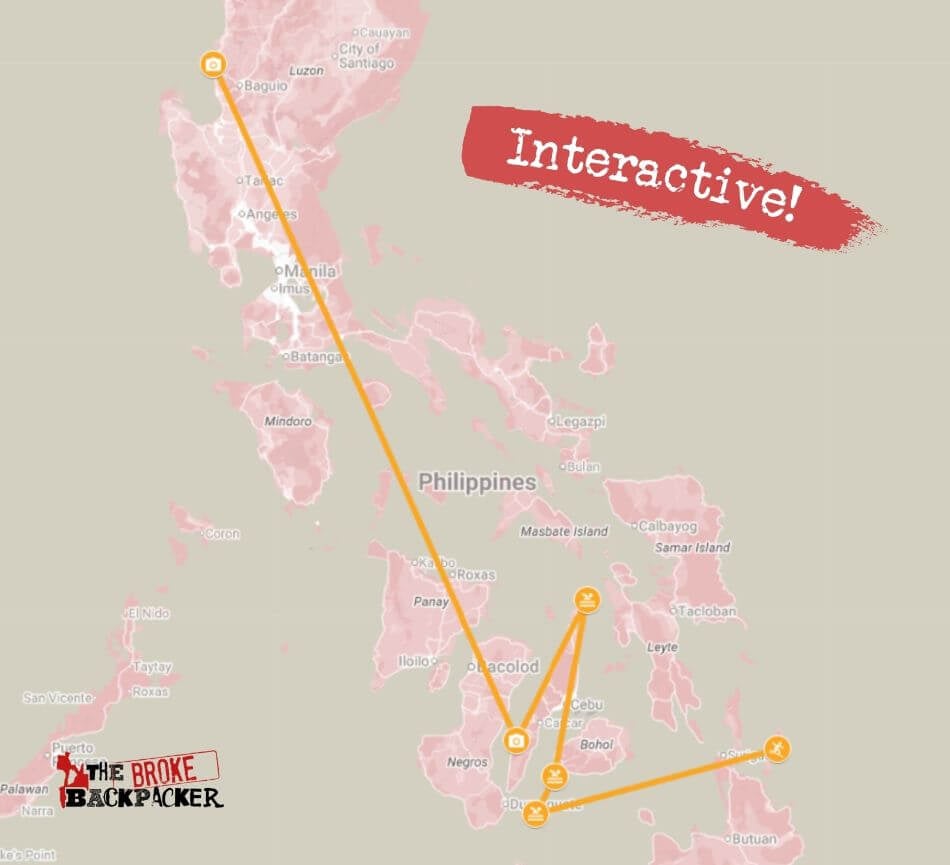
This one is for the surfers and divers. You can easily spend a month in Siargao alone, so feel free to tweak this depending on whether you want to chase epic breaks or play mermaids.
- Stop 1 – La Union. 2-3 hours north of Manila by bus and a world away from it. You’ve got beach, reef, and point breaks for every level, so pick your poison and get stuck in.
- Stop 2 – Moalboal. Head back to Manila, fly to Cebu and head south to Moalboal. The famous Sardine Run will headline the lineup of dives to be done here, though the reefs are epic in their own right.
- Stop 3 – Malapascua. Head north from Moalboal to tick off a big bucket list moment in the Philippines for many divers – seeing the elusive thresher shark.
- Stop 4 – Panglao. Another diving hot spot with some great dive schools – check out our TBB favourite, Diving Squad. You can also hike in the famous chocolate hills here, and motorbike around the area with ease.
- Stop 5 – Siquijor. Apo Island is the main event for diving here, but there are tons of epic sites to sink your teeth into.
- Stop 6 – Siargao. Bored of diving? Good, because you’ve arrived in the mecca of surfing. Emblematic of a mini Bali, but so, so much cooler.
The ULTIMATE Philippines Tour
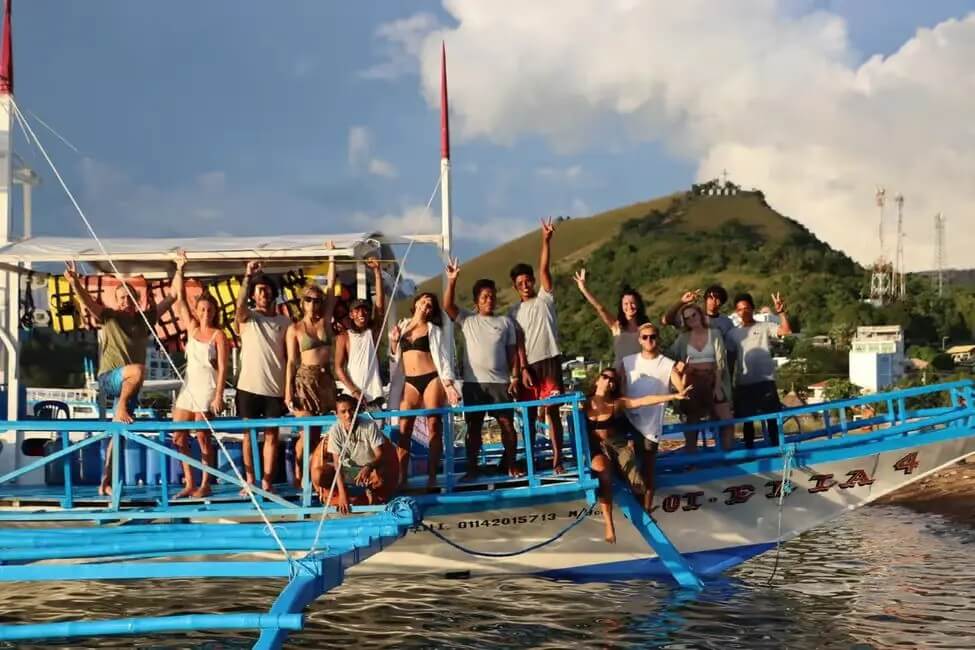
If you want the logistics to be sorted for you, the best option is to book a tour. I went on this Best of the Philippines, Manila to El Nido last year and it was without a doubt one of the highlights of my travels. Whether you’re new to travel or just want a trip with all the fun and none of the admin… this one is epic!!
- Number of days: 10 Days
- Group Size: Max 16, avg 14.
- Fitness required: Light
- Accommodation type: Comfortable tourist-class
Backpacking Costs in the Philippines
You can travel to pretty much anywhere in South East Asia and get by on a broke backpacker budget, and the Philippines is no exception. BUUUUT, I have to say, this country bled me dry more than others.
It’s not to say that the Philippines cannot be done on a budget, but factor in travelling over major holidays and unforeseen itinerary changes, and your budget can go out the window FAST. A last-minute flight here, a splurge hostel there, and it’s safe to say I was feeling the definition of rinsed.
Luckily, there are so many ways to bring your cost per day back down if, you too, have to swallow the Traveller Tax every now and then. And who cares if you’re drinking a beer from the mini mart when you’re in literal paradise?!
Daily Budget Ranges
| Expense | Broke Backpacker | Frugal Traveller | Creature of Comfort |
|---|---|---|---|
| Accommodation | $10-20 | $20-35 | $40+ |
| Food | $5-10 | $11-20 | $20+ |
| Transport | $5-10 | $11-15 | $20+ |
| Nightlife Delights | $2-10 | $11-15 | $15+ |
| Activities | $0-15 | $10-30 | $40+ |
| Total per day | $22-65 | $63-115 | $135+ |
This is based on a month-long trip. If you’re passing through for less/more than this, expect your transport costs to fluctuate!
Why Your Budget Will Never Quite Go to Plan
Ferries are cheap in theory and unpredictable in practice. A slow boat from Cebu to Siquijor costs next to nothing. A fast ferry between El Nido and Coron costs $20-30 and runs when it feels like it. Miss one, and you’re either paying through the nose for a last-minute flight or haemorrhaging money on an extra night’s accommodation you didn’t budget for. Build in buffer days and buffer cash.
Then there’s high season. December through April is peak time across most of the islands, and prices becomes eyewaterings vs the rest of the year. The statregy for this is simple – book ahead or prepare to overpay.
Where You’ll Blow Your Budget Without Noticing
Island hopping tours. They look like a bargain when you’re standing on the beach being promised ‘best price’. Then you add the environmental fee. Then the kayak rental. Then the cheeky remote-island beers you definitely paid too much for. It all tallies up very quickly, especially if you’re doing back to back tours.
Where It’s Surprisingly Cheap
Food, if you eat like a local. A carinderia plate of rice and adobo will set you back $1.50-2. Street food snacks are pocket change. This is where you can really claw back your budget if you keep your eye on the local joints.
And of course, not all activities have to be expensive boat tours. Some of the best things to do in the Philippines are free! Grab your snorkel, drive to a bay and there you have an easy afternoon spent without spending a penny. Some beaches and waterfalls ask for nothing, other iconic experiences like the sardine run in Moalboal will only set you back a couple of dollars. Jam-packed days don’t have to equal money spunked!
And beer. San Miguel is one of the cheapest decent beers in Southeast Asia. At PHP 35-50 a bottle from a mini mart, your sunset plans turn a LOT cheaper than the usual cocktail at a beach club.
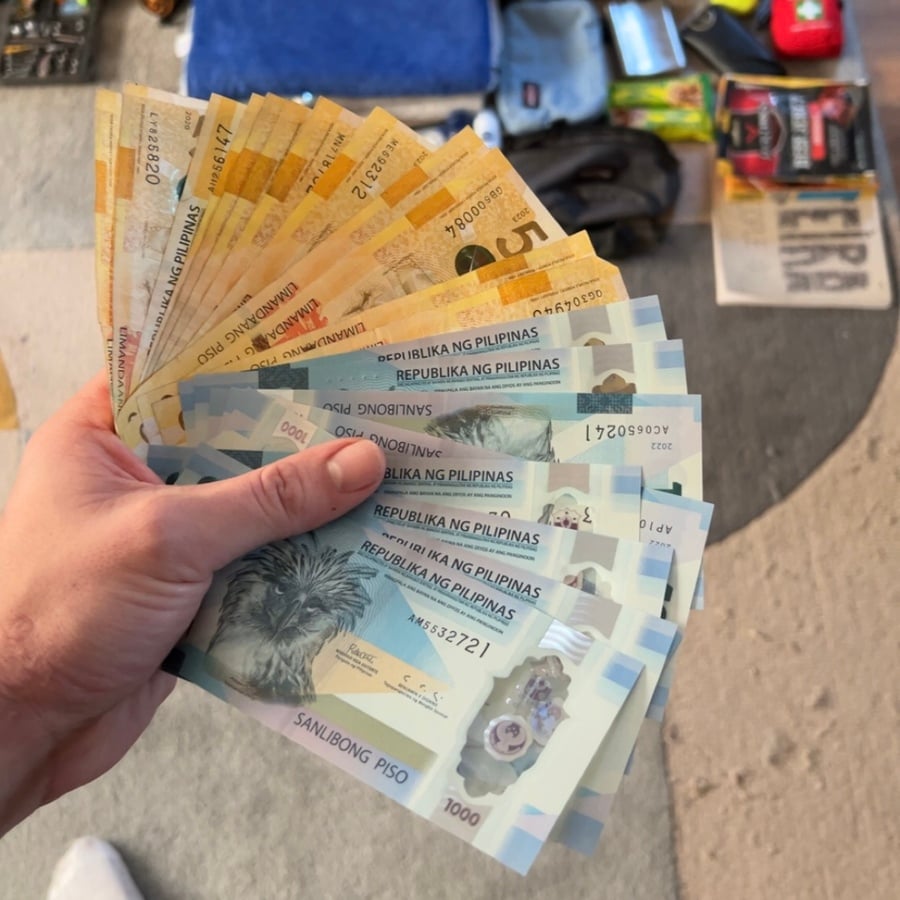
Photo: @joemiddlehurst
How to Save Money in the Philippines
- Haggle: Haggling is fun and totally normal in the Philippines. You can practice your skills across markets, tricycle rides, and small independent vendors, especially in tourist-heavy spots like El Nido and Boracay. Keep it light, keep it respectful, and have fun!
- Eat the Street Delicacies: Not only is it delicious, weird and wonderful but it’s damn cheap. Avoid the overpriced tourist restaurants and go where the locals go.
- Ride the Jeepneys: One of the cheapest ways to get around the Philippines, especially in the cities. It is also the most fun if you’re on top. Save your cash on private taxis and climb aboard!
- Slow Down the Island Hopping: This is where budgets go to die. Flights between places like look cheap at first glance, then you add baggage and taxis and suddenly you’ve burned a week’s budget in one travel day. Staying longer in each place cuts transport costs massively and lets you actually enjoy where you are instead of constantly packing and unpacking. Slow travel for the win!
- Book Tours Locally, Not Online: Online prices are padded for convenience. Turning up in places like Coron or El Nido and booking directly with local operators almost always lands you a better deal.
- Split Costs Whenever Possible: Boats, tricycles, private vans – a lot of things are priced per vehicle, not per person. Teaming up with other travellers slashes costs instantly.
Figuring out where to stay in the Philippines? Avoid the headache and check out the backpacker hotspot so you can start to devise your game plan.
Manila: Complete Urban Chaos
- Best for: Nightlife, history
- Budget vibe: Mid – cheap stays exist, but transport, food, and late nights add up fast
- Time needed: 1–3 days
- Getting there: Main international hub via Ninoy Aquino International Airport
- Don’t miss: Fort Santiago, National Museum of the Philippines, nightlife in Poblacion
- Skip if: Big cities drain your soul fast
- Overrated: Spending your whole trip here
- Where to base: Most hostels are concentrated around Makati
- Anything else: Traffic is brutal, distances lie, and ‘just around the corner’ rarely means what you think it means
Chances are, your Philippines backpacking route will begin in Manila. A bustling metropolis, Manila is filled with vibrant neighbourhoods to explore, fancy shopping malls, trendy bars, beautiful people, and fancy restaurants. The wealthy and the poorest live next door to each other and it can be pretty shocking for first-time travellers.
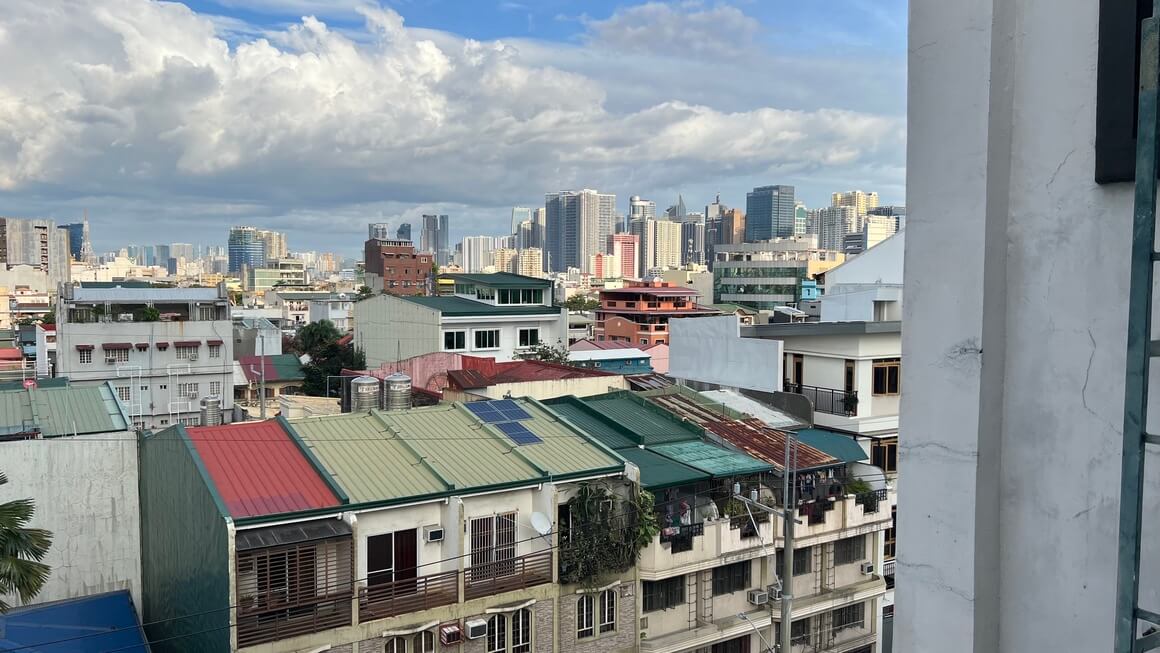
Photo: @joemiddlehurst
My advice:
- Party with the locals. If you want to party and meet lots of locals, Manila is a good place to start. While a bustling capital, Manila is still safe to visit and an awesome place to let loose a bit. It’s also the perfect hub to fly anywhere you want domestically in the Philippines!
- But…get out ASAP. I only spent a few days exploring Manila once landing, and a few more when I had to pass through on my way to my first island. There’s plenty to do in Manila, but ultimately get out as soon as possible and spend your time exploring the real reason why you’re here, and that certainly ain’t Manila.
Places to check out
- Fort Santiago. The Fort guards the entrance to the Pasig River with an oasis of gardens, plazas and fountains leading to its arched gate and lily pond. Explore the fort inside and even head down to the creepy cell blocks or relax in the museum. It’s essentially a shrine to the Philippines national hero, José Rizal.
- National Museum of the Philippines in Manila. Since 1998, the National Museum has been restoring and safeguarding important cultural values, sites and reservations throughout the Philippines. Super interesting and chilled, and perfect for those history nerds like me!
 Find the best areas in our Where To Stay in Manila Guide.
 Plan your perfect Manila Itinerary.
 Find a bed in our Hostels in Manila post.
 Why not rent your own pad? Check out Manila Airbnbs.
Mt Pulag: For the Adventure Junkies
- Best for: hiking, sunrise views, nature
- Budget vibe: mid – permits, guide fees, and transport add up, especially if booked as a package
- Time needed: 2–3 days
- Getting there: Bus from Manila to Baguio, then onward to the jump-off point
- Don’t miss: sunrise above the clouds, stargazing, summit views
- Skip if: early mornings and cold temperatures sound like a personal attack
- Overrated: expecting a hardcore trek
- Where to base: Baguio
- Anything else: guides and permits are required, and temperatures at the summit can drop surprisingly low
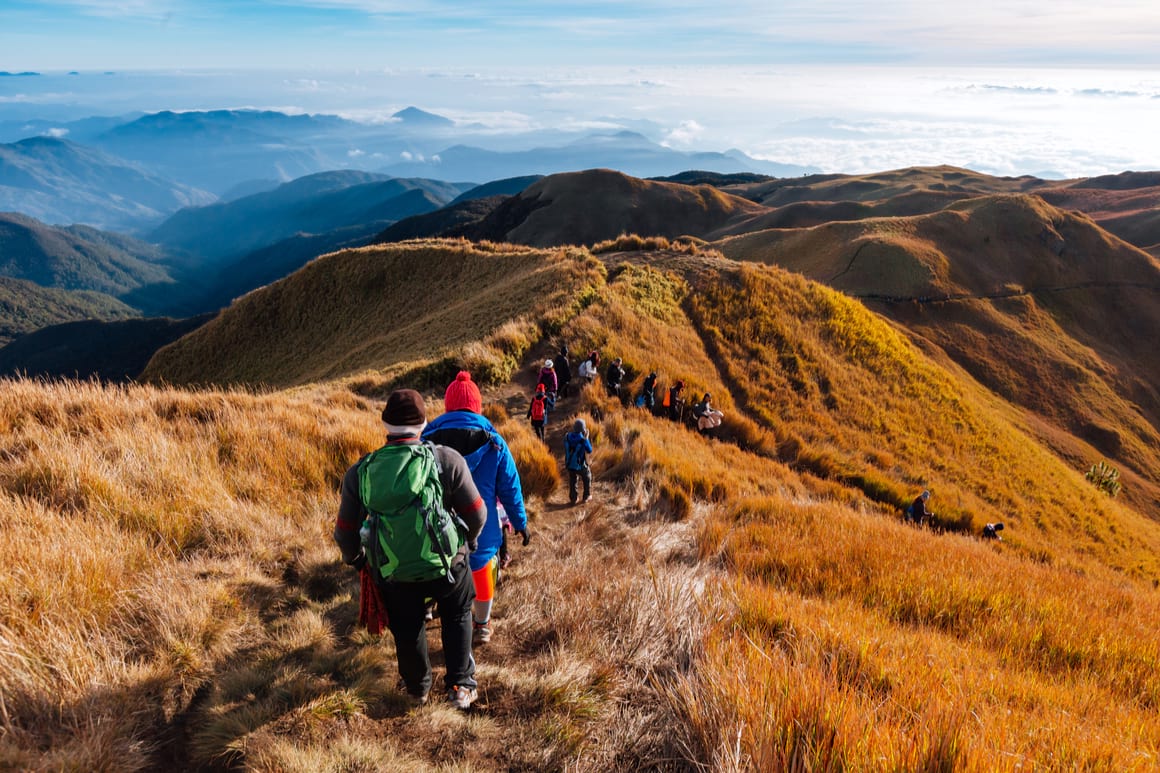
A six-hour bus journey from Manila is the legendary Mt Pulag, and the truly stunning sea of clouds. Not quite a mountain, the trek to the summit is typically done over two days and is very, very easy. Marked by clear trails and signs, you’d have to be really trying to get lost. Mount Pulag attracts hikers from all over the world.
The third-highest peak in the Philippines, standing at 2,922 metres above sea level, you know it’s going to offer some epic views at the top. You are technically ‘not allowed’ to hike this mountain without a guide. I booked my Mt Pulag trip through Travel Cafe, the cheapest and best tour guides out there. You’ll likely need to base yourself in nearby Baguio for at least one night or you’re going to be knackered! Thankfully, there are some great Airbnb’s in Baguio where you can rest up.
Sagada: Misty Mountains and a LOT of Caves
- Best for: adventure, hiking, offbeat travel
- Budget vibe: mid – guides are required for most activities, but daily costs stay low
- Time needed: 2–4 days
- Getting there: Bus from Baguio or overnight from Manila
- Don’t miss: caving, Hanging Coffins, mountain hikes
- Skip if: tight spaces and getting muddy sound like a nightmare
- Overrated: expecting luxury or easy access
- Where to base: Sagada town centre
- Anything else: guides are mandatory for most activities and organised at the local tourism office
Sagada is a four-hour bus ride from Baguio or overnight from Manila. Welcome to the adventure capital of the Philippines! This is hands down one of my favourite places I explored in all of the Philippines. Sagada has everything, from relaxed day hikes into the hills, advanced treks into the mountains, and for the adventurous, caving. Travelling to and exploring Sagada’s secrets is a recommendation for anyone visiting the Philippines.
Places to check out
- Crystal Cave. An explorer’s paradise. Spend the day squeezing through tight black holes, climbing raging waterfalls, abseiling further into the darkness before being led into another chamber filled with mammoth crystal formations.
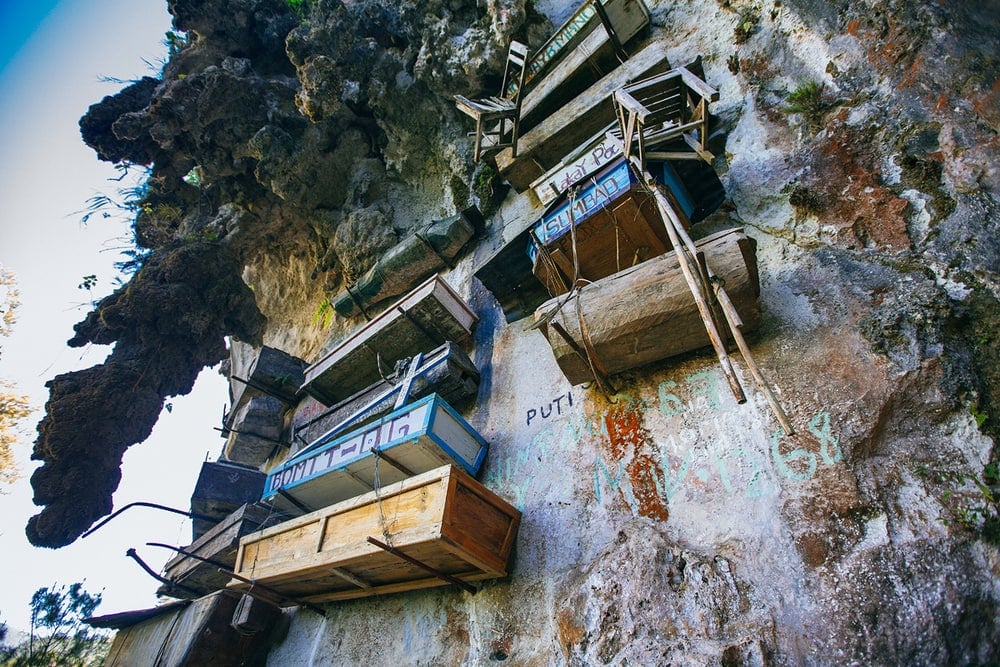
- Echo Valley and the Hanging Coffins. Want creepy and cool? This will be right up your alley. Paganism was the prominent religion before the 20th century, and Filipinos believed the dead had to be close to the gods to help reach their final resting place. So, instead of being buried in the ground, coffins were secured to the sides of mountains.
- Take to the hills and hike for an afternoon. My favourite thing to do in Sagada. The trails are so quiet I could venture for a day and see no one, having the countryside all to myself! Stunning views, great weather and deserted trails were the only reasons I needed to venture out to the wilderness.
I spent a lot of time staying in the Sagada area, and I recommend it to everyone backpacking the Philippines who wants to escape the tourist trap. Those looking for adventure should head here.
Puerto Princesa: Palawan’s Landing Pad
- Best for: transit stop, underground river, Palawan entry point
- Budget vibe: mid – cheap stays available, but tours and transport add up
- Time needed: 1–2 days
- Getting there: Flights into Puerto Princesa International Airport
- Don’t miss: Puerto Princesa Subterranean River National Park
- Skip if: you’re chasing beaches and island vibes
- Overrated: the city itself
- Where to base: near the airport or city centre for easy onward travel
- Anything else: most people pass through on the way to El Nido or Coron
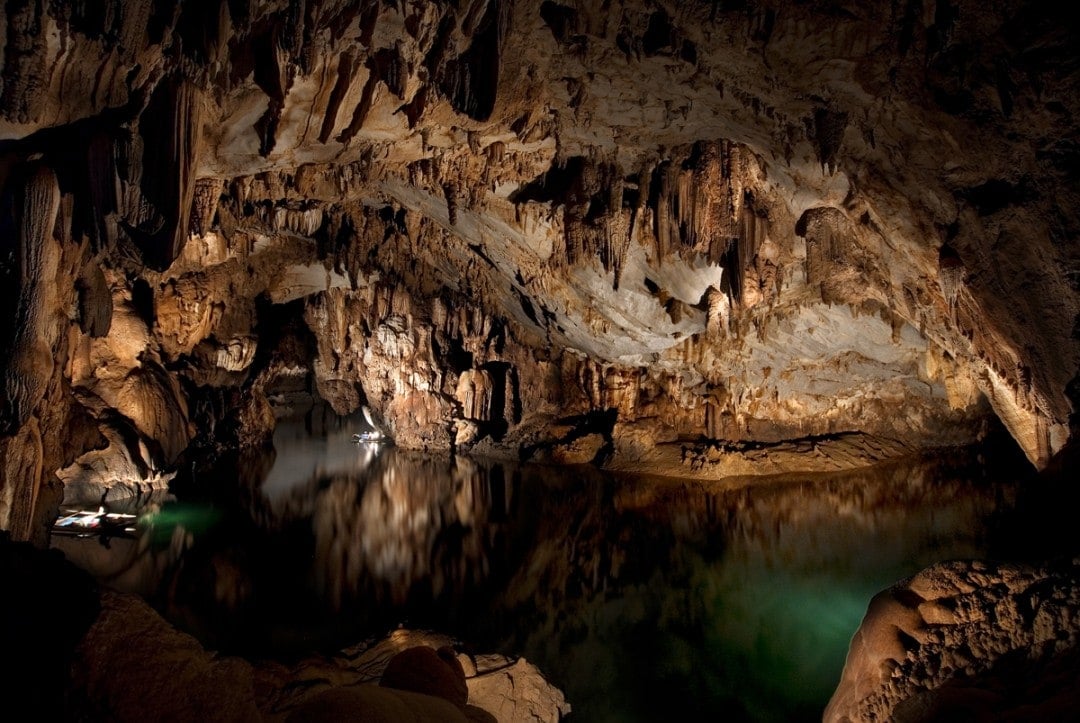
If you’re touching down in Palawan, you might find yourself passing through Puerto Princesa at some point. There’s only one real thing to see here: the underground river. It’s one of the seven new natural wonders of the world, so it’s certainly worth checking out if you care and have the time. Floating underground, blue water and waterfalls were just incredible, but the number of people that flock here didn’t make me want to hang around for long…
Puerto Princesa itself is a bit of a concrete jungle. While backpacking in Palawan I used it as a base to get to the national park and islands nearby. Unless you are a massive foodie (good restaurant culture here) move on quickly…
Port Barton: A Slice of Local Life
- Best for: chilled beaches, island hopping, off-grid vibes
- Budget vibe: cheap–mid – one of the cheaper placest in Palawan for affordable stays, tours and boat trips
- Time needed: 2–4 days
- Getting there: Bus or van from Puerto Princesa or El Nido
- Don’t miss: island hopping, beach camping, sunsets
- Skip if: you need fast WiFi or constant entertainment
- Overrated: expecting luxury or polished infrastructure
- Where to base: Port Barton town beach
- Anything else: roads are improving, but getting here can still be rough
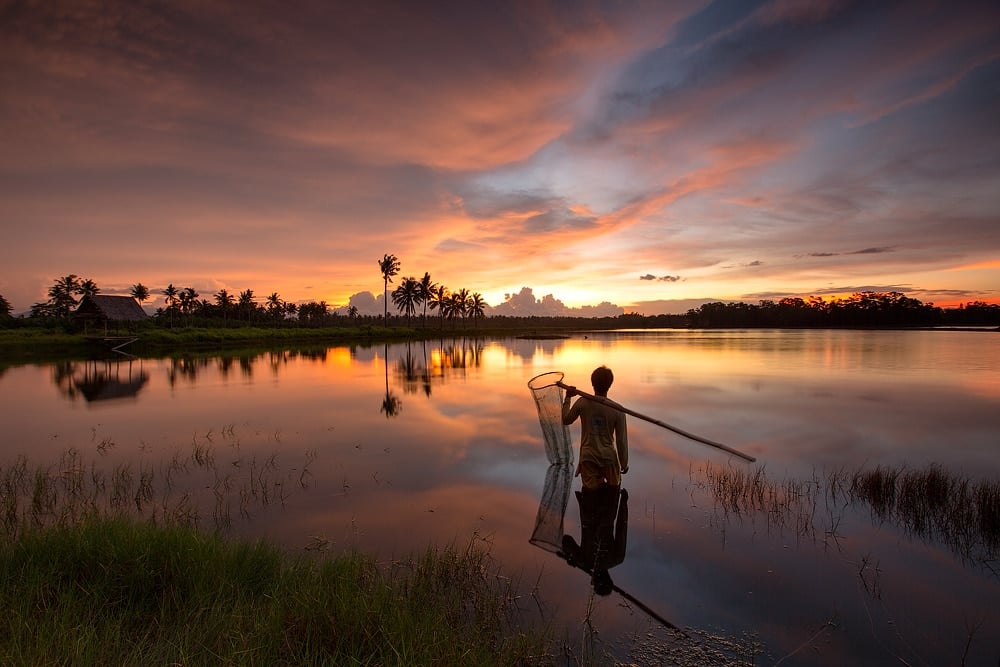
Port Barton still delivers that laid-back, under-the-radar feel, even as the rest of Palawan keeps developing around it.
It’s a small fishing village with limited infrastructure, fewer crowds, and a slower pace that makes it easy to settle in. Getting here isn’t as rough as it once was, with road improvements making the journey more manageable, but it still takes time and patience. That slight inconvenience is exactly what’s kept it from going full tourist mode.
Back on land, things are super low-key. Days revolve around the beach, short trips to places like White Beach, and long, slow meals. Evenings don’t try too hard, usually just food, a couple of drinks, and calling it early. There’s a noticeable shift starting to happen, with nearby areas like San Vicente seeing more development, so this version of Port Barton won’t last forever. For now, it still hits that sweet spot between accessible and low-key.
El Nido: The Poster Child of the Philippines
- Best for: island hopping, beaches, social vibe
- Budget vibe: mid–pricey – tours, accommodation, and fees stack up fast
- Time needed: 3–4 days
- Getting there: Van or bus from Puerto Princesa, boat from Coron
- Don’t miss: island hopping tours, lagoons, snorkelling
- Skip if: crowds and rising prices kill the vibe
- Overrated: expecting a hidden paradise
- Where to base: El Nido town or Corong-Corong
- Anything else: book accommodation early in high season and expect environmental fees
El Nido is one of the most popular spots for those backpacking in the Philippines to visit. The beaches are known for their epic parties, white sand, and blue waters; everybody ends up visiting El Nido one way or another…
Postcard-perfect views can only be enjoyed if you manage your expectations. It’s one of the most developed and popular spots in the Philippines now, which means higher prices, standardised tour costs, and environmental fees built into the experience. Accommodation fills quickly, especially in peak season, so turning up without a plan can leave you paying more than expected.
El Nido still delivers on the quintessential Philippines scenery. Just go in knowing you’ll be sharing the experience and paying a bit more for it.
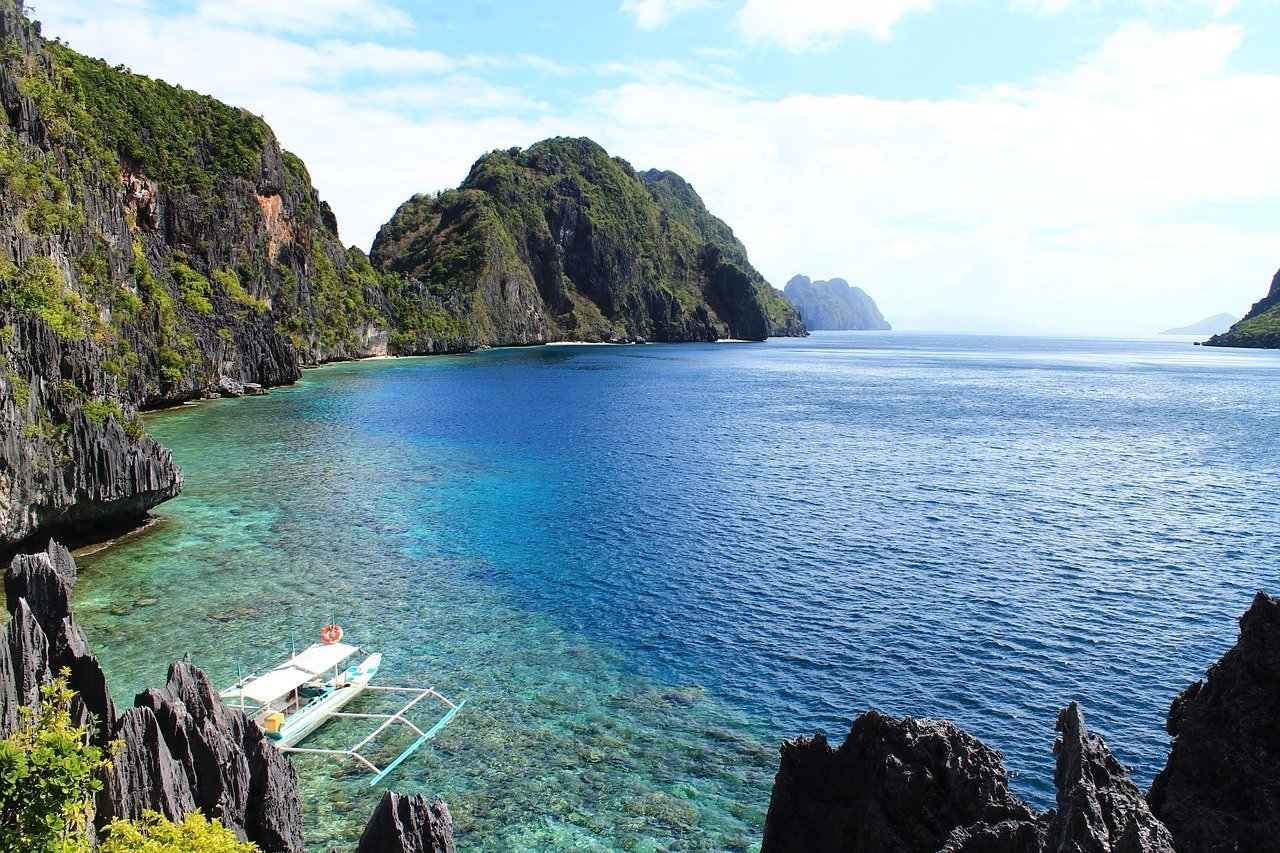
You shouldn’t miss
- Epic island hopping tours. Show off your backflip skills jumping from the boat into crystal clear waters below. Snorkel the reefs or if you dare, swim through the underwater caves found in the lagoon. The underwater caves are hard to find, so ask the local lads to show you; it’s in the lagoon and although dangerous is a lot of fun.
- Climbing. Fed up with water sports? El Nido is one of the best places in the Philippines to climb. The cliffs overhanging the ocean offer incredible views from the top, which even beginner climbers can enjoy. Check out Taraw Peak, one of the coolest climbs in El Nido.
- Diving. If you can afford the expensive boat ride, diver fanatics should make their way to Tubbataha Reef Marine Park, known for its reef and pelagic marine life.
- The hostel scene. There are tonnes of epic backpacker hostels in El Nido, HOWEVER, you will have to book in advance in high season as it’s super popular.
Coron: Wreck Diving Paradise
- Best for: diving, island hopping, lakes
- Budget vibe: mid–pricey – diving, tours, and fees add up quickly
- Time needed: 3–4 days
- Getting there: Ferry from El Nido or flights from Manila and Puerto Princesa
- Don’t miss: wreck diving, island hopping, Kayangan Lake
- Skip if: diving and boat trips don’t interest you
- Overrated: expecting a beach town
- Where to base: Coron Town
- Anything else: environmental and entrance fees are everywhere and stack up fast
Like El Nido, Coron is another one of those places that is basically a poster child of the Philippines. Still repping limestone caves, but what differentiates it from El Nido is what’s under the surface…Named one of the top dive spots in the world, Coron is popular for its World War II wreck diving.
Coron Town itself is more of a base than a destination, packed with hostels, dive shops, and bars. It’s social, a bit scrappy, and built around travellers coming and going. For those not keen on exploring these wicked wrecks, it’s a great place to kick back with a beer or two for the day. There are numerous chill places to stay in Coron and a lot of cool areas to explore.
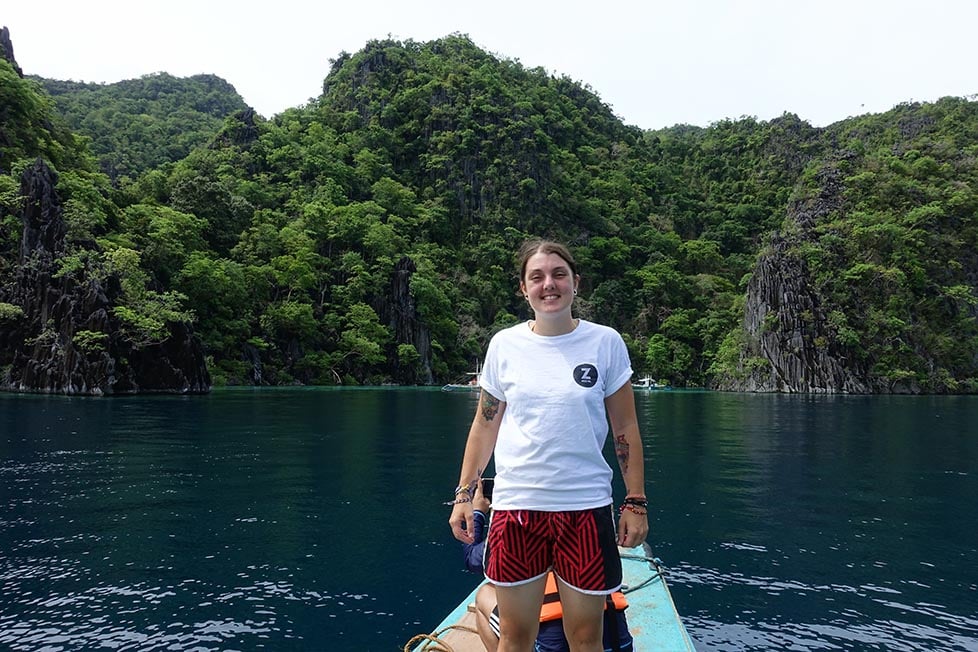
Image: Nic Hilditch-Short
You shouldn’t miss
- Diving…DUH. In September 1944, a fleet of Japanese ships hiding in the harbour were sunk in a daring raid by the US navy. The result is around ten well-preserved underwater shipwrecks surrounded with coral reef: a diver’s paradise!
- Island hopping. Like El Nido, Coron is known for it’s limestone cliffed islands and the crystal clear water that surrounds them. The best things to do in Coron involve exploring lagoons, lakes and pristine reefs.
- Some cool ass hostels. Backpackers rejoice – Coron is a gem on the Philippines backpacking route. There are tons of cool hostels, bars and unpretentious island living that backpackers go crazy for.
- Renting a bike and exploring. Back on dry land, rent your own two wheels and explore viewpoints, hot springs, and quieter spots to mix it up from the standard tours.
Legazpi: Volcano Views for Days
- Best for: volcano views, adventure, side trips
- Budget vibe: cheap–mid – affordable stays, activities like ATVs and tours add up
- Time needed: 2–3 days
- Getting there: Flights from Manila or buses from across Luzon
- Don’t miss: Mayon Volcano, ATV rides, viewpoints
- Skip if: you’re chasing beaches or island life
- Overrated: expecting loads to do in town
- Where to base: Legazpi city centre
- Anything else: volcano activity can restrict hiking access
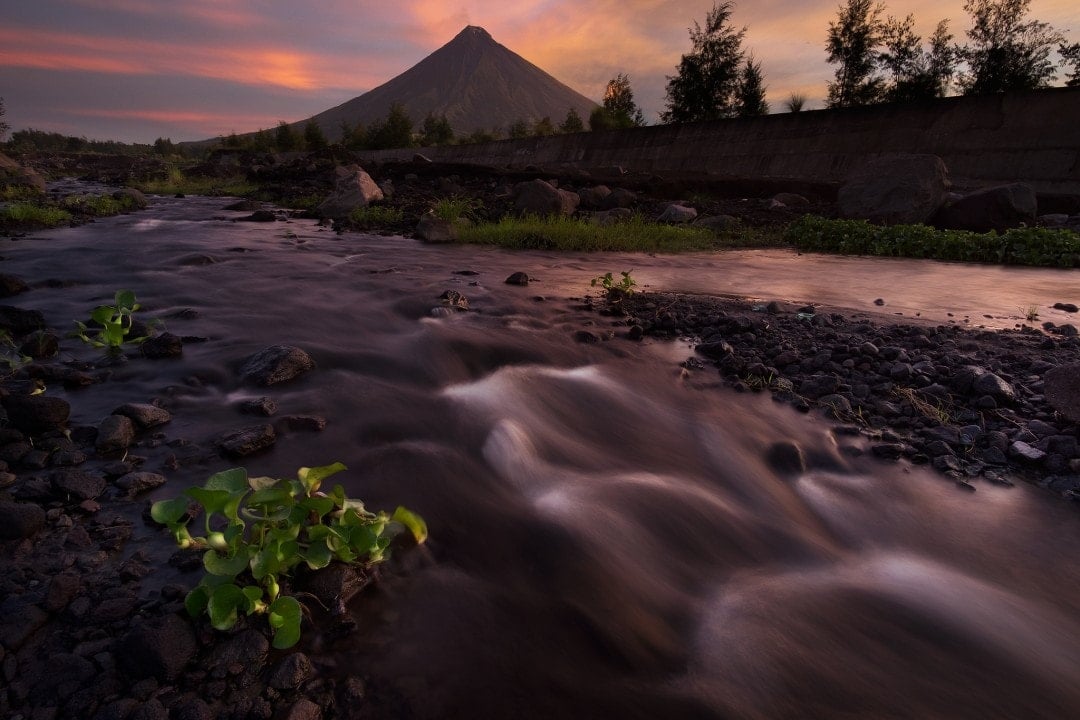
Legazpi is home of the most perfect cone-shaped volcano in the world, Mt Mayon, and is used as a gateway to dive in Donsol. You can hike to the summit of Mt Mayon, but it’s quite a difficult climb. Some companies offer an extremely expensive 2-day expedition; however, it does seem possible to climb it yourself too. If hiking isn’t your thing, hire an ATV and fang around the base of the volcano looking for wicked viewpoints like at Sumlang Lake.
The most popular viewpoint of Mt Mayon is Lingnon Hill, but it’s pretty touristy. I do think it’s worth checking out the Cagsawa Ruins while you’re here – they’re the remains of a small 18th-century church village after the huge eruption of Mt Mayon. Pretty much all the flights to Legazpi go via Manila, so check out Cebu Pacific for cheap sale deals.
Donsol: Pelagic Paradise
- Best for: wildlife, diving, offbeat travel
- Budget vibe: mid – tours and boat trips (if you choose to go on them) push costs up, but transport and stays are cheap
- Time needed: 2–3 days
- Getting there: Bus from Legazpi (around 2 hours)
- Don’t miss: whale sharks, manta ray diving
- Skip if: animal tourism doesn’t sit right
- Overrated: expecting guaranteed sightings
- Where to base: Donsol town
- Anything else: whale shark season runs roughly from November to May
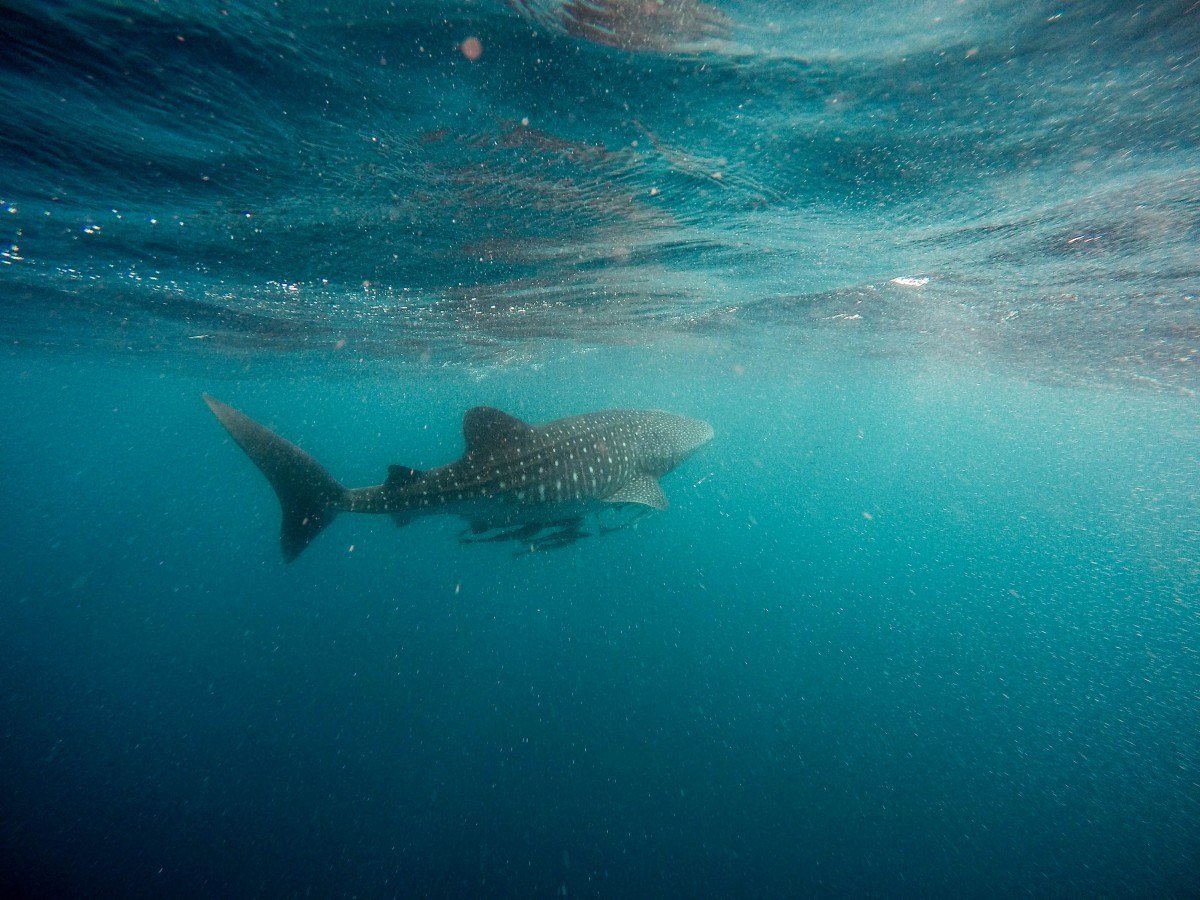
Image: Nic Hilditch-Short
Donsol is famous for the Whale Sharks as they pass through the bay during their migration. It’s one of the few places in the world where you can dive with them in their natural environment, unlike in Cebu where they’re hand-fed and never migrate. Whale sharks are drawn to Donsol Bay from November to May, due to the high concentration of krill and plankton. Though I recommend that you avoid the tours altogether, animal tourism is a tough line to toe. It’s just as good to hire a snorkelling kit and get out on the reefs without the worry of whether the tour is ethical or not.
Diving in Donsol is also quite popular, particularly in the Manta Bowl, where you can see both manta rays and whale sharks. However, it is a decent boat ride to get there and can be pricey if you’re diving solo. Your best bet is rallying together a few divers and sharing the cost of the boat rental. To get here from Legazpi is super easy: just go to the bus station and catch the Donsol Bus.
Cebu: A Mini Manila
- Best for: flying into the region to island hop
- Budget vibe: mid – food and stays are affordable, but transport in and out of Cebu adds up
- Time needed: 5–7 days
- Getting there: Flights into Mactan-Cebu International Airport or ferries from nearby islands
- Don’t miss: Kawasan Falls, Moalboal diving, Osmeña Peak
- Skip if: you’re only after quiet island vibes
- Overrated: Cebu City itself
- Where to base: Moalboal or south Cebu
- Anything else: avoid whale shark tourism in Oslob due to ethical concerns
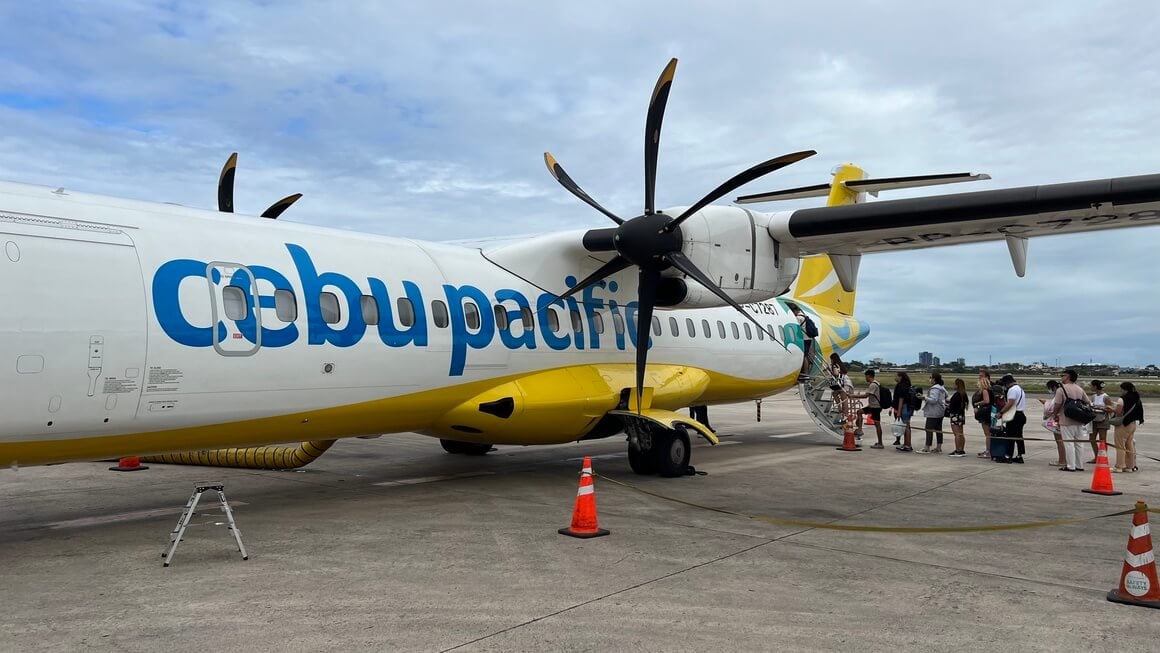
Photo: @joemiddlehurst
ebu is less about the city and more about everything happening further south. The city itself is a bit like a mini Manila with better traffic, but most travellers pass through quickly and head straight for the coast. You don’t really come to see the sights and sounds of the city, per se.
The real highlights are spread out. Kawasan Falls is a big one, often paired with canyoneering through rivers and jungle before finishing at the falls. Further along, Moalboal has wicked diving, coral reefs, and the famous sardine run just off the shore. Inland, places like Dalaguete (AKA little Baguio) and Osmeña Peak offer cooler air and wide views without the crowds.
If you’re a conscious traveller and wish to balance travelling and the need for the environment, don’t go to Oslob. Yes, it’s famous for swimming with Whale Sharks, but no, it’s not good for the animals or their environment.
Be sure to visit Cebu’s highlights.
Craft your own perfect Cebu itinerary.
Find a bed with our Cebu Hostel Guide.
Why not rent an entire Cebu Airbnb?
Siquijor: The Healing Island
- Best for: beaches, snorkelling, chill vibes
- Budget vibe: cheap–mid – affordable stays and food, transport and activities stay reasonable
- Time needed: 3–5 days
- Getting there: Bus to Lilo-an Port from Cebu, then ferry to Siquijor
- Don’t miss: Tubod Marine Sanctuary, waterfalls, coastal rides
- Skip if: you want big nightlife or constant action
- Overrated: expecting it to still feel completely undiscovered
- Where to base: San Juan area
- Anything else: watch out for sea urchins, especially at low tide
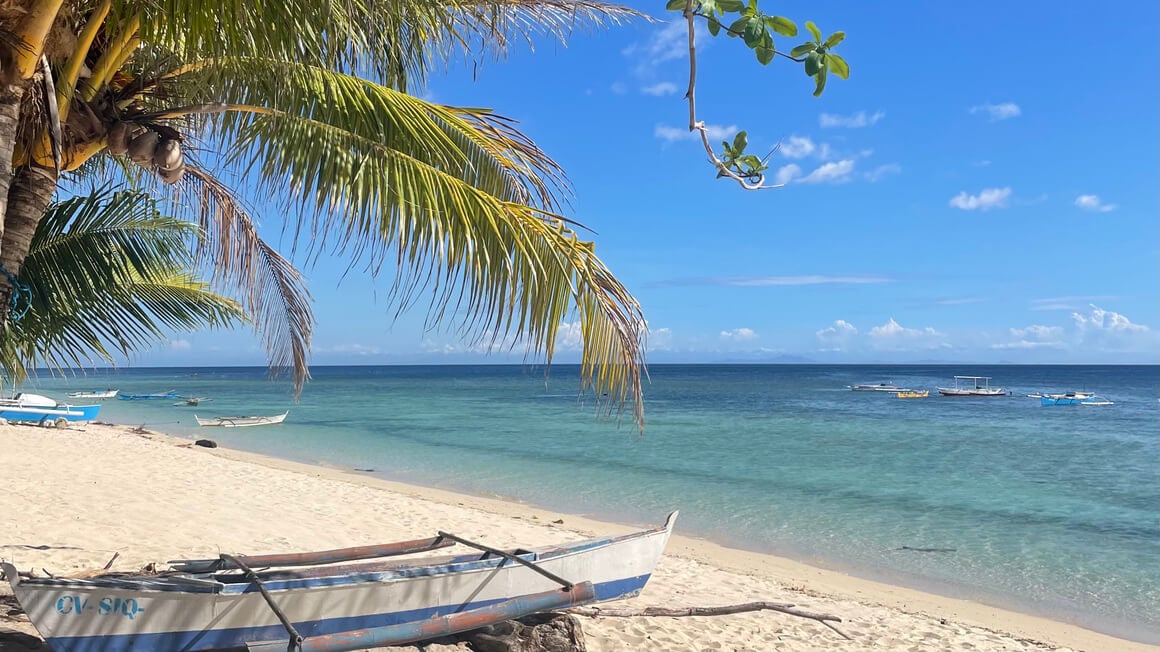
Photo: @danielle_wyatt
Siquijor Island is one of the best islands in the Philippines. It’s absolutely beautiful and used to be known for its witch-like healing practices, though today most healing is done with a relaxing beer on the beach and dip in the ocean. It’s one of my favourite backpacker hubs in the country thanks to it’s social and family-like hostels. If you’re wondering where to start your trip in the Philippines, this is it!
The island has amazing snorkelling and is great for diving too. There are tranquil waterfalls, caves and forests to explore around the island. It doesn’t boast the nightlife you’d see in other backpacker hubs like Siargao or El Nido, but that’s why I like it so much. The main event here seems to be a couple of San Miguels on the beach as the sun sets – right up my street.
Siargao: The Mecca of Surfing
- Best for: surfing, island life, social vibe
- Budget vibe: mid – prices have risen, especially in popular areas like General Luna
- Time needed: 4–7 days
- Getting there: Flights into Sayak Airport or ferry connections via nearby islands
- Don’t miss: Cloud 9, island hopping, lagoons
- Skip if: you want somewhere quiet and untouched
- Overrated: expecting it to be cheap across the board
- Where to base: General Luna
- Anything else: accommodation fills fast in peak surf season
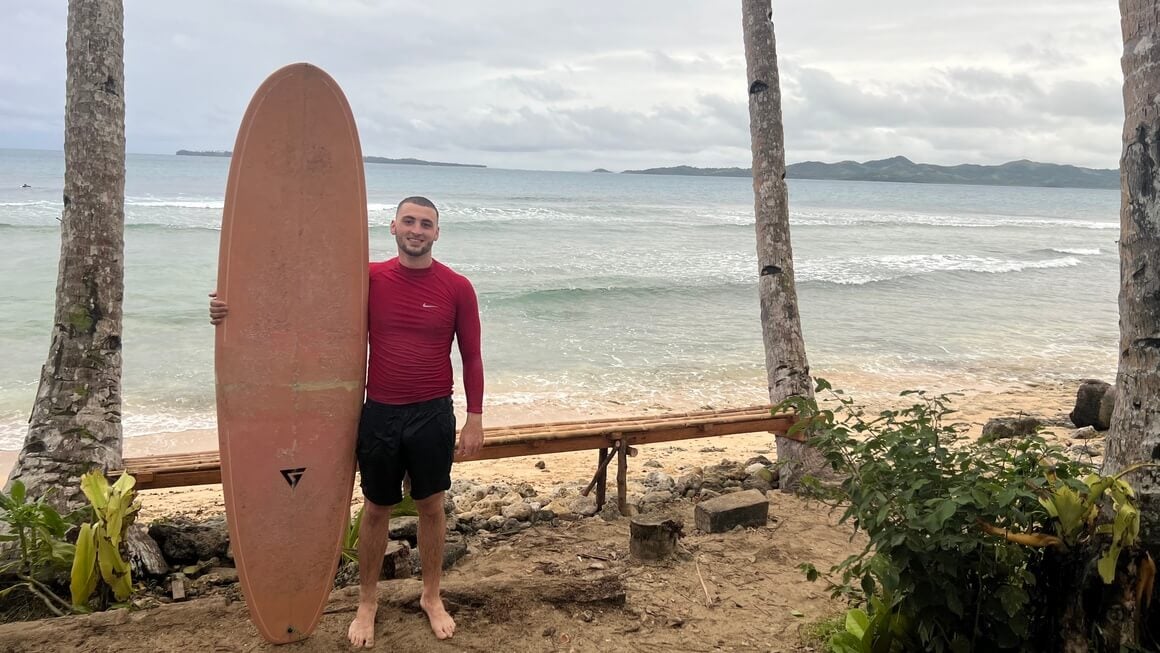
Photo: @joemiddlehurst
Siargao Island has built its name around surfing, with Cloud 9 drawing surfers from all over. Even without a board, the island keeps you occupied with white sand beaches, lagoons, reefs, and plenty of places to switch off for a few days. It’s even given Bali a run for its money in recent years. Siargao has changed a lot in recent years, with more development and higher prices, but it still holds onto a lot of that laid-back island feel.
Most backpackers stay in the General Luna area as it’s a lively part of the island and one of the best places to stay in Siargao. This is where nightlife is at its best in the Philippines. Every night, there’s a different party at a different venue along the coast where locals and backpackers alike come together for a big ‘ol boogie. If you end up coming and not extending at least once, consider me VERY impressed.
Boracay: The Philippines’ Swankier Side
- Best for: beaches, nightlife, social vibe
- Budget vibe: mid–pricey – accommodation and activities add up, but budget options still exist
- Time needed: 2–4 days
- Getting there: Fly into Caticlan Airport or Kalibo International Airport, then ferry to Boracay
- Don’t miss: White Beach sunsets, island activities, nightlife
- Skip if: crowds and commercial vibes aren’t your thing
- Overrated: expecting it to feel untouched
- Where to base: Station 2 for nightlife, Station 3 for cheaper stays
- Anything else: prices vary a lot depending on where you stay and when you visit
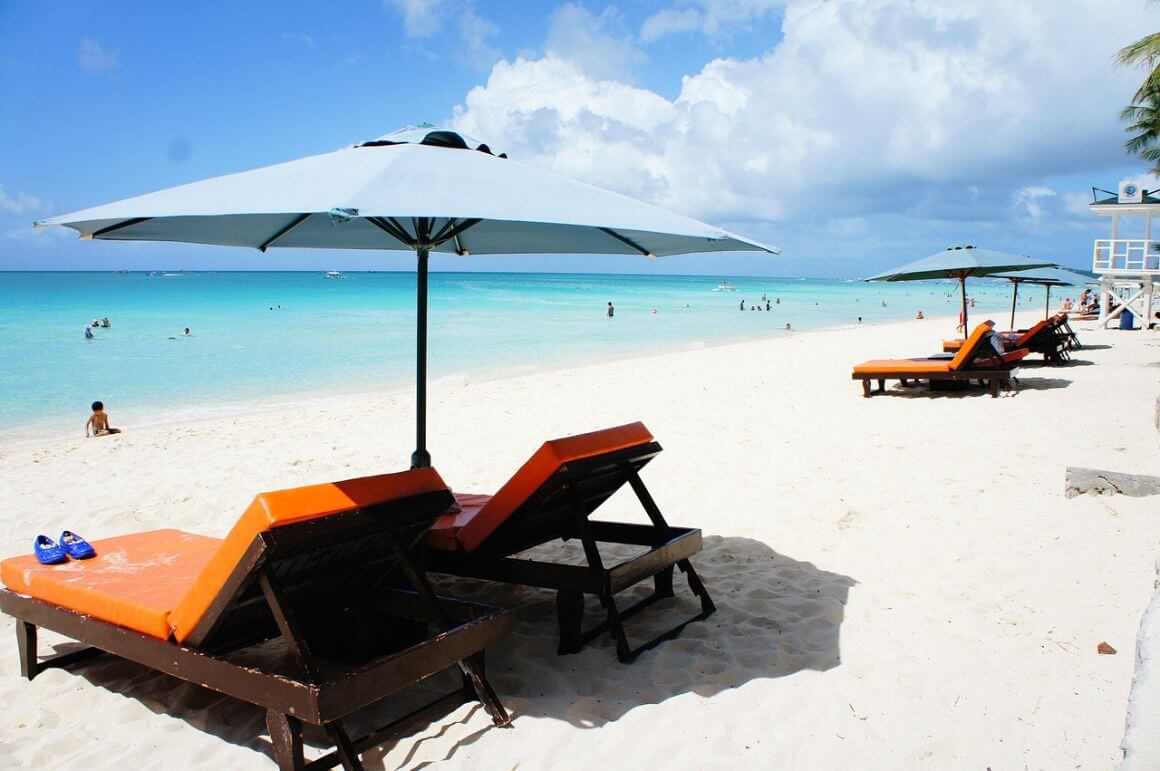
Boracay Island is something that you see on a postcard: beautiful, powdered white sand beaches and crystal clear blue water as far as the eye can see. The sunset on the white beach is absolutely breathtaking, the nightlife here is awesome! It’s a pretty commercialised and can be rather expensive, but you can deffo find cheap backpacking options if you know where to stay in Boracay. The cheapest drinks on the island are at Kurt and Mags on the beach in Station 3, cocktails are 45p and beers are 35p!
Make sure you get to Ariels Point! It’s all you can drink and eat while you spend the day cliff diving, kayaking, snorkelling and partying. My favourite place on the island is Spider House. Spend the day paddleboarding, jumping into the water and watching the sunset over the horizon. It’s busy, polished, and built for tourism, but for a few days of beach life and nights out, Boracay does exactly what it says on the tin.
Getting Off the Beaten Path in the Philippines
Here’s the thing about the Philippines: everyone is so busy racing between Palawan, Cebu, and Siargao that roughly 7,000 islands are sitting there completely untouched, wondering when you’re going to show up.
Getting off the beaten path sometimes involves some heroic feat of planning, but more often than not it’s usually as simple as getting on a ferry heading the opposite direction to everyone else.
- Leyte: The region is wide and varied. WWII history, ethical whale shark encounters in Sogod Bay and ridiculously cool sandbars in Kalanggaman Island. Most backpackers fly straight over it, which is exactly why you shouldn’t. Base yourself in Tacloban, ignore the city, and get out on the water.
- Alaminos (Hundred Islands): Hundred Islands is exactly what it sounds like – 124 limestone islands scattered across Lingayen Gulf, most of them uninhabited, all of them looking pretty insane. Plenty of opportunities to camp and go really off the beaten path here.
- Batanes: Closer to Taiwan than Manila, Batanes is all about rolling green hills, dramatic coastlines, and empty roads instead of palm trees and beach bars. It’s quieter, more remote, and easily one of the most unique places in the Philippines.
- Mindanao: The wild card of the Philippines – huge, diverse, and far less travelled than the usual island circuit. It’s packed with waterfalls, mountains, and raw landscapes, especially around places like Davao City and the adventure-heavy north.
- Dinigat Island: Neighbour to Siargao but with none of the tourists. It feels like a stripped-back version of Palawan, with jagged limestone cliffs, clear lagoons, and beaches that rarely see more than a handful of people.
Top Things to Do in the Philippines
The Philippines is great, wide and wonderful – and the things to do here are no different. There’s no one-size-fits-all here. If you want to dive, you can dive. If you want to hike, you can hike. If you want to get off the beaten path, guess what? The Philippines is your gal.
Let’s get into the best of the best things to do in this beautiful country so you can prioritise your precious time on the side quests YOU wanna do.
1. Go Diving
The Philippines is one of the best places in the world to dive under the sea. There are hundreds of sites ranging from reef to wreck diving, the open ocean and night dives too! Plus, your Philippines budget won’t be blown; it is one of the cheapest places in the world to dive for the day or learn how to free dive.
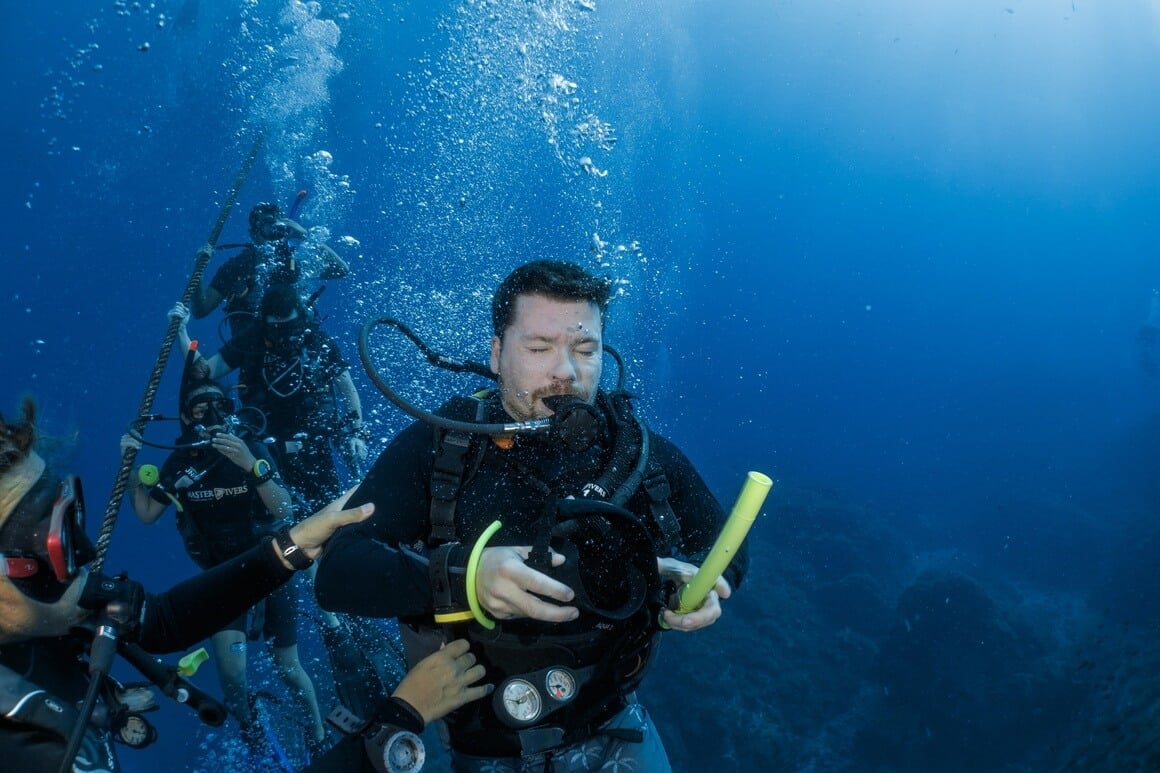
Photo: Will Hatton
The best spots to dive in the Philippines:
- Coron: for world-famous WWII wreck dives
- Malupasca: for thresher sharks
- Tubbataha: for the best liveaboards and remote dive sites
- Apo Reef: for the largest contiguous reef in the world after the Great Barrier Reef
- Donsol Bay: for a chance of diving with whale sharks
- Moalboal: for the famous sardine run
- Panglao: for wall dives and reef exploration
- Barracuda Lake (Coron): for alien-like underwater landscapes and legends of a monster-sized barracuda
- Tubbataha Reef National Park: for over 600 fish species, 360 coral species, 11 shark species, and 13 dolphin and whale species
2. Go Island Hopping
Considering this is a country made up of thousands of islands, it couldn’t really be a Philippines trip without hopping a couple of islands! Most hostels will offer some island-hopping trips. You can choose from a chilled trip or take on one of the Philippines infamous booze cruise island hopping trips! One of the best things to do in this amazing country is to simply go with the flow and head off on an island-hopping adventure.
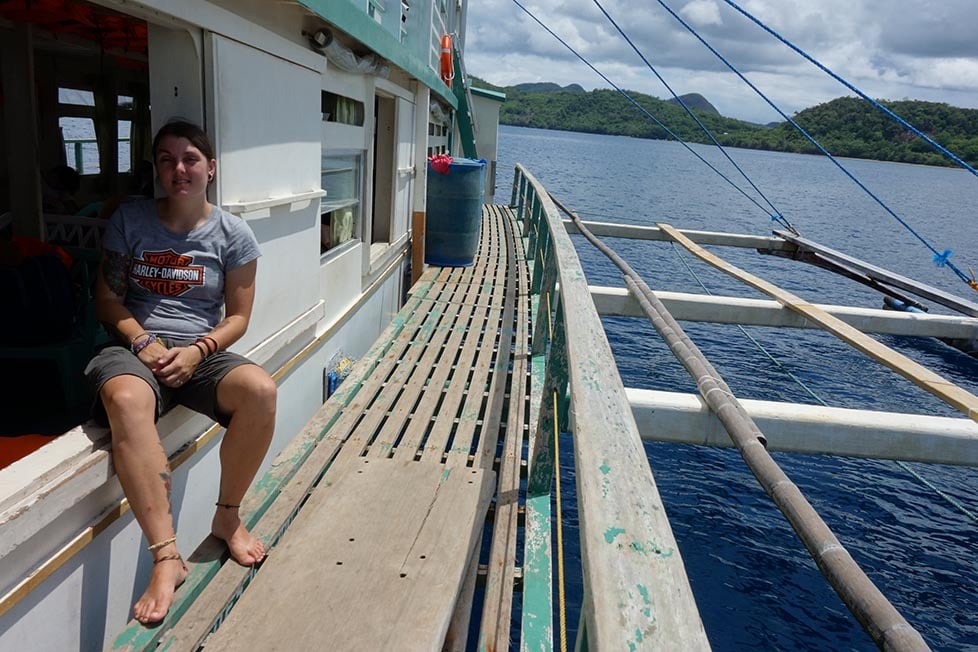
Image: Nic Hilditch-Short
One of my favourites that I did on my Philippines trip was in Port Barton. From unspoiled white sand beaches, to snorkelling with turtles and BBQs on the beach—an island hopping tour in Port Barton is a quintessentially Filipino experience.
3. Go snorkelling
If you’ve never been snorkelling before, this is the best place to learn how to do it.
You can snorkel with all sorts of amazing animals in Donsol! I highly recommend supporting the industry here versus Cebu (where they hand-feed whale sharks and disrupt the ecosystem and their migration patterns). Another favourite of mine is the sardine run in Moalboal. Grab a snorkel and be ready to be immersed in a school of hundreds of thousands of sardines just off of the shore of Moalboal. It’s pretty magical stuff.
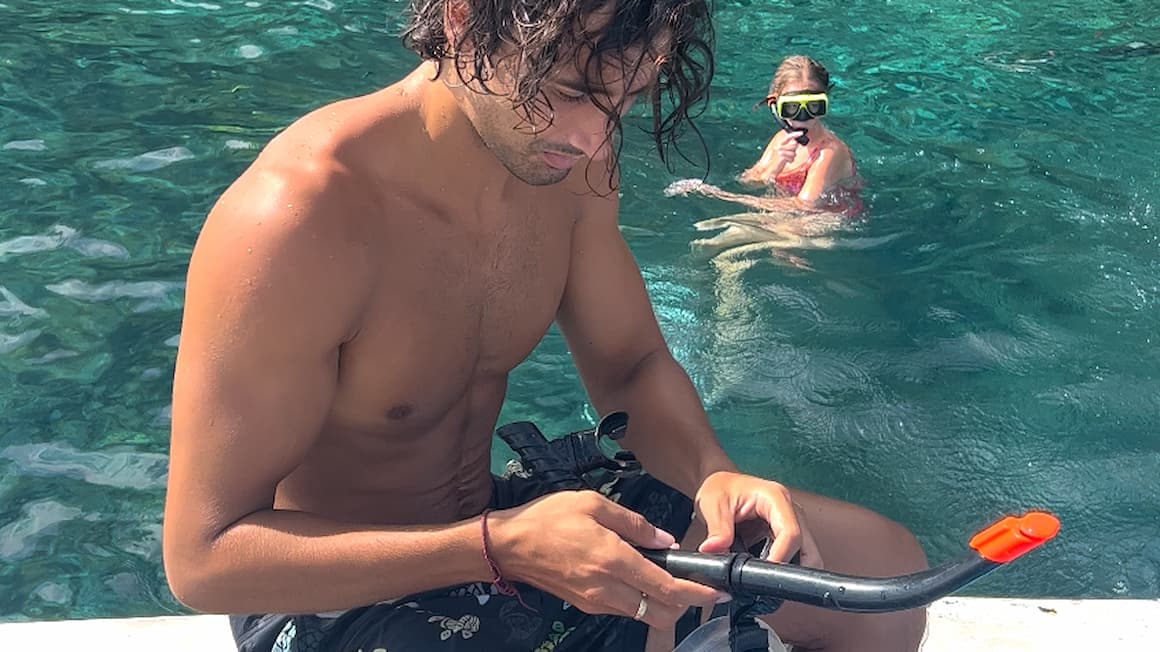
There are over 1000 islands in the Philippines so getting away from the tourist-trodden beaten path is actually pretty easy. Even the popular islands have quiet corners and lesser-known beaches and resorts.
4. Eat the Local Delicacies
Philippine local delicacies are so good, so cheap, and so weird! The Philippines has the most ‘interesting’ selection of street food I’ve ever seen. It’s the cheapest way to eat, the most delicious and surprising… watch out for hard-boiled eggs called Balut. Try at your own risk…
If you’re a bit intimidated by Filipino food like I was when I first touched down in the Philippines, then I DEFF recommend booking yourself into a food tour and getting the low down of the weird and wonderful by a local. You’ll be ordering and eating street food just like the locals do, and wandering around the city with the guides genuinely feels like a night spent with old mates. Warning: come hungry.

Dishes to try:
- Fresh lumpia (fresh spring rolls)
- Lechon (roasted pork belly)
- Adobo (braised chicken)
- Sisig (sizzling pork)
- Kare Kare (kinda like a stew with peanutty sauce)
- Bangus (milkfish)
- Sotanghon (chicken noodle soup)
- Pancit (the Filipino version of chow mein)
5. Go Caving in Sagada
Caving in Sagada is equal parts adventure and mild chaos, with narrow tunnels and underground rivers. If you don’t question your life choices at least once, you’re not doing it properly.
Routes like the Sumaguing Cave take you scrambling over rocks and wading through water, all surrounded by huge limestone formations that are pretty bloody cool. It’s muddy, physical, and not exactly glamorous, which is everything I’m looking for when adrenaline chasing.
6. Swim among the Picture-Perfect Lagoons of Palawan
While this area is touristy, there’s a reason why. The clear blue and green lagoons will have you wondering how places like this exist on Earth.
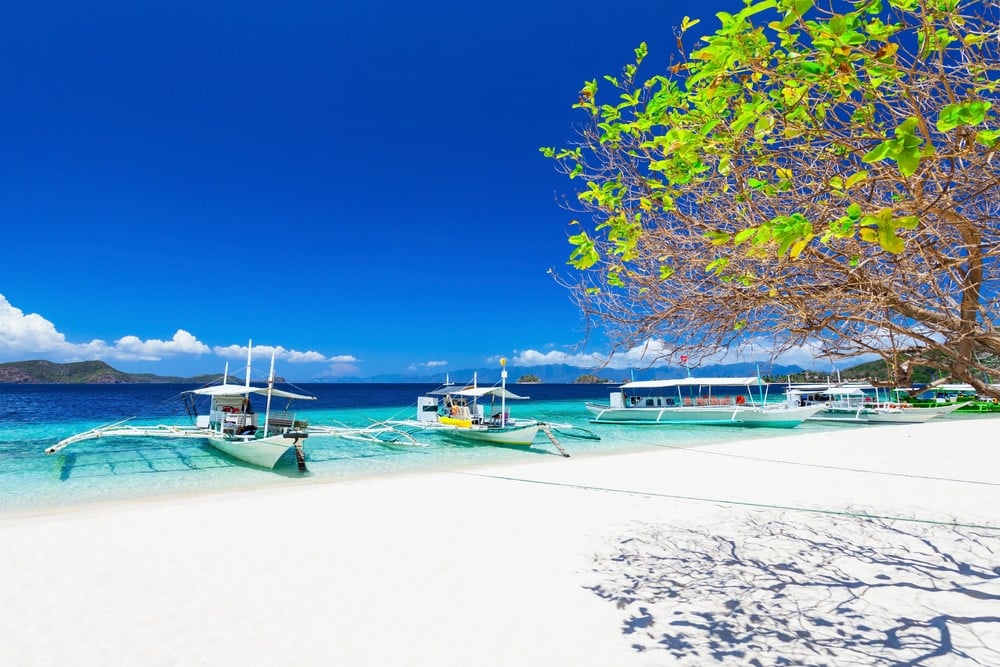
Tour A in El Nido is popular, and for good reason. It covers the main highlights—Big Lagoon, Small Lagoon, Secret Lagoon, Shimizu Island, and 7 Commando Beach—each one showing off a different side of Palawan’s coastline.
Calm waters, dramatic cliffs, and beaches worth the boat ride, all in one go. It’s one of the best things to do in Palawan, in all its otherworldly beauty, wrapped up in one tour.
7. Explore the Chocolate Hills of Bohol
This island is famous for green rivers, jungle, and yes, chocolatey hills! It’s one of my absolute favourite things to do in Bohol and it just never gets old.
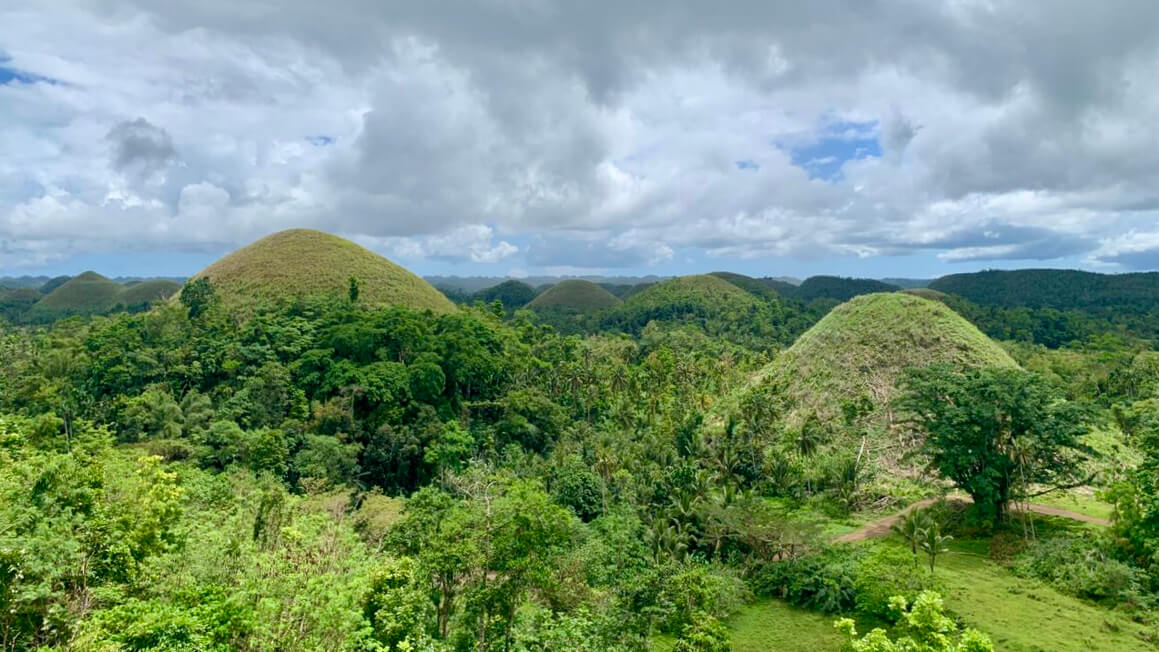
Photo: Alex Hatton
8. Surf Some Waves!
With over 7,000 islands, you’re never short of waves, but figuring out where to go depends heavily on the season and how much effort you’re willing to put in.
The headline spot is Siargao, home to Cloud 9, the country’s most famous wave. On the other side of the spectrum, La Union is the go-to weekend surf escape from Manila. Then you’ve got places like Baler, where surfing in the Philippines really started gaining traction. It’s less polished, a bit rough around the edges, and still feels more local than international.
Check out this surf guide for the Philippines to find the gnarliest curls!
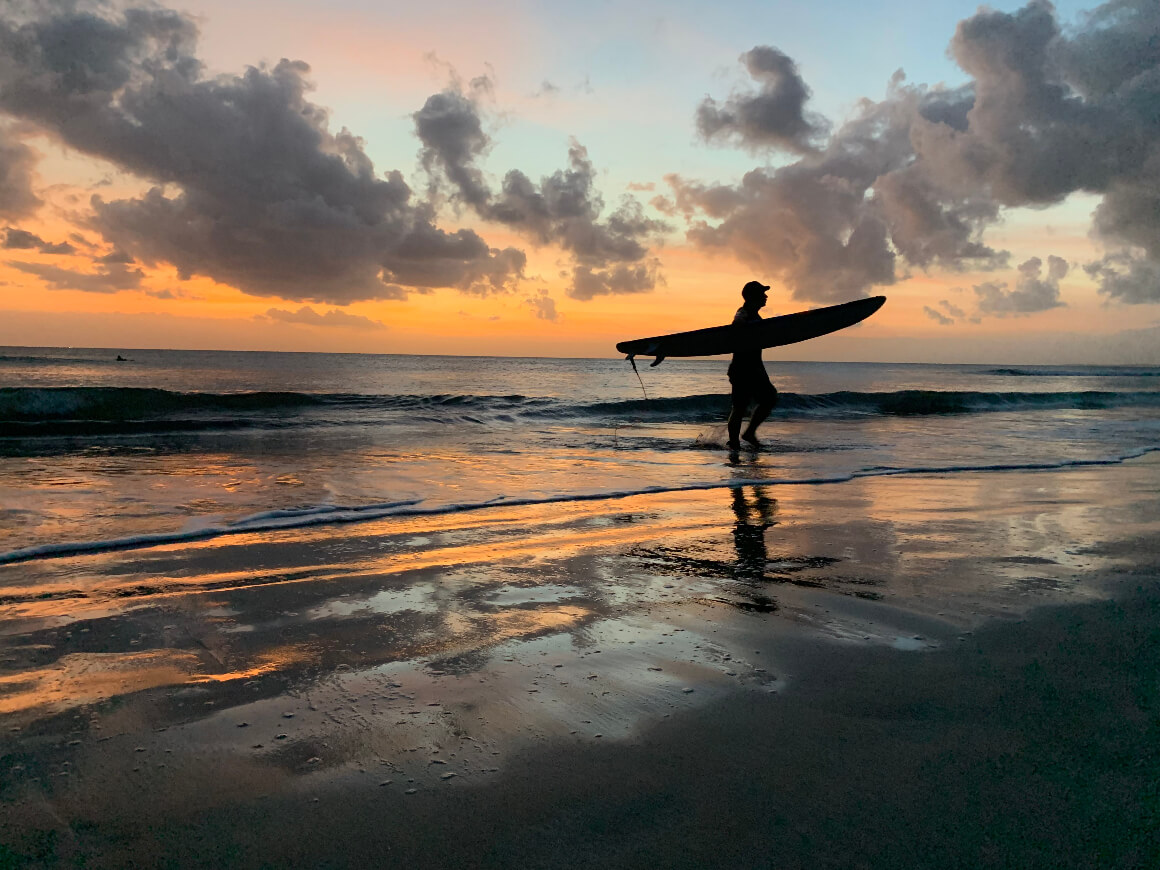
Photo: @joemiddlehurst
9. Go Trekking
There are endless trekking options in the Philippines: remote hill hikes and active volcanoes, gentle strolls, and multi-day backpacking trips.
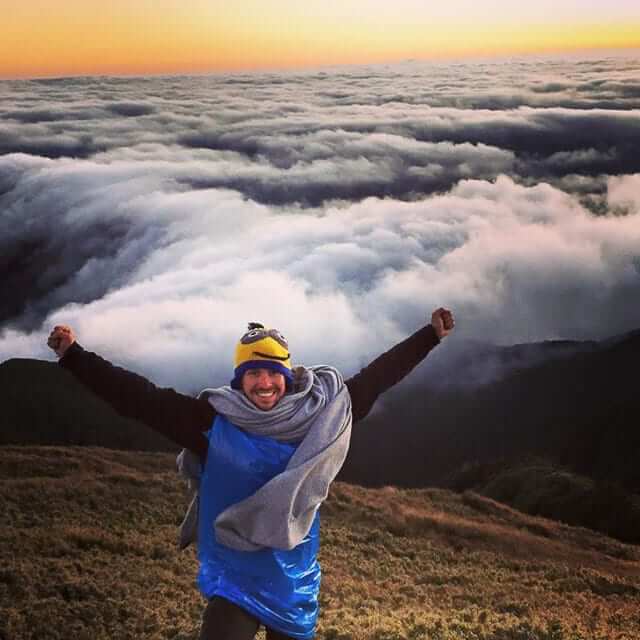
Photo: Alex Hatton
Some popular treks include:
- Cordillera and its rice terraces + Mt. Pulag.
- Sagada for its famous caves and mountain landscapes, and hiking in the hills
- Bohol gives you a chance to hike to the Chocolate Hills and other epic peaks
- Mt Mayon is famous for its perfect cone shape, one of the few in the world
- Mt Pinatubo has a serene crater lake in the middle.
- Mt Apo has the highest peak at 2,954m.
- Mt Isarog will take you through jungles and waterfalls.
- Mt Guiting-Guiting will take you through a strenuous 10-hour trek to the top
- Mt Kanlaon, the largest active volcano in the Philippines
- Kibungan Circuit is a three-mountain circuit spanning across the mountains of Tagpaya, Oten, and Tagpew.
10. Go Rock Climbing
Rocks rock, but climbing them rocks even more. There are numerous places to rock climb in the Philippines and for all levels. Some of the most popular places to climb include:
- Cantabaco and Poog in Cebu
- Sagada
- Wawa in Montalban
- Rodriguez
- Luzon
11. Experience a Festival in the Philippines
Festivals in the Philippines are the ultimate insight to local people and culture. Filipinos love their music, community, and food, and DANG do they know how to throw a party.
- Ati-Atihan Festival: 3rd weekend of January in Kalibo, Aklan; this is one of the oldest religious celebrations in the country. Ati-Atihan is characterised by a parade filled with face-paint, indigenous costumes and dance
- MassKara Festival: Basically, Masskara Festival is a giant masquerade party with Latin-inspired drumbeats, and intricate costumes, as well as sports events, concerts and a beauty pageant. Of course, participating in this event is also an opportunity for you to sample the most luscious delicacies that the city has to offer.
- Moriones Festival: Marinduque’s week-long Holy Week celebration combines Catholic pageantry with folk mysticism. During the festival, the centurion’s story will be reenacted in a theatrical play that’s staged by the locals.
- Giant Lantern Festival: San Fernando’s Giant Lantern Festival is a Christmas contest with giant bright lanterns. San Fernando has been fondly nicknamed as the “Christmas Capital of the Philippines.”
Accommodation in the Philippines
Accommodation in the Philippines is where you can really spunk your budget fast. The spectrum runs wide here – you’ve got everything from budget bungalows where flushing toilets and actual roofs feel like luxury amenities all the way up to boujey five-star resorts.
But what works for backpackers? Well, that depends.
For the most part, you’ll be relying on the ol’ faithful hostel scene, but sometimes, you’ll find that cheap guesthouses actually run a little cheaper. This might be even more likely if you’re splitting with pals or a partner.
Season, location and time of year are all factors to keep in mind too, so it’s worth looking ahead and giving a reckie of what accom looks like before you rock up with a budget in mind. With that, let’s look through your options.
Hostels
The bread and butter of the backpacker scene in the Philippines. You’ve got no frills spots all the way up to some seriously swanky flashpacker afair. They’re social, sometimes a little feral, and a one-stop shop for sorting tours, bike rentals, and outbound travel. Choose the best hostels in the Philippines in the busiest parts of the year and expect to fork out for them.
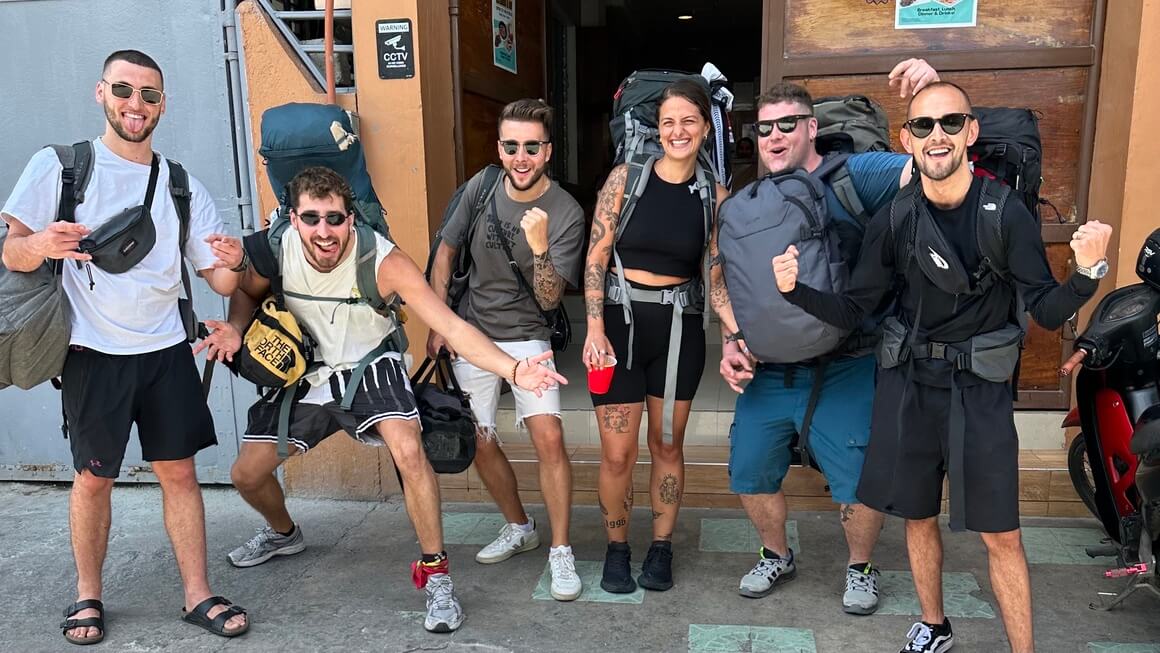
Photo: @joemiddlehurst
Guesthouses
Family-run, no-frills, and often better value than a hostel if you’re travelling with someone. You get a private room, a fan or aircon, and a local family who will almost certainly try to feed you. Filipino hospitality is unmatched, so don’t be surprised if you check out with an unintended adopted family. Not a shabby deal.
Couchsurfing
Filipino hospitality is the real deal. Couchsurfing works here partly because locals are genuinely warm towards travellers, and partly because you’ll often get invited to stay with someone before you even have to ask.
It’s not as active as it used to be back in the OG days, but that’s not to say striking free accommodation, a local guide, and a friend all wrapped into one isn’t still possible to find. Couchsurfing the Philippines not only saved me some pennies, but I got to experience the country like a local with some wicked new friends. I highly recommend being hosted through Couchsurfing to anyone backpacking the Philippines!
Airbnbs
Peak season in the Philippines means hostels fill up fast and prices creep. Airbnb is a solid backup, often landing you a whole apartment for the same price as a private room elsewhere. This is a good option for digital nomads who are looking for a small slice of normality so they can crack on with some work.
Splurge Hotels and Resorts
If your budget has a little breathing room, the Philippines will absolutely take advantage of it. The Philippines has some insanely fancy pants resort hotels all over the mainland and islands. Resort hotels start from around $100 and go as far as your credit card is willing to follow. Worth it at least once if you can justify the splurge.
The Best Places to Stay in the Philippines
| Destination | Why Visit? | Best Hostel | Best Private Stay |
|---|---|---|---|
| Boracay Island | Banging beaches, boujee hotels, clear blue water, epic watersports. The LOT. Boracay is just where it’s at. | Frendz Hostel | Boracay Amor Apartment |
| Manila | Manila is the best way in and out of the Philippines. Seeing as you’re gonna be here anyway, why not explore? | Z Hostel | Glory Hotel Cubao |
| El Nido | If you’re into blue lagoons, coral reefs and nature, El Nido’s the place for you. Gorgeous limestone cliffs are EVERYWHERE here too. | Outpost Beach Hostel | Inngo Tourist Inn |
| Cebu | Dive into the clear blue water, magical waterfalls or even some modern and tradtional culture. | Nacho Hostel Cebu | Sun and Sea Homestay |
| Siargao | To surf, bruh. If you’re a surfer, get yo’ ass to Siargao, seriously. The waves are the main event here. | Mad Monkey Siargao | The Broken Board |
| Puerto Princesa | To see the AMAZING and world famous underground river and eat some damn nice Filipino food, if nothing else. | Guni Guni Hostel | Andrew and Sophias Guesthouse |
The Best Time to Travel to the Philippines
The Philippines, like most Asian countries, has popular seasons and of course, the wet season. Thankfully, backpacking in the Philippines is great all year round – even in the rain! Most travellers will flock to the Philippines around January and February when the weather is more reliable and cooler, perfect for travelling around!
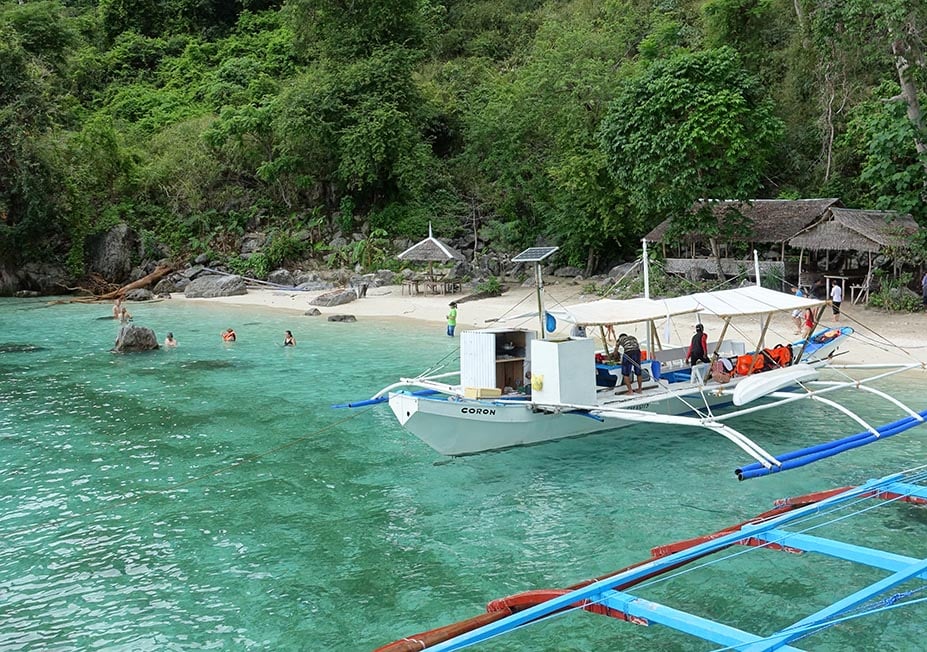
Image: Nic Hilditch-Short
Want more specifics? Let me break down the rest of the year for you amigos planning to go backpacking in the Philippines…
- Dry Season (November – April): This is when the weather is at its warmest and the rains are less likely to hit. Expect comfortable warm temperatures of around 30 degrees, reaching the mid-thirties on the Islands. The hottest months and most humid are March to May, when temperatures will reach up to 36 degrees.
- Wet Season (May – October): ‘Wet Season’ normally puts people off; however, this is a great time to backpack in the Philippines. The rains aren’t constant, normally an hour or so of downpours before the sun dries everything up again. Expect temperatures of around 25 degrees.
- Typhoon Season (June – August): Not the greatest time to backpack in the Philippines. Rains are much heavier at this time, and typhoons are common. Many flights and ferries will be cancelled or face delays. Avoid some of the more rural islands at this time of year.
Safety, Scams & Common Backpacker Mistakes
The Philippines is, for the most part, a perfectly safe country to backpack. The locals are warm, the tourist infrastructure is well-worn, and the biggest danger most travellers face is a sunburn and a Red Horse hangover. That said, there are a few things worth knowing before you rock up.
Areas to Avoid
- The area of Mindanao (Apart from the north, there are some great Airbnbs in Cagayan de Oro and decent Airbnbs in Davao City too for example)
- The Sulu Archipelago and southern Sulu Sea are a hard no
- The Zamboanga Peninsula are all considered extremely dangerous due to terrorist activity.
Transport Safety
- In the cities: Grab is your best friend in any city. Fixed price, no meter drama, no scenic detours through every suburb in Manila. At the airport, unlicensed drivers and fixers will approach you before you reach the official taxi queue with ‘flat rates’ that run three to five times what a metered fare would cost. Walk past them and head to the designated zone for Grabs.
- Out on the islands: There tends to be no Grab here. You’ll be relying on your haggling skills to secure a sweet price for your journey. Sometimes the tuktuks have a set price so you have to just grin and bear the couple extra bucks.
- Renting motorbikes: If you decide to rent your own two wheels, always check for any damage beforehand (the brakes being the most important!) Never leave your passport as a deposit. The rest is common sense – follow the local road laws, drive sensibly and NEVER drunk.
- Travel between islands: Ferries and bangkas are just how things work here and usually they’re fine. The thing to watch is the weather. Boats in the Philippines have a well-documented habit of departing in conditions that would ground sensible captains elsewhere. Check the forecast, and if something feels sketchy, wait for the next one. There is always a next one.
Diving and Adventure Safety
The Philippines is one of the best places on earth to do things that could theoretically kill you, which is why so many of us are drawn to it in the first place. Diving, canyoneering, cliff jumping, surfing, volcano trekking…at least one of them will probably be on your itinerary. As always, common sense rules here. Always risk assess whatever activity you do and the company you go with for said activity.
Diving schools and rescue services may not meet the standards you’re used to at home. I’ve heard dive schools in Coron are somewhat shady for letting people dive to wrecks beyond their certification. Researching legit companies will make sure you’re safe and have the best time exploring underwater.
Beaches are unlikely to have lifeguards or warning signs, and riptides are common. Ask locals before you swim anywhere new. Also, make sure your travel insurance actually covers the activity before you do it, not after.
Money and ATMs
Getting your card swallowed is a rite of passage for any backpacker. It happens. To avoid the inevitable heartbreak if this happens is to only use ATMs inside a bank during opening hours so there’ll be someone at hand to help you get it back.
There might not be any ATMs on smaller islands, and if there is, they often run out of cash during busy periods. Always make sure you’re stocked up on cash before heading off the beaten path, and bring more than you expect to spend.
If exchanging money, always research the going rate, make sure you’re happy with the exchange rate given and ALWAYS double-check bills and denominations before walking away.
Drugs & legal realities
- Drugs: don’t. The Philippines has some of the harshest drug enforcement in Southeast Asia and foreigners are not exempt from any of it. Penalties for possession, use, or trafficking are severe, with convicted offenders facing long jail sentences and heavy fines. Just testing positive to a drug reading could land you in jail for 6 months. You’re better off just staying away from drugs altogether in the Philippines.
- Alcohol: It’s widely drunk and readily available. The Philippines has horrifically strong Red Horse beer and some tasty rums on offer.
- Sex tourism: it’s big and obvious, especially around Go-Go bars. Prostitution is illegal, but clearly happens and some of the interactions I’ve seen between young local women and old white men is…grim, to say the least.
- Dating: Tinder very much works in The Philippines, and the locals are… erm, very friendly. Just be honest with people about your intentions and don’t be that guy.
Travel Insurance
Get it before you fly, not after you’ve snapped something on a motorbike or ended up in a rural clinic with no idea what the bill looks like. With diving, ferries, typhoons, and the general chaos of island hopping all baked into the itinerary, the Philippines is one of the less sensible places to go without cover.
SafetyWing is built for exactly this kind of trip: month-to-month, no lock-in, no itinerary required. Sort it early and stop thinking about it.
How To Get Into The Philippines
Flying into the Philippines was incredible. Thousands of islands surrounded by a beautiful blue ocean looked like the paradise that was promised after all the hype! Most backpackers travelling in the Philippines start off in Manila, the main flight hub. It’s likely your flight will land here or at least connect through to one of the many islands.
Photo: @joemiddlehurst
If you’re flying within Asia, rejoice broke backpackers, it’s so freaking cheap! You can get flights with the likes of AirAsia, Cebu Pacific and Philippines Airlines, which both run extensive regional routes at consistently low prices, and catching a sale can get you somewhere absurd for next to nothing. From further afield, routing through a Gulf hub or via China tends to produce the best international fares.
For getting around once you’re in the country, Cebu Pacific and AirAsia are the budget workhorses for domestic island hopping. The key here is to BOOK AHEAD!!!! Routes to El Nido, Siargao, and Coron sell out fast in peak season and could cost you a bomb booking last-minute.
Entry Requirements
Visitors from 157 countries get visa-free entry to the Philippines, most for 30 days. If you’re planning to stay longer, you can extend at any Bureau of Immigration office once you’re in the country. It’s a straightforward process, worth knowing before you lock yourself into a one-month itinerary you’ll definitely want to stretch.
All arrivals must complete the eTravel digital registration between 72 hours and 3 hours before landing. It replaces the old paper arrival card and takes about five minutes to do.
One thing that catches people off guard: you need a return or onward ticket to board your flight and clear immigration. If you’re travelling indefinitely and haven’t sorted onward travel yet, you’ll need either a refundable flight or a dummy ticket to show proof. Sort this before you get to the airport, not at the check-in desk.
How To Get Around the Philippines
Backpacking the Philippines is easy, even for those with the worst sense of direction! A spider web of bus links, friendly and helpful locals, and all modes of travel offered at super low prices mean that getting around the Philippines couldn’t be easier! As long as you don’t expect air con, you are happy with loud music or movies playing, and a lack of glass windows, your budget Philippines adventure will be a breeze.
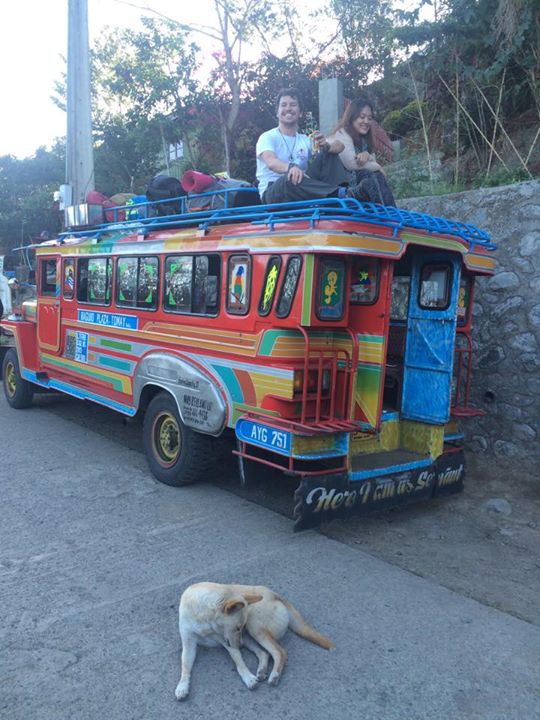
Photo: Will Hatton
Traveling By Public Transport in the Philippines
- Bus: Most backpackers opt to travel The Philippines through its intensive network of long bus distance links. Seriously, the country has a spider web of bus routes, making it so easy to get from A to B. Prices vary around P435 – P500 and tend to run every half an hour or so.
- Ferries or bangkas: These little wooden outrigger boats, Bangkas, are often uncomfortable and packed full of people, but the cheapest way to sail to the islands. If you want to do it more comfort there are larger ferries. Prices for the ferries will range from P750 – P2500 (add an extra thousand for private cabins) and tickets can be bought at the pier right up to departure. Just keep an eye on the weather, take it from me; being on one of these tiny boats, packed with people and seasickness is not worth it – and pack suncream!
- Flights: This is definitely the quickest way to travel around but it isn’t the cheapest. There are a number of domestic, cheap airlines available including Cebu Paciifc, AirAsia and Philippine Airlines. On average, regular fares will be around P800 – P2500 depending on the flight route. The only downside of air travel? Flights rarely run directly from your desired A to B, meaning you’ll be getting pretty familiar with Manila and Cebu airport.
- Jeepneys: The ultimate Philippine icon, these are not rare in the cities of Manila, Cebu City, Davao and Baguio and essentially are repurposed American Jeeps from WWII given a dash of paint. Although they’re slowly coming out of circulation, you will probably end up travelling on one of these while backpacking the Philippines at some point. There are no fixed schedules, you simply hail Jeepneys down from the side of the road and learn their route from what is scribbled on the window that day. Expect to pay around P8-20 for a journey.
- Tourist buses: You can just hop on a bus without a ticket but if you’d rather book in advance, I’d recommend checking out Bookaway. Rather than just rocking up at the bus stop in the hope they will have space to fit you on, you can book tickets in advance!
Hitchhiking
Getting around the Philippines is relatively easy, and with many different modes of transport for all budget levels it seems silly to even consider hitchhiking… Wrong amigo!
Hitchhiking in the Philippines is easy if you are hoping to travel a small distance and it’s a great way to meet cool people on the road. Not only will locals pull over to curiously help you on your way, but Jeepneys will often stop as well. Just make sure to let them know you’re hitchhiking with no money before you hop in, or you could find yourself in an awkward situation.
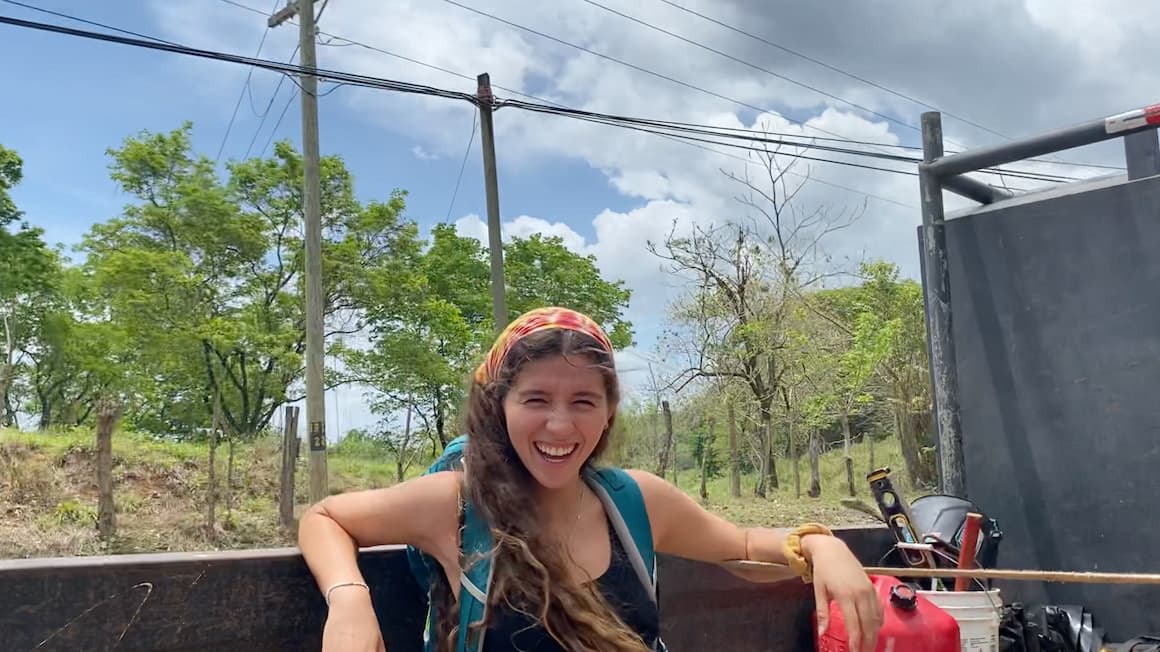
Photo: @amandaadraper
Travelling a longer distance? Hitchhiking becomes a little harder. Most locals with their own vehicles are only travelling short distances and those who are travelling longer distances will often look for a bit of cash to help with fuel. If you are planning to hitchhike in the Philippines I recommend hitchhiking short distances. If you’re travelling longer, hop in a Jeepney.
Culture, Food & What to Expect From Locals
The Filipino people are some of the warmest, friendliest, and generous people I’ve met on my travels. They are always keen to find out where you’re from and going, offering to show you the way and helping you haggle the best price, all with a smile on their faces. It’s not a surprise to be invited out for a beer, back for some local delicacies, or even a place to stay! Embrace it: you’ll meet some incredible friends, be taken to some wicked hidden spots and shown how to party local style!
Cultural Do’s & Don’ts
- Do greet people with a smile and basic politeness, it goes a long way
- Do show respect to elders; it’s a big part of Filipino culture
- Do accept food or drink when it’s offered, turning it down can come off a bit cold
- Don’t be overly loud or confrontational in public; it doesn’t land well
- Don’t criticise the country or culture openly, especially in casual conversation
- Do dress modestly in smaller towns and around churches
- Do be patient, things don’t always run on a tight schedule
Food to try
The Philippines has an awesome selection of Street food; from the damn delicious to the slightly weird, there is something for everyone. The food in the Philippines is influenced by Spanish, Chinese and Malay recipes so expect a good mix of East meets West. It’s a seriously underrated place to travel to for food.
So what to try when wandering the streets and spoiled for choice? Let me tell you my favourite delicacies I tried while backpacking the Philippines…
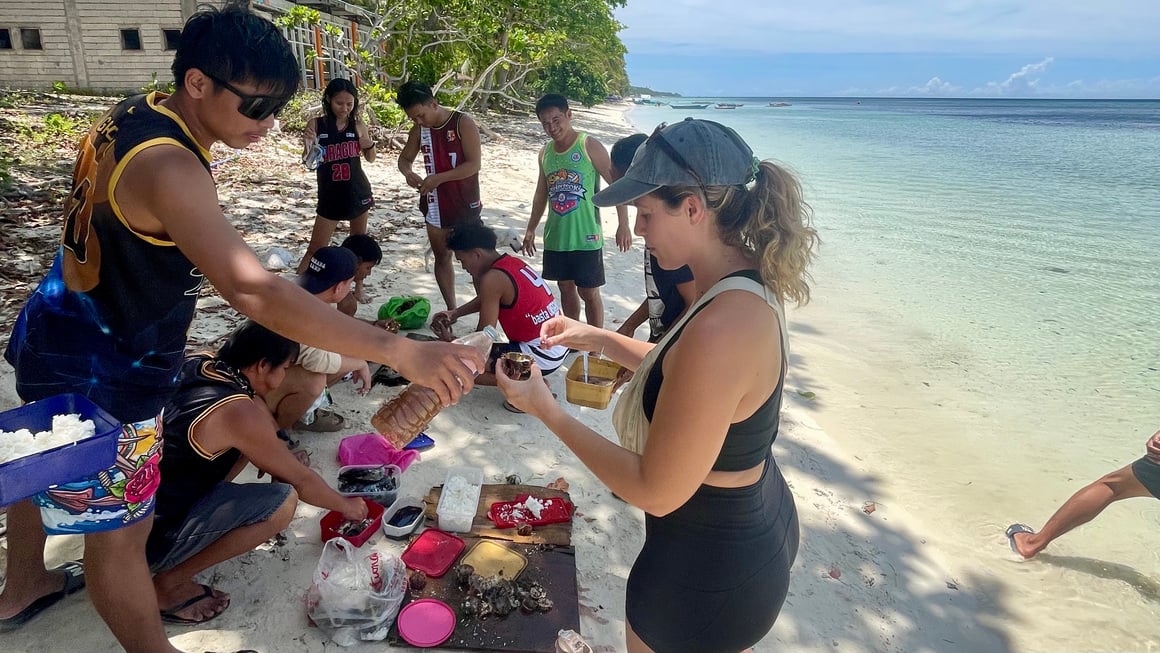
Photo: @danielle_wyatt
- Chicken Adobo: Basically beautifully marinated Chicken or Pork in Soya Sauce and Vinegar. Seriously, delicious and so simple. Perfect on its own or with some noodles.
- Kare Kare: Kare Kare is famous throughout the whole country because it is SO delicious. If you’re missing the curries from Asia grab this dish! Basically, oxtail and ox tripes stew with lots of vegetables, flavoured with ground roasted peanuts or peanut butter, onions and garlic….
- Kinilaw: Sushi lovers, rejoice! I was skeptical trying raw food from the street, but wow! The raw fish salad is served in an acidic juice, usually kalamansi and vinegar, which “cooks” the meat.
- Paksiw Na Lechon: Lechon means ‘suckling pig’ in Spanish and is literally a whole pig roasted over charcoal for many hours for special occasions… This is considered the national dish of the Philippines.
- Tapsilog: Missing your English cooked brekkies? This is the next best thing. Cured beef, fried rice and a fried egg, great to have after a boozy island hopping trip!
- Fresh Lumpia: Ever wondered what a spring roll crossed with a burrito would taste like? Well wonder no more! Filled with meat, lettuce, carrots, peanuts and even some coconut in there. Have it fresh or try the deep fried version – even more awesome.
- Chicharon: Deep fried pork skin or as I call them; The Doritos of The Philippines. Bags of these are opened and shared around when kicking back and relaxing, served with dips you now just need a good smoke or movie…
What to Pack for the Philippines
Packing for the Philippines is less about looking good and more about surviving heat, humidity, and hopping from boat to plane to yet another boat. You’ll want gear that handles sweat, sand, and being shoved into a backpack repeatedly.
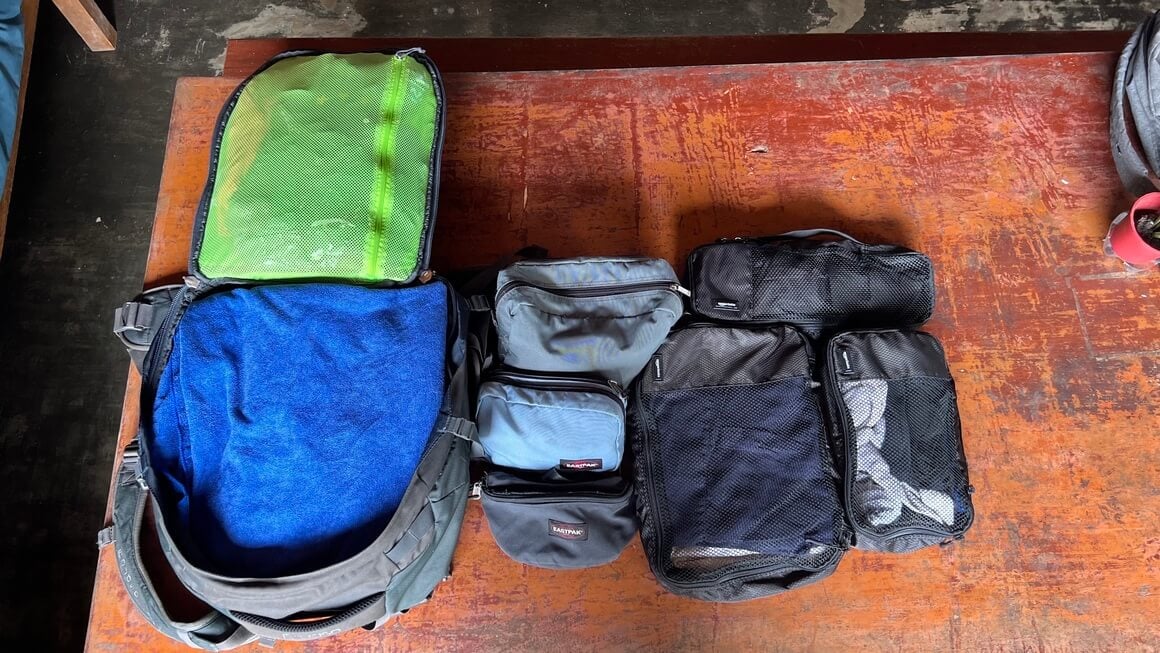
Photo: @joemiddlehurst
Essentials
- Travel insurance docs
- Cash (small notes for islands and rural spots)
- Bank cards (at least two, because one will betray you eventually)
- Daypack. Lightweight and water-resistant works best. I take this packaway backpack everywhere I go!
Tech
- Power bank. I tend to stick to MagSafe ones so I don’t have to faff with wires
- Universal travel adapter
- Dry bag
- A DRONE! This is a paradise for those who geek out over drone shots like me. Island hopping = a dream
Clothes and footwear
- Lightweight t-shirts or tank tops
- Breathable shorts
- Swimwear (this’ll be your everyday uniform, so bring enough)
- Light long-sleeve shirt (for sun protection and temple visits)
- Rain jacket or poncho – especially during monsoon season
- Underwear that dries quickly
- Flip flops/sandals – easy for beaches, hostels, and short walks
- Trainers or lightweight walking shoes for anything vaguely adventurous
- Wet shoes – for caving, waterfalls and general wading through water getting on and off boats
Nice-to-Have Extras
- Microfibre towel – keep this separate from your sandy beach towel
- Reusable water bottle
- Snorkel mask – this’ll save you a TON of money if you’re in the water a lot
- Packing cubes – my travel non-negotiable really. These packing cubes have been going strong for years
- Earplugs – my trusty Loops are my ride or dies for blocking out roosters, karaoke, and thin hostel walls
My ‘I Regret Bringing This’ List
- Too many clothes – you’ll rotate the same few outfits anyway
- Heavy jeans/denim shorts – they’re an absolute misery in humidity
- Bulky shoes – they take up space and they’ll get used once or twice
Working, Volunteering & Long-Term Travel
The Philippines isn’t typically a destination that ex-pats come to looking for work. Salaries are low, the currency is weak and economic migration usually heads the opposite direction. That said, the Philippines is a popular destination for Westerners to retire to, is a bit of a digital nomad hub and there are always teaching opportunities for backpackers. The cost of living in the Philippines is pretty low, too!
Visas & extensions
Most nationalities arrive visa-free and get stamped in for 30 days. That’s your starting point, which is pretty straightforward.
If you want to stay in paradise for a little longer, your next move is a 29-day visa waiver extension, which takes you to 59 days total. From there, you can extend in increments of one month, two months, or six months at any immigration office in the country. Visa-exempt nationals can extend their stay up to 36 months, while visa-required nationals are generally capped at 24 months.
For formal work, a work permit sponsored by an employing company is required. The Philippines doesn’t have a working holiday visa arrangement with most Western countries, so that route is off the table.
The Digital Nomad Scene
The Philippines has slowly but surely become one of SEA’s hotspots for digital nomads. Not as polished as Bali, not as established as Chiang Mai, but with 7,600 islands to rotate through when you need a change of scenery.
As of mid-2025, there’s finally an official Digital Nomad Visa. It gives you up to 12 months of legal stay, renewable for a second year, with your foreign income untaxed locally. The catch: your home country needs to offer a reciprocal visa to Filipinos, which rules out a few major nationalities, so check before you get excited.
If you don’t qualify, the tourist visa extension route is what most remote workers default to anyway, and it works fine up to 36 months if you’re willing to make occasional trips to the immigration office.
In terms of where to base yourself, here are a couple of hotspots:
- Manila (Makati / BGC): It’s loud, congested, and not exactly a postcard. BUT the internet is fast, the coworking spaces are proper, and the expat scene is alive, meaning you’ll have company if you want it.
- Cebu City: Good connectivity, lower costs than Manila, and an international airport that makes island-hopping at the weekend ridiculously easy.
- Siargao: Where the surf crowd and the laptop crowd have fully merged. General Luna now has fiber internet, coworking-friendly cafes, and a permanent cool crowd of remote workers.
- Dumaguete: Low cost of living, loyal expat community, solid Wi-Fi, and some of the best diving in the country within easy reach.
Teaching English
Speaking English is a highly valued skill all over the world. For locals, it opens up whole new worlds of employment opportunities and travel.
Perhaps one of the best moves for anyone wanting to put down roots for a while is to get a TEFL certificate before you arrive. You can do this online, it won’t cost a fortune, and it dramatically improves both your job prospects and your earning power once you’re in-country. The Philippines is a particularly good spot for first-time English teachers. The widespread English proficiency means you’ll have an easy time settling in, and the demand for qualified teachers is consistent.
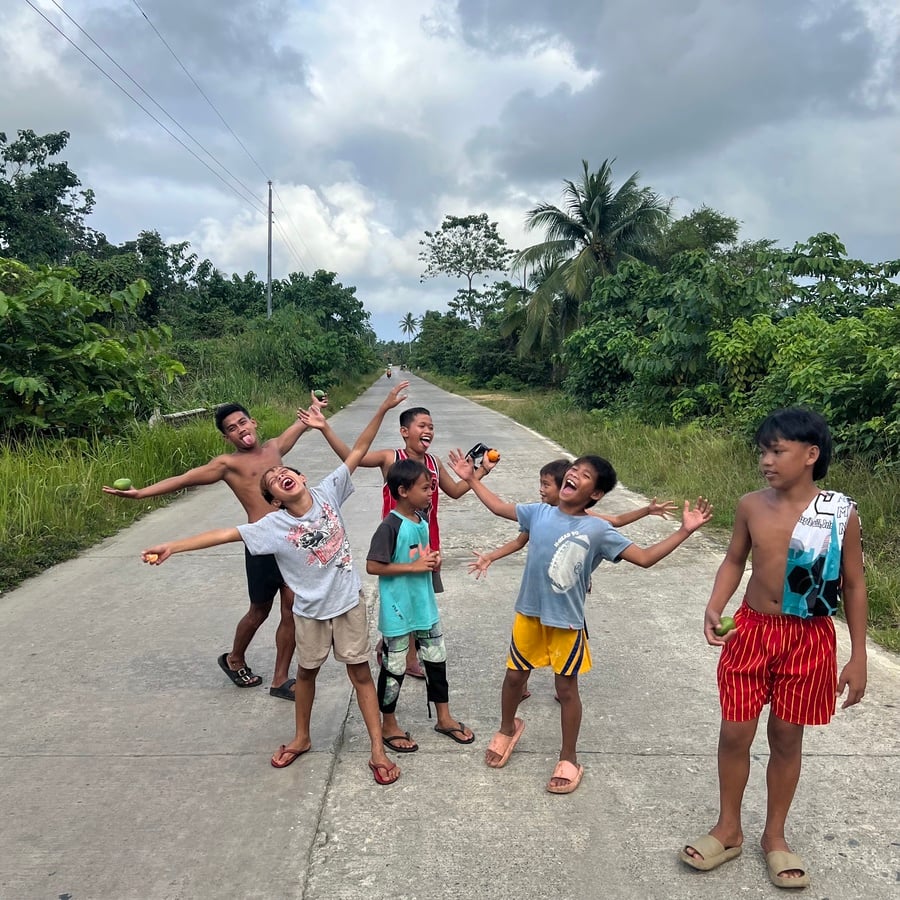
Photo: @joemiddlehurst
Volunteer in the Philippines
Volunteering overseas is a great way to experience a culture while doing some good in the world. There are lots of different volunteer projects in the Philippines which you can join, ranging from teaching, to animal care, to agriculture to pretty much anything!
High levels of poverty throughout the Philippines mean there are plenty of opportunities for backpackers to volunteer and help small communities. Social work, like teaching and cultural exchanges are always available to aid community development. Other opportunities include helping out in hospitality and assisting with eco-projects on farms. Travellers won’t need a special visa to volunteer in the Philippines for less than 90 days, but you’ll have to apply for the appropriate permit to stay long-term.
Our go-to platform for finding volunteering gigs is Worldpackers, who connect travellers with host projects. Have a look at the Worldpackers site and see if they have any exciting opportunities in the Philippines before signing up.
Alternatively, Workaway is another excellent common platform used by travellers searching for volunteering opportunities. You can read our review of Workaway for more info on using this terrific platform.
Volunteer programs run through reputable work exchange programs like Worldpackers and platforms like Workaway are usually very well-managed and reputable. However, whenever you are volunteering do stay vigilant, especially when working with animals or children.
What’s New for Philippines Backpacking Trips
The Philippines you’re heading to this looks a little different from the one the older guides were written about. A few things have changed enough that you’ll want to know about them before you land.
- Start with the eTravel system: The Philippines now requires all arriving visitors to register online at etravel.gov.ph within 72 hours before arrival. It’s free, takes five minutes, and spits out a QR code you’ll need to show at immigration.
- Budgets have changed: In 2018, a broke backpacker could scrape by on $25-$30 a day. That’s no longer realistic. A comfortable backpacker budget now sits closer to $40-$50 a day, factoring in dorm beds, local food, and getting around. It’s still cheap by global standards, but the days of doing the Philippines on a completely broke backpacker budget are (unfortunately) over.
- Grab as the standard: Getting around cities has changed too. Grab is now the standard way to move around Manila, Cebu, and most major cities. Sometimes metered taxis are the cheaper option, but the whole appeal of Grab is the fixed price, with no need to hail.
- Boracay iPass: Boracay has a registration system now – if it’s on your itinerary, you’ll need to register for a Boracay iPass and have a confirmed booking with an accredited hotel before you arrive on the island.
- Backpacking El Nido/Coron: Tour prices in both Palawan hotspots are now strictly regulated, and environmental user fees are mandatory and checked frequently. It’s not a bad thing; the money goes toward protecting the reef systems that make both places worth visiting. Just factor them into your budget from the start rather than acting surprised at the dock.
- Cash is still king BUT…GCash has taken over almost everywhere outside of rural areas and islands. This can be finnicky to set up as a tourist so either ask your hotel or a local to help or expect to still rely on cash.
What I’d Do Differently Next Time
As far as island hopping goes, it doesn’t get much better than the Philippines. And whilst, for the most part, my time there was awe-inspiring, there are certainly things I’d do differently when I (inevitably) go back.
The main one is NOT to travel during the holidays. I went over xmas and New Year’s and, whilst it was cool to get involved in the festivities of a Catholic country, it didn’t make up for all of the downsides.
It was busy, it was expensive, and I felt that I was missing out on that infamous Filipino warmth BECAUSE it was so busy. People, for the most part, felt rushed, stressed, and I felt guilty for being part of that burden. You also have to plan in advance way more than usual, and, as a type B traveller, that’s just not my forte. I still saw my fair share of rain, so next time I’d go back in low season and will take whatever bad weather that comes with it on the chin.
I’m glad I ticked off the heavy hitters, but I certainly won’t be returning to the usual tourist trail. Nothing wrong with the islands I visited…there’s just over 7000 of ’em! I’m guessing that going off the beaten path next time will unlock a side of the Philippines not accessible to the less adventurous tourists. I’d also visit some mountains and do some trekking…beach bumming gets boring after a while, dare I say.
I can’t wait to visit again so I can unlock some undiscovered islands and mix it up by throwing in a volcano every once in a while. If you’ve got spots of your own that you’d like to share, do me a solid and share them in the comments!