Bali has a reputation problem. Not because it’s bad, but because it’s been photographed, filtered, and posted so many times that it can feel like you’ve already been there before you’ve booked a flight. It’s why I was really unsure I would EVER visit Bali. Hadn’t I already seen the whole place on Instagram?
I promise that you have not.
Here’s the thing, though. Knowing what Bali looks like and knowing how it actually feels to backpack are two completely different things. Where do you base yourself? How do you get between islands and beaches and volcanoes without completely blowing your budget? Which parts are worth the hype and which parts are just hype? Where do all the cool people hang? Backpacking Bali can get complicated fast, which is why I’m here to set the record straight.
Backpacking Bali means a lot of things. It means cheap warungs, cold Bintangs, surf breaks for every level, waterfalls you have to hike to earn, temple hopping, yoga if that’s your thing, proper beach town chaos if it isn’t, and enough café culture to keep any remote worker caffeinated for months. It also means making a lot of choices, because Bali is bigger and more varied than the Instagram grid suggests, and you can’t do all of it in one go.
This updated budget travel guide to Bali covers everything and more that you need to know for your trip. Here I’ll go into:
- How much you’ll be spending on an average day here (basically fuck all in many places).
- Detailed safety tips, and issues you need to look out for. The monkeys DO bite!
- Transport, insurance, things to do, itineraries, accommodation, and sooooooo much more.
Get your scuba gear out the closet, because it’s time to dive into the depths of Bali’s beauty.
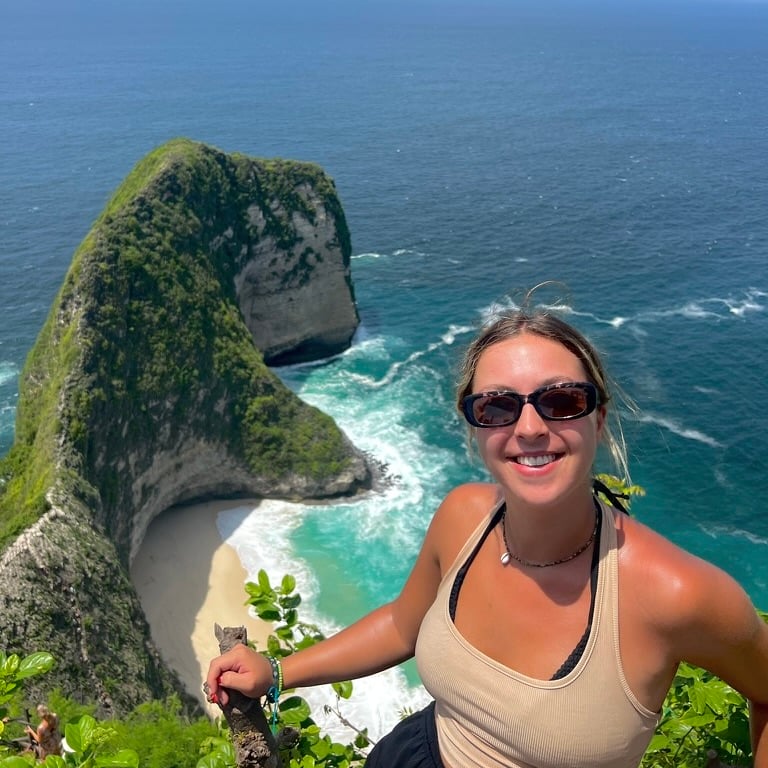
Photo: @taya.travels
The Broke Backpacker is supported by you. Clicking through our links may earn us a small affiliate commission, and that's what allows us to keep producing free content 🙂 Learn more.
- Why Go Backpacking in Bali?
- Best Itineraries for Backpacking Bali
- Best Places to Visit in Bali
- Top 10 Things to Do in Bali
- Backpacker Accommodation in Bali
- Backpacking Bali Costs
- Bali Budget Tips That Actually Make a Difference
- Best Time to Travel to Bali
- Staying Safe in Bali
- How to Get to Bali
- Entry Requirements for Bali
- How to Get Around Bali
- What’s New for Bali Travel
- Working in Bali
- Balinese Culture
- A Short, Useful History of Bali
- Some Unique Experiences in Bali
- Final Advice Before Visiting Bali
Why Go Backpacking in Bali?
Part of what makes Bali work so well for backpackers is how much it packs into a relatively small island. You can surf in the morning, chase waterfalls in the afternoon, eat a ridiculous meal for next to nothing, and still make it to a rooftop bar for sunset. Then do something completely different the next day. People shit on Bali, but the range here is genuinely hard to match: beach towns, rice terrace hikes, dive sites, temple complexes, surf breaks, wellness retreats, and party strips all exist within a few hours of each other.
That variety also means Bali bends to fit different travel styles. Come with a tight budget and you’ll find warungs serving full meals for a dollar, guesthouses that won’t hurt your wallet, and plenty of free or cheap things to fill your days. Come with a bit more to spend and you can easily spunk your money fast and have fun in the process. Beach clubs, insanely impressive villas and some of the best food I’ve had in Southeast Asia. The island rewards both approaches.
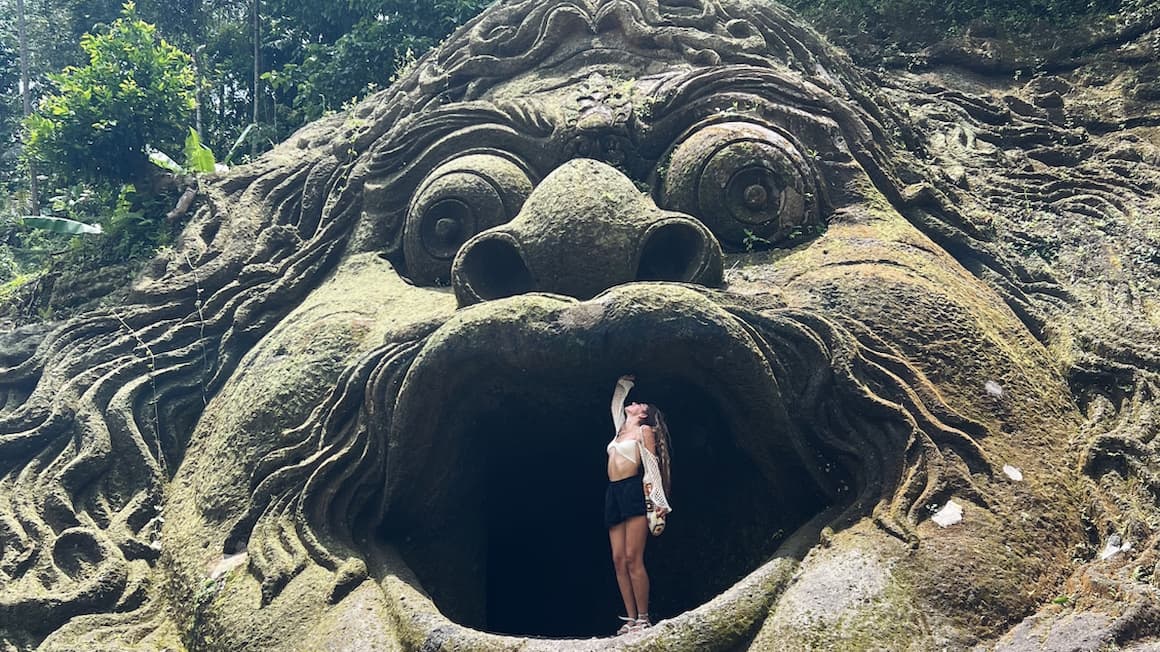
Photo: @amandaadraper
It also rewards staying longer than you planned. There’s a reason so many people book a week and quietly extend. The pace is easy, the cost of living is low, and the lifestyle teeters between productive and completely horizontal, depending on the day, making it hard to justify leaving. Yoga, surf lessons, a cheap villa with a pool, a café where you can actually get work done: Bali has built an entire ecosystem around people who aren’t quite ready to go home yet.
It’s not all sunshine and rainbows though: the notion that parts of Bali are crowded are very much real. Certain areas can feel more like a theme park than a destination. That’s not a reason to skip it, but it is a reason to plan carefully, because the Bali that feels rewarding is still there. You just have to hunt a little harder for it.
Best Itineraries for Backpacking Bali
With so much to do, where do you start a Bali budget trip?
Lucky for you, I’ve created a few itineraries that show you a few of Bali’s best sides. Hopefully you’ll stick around and stay for a few weeks at least to check out all the best things to see in Bali!
Distances here are not insurmountable; the points in these itineraries are just 1-2 hours apart. If you’re brave enough to take a scooter to the infamous Bali roads, you’ll be backpacking Bali in no time at all.
1 Week Travel Itinerary: Bali’s Best Bits
- Best for: First-timers, solo travellers, backpackers wanting culture and beach
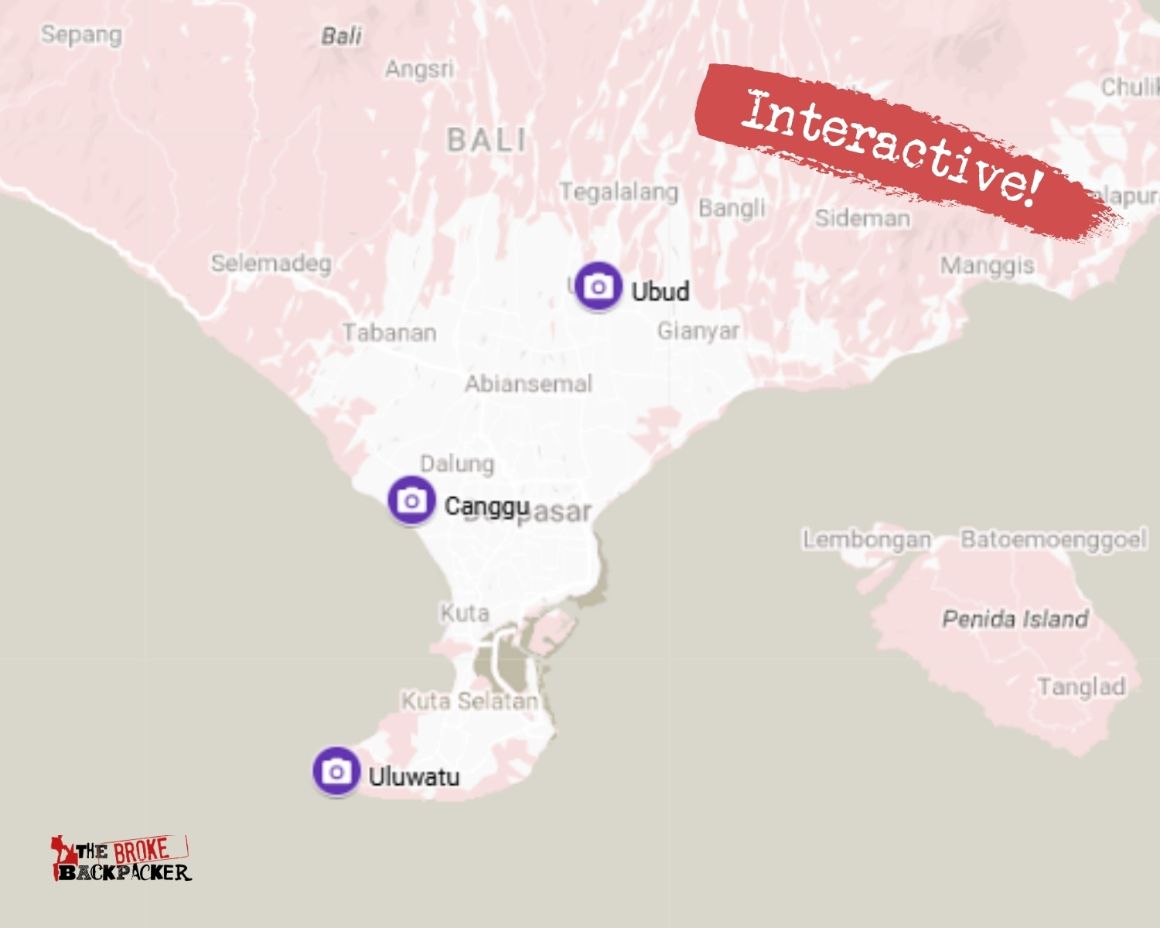
- Suggested route: Canggu – Ubud – Uluwatu
- Total days: 7
- Transit intensity: 3 base changes, scooter recommended for getting around each stop
- Difficulty: Easy
- Best season: May to September (dry season)
- Budget: $35–$50/day
- Vibe: Temples, waterfalls, surf, sunsets, late nights, repeat
Seven days is enough to get a real feel for Bali, as long as you’re not trying to do everything. This route hits three distinct bases: Canggu for easing in off the plane, Ubud for culture and jungle, and Uluwatu for cliffs, surf, and sunsets to finish on a high. It flows south through the island in a logical direction, which means no doubling back and no wasted transit days.
This works best for first-timers who want a little bit of everything, from activity days to stretches of working on your tan.
Stop One: Canggu
Start in Canggu to really dive into the chaos. Get the full Bali experience by visiting beach clubs, hopping from restaurant to bar and staying out until the sunsets. After a couple days of partying, you’ll be well and truly prepped for a little zen in Ubud.
Stop Two: Ubud
Many travellers argue that backpacking Ubud and the lush mountains of northern Bali require their own separate itinerary and for good reason – there’s so much to do here! Go rambling in the rice terraces; visit the many volcanoes in Indonesia; have a spa day in one of the many jungle retreats… there are a lot of options. The town itself has stuff to see and explore for at least a day, and you can easily find tons of good day trips around there – just take your pick.
Stop Three: Uluwatu
Head down to Uluwatu for your last stop. Home to my favourite beaches on mainland Bali, this coastal town is all about sun, surf and yoga. The pace is slower than that of Canggu, but you’ve still got your fair share of restaurants and beachside clubs to dabble in.
Two Week Itinerary: Culture, Coast & the Nusa Islands
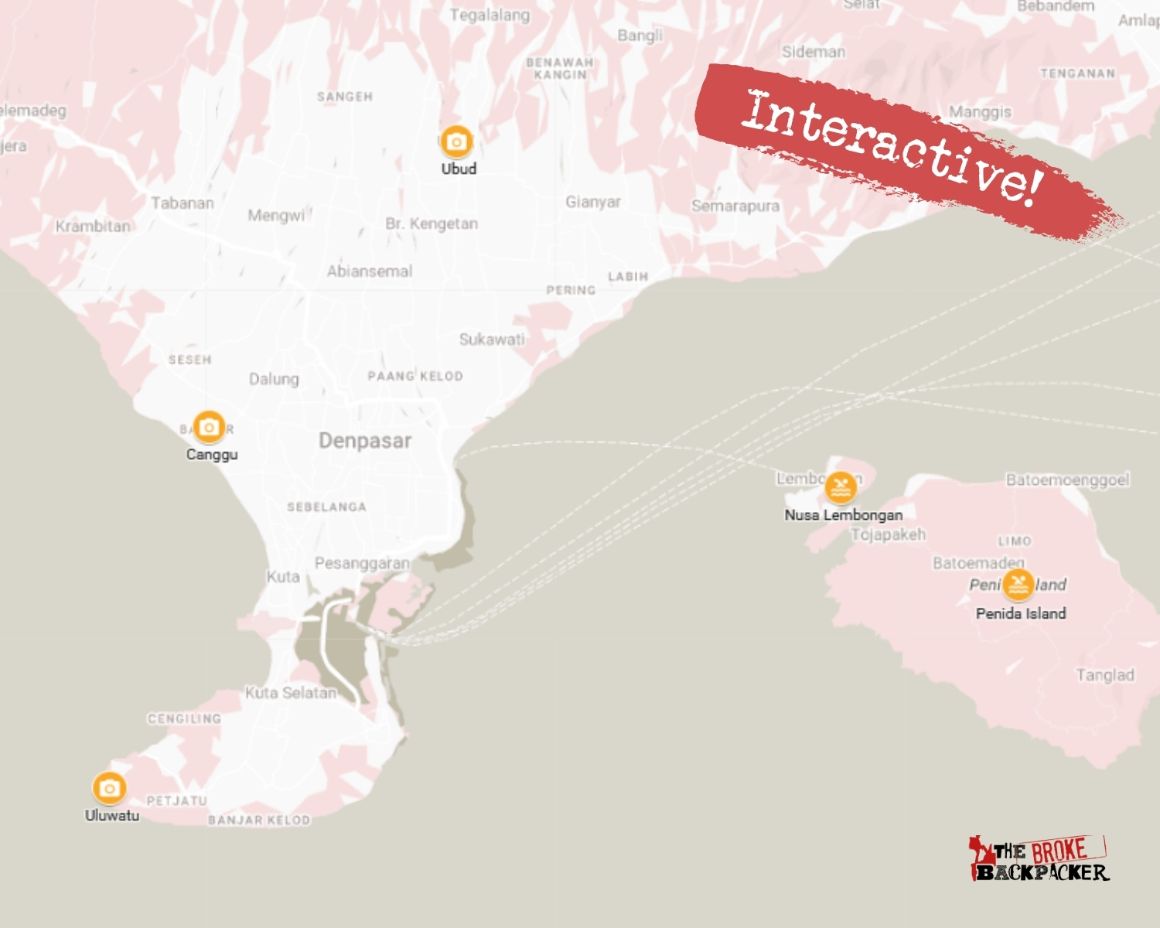
- Best for: First-timers, backpackers wanting the full spread, anyone who can’t choose between culture and beach
- Suggested route: Canggu – Ubud – Nusa Penida – Nusa Lembongan – Uluwatu
- Total days: 14
- Transit intensity: 5 base changes, including two boat rides
- Difficulty: Easy to moderate
- Best season: May to September
- Budget: $40–55/day on the island, slightly more on the Nusas
- Vibe: Surf, temples, waterfalls, island hopping, sunsets, repeat
Two weeks is where Bali starts to make real sense. You have enough time to actually slow down in each place rather than just passing through, and you can add the Nusa Islands into the mix to add a little razzle dazzle into the mix. This route covers the main bases on the island itself and then gets you off it for a few days, which is worth doing even if you only have a day or two to spare over there.
This suits backpackers who want range: culture, surf, beaches, island-hopping, and enough downtime to feel like you’ve actually been somewhere rather than just ticked boxes.
Stop One: Canggu
Land in Denpasar and head straight to Canggu. It’s the closest proper base to the airport, the easiest place to find your feet, and a solid introduction to what Bali does well: beaches, cheap food, and a social scene that doesn’t require effort. Three days is enough to surf, eat your way through the warung scene, and shake off the flight before heading inland.
- Surf at Batu Bolong or Echo Beach; lessons easy to arrange for beginners
- Ride out to Tanah Lot for sunset on your first or second evening
- Old Man’s bar at least once
Stop Two: Ubud
Head inland to Ubud, Bali’s cultural heartland. The drive takes about 90 minutes and the landscape shifts fast. Four days here still won’t feel like enough, but you can do a lot with it: rice terraces, waterfalls, temples, a volcano hike if you want to earn your breakfast, and more cafés per square metre than anywhere has any right to.
- Tegallalang Rice Terraces before 9am, before the tour groups arrive
- A full waterfall day: Tegenungan is closest, Sekumpul is the best if you can commit the time
- Mount Batur sunrise hike if you’re up for a 4am start; worth every minute of lost sleep
- Kecak fire dance at Ubud Palace or Uluwatu Temple at sunset
Stop Three: The Nusa Islands
Take a fast boat from Sanur (around 45 minutes) to Nusa Penida, spend two nights, then hop across to Nusa Lembongan for two more. Penida has the most insane beaches with crowds to match whilst Lembongan is smaller and feels more off-the-beaten-path, with a super chilled out beach town pace. Together, they feel a world away from Bali.
- Penida: Kelingking Beach viewpoint, Angel’s Billabong, Broken Beach, Diamond Beach
- Penida: Crystal Bay for snorkelling, manta rays appear here seasonally
- Lembongan: cross the Yellow Bridge to Nusa Ceningan, Devil’s Tears, Dream Beach
- Lembongan: snorkel or dive the channel between the two islands
Stop Four: Uluwatu
Boat back to Sanur and head south to the Bukit Peninsula to finish. Uluwatu is dramatic cliffs, serious surf breaks, and a pace that rewards slowing down. It’s a good place to end a trip.
- Uluwatu Temple at sunset, no exceptions
- Bingin Beach for a slow day, Padang Padang if the swell allows a swim
- Single Fin on a Wednesday or Sunday if you want one last proper night out
- Surf lesson at Balangan if two weeks still hasn’t converted you
1 Month Travel Itinerary for Bali: The Grand Tour
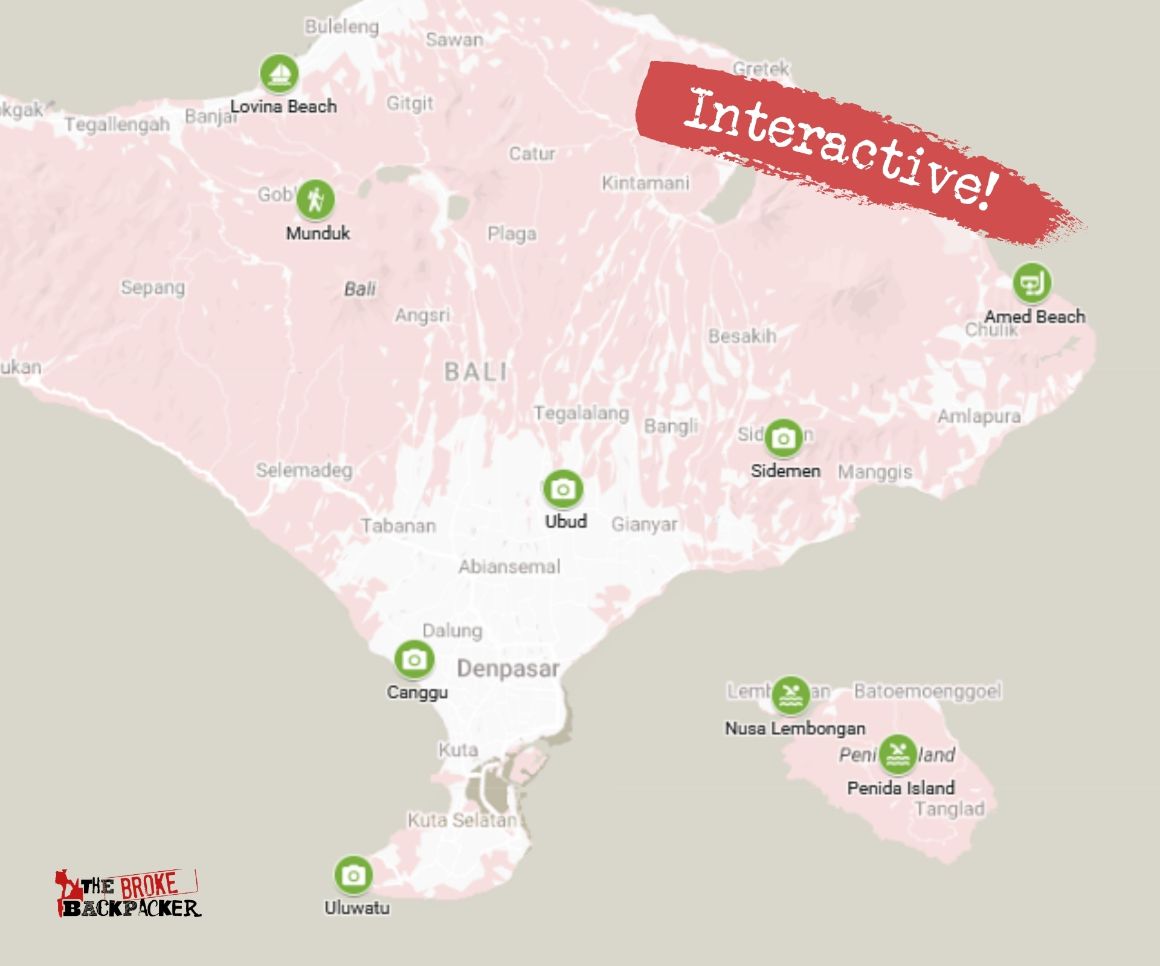
- Best for: Slow travellers, returning visitors, longer-term backpackers, digital nomads with flexibility
- Suggested route: Canggu – Ubud – Sidemen – Amed – Munduk – Lovina – Nusa Penida – Nusa Lembongan – Uluwatu
- Total days: 30
- Transit intensity: 9 base changes, two boat rides with a scooter being essential in some spots
- Difficulty: Easy to moderate
- Best season: May to September
- Budget: $35–50/day averaged across the trip
- Vibe: Slow travel, real Bali, fewer tourists, all the good stuff
Got a whole month to spare for backpacking Bali? Good. This itinerary will take you all over: you’ll see the jungles, volcanoes, temples, beaches, dive bars, everything you can imagine!
This route moves from the busy south through the cultural centre, up into the mountains and north coast, across to the quieter east, and back down through the Nusa Islands to finish on the Bukit. It’s the full picture, done at a pace that actually lets you enjoy each stop.
Stop One: Canggu
Land in Denpasar and start in Canggu. With a month ahead of you there’s no need to rush, but Canggu is good for easing yourself into it: it’s the most social base on this route, the surf is accessible, and the food scene is excellent.
- Surf at Batu Bolong or Echo Beach; lessons easy to sort for beginners
- Tanah Lot for sunset, ideally on a weeknight when it’s quieter
- Dive head first into the food scene, you’ve got cuisines from every corner of the globe
- Old Man’s bar at least once
Stop Two: Ubud
Head inland to Ubud. Ubud rewards slowness more than most places in Bali so give yourself enough time to do it properly: enough time for the day trips, the waterfall runs, a volcano hike, and still have mornings where you do absolutely nothing.
- Tegallalang Rice Terraces before 9am, every time
- A full day of chasing waterfall day, from the popular spots like Sekumpul to more undiscovered spots
- Mount Batur sunrise hike
Stop Three: Sidemen
Drive east from Ubud into Sidemen, a quiet valley with some of the best rice terrace views on the island and a fraction of the visitors. Most people skip it entirely, which is exactly why it’s worth going. It sits in the shadow of Mount Agung and the landscape is dramatic in a way that feels completely different from anywhere else on this route.
- Walk or ride through some of the most stunning rice fields on the island
- Visit Tukad Cepung Waterfall, a cave waterfall reached via a short river walk
- Use it as a base to visit Besakih, Bali’s largest and most sacred temple complex, on Mount Agung’s slopes
Stop Four: Amed
Continue east along the coast to Amed, a string of quiet fishing villages with black sand beaches, good diving, and a feel for what the rest of Bali must’ve felt like 20 years ago. This is where the itinerary genuinely slows down. Amed suits people who are happy to be somewhere without much going on, making it a good breather in the middle of this itinerary.
- Snorkel straight off the beach
- Dive the USS Liberty wreck at Tulamben, 45 minutes up the coast and one of the best shore dives in Southeast Asia
- Rent a kayak and paddle out at sunrise before the heat kicks in
Stop Five: Munduk
Drive up into the mountains to Munduk. The road gains altitude fast and the temperature drops noticeably. Munduk is a small highland village surrounded by coffee and clove plantations, crater lakes, and enough waterfalls to fill several days. It’s one of the least touristy places you’ll find on an island this visited.
- Sekumpul Waterfall: the best waterfall in Bali, a 30-minute trek through jungle and rice fields to reach it
- Banyumala Twin Waterfalls for swimming, quieter than Sekumpul and easier to reach
- Ulun Danu Beratan Temple on Lake Beratan: one of the most photographed temples in Bali, worth an early morning visit before the day trippers arrive
Stop Six: Lovina
Drop down from the mountains to the north coast and Lovina. People tend to come here for one reason: dolphin watching. Early morning boat trips out to see wild dolphins in the Bali Sea is one of the rawest experiences you can have to nature-spot on the island. Back on dry land, Lovina is a chill, low-key place to decompress for a night before heading back south.
- Dawn dolphin watching boat trip: out by 6am, back for breakfast, dolphins almost guaranteed
- Banjar Hot Springs: natural volcanic hot springs 45 minutes from Lovina, cheap entrance, genuinely relaxing
- Eat fresh seafood on the beach for dinner and call it an early night
Stop Seven: Nusa Islands
Head back south to Sanur and take the fast boat to Nusa Penida. After a month of being on the main island, the Nusas feel like a proper escape. Spend at least two nights on Penida hitting the main viewpoints, then hop across to Lembongan for two nights of slower beach time before heading back.
- Penida: Kelingking Beach, Angel’s Billabong, Broken Beach, Diamond Beach
- Lembongan: Devil’s Tears, Dream Beach, the Yellow Bridge crossing to Ceningan
Stop Eight: Uluwatu
Two final nights in Uluwatu to finish Bali off with a bang: cliff sunsets, one last temple visit, one last surf session or beach day, and a decent final dinner somewhere with a view. The airport is close enough that an early departure is easy breezy.
- Uluwatu Temple at sunset
- Bingin Beach for a slow morning or a bit of surfing
- Single Fin on a Wednesday or Sunday if the timing works out
Best Places to Visit in Bali
Now it’s time to cover the best places to visit in Bali more in-depth, so you know exactly where to go during your trip. From the most popular destinations to some hidden gems, this is where to go backpacking in Bali.
Note that the towns on the south coast of Bali are pretty much blended together with no visible city borders. Each area has a bit of a different vibe to others, though. My best advice is to base yourself in Canggu and commute from there to wherever you want to go!
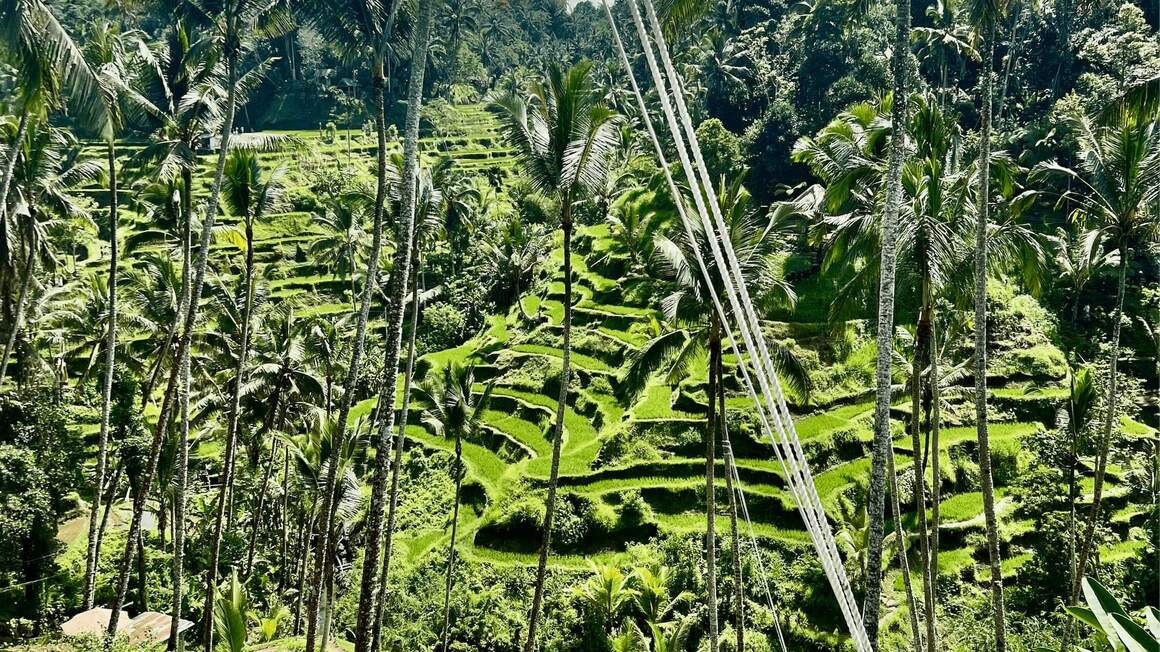
Photo: @amandaadraper
Backpacking Canggu
- Best for: Surfers, digital nomads, social backpackers, anyone who wants a lively base with good food
- Known for: Surf beaches, café culture, nightlife, the expat and nomad scene
- How long to stay: 3–4 days
- Don’t miss: Sunset at Echo Beach, Tanah Lot day trip, Old Man’s on a busy night
Canggu is the loudest, most caffeinated, most socially active base in Bali, and depending on your travel style, that’s either exactly what you want or a reason to move on quickly. It’s the undisputed heart of Bali’s expat and digital nomad scene: the place where people come specifically for the surf, the coffee, the co-working spaces, and the kind of social life that has a habit of extending your visa without you quite meaning to.
Between yoga studios, vegan restaurants, a great surf beach, awesome nightlife, famous gyms… I fucking love it here. There’s just so much to do in Canggu! Canggu is a village with a big city heart. The food scene is excellent, the nightlife runs late, and there is always something going on, which is both the appeal and the problem depending on what kind of trip you’re on.
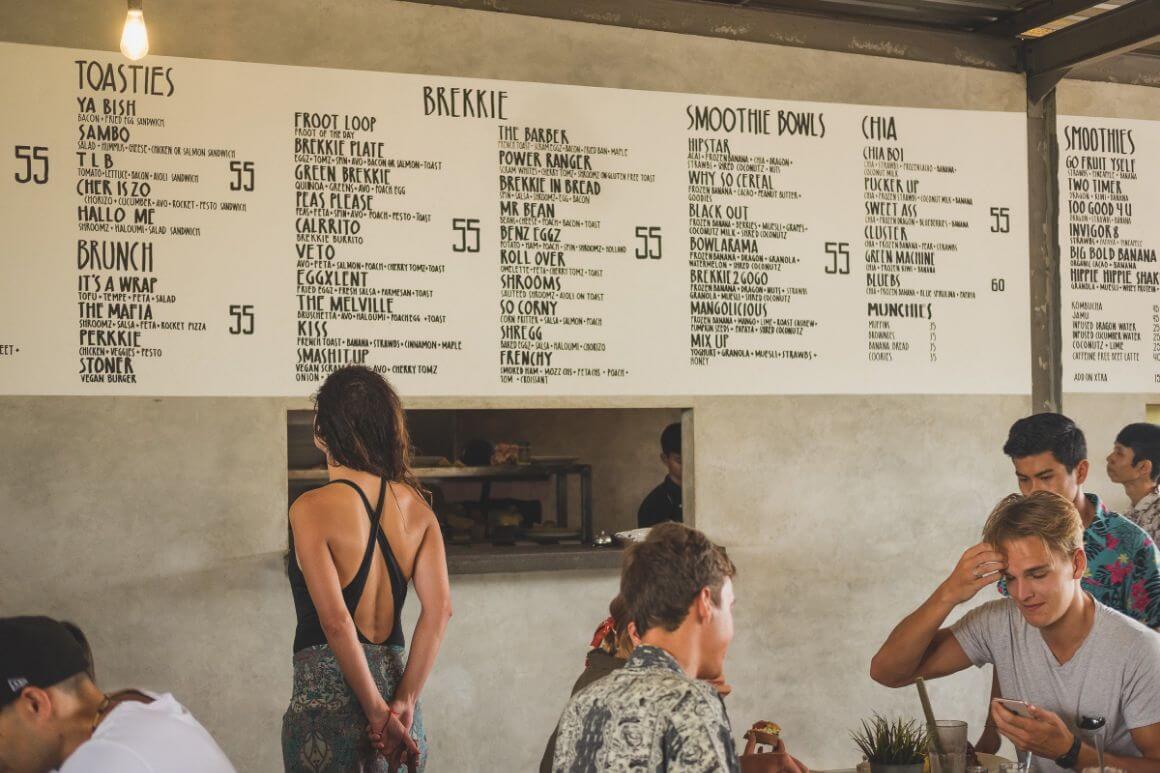
Photo: Roaming Ralph
- The beaches, mainly Echo Beach, Batu Bolong, and Berawa, are not postcard-pretty but they work well for surfing and sunset sessions. Lessons are easy to arrange at all levels.
- The café and co-working scene is among the best in Southeast Asia. If you’re working remotely, you’ll be well set up here. Make sure to head down to Tribal Hostel for some networking, slamming the keyboard, chilling in the pool or sipping on a cold coconut from the bar.
- Some of the best bars in Canggu are Black Sand Brewery (great craft beers!), La Brisa (best shisha), and The Lawn (awesome place for sunset cocktails!) All these spots are pricey for Bali standards though so if you’re backpacking Bali on a budget, join the crowds at seedy dive bars, in front of mini-marts, or just the backpacker bar at your hostel in Canggu.
- Tanah Lot, the sea temple on the coastal rocks just up the coast, is an easy and worthwhile day trip, best visited on a weeknight to avoid the worst of the crowds.
The honest caveat: Canggu has grown fast and parts of it are a construction site. It can feel more like an expat neighbourhood than a Balinese town, which is fine if that’s what you’re after and slightly jarring if it isn’t. Keep your warung habits intact here and you’ll spend very little. Start eating and drinking at beach clubs every day and the budget will suffer.
Backpacking Ubud
- Best for: Culture lovers, nature seekers, spiritual travellers, digital nomads, anyone who wants more than a beach
- Known for: Rice terraces, temples, jungle, wellness, art, the monkey forest
- How long to stay: 4–6 days
- Don’t miss: Tegallalang Rice Terraces at dawn, Sekumpul Waterfall, a Kecak fire dance at sunset
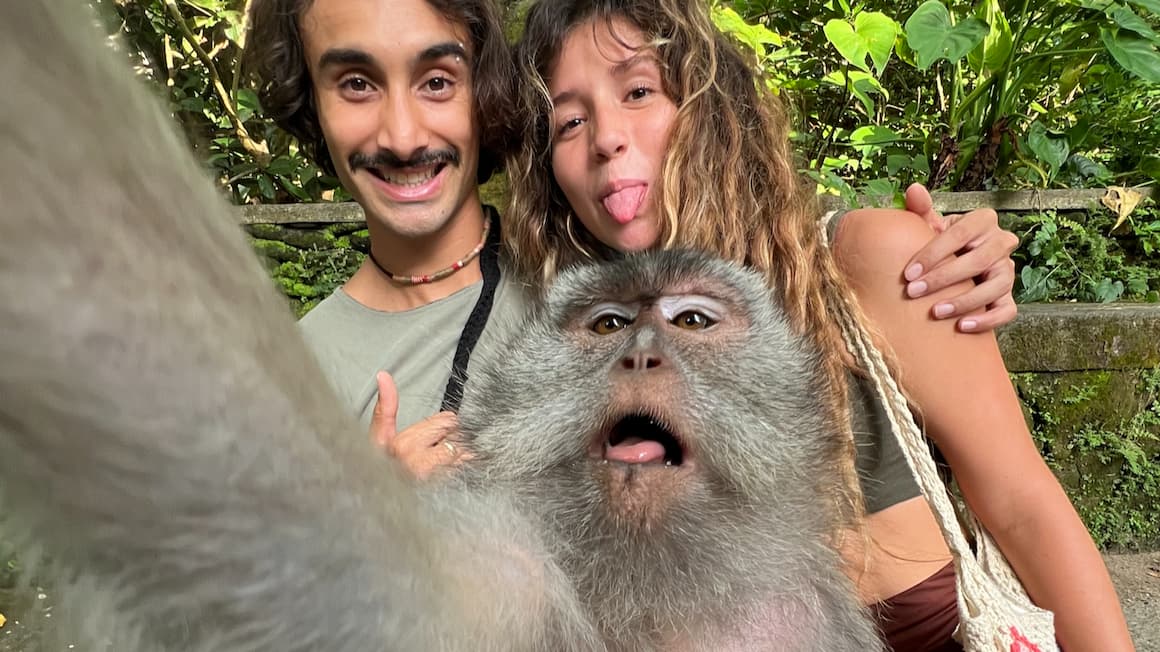
Photo: @amandaadraper
Ubud is the primary base for backpackers to explore the highlands of Bali. The ‘green heart of Bali’, it sits in the highlands of central Bali, surrounded by rice terraces, jungle, rivers, and more temples than you can reasonably visit in a week. The pace is slower than the south, the food scene is strong, and the café and co-working infrastructure is solid. This town is also known for its hippies. Spiritual backpackers will feel right at home here, and it offers some of the best yoga in Bali. Don’t be surprised if you find a hostel in Ubud to settle into and end up staying for a month.
- Ubud is absolutely jam-packed with temples – nowhere else in Bali can you find so many religious sites and in such great abundance. Make sure you check out the epic Goa Gajah, Pura Kehen, the humble Yeh Pulu, and the Tirta Empul. My real favourite is Gunung Kawi, mostly for its expansiveness but also for its ambience.
- Visiting the Monkey Forest is one of the very popular things to do in Ubud for very obvious reasons – here, monkeys run freely among the wooded grounds and play with visitors. Be careful though: monkeys are fuckers and they will steal your snacks, iPhone, and probably soul, too.
- Be sure to visit the Neka Art Gallery, Setiadarma House, Ubud Palace, and the Agung Rai Museum for some prime culture.
- Ubud is all about nature. You probably already know the Tegallalang rice terraces and the Campuhan Ridge Walk from Instagram, but in real life, they’re also gorgeous. Just get up early to avoid crowds!
- Ubud has a strong wellness scene: yoga studios, sound baths, cooking classes, and retreat centres are everywhere and mostly affordable. You don’t have to be that kind of traveller to get something out of it.
The honest caveat: Ubud’s main strip is very touristy and can feel overwhelming if you arrive expecting something quieter. Choose an area less central as your base and you’ll still be able to feel the Ubud that everyone bangs on about. The rice terraces also now charge entrance fees and some have become more photo-op than experience. Go early, go on foot where you can, and you’ll still find what everyone came here for.
Backpacking Kuta
- Best for: Party-focused backpackers, first-time surfers, budget travellers who want cheap beds near the beach
- Known for: Nightlife, long surf beach, wall-to-wall bars, budget accommodation
- How long to stay: 2–3 days maximum
- Don’t miss: A surf session on Kuta Beach
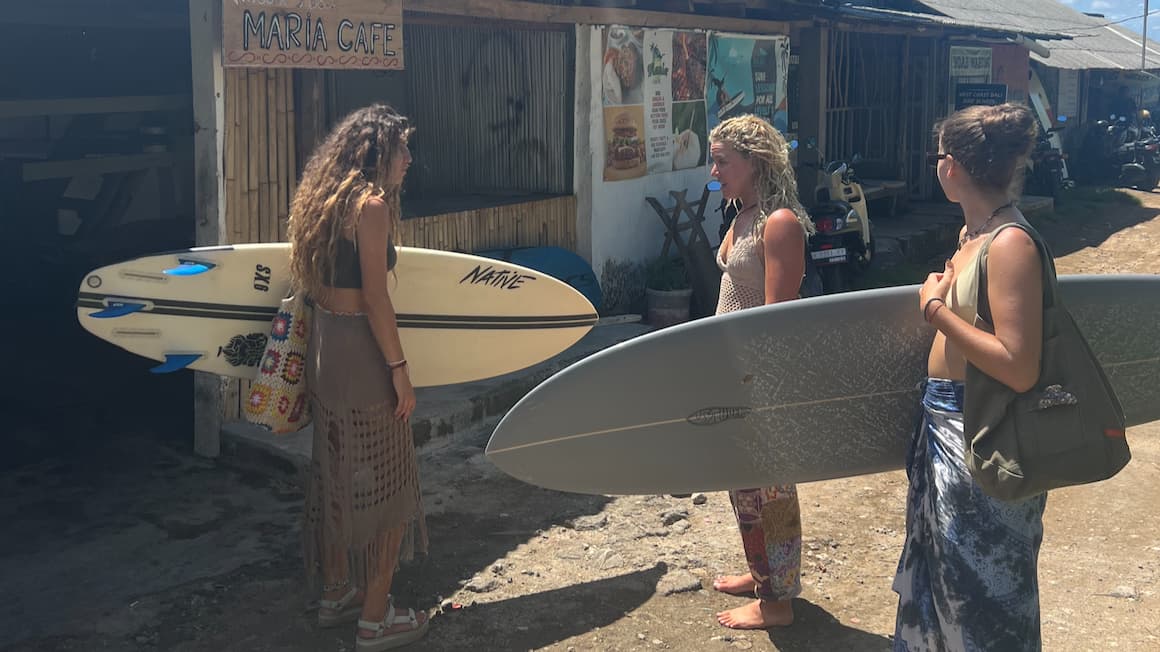
Photo: @amandaadraper
Stretching west of Denpasar through Legian and into Seminyak, this region is the most developed, most crowded, and most aggressively touristy part of the island. Kuta definitely has a reputation for being pretty debaucherous and grimy. All of Kuta’s neighbourhoods are lined with countless dive bars, and by night, wasted drinkers stumble around, trying their hardest not to fall off their motorbike taxis. It’s chaotic in a way that some people find electric and others find exhausting within 48 hours.
If you’re looking for the best parties in Bali, you’ll definitely find many of them here in Kuta. If you’re young, on a tight budget, and want to drink cheaply and surf in the morning, it does what it says on the tin. If this is your jam, book into a party hostel in Kuta and have yourself an absolute blast. If you’re looking for cultural immersion or anything resembling a quiet evening, it doesn’t.
- The bar scene is extensive and mostly generic. There are exceptions but the honest version is that most of Kuta’s nightlife blurs together after the first night.
- Seminyak, at the northern end of the strip, is noticeably more upmarket and slightly less chaotic. Worth knowing if you want something between Kuta’s energy and Canggu’s price point.
- Kuta also has a number of spas and yoga studios -the perfect way to spend a hangover IMO.
- The beach itself is long and actually very nice, although crowded.
- Kuta Beach still remains one of the best places to surf in Bali, so long as you don’t mind sharing the beach.
The honest caveat: Nearly all of Kuta’s bars will have a certain seediness to them whether you like that kind of thing or not – there are a lot of working girls around, try not to be a dick and if you’re going to interact, treat these ladies of the night kindly.
Backpacking Seminyak and Legian
- Best for: Backpackers who want a step up from Kuta without going full Canggu, anyone after decent beaches with less chaos
- Known for: Upscale bars and restaurants, cleaner streets, beach clubs, boutique shopping
- How long to stay: 2–3 days
- Don’t miss: Sunset from a beach club, a wander through Legian’s backstreets away from the main strip
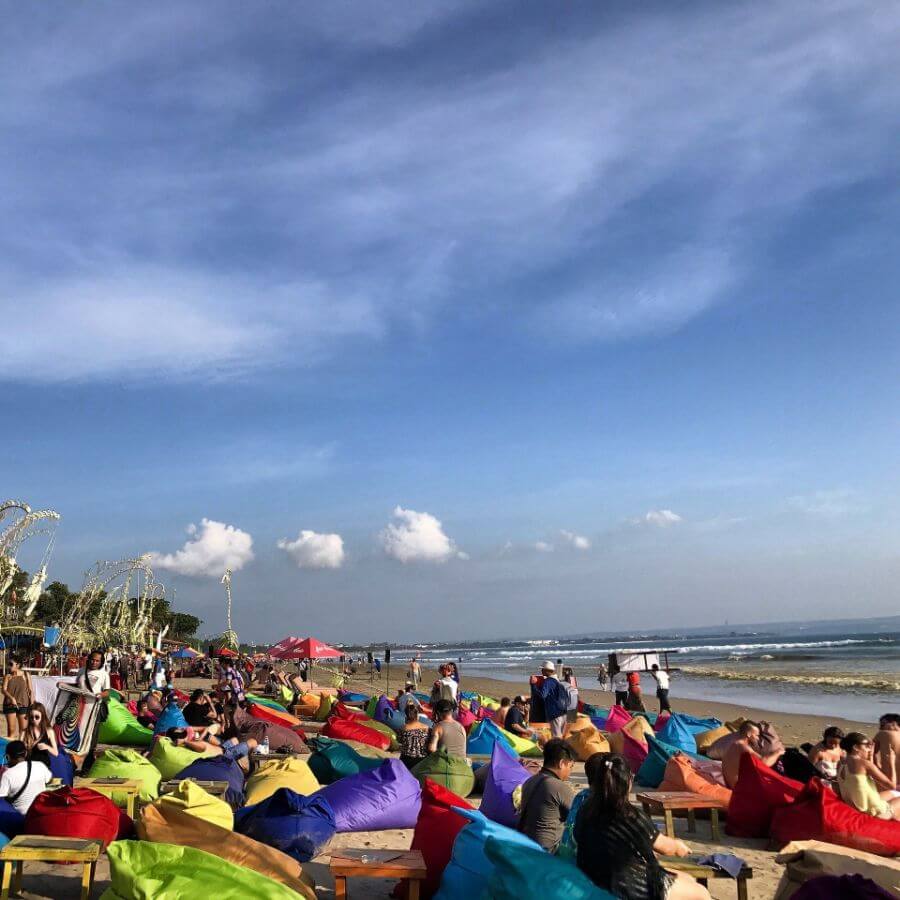
Seminyak and Legian sit between Kuta to the south and Canggu to the north, and they occupy a middle ground in terms of energy and price. Seminyak is the more polished end: wider streets, smarter restaurants, beach clubs with actual dress codes, and accommodation that trends upmarket even at the budget end.
If you’re finding staying in Seminyak a bit too bougie for your tastes, head a little south to the neighbourhood of Legian. Legian is scruffier and more relaxed and has a little bit of everything: some shopping here, some bars there, and plenty of beach in between. The vibes are not too extreme, and the energy here feels much more stable.
- The beaches are wide, well-kept, and better for swimming and sunsets than surfing.
- Seminyak’s bar and restaurant scene is strong but expensive by Bali standards. Ku De Ta and Potato Head are the famous names; La Favela is worth a look for the interior alone.
- Legian has more varied shopping than Kuta and a calmer energy overall. Prices sit between the two neighbouring areas.
- Neither is the obvious backpacker base on this stretch. Canggu to the north gives you more for your money with a stronger scene for the budget crowd.
The honest caveat: Seminyak is easy to overspend in without noticing. The beach club and restaurant pricing is aimed squarely at people on holiday budgets, not backpacker ones, and it adds up fast. Go in knowing which mode you’re in.
Backpacking Uluwatu
- Best for: Surfers, cliff chasers, anyone wanting dramatic scenery and a slower pace than the north
- Known for: Legendary surf breaks, clifftop temples, hidden coves, sunset views
- How long to stay: 3–4 days
- Don’t miss: Uluwatu Temple at sunset, Bingin Beach, a cliff-view drink at Blue Point
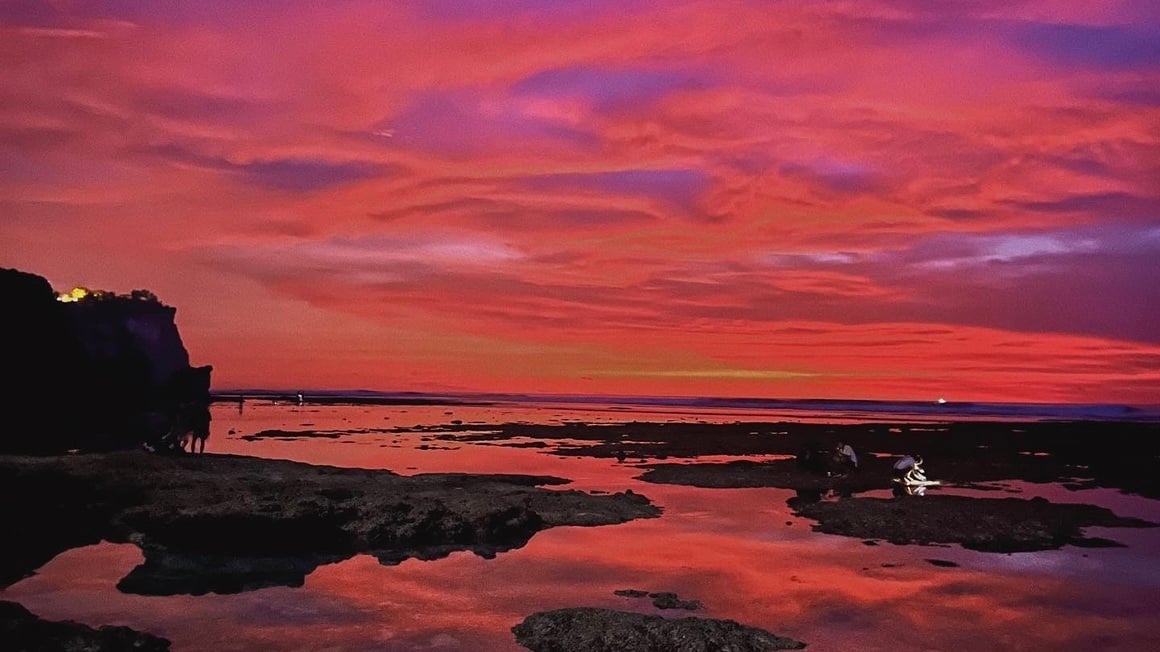
Photo: @amandaadraper
Uluwatu is a surfer mecca! Located on the southern tip of the island, Uluwatu has legendary surf, gorgeous temples, and some of the most beautiful beaches in Bali. Uluwatu is, for lack of better terms, simply stunning and just really fucking cool. The landscape is distinctly more rugged and arid than the rest of Bali. Here you will find epic coastal cliffs and hidden coves that are just waiting to be explored. Some of the best beaches in Uluwatu include Nyang Nyang Beach, Balangan Beach, Bingin, Padang-Padang, and Suluban Beach, among others.
- The surf here is serious. Uluwatu, Padang Padang, and Bingin are world-class breaks suited to experienced surfers. Beginners should head to Canggu instead and come back when they’re ready.
- Pura Uluwatu, the clifftop temple complex on the western edge of the peninsula, is one of the best temple visits in Bali. Catch the Kecak fire dance at sunset here if you can.
- One of the best things to see in Uluwatu is definitely on the western edge of the peninsula – an area that is referred to locally as “Blue Point.” Built among the cliffs overlooking the sea, the hotels here are a pretty awesome sight. Grabbing a drink and watching the surfers catch waves as the sun sets is one of the best things to do in Bali as night approaches.
- Nusa Dua on the eastern side of the peninsula is a different world entirely: it’s a gated community and pretty much a bore if you’re travelling Bali on a shoestring budget. If you’ve got some dough to spend, though, the fancy resorts can treat you like royalty.
The honest caveat: Uluwatu has less infrastructure for budget travellers than Canggu or Ubud. Hostels exist but options are thinner, and eating cheaply requires more effort. That said, the slower pace and the scenery make it one of the most rewarding places to finish a Bali trip.
Backpacking Sanur
- Best for: Transit stopovers, divers, travellers who want a calm base without the party scene
- Known for: Quiet beaches, eastern sunrises, fast boat departures to the Nusa Islands
- How long to stay: 1–2 days
- Don’t miss: The beachfront promenade at sunrise, fast boat to Nusa Penida or Lembongan
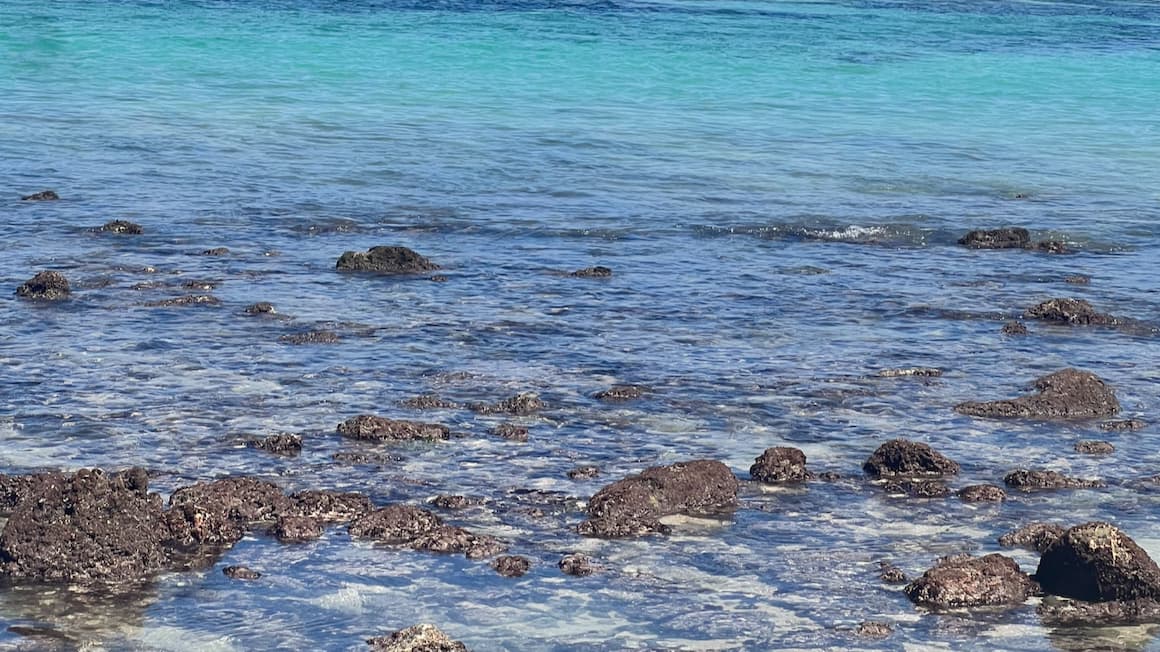
Photo: @amandaadraper
Sanur is one of the oldest resort areas in Bali and maintains a pretty relaxed atmosphere. As such, Sanur is more popular with the middle-aged crowd and/or those with families who are just trying to avoid dealing with the madness of the western beaches. Like any beachside resort worth two shits, Sanur has some great beaches to chill on. These beaches are notably devoid of the bars that litter the western shores and are instead replaced by a well-maintained promenade. I’ll be real, most people only find themselves here for the boat to the Nusas, but if your schedule and your social battery needs it, it’s a decent place to recharge for a night.
- The beaches face east, which means sunrises over the water rather than sunsets. Worth setting an alarm for at least once.
- Sanur is the main departure point for fast boats to Nusa Penida and Nusa Lembongan. Most boats leave in the morning, so an overnight here before an early crossing makes logistical sense.
- Kitesurfing is popular along the coast and conditions are good. Operators are easy to find along the beach road.
- The La Mayeur Museum, a former residence turned gallery exhibiting the work of Belgian impressionist Adrien Jean La Mayeur, is a worthwhile couple of hours if you want something cultural and low-effort.
The honest caveat: Sanur doesn’t have much to offer backpackers beyond its transit function and its calm. If you’re looking for nightlife, surf, or a social scene, you’re in the wrong place.
Backpacking Amed
- Best for: Divers, snorkellers, travellers wanting east Bali without the crowds
- Known for: USS Liberty wreck, black sand beaches, Mount Agung views, budget beachfront stays
- How long to stay: 3–4 days
- Don’t miss: Diving or snorkelling the USS Liberty wreck at Tulamben, sunset at Jemeluk Bay, Lempuyang Temple
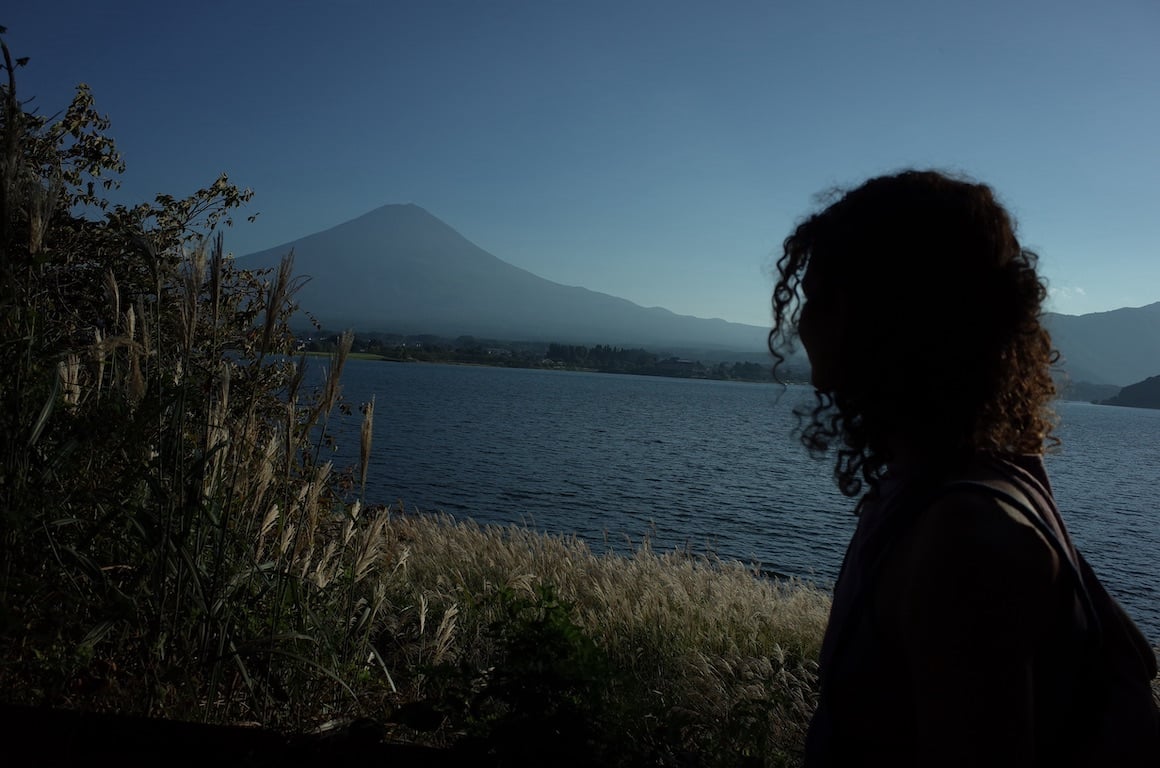
Photo: @audyscala
Once one of the sleepiest, most impoverished fishing villages in Bali, Amed is now becoming one of the most popular diving destinations on the island! Set against the inspiring Mt. Agung, Amed has some of the best scuba diving and snorkelling in Bali, in addition to some stunning scenery. Amed’s main attractions are mostly ocean-oriented. Between Amed and the local community of Tulamben, there are a plethora of dive sites to visit. There are several dive operators within either town that can organize trips out to the sites easily and affordably.
- The USS Liberty wreck is one of the most awesome dive sites in the area, as it has become a menagerie for aquatic life.
- The Japanese wreck at Lipah Bay and the underwater sculpture garden at Jemeluk Bay add variety if you’re staying long enough to do multiple dives.
- Jemeluk Bay is the spot for sunset views of Mount Agung. Seats at the local bar fill up fast; arrive early or watch from a paddleboard on the water.
- If you’re feeling invigorated by Mt. Agung, why not consider visiting or even climbing it?! Mt. Agung is only within an hour’s drive of Amed. The holiest temple on the island, Pura Besakih, is also located at the base of the mighty mountain.
- Lempuyang Temple is within easy reach of Amed and worth visiting properly. Skip the queue for the famous gate photo and climb further up the hill to see the full complex, which most visitors never bother with.
The honest caveat: Amed is genuinely quiet, which is the appeal and also the limitation. Nightlife is minimal, the restaurant scene is limited, and if you’re not into diving or snorkelling, there’s less to anchor a long stay. Two nights is enough for non-divers; proper dive enthusiasts could easily spend a week.
Backpacking Lovina
- Best for: Travellers wanting a genuine slow down, dolphin watchers, waterfall chasers
- Known for: Early morning dolphin trips, black sand beaches, nearby waterfalls, hot springs
- How long to stay: 2–3 days
- Don’t miss: Dawn dolphin boat trip, Sekumpul Waterfall, Banjar Hot Springs
Photo: @amandaadraper
Located in northern Bali, Lovina is perhaps the most laidback of all the beach destinations on the island. A loose collection of villages rather than a single town, it has black sand beaches, calm water, almost no nightlife, and a pace that makes even Amed feel busy by comparison. Because of the calm sea, diving and snorkelling are also popular activities, but let’s be real, you’ll most likely find yourself here to spot a dolphin or two.
- The dolphin watching trips are the main event. Boats go out at dawn and sightings are frequent enough that it’s worth the early alarm. Make sure you do your research for an ethical tour provider as there are currently no proper regulations in place in Lovina that protect wildlife.
- Sekumpul Waterfall is widely considered the best waterfall in Bali and sits within easy reach of Lovina. Gitgit, Aling-Aling, and Singsing are all nearby and worth building a full day around.
- Banjar Hot Springs, natural volcanic pools about 45 minutes from town, are cheap, uncrowded, and a good way to spend a slow afternoon.
- The Brahmavihara-Arama Buddhist temple is the largest Buddhist monastery in Bali and worth a visit for the architecture and the views back down toward the coast.
The honest caveat: Lovina is quiet to the point where some travellers find it underwhelming. The beaches are not Bali’s best and the town itself is low on atmosphere. Come for the waterfalls and the dolphins, use it as a recovery stop between bigger stretches of the route, and don’t expect it to be more than it is.
Backpacking Denpasar
- Best for: Transit, a cultural day trip for those with an interest in Balinese history
- Known for: Bali’s capital city, museums, temples, the main airport
- How long to stay: A day trip at most
- Don’t miss: Lapangan Puputan Margarana, the Bali Museum, Taman Budaya Art Center
Photo: @amandaadraper
Denpasar is Bali’s capital and most people’s entry point to the island, and for most backpackers that’s the extent of the relationship. It’s dense, traffic-choked, and short on the beaches and scenery that most people came to Bali for. The honest advice is to base yourself on the coast and treat Denpasar as a day trip if you’re curious, rather than a stop in its own right. Still, it’s not all tragic. Denpasar has many temples, museums, and cultural centres to visit. I also come to Denpasar when I’m craving a little bit of normalcy as Bali’s best movie theatre is here.
- Lapangan Puputan Margarana is probably the most prominent and important landmark in the area. At the centre is a large monument that commemorates Balinese independence through the celebration of the puputans – the original Balinese fighters who committed suicide to combat the Dutch.
- Near the Puputan is the Bali Museum, which has a great collection of Balinese artefacts. Though the Bali Museum is perhaps the largest, there are several others that you can visit in Denpasar, including the Sidik Jari Museum, the Wedhi Budaya Cultural Centre, and the Interactive Art Museum.
- Taman Budaya Art Center hosts dance and music performances and is the home of the annual Bali Arts Festival. Worth checking what’s on if your timing lines up.
- Pura Sakenan, Pura Agung Jagatnata, and Pura Maospahit are a few noteworthy temples around Denpasar.
The honest caveat: Denpasar is not a destination in the conventional backpacker sense and there’s no shame in skipping it entirely. If you have a genuine interest in Balinese culture and history beyond the temple trail, a half day here suffices.
Backpacking Nusa Lembongan, Ceningan, and Penida
- Best for: Anyone wanting to get off the mainland, divers, snorkellers, beach explorers
- Known for: Dramatic cliffs, pristine beaches, manta rays, Kelingking Beach viewpoint
- How long to stay: 4–5 days across the three islands
- Don’t miss: Kelingking Beach, Diamond Beach, Devil’s Tears, manta ray snorkelling at Crystal Bay
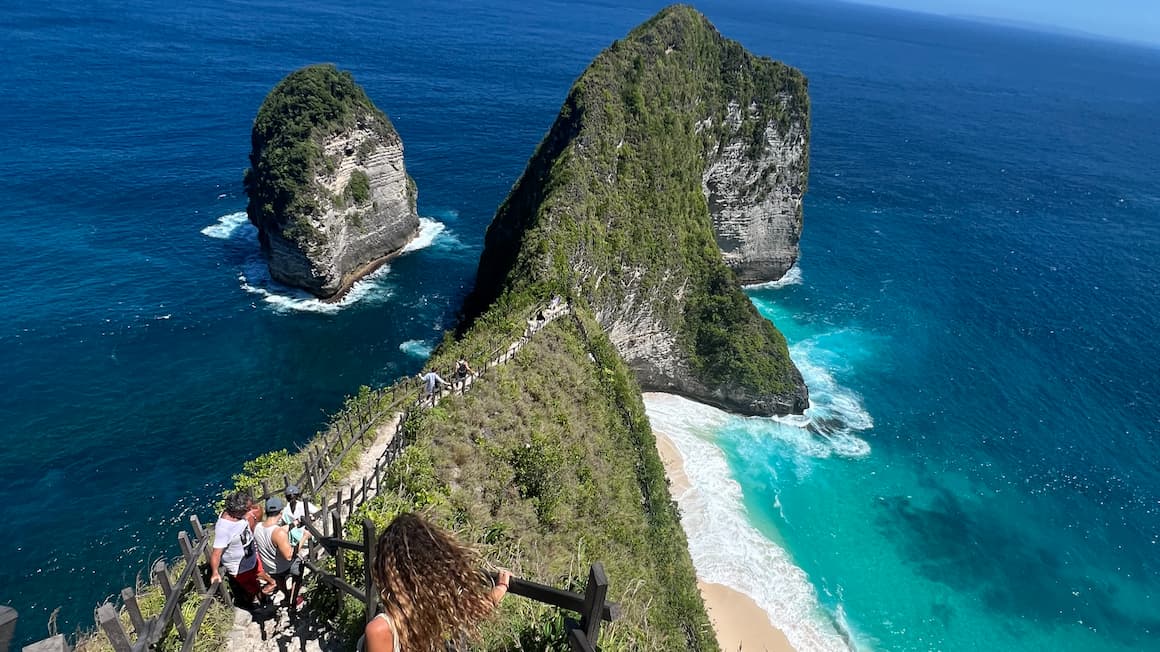
Photo: @amandaadraper
For those looking to get away from the madness of mainland Bali, to find an island escape from a bigger island escape, if you will, the Nusa Islands make for an awesome respite. Let the island hopping begin! The Nusa Archipelago is composed of three islands: Lembongan, Penida, and Ceningan. Each one has different sorts of attractions and varying levels of development – Lembongan has the most infrastructure, while Penida has the least; Ceningan is connected to Lembongan by a famous yellow bridge and is practically an extension of the island. Together they make one of the strongest additions to any Bali itinerary, and doing them as a day trip from the mainland is a waste of what they actually offer.
Each of the islands has a similar ultra-rugged topography; think Uluwatu but more rough and epic. Rising prominently from the sea, these islands are protected by sheer, sometimes crazy coastal cliffs that are awe-inspiring to see. Between you and me, two of my top five beaches I’ve EVER seen live on Nusa Penida. That should be reason enough to go and check it out.
- Nusa Penida’s coastline is the main draw: Kelingking Beach viewpoint, Angel’s Billabong, Broken Beach and Diamond Beach are all genuinely as dramatic as they look. While they’re incredible places to visit, they’re not safe for swimming, with local restrictions in place due to dangerous currents and previous incidents. Roads are rough, and scooter hire requires more confidence than on the mainland, but it’s manageable.
- Crystal Bay on Penida is the spot for manta ray encounters. Sightings are seasonal, peaking roughly July to October, worth checking before you go.
- Lembongan’s Devil’s Tears on the southwest coast delivers wave action against the cliffs that’s worth timing to high tide. Dream Beach and Mushroom Bay are the best stretches of sand.
- Crossing the Yellow Bridge to Ceningan opens up cliff jumps, quieter roads, and a slower afternoon than anywhere on Lembongan proper.
- The diving and snorkelling across all three islands is excellent. The channel between Lembongan and Ceningan in particular has strong currents and rich marine life.
The honest caveat: Nusa Penida’s popularity has grown fast and the main viewpoints get busy with day trippers by mid-morning. Staying two nights on Penida puts you at the key spots before and after the crowds, which is a completely different experience. Don’t do these islands as a day trip if you can avoid it.
Off the Beaten Path in Bali
Bali’s busiest areas are busy for good reason, but they can also make the island feel smaller and more commercial than it actually is. The places below won’t fix the traffic in Canggu or the queues at Tegallalang, but they offer something the main circuit doesn’t: a version of Bali that moves slower, looks different, and reminds you why the island has a reputation beyond the beach clubs and the smoothie bowls.
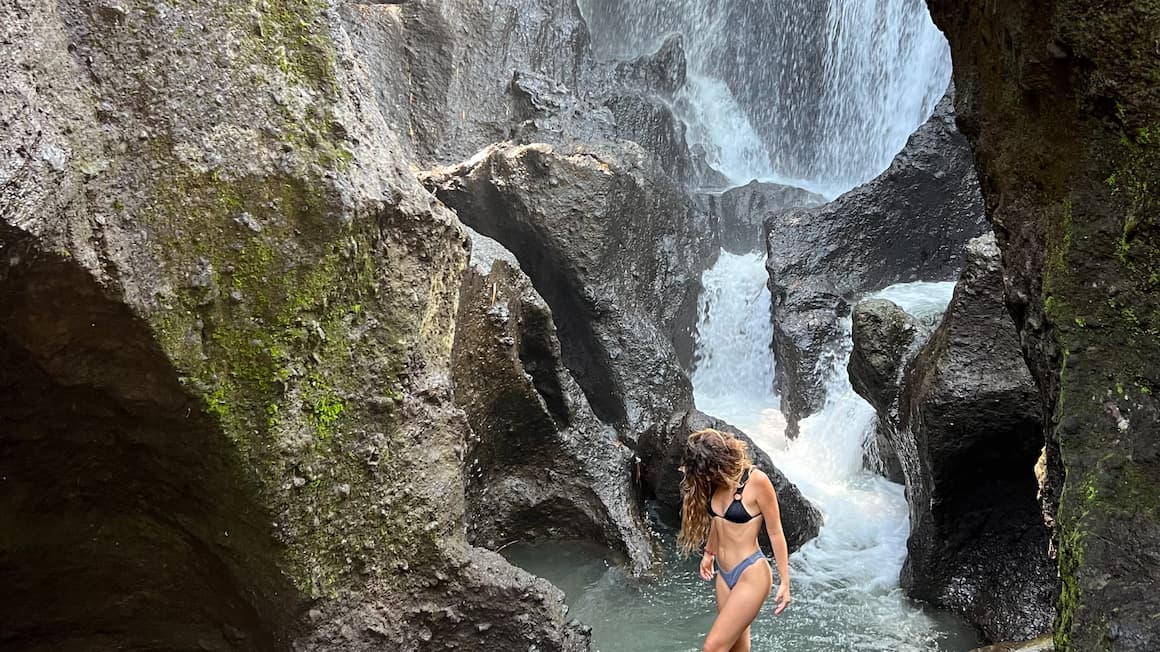
Photo: @amandaadraper
Bedugul
Okay, this mountain village is not exactly offbeat – it’s home to Pura Ulun Danu Beratan, a water temple that is literally one of the most famous sights in Bali. Most people just stop by for the temple (and the Insta-famous giant gate that is, in fact, just a gate to a golf resort). However, it’s worth sticking around for at least one night. You can visit the Botanical Gardens, hike Mount Catur, drive up to the nearby twin lakes Tamblingan and Buyan, and explore the multitude of nearby waterfalls.
Munduk
Munduk is one of the best mountain getaways in Bali, and probably among the best places for hiking in Bali. This little mountain village is surrounded by green jungles and gorgeous waterfalls. Plus, since it’s up in the mountains, the crisp air offers some much-needed relief from the stifling Bali heat.
Sideman
Sideman is a valley in east Bali that most itineraries skip entirely in favour of pushing straight to Amed or back to Ubud. That’s a mistake. The rice field views here, framed by Mount Agung on the horizon, are among the most dramatic on the island, and the area has almost none of the foot traffic that makes similar scenery elsewhere feel staged. Tukad Cepung Waterfall, a cave waterfall reached by walking through a shallow river, is one of the more quietly spectacular things you can do in Bali and it rarely has a queue.
West Bali National Park
Still off the beaten path, maybe because it’s pretty damn far from everything else: 1.5 hours from Lovina and 5 hours from Canggu. This area of Bali is gorgeous, though. West Bali has some of the most unique nature in Bali, including flora and fauna that are not found anywhere else, and incredible snorkelling spots. If you’re planning to take a ferry to Java next, the park is basically on your route anyway, so it’s definitely worth a visit.
Top 10 Things to Do in Bali
Bali has oodles of awesome stuff to see and do, so where do you even start? Here is my shortlist of the ten coolest things to do in Bali for tourists, backpackers, and adventurous travellers alike. Don’t worry – all of these things are possible to try out, even if you’re travelling Bali on a budget!
1. Slow down and actually enjoy the Bali lifestyle
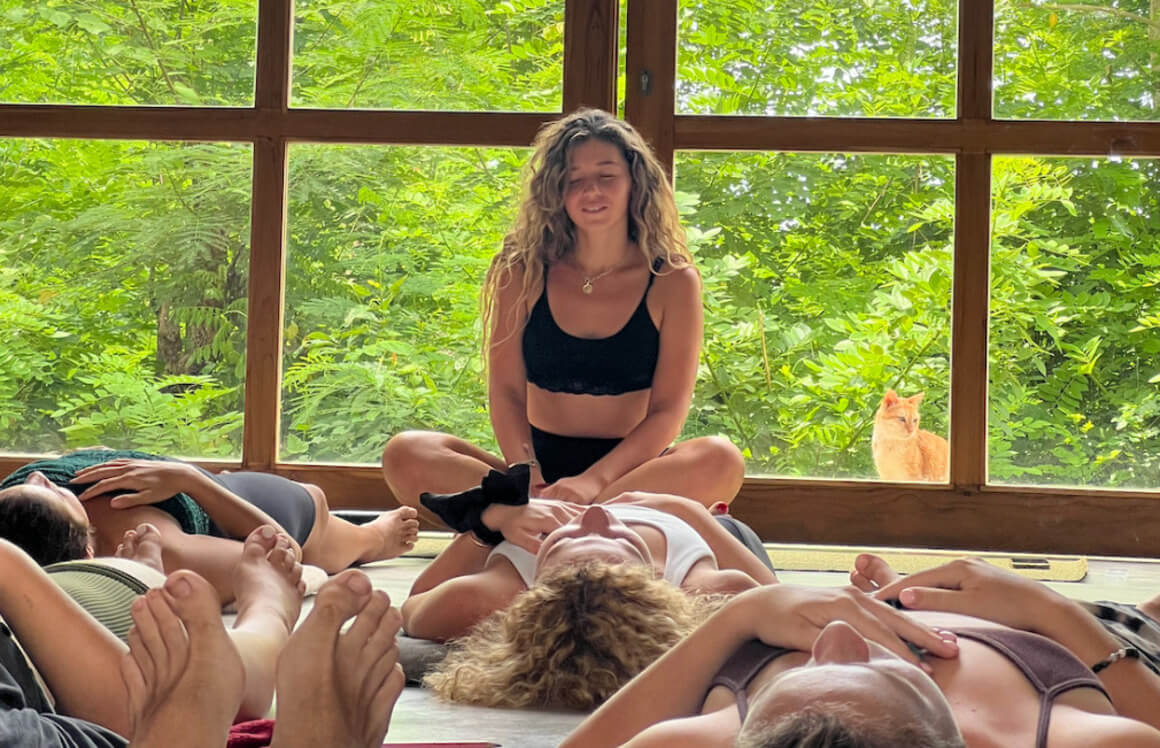
Bali has built an entire ecosystem around doing very little, and doing it well. A Balinese massage costs next to nothing and is one of the better uses of an afternoon on the island. Breathwork sessions, sound baths, and yoga classes are everywhere and mostly affordable, even on a backpacker budget. If you want to go deeper, meditating with a shaman is one of those experiences that sounds questionable on paper but leaves a mark more meaningful than nights spent partying down the strip. Build at least one genuinely unscheduled day into your trip and let Bali fill it. In short: treat yo self. You deserve it.
2. Surf or take a lesson
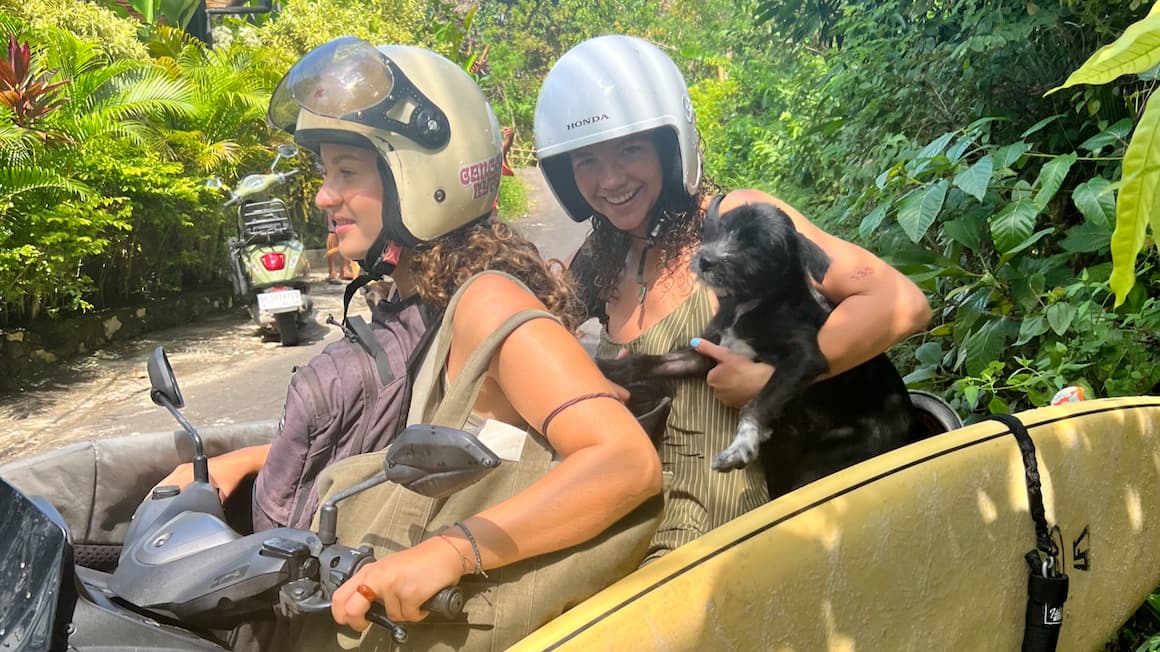
Photo: @amandaadraper
Bali has some of the best surf in the world and the breaks are varied enough to cater to every level, which is part of what makes it such a good place to learn. Beginners should head to Batu Bolong in Canggu or Kuta Beach, where lessons are cheap, instructors are everywhere, and the waves are forgiving enough to actually make progress.
Intermediate surfers will find plenty to work with at Balangan and Medewi. If you know what you’re doing, Uluwatu, Padang Padang, and Bingin are world-class breaks that draw serious talent for good reason. Even if you never touch a board, watching experienced surfers work a proper Uluwatu set from the clifftop bar above is its own kind of entertainment.
3. Visit temples that genuinely add something to the trip
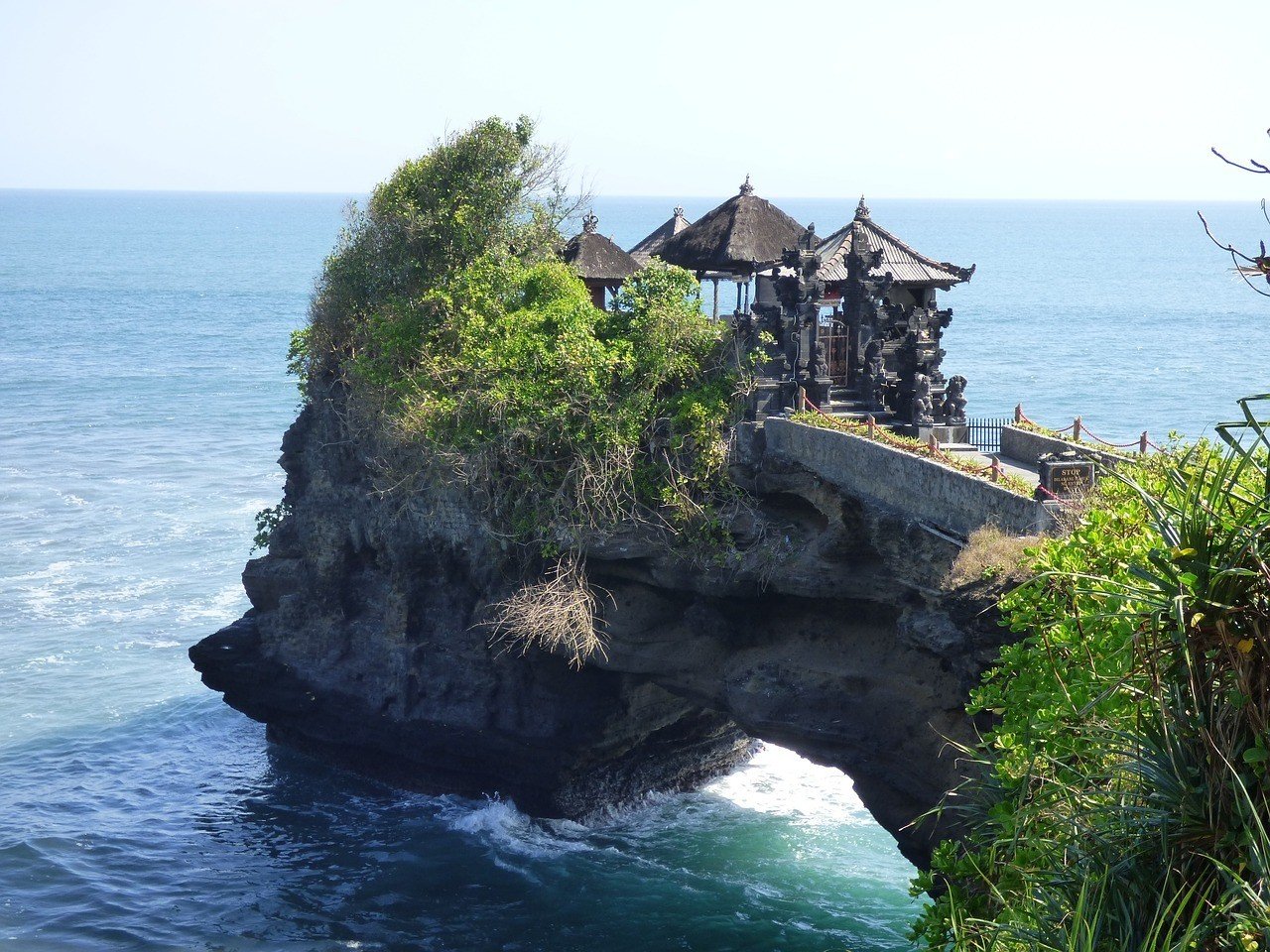
Bali has thousands of temples and most backpackers end up at the same three or four, which is fine because if those three or four are worth it. Tanah Lot, perched on a coastal rock just outside Canggu, is the easy sunset option and is still enjoyable despite its popularity. Uluwatu Temple on the clifftop is best paired with the Kecak fire dance at dusk, one of the more memorable evenings you can have on the island.
Tirta Empul near Ubud is a functioning holy spring where Balinese Hindus come to purify themselves, and watching or participating is a more meaningful experience than most temple visits. Gunung Kawi, carved directly into a rock face in a river valley outside Ubud, is the one that tends to catch people off guard. Go early, bring a sarong, and treat these places as what they are: active sites of worship, not backdrops.
4. Try the wellness side of Bali
Bali takes its wellness side VERY seriously. It’s only right that you experience some part of it. Yoga studios are everywhere and cater to all levels, from sweaty vinyasa classes to slower, more meditative practices. The food scene is healthy, fresh and cheap, making it one of the easiest places to eat clean in South East Asia.
If you’re into training, the gym culture is strong, particularly in Canggu where CrossFit Wanderlust has built a reputation as one of the best boxes in Asia and welcomes drop-ins. Most gyms and studios across the island operate drop-in rates, so there’s no excuse to let your routine slide entirely just because you’re on the road.
5. Chase waterfalls
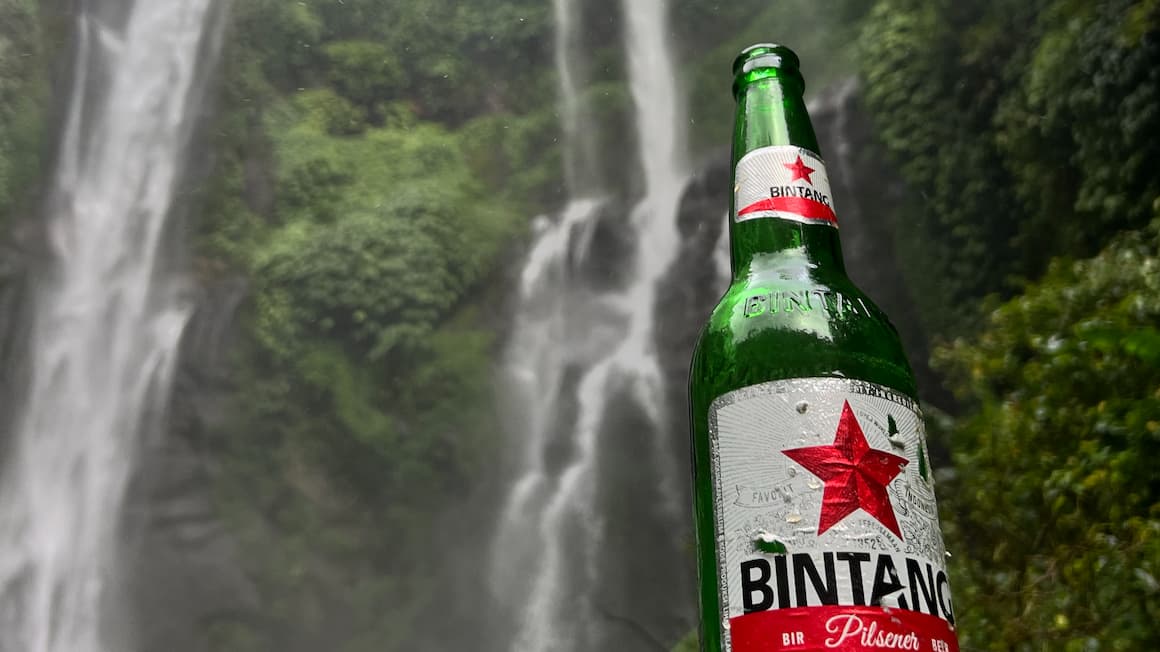
Photo: @amandaadraper
Resist the urge to burst into the TLC song as you make your way from waterfall to waterfall. Bali has HEAPS.
Bali’s most famous waterfalls are also unfortunately super crowded. Come with patience; if you want your picture taken, you sometimes have to wait for an hour. Or even better: get up ultra-early to beat the crowds or go on one of the best tours in Bali where they’ll take you off the beaten track. The sun in Bali rises at 6am, no excuses 😉
6. Swim / snorkel / dive with marine life
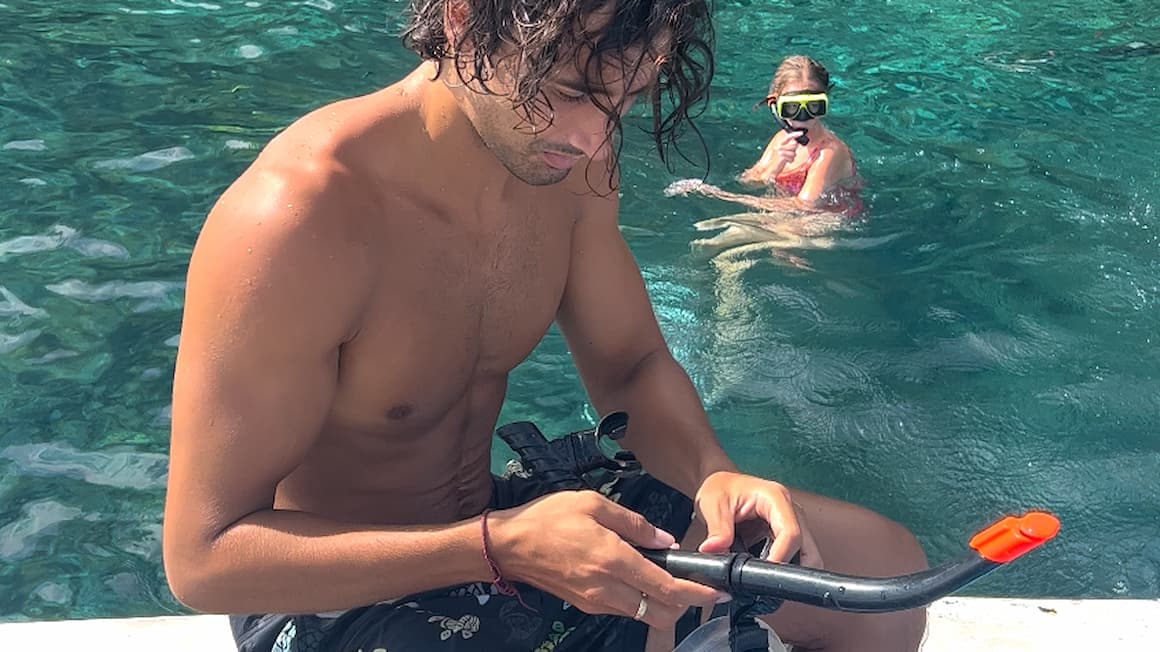
Photo: @amandaadraper
Bali’s underwater offering is serious. Mantas at Nusa Pendia? Check. Flourishing coral reefs in Amed? Check. Rare, funky-looking fish, well, everywhere? Check.
One of my favourite experiences has been swimming with manta rays in Nusa Penida’s Manta Point. These gentle giants are breathtaking, and you can easily spot them even with a snorkel – no diving needed! Short on time? A tour from Bali gets you from your hotel, swimming with the fishes in Nusa Penida by lunch and back with a Bintang in hand before the day’s done. Bosh.
7. Hike Mount Batur at sunrise
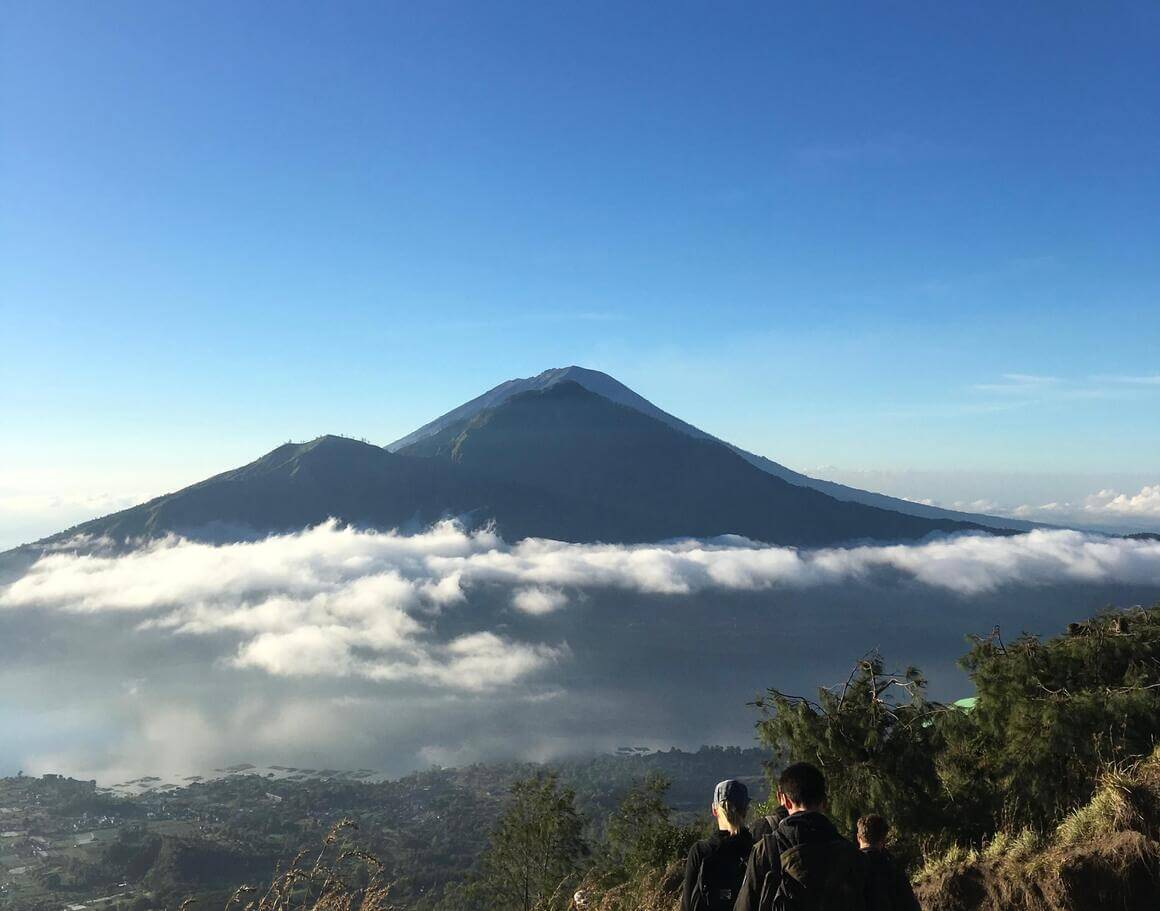
Photo: @joemiddlehurst
A sunrise hike to Mount Batur is by far one of the most fun things you can do in Bali. You do have to get up at 4 a.m. but once you reach the top and can spot the shape of Mount Rinjani in the distance – that’s why life is worth living, baby.
As much as the hike up to summit is fairly easy and well paved, you’ll need to do this one with a tour unfortunately. The surrounding region is mafia-ran who are insistent that you need a tour guide. I rocked up hoping to slide through undetected and was met with a fair bit of abuse and eventually caved in to hiring a guide ie. a dude who just followed me up the mountain for $20.
Annoying? Yes. Save yourself the hassle and book a tour in advance, this one is a great option and John is an absolute legend in motivating you to haul your ass up there at 2am.
8. Catch sunset from the west coast
Photo: @amandaadraper
Bali’s west-facing coastline exists almost entirely to make sunset look good, and it delivers pretty much every time. The options range from a cheap plastic chair and a coconut on the beach at Canggu to a clifftop bar above the surf break at Uluwatu to the rocks at Tanah Lot with the temple silhouetted against the sky. None of them are bad.
The version that costs nothing is usually as good as the version that doesn’t. Pick a spot, stop whatever else you were doing, and give it the full attention it deserves.
9. Walk the rice terraces and inland landscapes
There’s something enchanting about the highlands of Ubud. The way the morning light reflects in the rice paddies, the occasional mist that settles in the trees, the ethereal sounds that the jungle emits; few places in the world can imitate these aspects of Bali. Just go for a walk around and feel the magic.
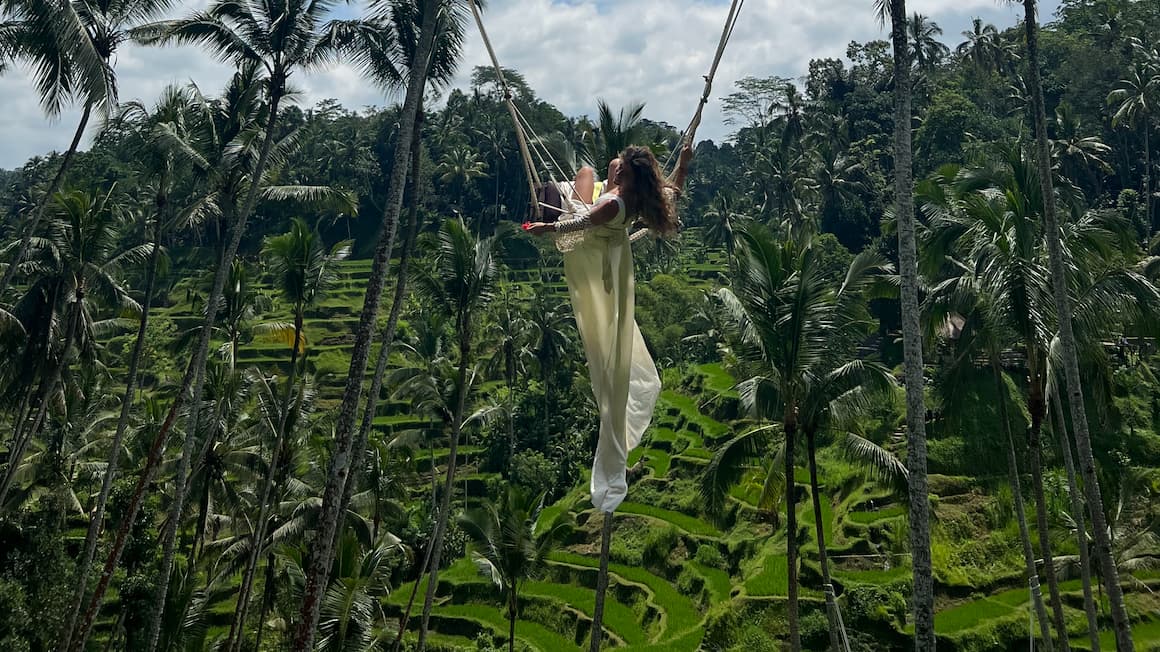
Photo: @amandaadraper
10. Immerse yourself in Balinese culture!
As a Hindu island in the middle of Muslim-dominated Indonesia, Bali is a bit of a cultural microcosm. Its religion, stories, and history are truly some of the most fascinating in the world.
Take part in one of the many festivals in Indonesia, there always seems to be one going on – or just start conversing with locals to get to grips with this unique island.
Backpacker Accommodation in Bali
Bali’s accommodation range is one of its strengths and one of its traps. At the budget end, it still gives you massive bang for buck: dorm beds may run a little more expensive than other countries in SEA, but they’re home to some of the nicest hostels I’ve ever stayed in. You can still get your cheap and cheerful spots, but Bali is the place to fork out a little more and live in serious flashpacker mode.
Decent private rooms in guesthouses start from $15–25, and if you’re willing to stay slightly outside the main tourist areas you can find private villas with pools for less than you’d pay for a mid-range hotel room in most European cities. At the other end, Canggu, Seminyak, and Uluwatu have no shortage of places that will cheerfully charge boutique hotel prices for boutique hotel vibes. The island accommodates both without much effort.
The area you pick matters more than almost anything else for your budget. Amed, Sidemen, and Lovina are the cheapest stretches on the island. Ubud sits in the middle, with good value across all categories if you look slightly outside the centre. Canggu and Seminyak are where costs creep up, particularly for private rooms, where the ‘Bali lifestyle’ tax comes firmly into play.
Hostels are the sweet spot for most backpackers. Again, you’ll find some seriously swanky spots here. Most have pools, social scenes, co-working spaces, and amenities making life so comfortable you could unpack and kick back for a while. The vibe varies considerably by location: hostels in Kuta skew toward parties, Ubud hostels are quieter and more nature-focused, and Canggu has the full range, from raging party mode to a strong nomad-friendly hostel scene with decent infrastructure for people who need to get work done.
Take Tribal Bali, for example – a hostel specifically built for Digital Nomads and backpackers who value quality and comfort, located just minutes from the beach and amazing cafes.
Another great option for staying on a backpacking budget is cheap guesthouses. You can easily find a very decent private room for as low as ten bucks a night, and guesthouses often also come with an attached pool. All the luxury for a fraction of the price!
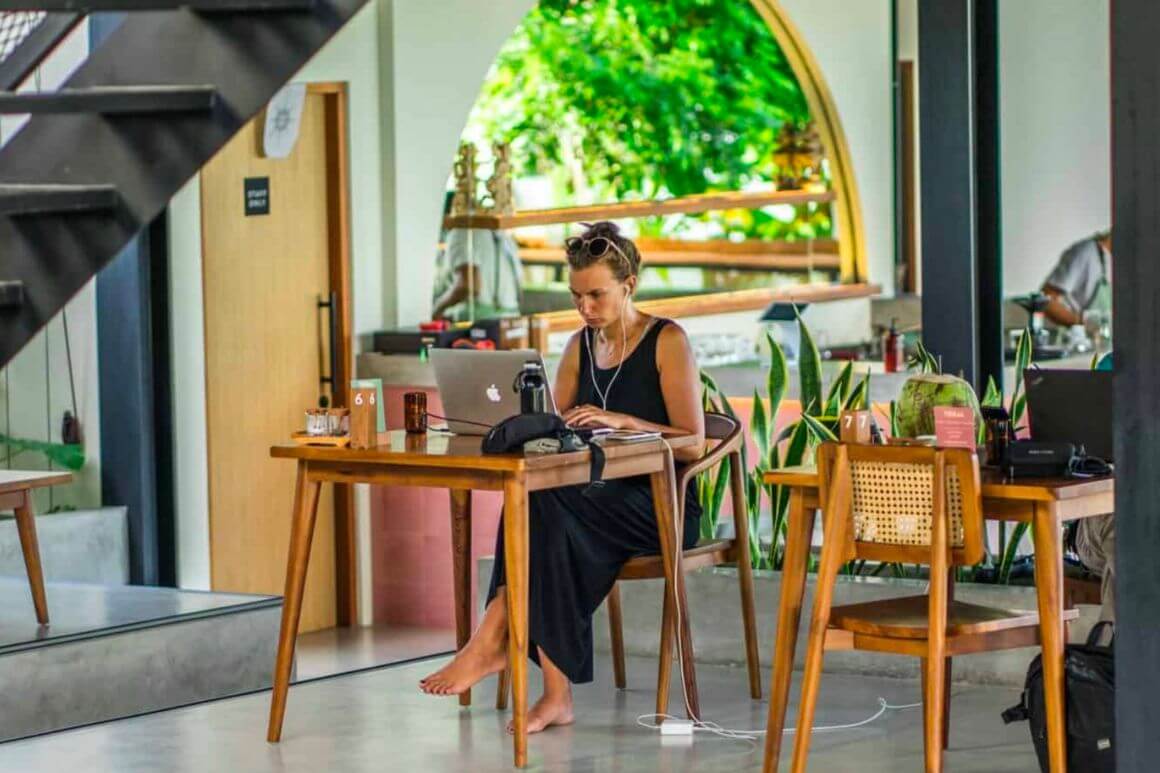
You can also book a bungalow in the middle of the jungle that has next to nothing except for good views and vibes, or a fancy Bali treehouse overlooking the ocean views! Either way, whilst these are not exactly cheap accommodation options, they ARE super good value and a very unique experience to have. Another great option for staying on a backpacking budget is cheap guesthouses. You can easily find a very decent private room for as low as ten bucks a night, and guesthouses often also come with an attached pool. All the luxury for a fraction of the price!
The Best Places to Stay in Bali
Bali has many a towns to lay down your backpack for a bit. Here are the best places to stay in Bali on a budget, featuring the best backpacker hostels in Bali and a few epic Airbnbs!
| Destination | Why Visit! | Best Hostel | Best Private Stay |
|---|---|---|---|
| Canggu | The heart of action in Bali has beaches to surf, cafés for days, and all types of events from comedy to music and workshops. | Tribal Bali | Kayumanis Homestay |
| Ubud | Green, peaceful and beautiful… No wonder backpackers come here to find themselves! | Ubud Rice Field House | Puri Garden Hotel & Hostel |
| Kuta | Like to surf in the morning, then party at night? Kuta may be your place! | Lokal Bali Hostel | D’Sriwing Villa Gallery |
| Seminyak | Like an upscale version of Kuta; Seminyak has chill beaches and great shopping. | My Capsule Bali | Vansari Hotel |
| Uluwatu | Epic cliffsides, hidden beaches and teh best sunset views in Bali – need I say more? | Lay Day Hostel Uluwatu | Gelis Gede Cottages |
| Sanur | If you’re craving a quiet beach side for water activities, this is your spot. | Made House Homestay and Dormitory | Villa Felise |
| Amed | The diver and snorklers’ mecca is the best place to get underwater in Bali. | Ocean Prana Village | Salt Resort & Spa |
| Lovina | Swim with dolphins at daybreak, chase down epic waterfalls in the afternoon. | Lovina Loca | Suma Beach Hotel |
| Denpasar | The capital of Bali is full of cultural treasures and museums. | Ratih Bali Hostel | Sugiras Living |
| Nusa Penida | Almost-off-the-beaten-path, all three Nusa islands are super chill and beautiful. | The Penida Project | Sentulan Garden |
Backpacking Bali Costs
Bali sits in an interesting position for budget travellers: cheaper than almost anywhere in Europe or Australia, but no longer the ultra-cheap destination it was a decade ago. The south in particular has caught up with itself, and areas like Canggu and Seminyak will test a tight budget if you’re not paying attention. That said, the infrastructure for spending very little is still very much intact if you know where to look.
A comfortable backpacker daily budget sits around $35–50 a day. That covers a dorm bed, warung meals, scooter transport, and leaves room for a beer or two and the occasional paid activity. Push it and you can get by on less. Stop paying attention and you can spend considerably more.
Personally, though, my Bali travel costs ended up being significantly more because I was eating in awesome healthy restaurants and well… partying.
Broke backpackers can also thrive in Bali, though. If you use a scooter to get around, stay in cheap hostels in Bali, eat mostly local food, and don’t want to splurge for expensive activities like surfing or diving, your monthly budget could easily total less than $1000 USD a month.
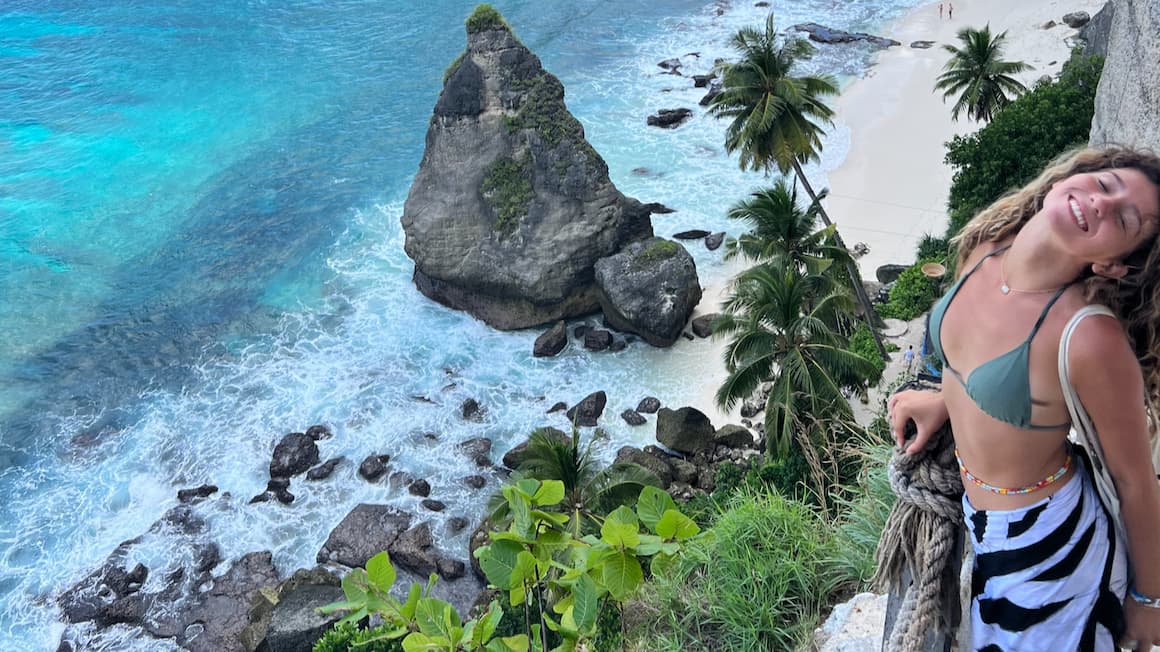
Photo: @amandaadraper
Dorm beds at decent hostels run $10–15 a night across most of the island. The budget end exists, Kuta has beds for less, but you get what you pay for. Private guesthouse rooms average around $30 island-wide, often with a pool thrown in. Canggu and Uluwatu sit at the top of the range; Amed, Sidemen, and Lovina at the bottom.
Local food is inexpensive in Bali. A meal at a warung – a local restaurant – costs about $2-4 USD.
If you eat in Western restaurants, expect to pay a whole lot more. It’s easy to spend $20-30 USD on food only if you don’t watch it! Hunt around for deals – lots of places do breakfast + coffee combos for just a few dollars.
Eat at warungs for every meal and you can keep food costs under $10 a day. Saying that, I highly recommend eating at the boujier spots while backpacking in Bali. Going out to a nice restaurant is still comparatively cheaper than in the West, and Bali – especially Canggu – has INCREDIBLE food.
If you insist on getting drivers around the island, your transportation budget will definitely be big. Public transportation isn’t really a thing in Bali, other than around the capital Denpasar.
The absolute best and cheapest way to get around is to rent a scooter. A daily rent for the smallest bikes could be as low as $5. It’s best to rent for a whole week or a month, then you can easily find a bike for $40-50 for a month. This is your trustiest steed for all the adventures around the island 🙂 Those cheap bike rentals may look alluring on paper but make sure you check the brakes! You often get what you pay for.
In busy areas like Canggu, I’d avoid renting your own bike altogether. Motorbike taxis like Gojek and Bolt are cheap and plentiful – you’ll never have to wait more than a couple minutes for a driver and a 10-minute ride on one costs about a dollar.
This is where it’s very easy to blow up your budget!
A small local beer, Bintang, costs about $2 from a mini mart.
Beer prices in Bali in nicer places can be double that, though, so if you’re backpacking Bali on a budget, avoid the fancy schmanzy spots.
Cocktails are expensive – importing booze to Bali is pricey so fancy drinks come with a price as well. Also: if drinks somewhere seem suspiciously cheap, skip them. Methanol poisoning from fake alcohol is a real and recurring problem in Bali.
Another point that can make or break your budget…
There are heaps of free or ultra-cheap things to do in Bali. For example, waterfalls are either free to enter or cost about a dollar. No problem there.
Gym classes can be kinda pricey on a shoestring budget, about $10 a pop. Of course, you could just go to a weightlifting gym for way cheaper than that.
If you want to try surfing, diving, paragliding or any other fun special activities, prepare to throw some more money in.
Bali Daily Budget
Whether you’re a broke backpacker backpacking Bali on a shoestring budget or a bougie babe trying to get the best value for your money, you can definitely travel to Bali. Here are some example budgets of expenses in Bali.
| Expense | Broke Backpacker | Frugal Traveler | Creature of Comfort |
|---|---|---|---|
| Accommodation | $10-15 | $20-30 | $40+ |
| Food | $7-10 | $15-25 | $30+ |
| Transport | $4-7 | $8-15 | $20+ |
| Nightlife | $0-5 | $6-12 | $20+ |
| Activities | $0-10 | $10-20 | $30+ |
| Total per day | $21-47 | $59-102 | $140+ |
Money in Bali
The official currency of Bali is the Indonesian Rupiah (IDR). Find out how much your money is worth today by using the up-to-date converter below.
Yes, for just $60, you could be an Indonesian millionaire!
Due to huge economic inflation in the past, the Indonesian Rupiah has lost value over the years and as such is now printed in the thousands. Most Indonesians completely disregard the last 3 zeroes anyway; often, you’ll just end up bartering as if those last 3 zeroes didn’t exist.
For example, if you offer someone 10, they’ll understand that you mean 10,000.
Money changers are ubiquitous in urban areas and offer different rates. Walk around and find the best rates for your particular currency. Be mindful of shady dealers who don’t post their rates. Also, note that older USD bills are no longer accepted.
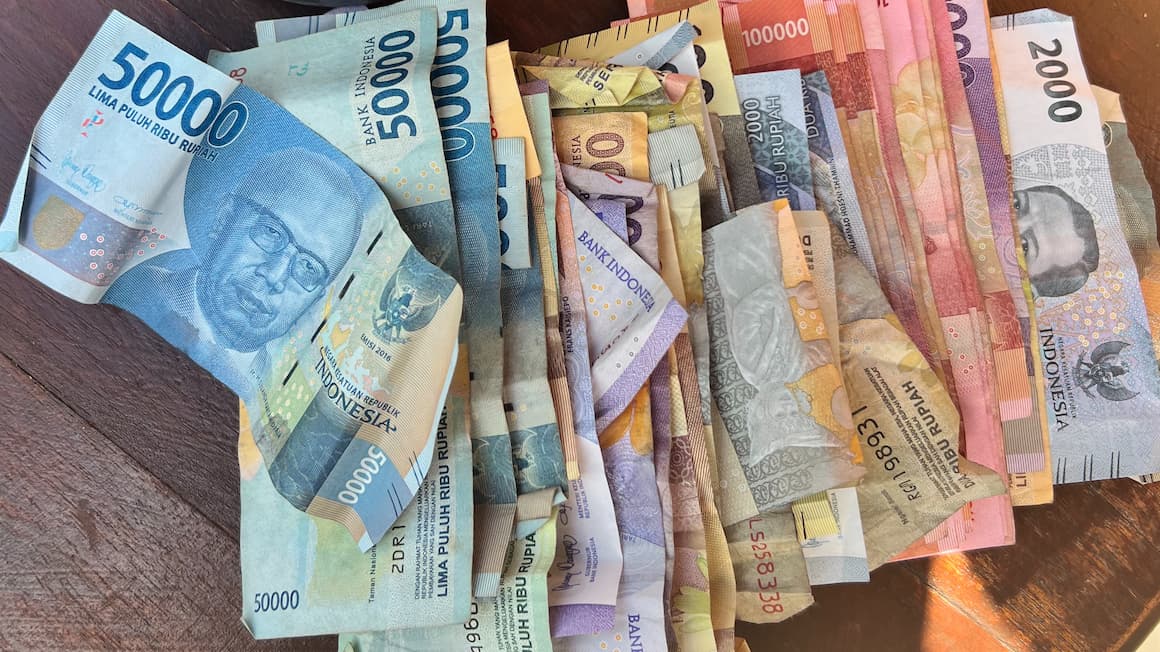
Photo: @amandaadraper
ATMs are widely available in Bali, especially in busier areas. If you think you’re going somewhere pretty remote, it’s definitely best to take out cash in the city beforehand.
Many people have reported fraudulent charges after using a random ATM. When withdrawing cash, it’s usually best to use the ATMs inside banks. Many unfortunate travellers have also had their cards swallowed up by greedy ATMs, so make sure you’ve got a couple of cards with you!
Speaking of travel banking like a pro…
For all matters of finance and accounting on the road, The Broke Backpacker strongly recommends Wise! Our favourite online platform for holding funds, transferring money, and even paying for goods, Wise is a 100% FREE platform with considerably lower fees than Paypal or traditional banks. But the real question is… is it better than Western Union?
Yes, it most certainly is.
Bali Budget Tips That Actually Make a Difference
Bali is good value. It’s even better value if you’re paying attention. These are the small things that genuinely make all the difference to your backpacking budget.
- Fill up your water bottle, every time. Tap water isn’t drinkable in Bali, and buying plastic bottles adds up fast. Most hostels, guesthouses, and warungs have free refill stations. Bring a decent bottle and use them. It’s one of those habits that saves you money AND the planet.
- Stay longer in fewer places. Moving every two days sounds like you’re seeing more. What it actually means is more transport costs, more time in transit, and less time actually enjoying where you are. Negotiate weekly rates at your hostel or guesthouse: most places will drop the price for a longer stay without much pushing. Renting a bike for longer vs daily also makes a big difference too.
- Ride a scooter, but ride it smart. Scooters are cheap within each base. They are not always the right call for longer inter-base transfers, where a shuttle is cheaper, safer, and less exhausting. Use Grab for short in-town trips when you don’t have a scooter handy. Avoid paying for a private driver unless you’re in a group splitting the cost.
- Eat at warungs most of the time, not all of the time. Three warung meals a day is the budget dream but gets boring FAST. Eat local for at least 1 or 2 of your meals a day, and give yourself permission to eat somewhere nicer for dinner a few times a week. My favourite combo is always lunch at a cool cafe and a nasi goreng for dins.
- Go in shoulder season. May, early June, and September sit between the wet season and peak July-August crowds. Prices for accommodation drop noticeably, popular spots are quieter, and you’ll get a better version of Bali for less money. July and August are the most expensive months on the island and the most crowded. Unless you have no other choice or are happy to cough up, avoid them.
- Not every famous activity is worth the price. The Gates of Heaven at Lempuyang Temple charge an extortionate amount for what is essentially a photo op that uses a mirror trick to fake the reflection. Tegallalang Rice Terraces now charge entrance fees for what is essentially a walk through terraces you can find for free ten minutes down any back road around Ubud. The Bali Swing is a photo prop, not an experience. Know what you’re paying for before you pay for it.
- Book transport in advance, not at the kerb. Airport taxis and drivers who approach you on arrival will quote two to three times the going rate. Use the official Grab lane at the airport, book shuttles through Bookaway or inDrive in advance, and agree on any private driver price before you get in the car.
Best Time to Travel to Bali
Bali only has two distinct seasons: the rainy season and the dry/windy season. But you’d be wrong to automatically think that rainy season = all bad. I’ve come to Bali in multiple monsoon periods with varying degrees of success.
Dry season (April to November)
This is the obvious choice for most travellers. The weather is sunnier, the roads are drier, and the surf on the west coast is at its most consistent, particularly May to September when the swells are reliable and the winds are offshore. Beach days are straightforward, waterfalls are accessible, and the overall vibe is easier. The tradeoff: July and August are peak season, which means higher accommodation prices, and the main attractions feel like a theme park often times.
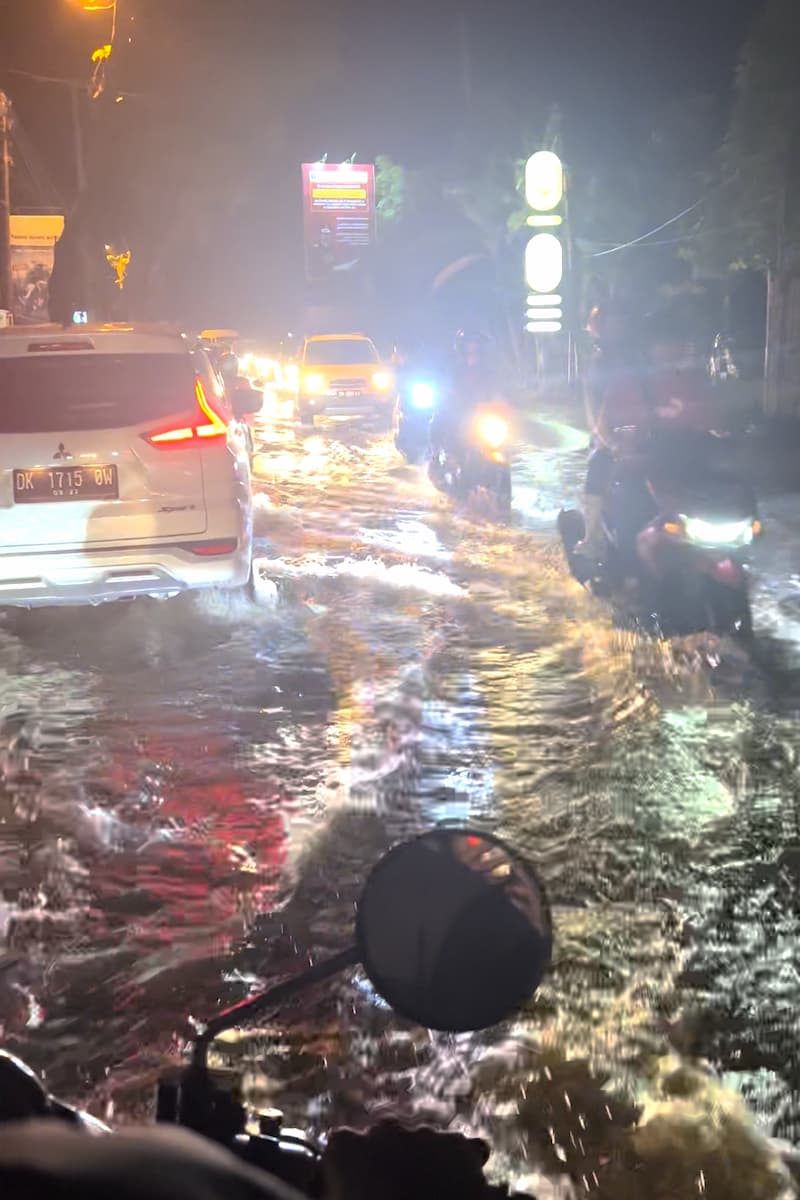
Photo: @amandaadraper
Wet season (December to March)
The rainy season gets a worse reputation than it deserves, but it does require realistic expectations. Rain in Bali rarely means all-day grey drizzle; but I’ve done a few seasons where this has been an unfortunate reality. More often than not, the doom and gloom only happen in the evening, leaving mornings for exploring.
It tends to come hard and fast, usually in the afternoons or evenings, and then clear. When it does finally rain, it POURS: flooded streets, intense thunderstorms, and occasionally flooded accommodation. Waterfalls are fuller and more dramatic. The east coast surf picks up. Prices drop and crowds thin. If you’re not chasing beach days and perfect surf conditions, wet season Bali is still a solid trip.
Shoulder season
The period sitting either side of each peak: May to early June and September are the sweet spot. Dry weather, thinner crowds, and noticeably lower prices. If you have flexibility, aim here.
Temperatures barely fluctuate throughout the year, but they can feel higher when it’s more humid. Bali’s meteorological consistency is very apparent on a macro level e.g. the whole island is subject to the same lovely weather. On a micro level though, there are some unique weather conditions in Bali.
The highlands of Bali (i.e. the regions around Ubud and Bedugul) can receive rain at any time of the year. The mountains, in general, are less hot and humid than the lowlands, and in the evenings you should arm yourself with a sweater or a jacket.
Note on Nyepi:
Nyepi, or the Balinese Day of Silence, is a truly unique day in the Balinese calendar. It is a day when the entire island stops and quiets for 24 hours – literally. No electronic lights are allowed on, no loud speaking or music either, and you are absolutely forbidden to go out to the streets. (This means no food delivery either – get ready for a home-cooked meal!) Even the airport stops. Nyepi can be a super magical and unique thing to experience in Bali and a good moment to be quiet and reflect during your backpacking trip, but if you’re on a tight schedule, you should absolutely avoid Nyepi since you won’t be able to leave your accommodation at all. Nyepi usually takes place some time in March.What to Pack for Bali
What you pack depends heavily on when you’re going and what you’re doing. Are you surfing? Diving? Beach bumming? No matter the answer, here are some non-negotiables in my backpack when I head to Bali.
- Lightweight, breathable clothing is non-negotiable. Bali is hot and humid year-round and anything that doesn’t dry fast will spend the trip damp. Pack less than you think you need: laundry is cheap and everywhere.
- A reusable water bottle is essential. Tap water isn’t drinkable and buying plastic bottles every day is both expensive and unnecessary. Most hostels, guesthouses, and warungs have free refill stations. The Grayl Geopress filters as it goes, which is useful if you end up somewhere without a refill option.
- A sarong is worth more than it takes up. You’ll need one to enter temples, it doubles as a beach towel, a blanket on cold buses, and a privacy screen in a pinch. Buy one when you arrive for next to nothing.
- Reef-safe sunscreen. Bring it from home if you can: it’s available in Bali but expensive. Your skin will need it every day even when it’s overcast.
- A good pair of earplugs. Bali is noisy: dogs, roosters, motorbikes, and snoring dorm-mates don’t coordinate their schedules. A decent pair will save your sleep more than once.
- A microfibre towel. Hostel towels exist…in theory. In practice, your own is lighter, dries faster, and doesn’t smell like the last twelve people who used it.
- Add a packable rain jacket. The afternoon downpours are genuine and a poncho from a roadside vendor will fall apart within a week. A lightweight waterproof layer takes up minimal space and will have you sorted for the whole trip.
- Waterproof sandals or shoes worth wearing in the rain. Flip flops are fine until you’re riding a scooter in a tropical downpour on a flooded road, which will happen. My trusty Tevas do the job for this purpose.
- A dry bag or waterproof phone case. Whether you’re on a scooter in the rain, doing a waterfall hike, or taking a fast boat to the Nusas, something is going to get wet. I used this a lot when snorkelling so I could record shit.
Staying Safe in Bali
Bali is one of the most popular places in the world to travel to, and as such suffers from many of the blessings and sins that come from rampant tourism. Now, don’t get stressed – Bali is safe to travel. Taking normal backpacker’s safety precautions will usually get you by just fine.
- Scooters and traffic. This is the biggest real risk for most backpackers in Bali. Traffic in the south is genuinely chaotic, roads are narrow, potholes appear without warning, and drivers do things that will seem insane until you’ve been here long enough to understand the logic. Wear a helmet every single time, no exceptions. Ride slowly until you know the roads. Avoid riding after dark if you can help it, and never ride after drinking. Most injuries tourists sustain in Bali happen on scooters, often close to where they’re staying, often at low speeds.
- Phone snatching. Lots of phones get stolen in Bali. This is not Brazil – you’re not gonna get mugged for your valuables, and it’s totally OK to have your phone out on the street to check for directions or whatever. Just take note of motorbikes driving as they are sometimes known to snatch phones off people’s hands. And if you’re driving yourself, for hell’s sake, don’t keep your phone in the glovebox. At night, it’s best to keep your bag under the seat.
- Ocean conditions. The seas around Bali can be deceptively strong. Rips and currents at beach breaks like Kuta and Seminyak catch swimmers off guard regularly, and several beaches on the Bukit Peninsula are not safe for swimming at all. Pay attention to flags, ask locals about conditions before entering, and don’t overestimate your ability in unfamiliar surf.
- Natural hazards. Small earthquakes happen a lot and are pretty much harmless. Part of Bali is in the tsunami zone, but that kind of event would be extremely unlikely. Mount Agung, the biggest mountain in Bali, is an active volcano. It last erupted a few years ago, but you know, it’s a possibility. The coasts on the south and west of the island are in a tsunami zone, but this is a low-probability event rather than a daily consideration. During wet season, flooding can happen fast in low-lying areas after heavy rain. If water is rising around your accommodation, move to higher ground rather than waiting it out.
- Watch out for monkeys. They’re generally chill except for the ones at Ubud’s monkey temple, which are total bastards. They may steal your sunglasses, and they may bite. If you get bitten by a monkey (or any other animal in Bali, for that matter), go get treated for rabies!
- Scams and nightlife. The most common scams in Bali involve transport pricing, money changing, and fake alcohol. Use official money changers or ATMs rather than street changers offering suspiciously good rates. Agree on transport prices before getting in. And on the fake alcohol point: if cocktails somewhere seem unusually cheap, skip them. Methanol poisoning from bootleg spirits has hospitalised and killed tourists in Bali. It is not worth the saving.
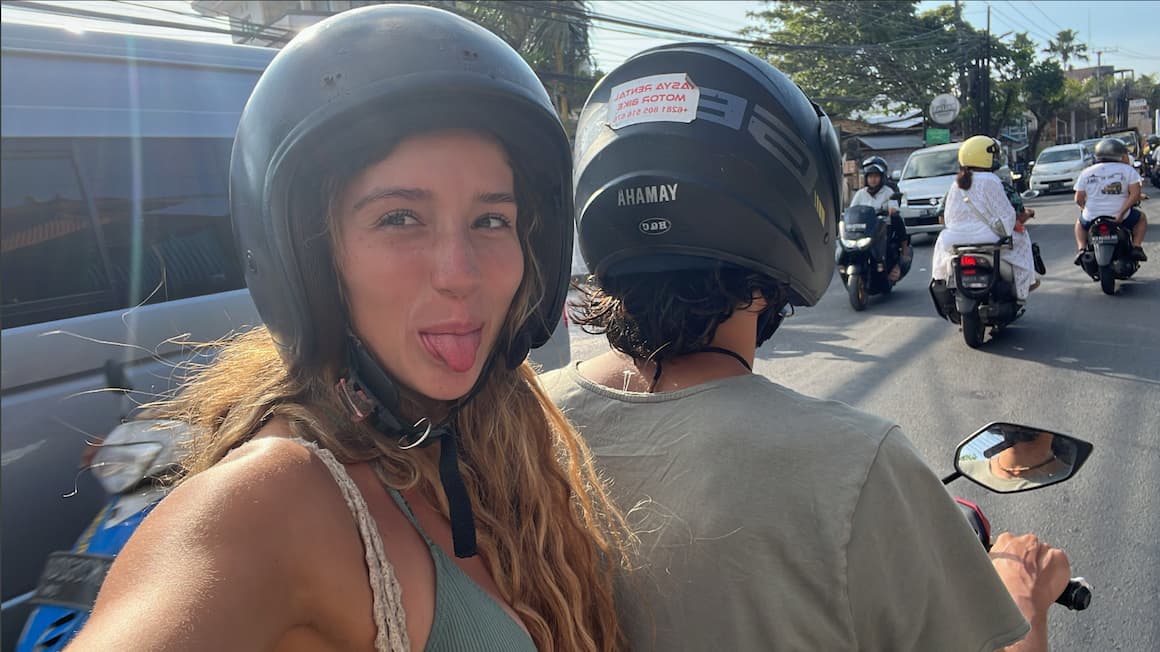
Photo: @amandaadraper
Sex, Drugs and Rock ‘n’ Roll in Bali
Let’s be frank: Bali is kind of a shitshow at times. Though what do you expect when you throw a bunch of backpackers, Australian holidayers, and overly-welcoming locals on the same island?!
Drugs
Before you start to think that Bali is Hamsterdam and there are no rules, some things need to be said. Indonesia, on a federal level, is very, very anti-drug. Do NOT get caught with drugs in Indonesia.
Many have probably already heard this, but there are cases where tourists are incarcerated or even sentenced to death for drug possession. People have been locked up just for having a joint on them, and unlike other Southeast Asian countries, the police in Indonesia are not so easy to bribe. Taking drugs on the road is fun, but in Bali, it’s too much of a hassle and not worth the risk. If you want to smoke, take a boat to the Gili Islands or track down a reggae bar, but I wouldn’t bother on mainland Bali.
Alcohol
Indonesia is a mostly-Muslim country with Bali being a little hedonistic oasis in the middle of it all. Drinking is fine in Bali, and both foreigners and Indonesians do it rampantly (too much, some might say). Domestic beer and imported spirits are readily available and safe to drink. Drinking is, however, pretty expensive in Bali.
The main thing worth repeating: counterfeit alcohol is a real and recurring problem in Bali. Methanol has been found in drinks at bars and clubs, particularly in cheap cocktails and arak-based mixes. If a drink tastes off or burns differently than expected, put it down. Stick to sealed bottles and reputable venues when you can.
Dating and love on the road
Just a note on dating: for those looking for some love or sex on the road, Bali might be an island paradise for you. The dating scene here is as much of a shitshow as the party scene but it’s exactly what you’d expect when you put a few thousand backpackers, digital nomads, and Australian holiday-makers in the same place. It’s not my cup of tea but, hey, go in with your eyes open and your phone charged.
Getting Insured BEFORE Visiting Bali
Just ’cause you’re lounging in an island paradise, doesn’t mean you shouldn’t be prepped for a rainier day. Did you sprain your toe surfing? Get into a scooter crash? Medical care in Bali is expensive without insurance. Don’t become another GoFundMe going around local Facebook groups – take care of yourself beforehand.
A savvy backpacker should always consider getting a comprehensive travel insurance policy before leaving home.
Sort out your insurance before you go. There are several good options, but our overall pick is SafetyWing. Most of the Broke Backpacker team has used it at one point or another, and we’ve filed claims for rabies jabs in Bali, a hospital stay in Mexico, and a clinic visit for a stomach bug that wouldn’t quit. All paid out.
It’s month-to-month, no lock-in, no itinerary required, and you can buy it after you’ve already left. A little over $2 a day if you’re under 40.
New SafetyWing customers: use code BROKEBACKPACKER for 8 free weeks of electronics theft coverage. You have to scroll down and click the pink camera on their landing page to enter it, and you have to do it before creating your account.
How to Get to Bali
Most people fly in. A few arrive by ferry from neighbouring islands. That’s pretty much it.
- By air. Ngurah Rai International Airport in Denpasar is Bali’s only international airport and the entry point for almost every backpacker on the island. It’s well-connected to major hubs across Asia, Australia, and the Middle East. Direct flights run from Singapore, Kuala Lumpur, Sydney, Melbourne, Hong Kong, Dubai, and more. On arrival, most nationalities can get a visa on arrival for 30 days, extendable once for another 30. Sort it at the airport before hitting the immigration queue.
- By ferry from Java. If you’re travelling overland through Indonesia, the Gilimanuk ferry crosses the Bali Strait from Banyuwangi in East Java. It runs 24 hours, takes around 45 minutes, and costs next to nothing. It’s a straightforward crossing and the most common overland entry point for people coming from East Java.
- By ferry from Lombok. Ferries run between Padang Bai on Bali’s east coast and Lembar in Lombok. The crossing takes around four to five hours. It’s cheap and functional, though schedules are loose and punctuality is not a strong suit. Fast boats also connect Bali to the Gili Islands and Lombok directly, running from Sanur and Padang Bai: quicker, pricier, and worth it if you’re short on time.
Entry Requirements for Bali
- Visa on arrival. Most Western nationalities qualify. It costs around 500,000 IDR and gets you 30 days, extendable once for another 30. Apply online as an e-VOA before departure to skip the airport queue, or pay at the counter on arrival.
- Visa-free entry is only available to ASEAN nationals plus a handful of others including Brazil, Peru, Colombia, Suriname, Hong Kong, and Turkey.
- Tourist levy. Every international visitor pays an additional 150,000 IDR (around $10) on top of visa costs. Pay it in advance at lovebali.baliprov.go.id or at the airport. Keep the QR code on your phone. It applies to Bali specifically, not the rest of Indonesia.
- Customs declaration. Fill out the All Indonesia arrival card online within three days of arrival on the official gov website.
- Longer stays. Sixty days is the maximum on a visa on arrival. Beyond that, you’ll need a C-Type Visit Visa arranged before arrival. Visa agents in Bali handle extensions, typically around $30 a month, but verify this before you rely on it.
- Overstaying. Note that you DO NOT want to overstay your visa even a little bit. The day you arrive and the day you leave are included in the duration of the visa. Each day of overstaying is fined 1,000,000 IDR – about $60 USD.
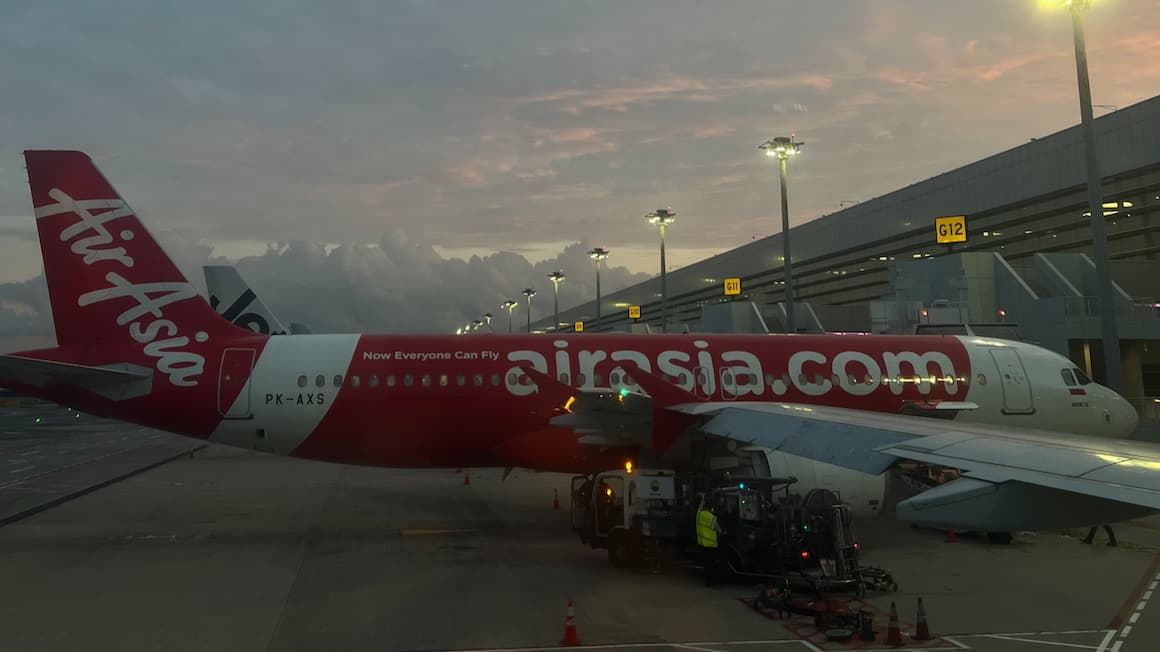
Photo: @amandaadraper
How to Get Around Bali
Bali can seem like an overly chaotic mess of scooters, taxis, and minibuses at times. The south coast and its towns are a special hellscape for traffic.
There is a certain method to this madness, though. You won’t notice it until you’re driving in Bali yourself but there is a rhythm to the chase of the road, and you soon learn to go with its flow.
Travelling by Scooter in Bali
As part of a Southeastern Asian nation, the scooter is king when it comes to getting around in Bali. Driving one is super simple so anyone can pick it up, and it’s the option that offers you the most freedom and fun.
Most hotels will have a personal fleet of scooters available to rent; otherwise, there are several shops around. You can normally get a scooter for around 70,000 Rupiah a day, or perhaps a little higher. This can be even cheaper if you rent it for a week or a month.
Photo: @amandaadraper
I highly recommend getting a scooter in Canggu (for example), driving it all over the island on your adventures, then returning it to Canggu at the end of your holiday.
Just note that you’re required to have an international driver’s licence in Bali. Literally no rental place will care if you don’t have one but I HIGHLY recommend having one anyway: if you get stopped by the police without a valid licence, you’ll either get fined or have to bribe your way out, and if you get into a crash, your insurance won’t cover your costs if you were driving without a valid licence.
Other Forms of Transportation in Bali
Taxi – Bali does have its regular taxis and motorbike taxis. They also have a legit taxi mafia that likes to overcharge tourists. Download a rideshare app instead. In Bali, the ones used are called Grab and Gojek (Gojek is a brilliant name – “ojek” in Indonesian means “motorbike taxi”.)
Motorbike taxis are the best way to get around city clusters but if you’re headed further, say, Kintamani, you could consider hiring a driver if you’re not comfortable driving yourself. You can also get a one-way car ride through Grab and Gojek to nearer destinations.
Car – Yes, people do rent their own cars in Bali, but I do not recommend this if you can just stay upright on a scooter. The roads in Bali are narrow and congested, and taking a car anywhere takes 3x longer than a scooter.
Walking – Don’t even dream it. There are some sporadic sidewalk areas, otherwise you’re always in danger of getting mowed down by erratic drivers!
Hitchhiking in Bali
Hitchhiking in Bali and Indonesia uses a different method for hailing a car. No one uses their thumb in Indonesia but instead waves or maybe points their thumb to the ground.
Never use your left hand as, since this is a Muslim nation, it is considered the “unclean” one. Try to learn a bit of Bahasa Indonesia or Balinese as well; doing so will make your life much easier.
These cultural differences aside, hitchhiking is as straightforward in Bali as anywhere else.
To be fair – I’ve never heard of anyone hitchhiking in Bali. It’s not much of a thing here. You could always try it but be prepared that finding a lift might be tough. Not because drivers aren’t friendly – they’re SUPER friendly – but because most vehicles on the road are motorcycles, tourists in hired cars and small trucks with no space for an extra passenger.
What’s New for Bali Travel
Sorry guys, but visa-free entry is no longer a thing for most nationalities, bar ASEAN countries and a seemingly random handful of others (mostly from South America). Western tourists gotta cough up $30 on arrival. The official Indonesian immigration portal handles e-VOA applications online before you fly: 30 days, extendable once for another 30, at IDR 500,000. Sorting this before you land also gets you through the faster autogate lanes at Ngurah Rai, where 90 autogates have been operating since October 2024, cutting immigration wait times considerably for travellers who arrive prepared.
In 2024, Indonesia introduced a Bali tourist tax which costs around $10 and must be paid by anyone entering Bali (but as the name suggests, you don’t need to pay this to go elsewhere in Indonesia). Pay it in advance at the Love Bali platform and keep the QR code on your phone. You’ll also need to complete the All Indonesia arrival card within 72 hours of landing: a single digital form covering immigration, customs, and health declarations that replaced the old paper card.
Bali has also tightened its expectations around tourist behaviour. Governor Circular Letter Number 07 of 2025 sets out official guidance for foreign visitors around cultural respect, local values, and sustainability. Cover up at temples, don’t treat ceremonies as photo opportunities, and act with basic decency toward the communities you’re moving through. It’s not new advice, but it now carries official weight and Bali has been more willing to enforce it recently.
Unfortunately, Bali is a victim of its own success in some ways, and that means it’s more expensive to visit. Canggu especially, is digital nomad central, and you’ll be paying a premium to stay in this westernised corner of the Island of the Gods. Seminyak ain’t much better, but northern spots such as Lovina are a little easier on the bank balance. Bali isn’t ultra cheap compared to its South East Asian neighbours these days. But it’s still a bargain compared to even the cheapest spots in Europe, so don’t fret too much. 🙂
Working in Bali
Listen, let’s be honest – actually, legally working in Bali is kinda tough. To work with proper authorisation you need a work visa tied to an Indonesian employer, which means finding a company willing to sponsor you. That’s not always easy since Westerners typically cost more to hire than local candidates. The most accessible routes in are teaching English or as a trainer at a gym. For these kinds of jobs, you don’t really even need to know Indonesian (although it’s good form that you do).
Most foreigners who want to stay long-term and earn money either work remotely on a tourist visa, which is technically not permitted but is the reality for the majority of digital nomads on the island, or go down the route of setting up their own business. Starting a company in Indonesia requires its own visa category and bureaucratically, it’s a little tricky navigating the whole start-up process in Bali, but tons of foreigners have done it before so it’s not impossible at all.
Volunteering is also worth considering. Opportunities exist across teaching, conservation, eco-farming, and community development. Use a reputable platform like Worldpackers or Workaway, make sure the placement genuinely benefits the community, and check your visa covers the activity. For shorter commitments, beach clean-ups and local charity events are easy ways to contribute without the paperwork.

Image: Nic Hilditch-Short
On the digital nomad side, Bali is as good as it gets. Canggu and Ubud both have strong co-working scenes, reliable internet, and communities large enough that you’ll find your people quickly. Being a digital nomad in Bali is a blast – if you’re a nomad, your road is bound to lead here eventually.
And if you’re looking for the perfect place to live, work, play and stay in beautiful Bali… Boy, do I have the spot for you. Introducing Tribal Bali – Bali’s first custom-designed, purpose-built co-working hostel. This is the place where backpacker babes, aspiring entrepreneurs, adventurous explorers and vagabond hustlers alike come together to work, eat, play and fall in love… well, at least with the absolutely fantastic coffee and beautiful views!
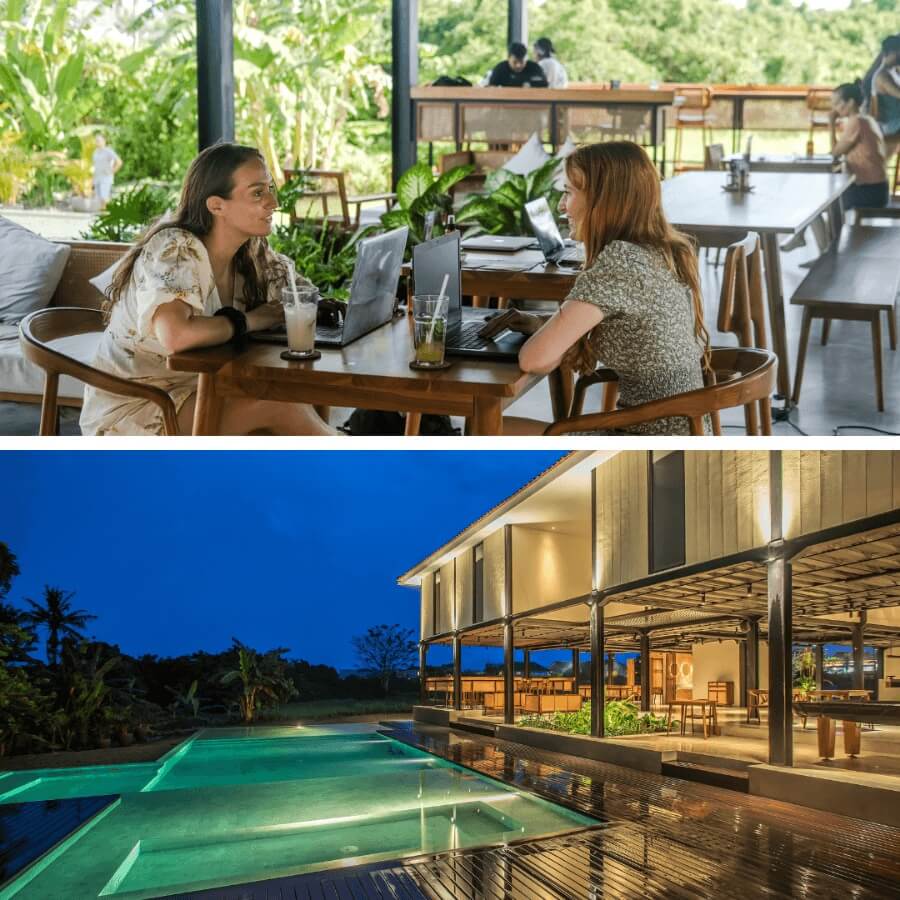
Photo: Tribal Bali
Mingle, share inspiration and find your tribe whilst working in the TREMENDOUSLY FUCKING HUGE co-working space and shooting a game of pool on Tribal’s electric pink billiards table. There’s a gigantic pool as well so it’s always time for a refreshing dip to break up the day’s hustle, brainstorming, work, and games…
With epic food, legendary coffee, awesome cocktails (Tribal Tonics are the best signature cocktails you’ve ever had in a hostel – I guarantee you that!) and a dedicated co-working space, this is the place where digital nomads want to be when visiting Bali. If you love the site and want to support Will, swing on by next time you’re in Bali 😉
Balinese Culture
Bali is culturally unlike anywhere else in Indonesia. While the rest of the archipelago is predominantly Muslim, around 87% of Bali practises its own distinct form of Hinduism, woven through with animist traditions, ancestor worship, and a ceremonial calendar that never stops. It’s why Bali feels so distinct from the rest of Indonesia.
Religion
No other aspect of this unique culture is more valued than religion. The gods are still all-powerful in Bali and the people pray to them very frequently. You’ll see little offerings absolutely everywhere: left at intersections, on doorsteps, and in altars that almost every house in Bali has in their yard.
Daily offerings
Canang sari, small woven baskets of flowers, incense, and food, appear on doorsteps, intersections, and household shrines every morning. If you accidentally step on one, don’t stress: the Balinese believe whatever happens to an offering after it’s placed is the will of the gods.
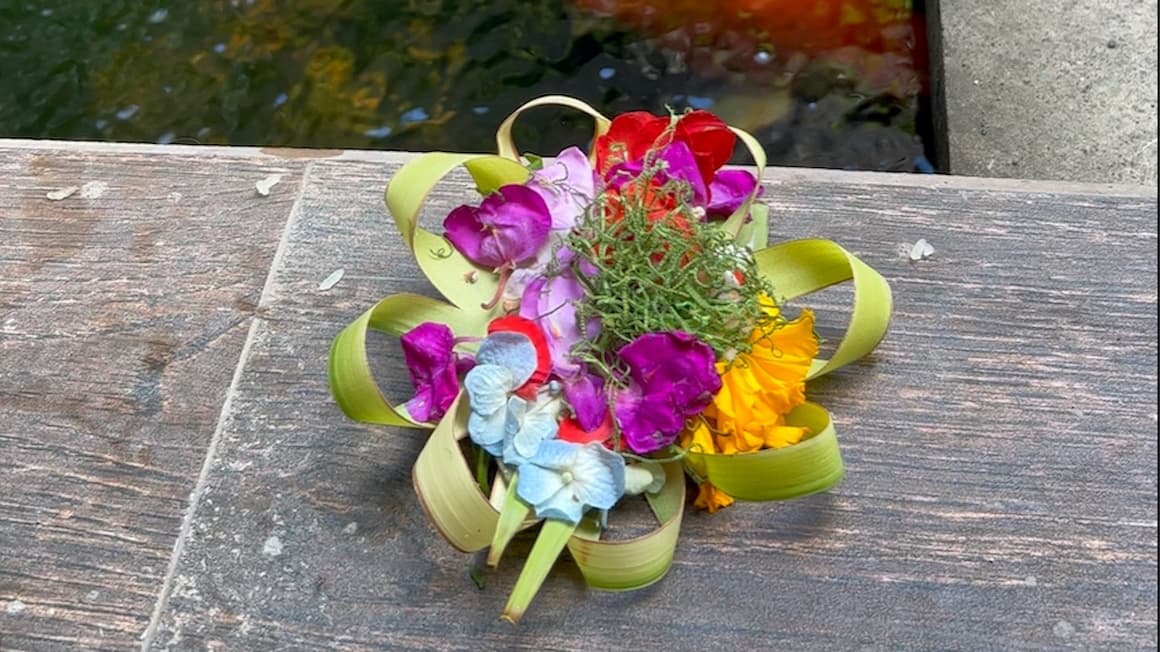
Photo: @amandaadraper
Community structure
There is a very strong sense of community in Bali. Balinese village life is organised around the banjar, a community unit that manages everything from ceremonies and land use to local disputes. It’s deeply ingrained and partly why Bali feels more cohesive than most places its size.
Temples
There are over 20,000 on the island, most of them active. Cover up, wear a sarong, and follow the lead of locals. Don’t enter during a ceremony unless explicitly welcome.
Engaging respectfully
Watch ceremonies from a distance rather than pushing forward with a camera. Eat at locally owned warungs. Learn a few words of Bahasa Indonesia. If you’re invited into someone’s home or a community event, act like the guest you are.
Festivals
Balinese people are very serious about their culture and go through great pains to make sure it’s preserved. Festivals in Bali are regularly organised to excite locals and tourists alike. The arts are highly valued in Balinese society as well, mostly because of their historical significance but also because creativity is actually seen as pious in the eyes of the gods.
Balinese Travel Phrases
Bahasa Indonesia is the official language of Indonesia and is universally understood throughout the country, including Bali. Note that “bahasa” is just the Indonesian word for “language”. However, most people use the word “bahasa” alone to just refer to Indonesian .
But did you know that Bali also has its own traditional language called Balinese? This fascinating language is very distinct from Bahasa Indonesia and the two are actually unintelligible to each other. Traditional Balinese isn’t used as much these days as the standardized Bahasa Indonesia is the dominant language. In fact, the script is becoming so uncommon in day-to-day life that most people can only speak Balinese, not read it.
English is widely understood in the tourist centres in Bali thanks in part to the hyper-developed tourism infrastructure and the inflated presence of Westerners. However, not nearly everyone speaks it even in the cities.
I’ve listed some travel phrases in Balinese below. If you really want to impress some people in the villages, throw in a phrase or two. You should know though that especially in the cities – Denpasar, Uluwatu, Canggu – there are HEAPS of Indonesians that are NOT Balinese. So, these here phrases are more for funzies; it’s usually better to use Bahasa Indonesia.
- Inggih – Yes
- Ten – No
- Rahajeng Semeng – Good Morning
- Rahajeng Wengi – Good Evening
- Suksma – Thank you
- Punapi gatra? – How are you?
- Tiang becik-becik – I am fine
- Tidak ada kantong plastik – No plastic bag
- Tidak ada jerami silahkan – No straw please
- Tolong, jangan gunakan sendok garpu plastik – No plastic cutlery please
- Tiang uling… – I am from…
- Aji kuda niki? – How much?
- Angayu bagia kacunduk sareng ragane – Pleasure to meet you
What to Eat in Bali
With a liberal use of spices and ingredients, Balinese food is hugely varied and somewhat unique. The cuisine is similar to that found in the rest of Indonesia and, in some ways, Hindi cooking albeit with a few caveats.
In Bali, you’ll see pork on the menu quite often, which is unheard of in the rest of Indonesia. Likewise, you’ll see that Balinese cuisine is very meat-centric, which is somewhat converse to many Hindi culinary traditions.
Like its culture, Balinese cooking is a synthesis of many styles that forms its own culinary gestalt.
(Don’t worry, vegans – there are heaps of places that cater to you too. These are not just Western restaurants but Balinese local food also has stuff to offer.)

Photo: @amandaadraper
Most restaurants in Bali will have a diverse selection of dishes to choose from. When backpacking in Bali, we wholeheartedly suggest staying away from the touristy restaurants and eating at the local spots, which are referred to as warungs. The food will be more authentic and less expensive. (Restaurant prices in Bali can really drive up your budget.)
Rice (nasi) is the most ubiquitous ingredient in Balinese cooking and most dishes will include it.
Food carts base most of their dishes around rice and will serve them in paper cones. You’ll easily recognize the food carts trolling around the beaches and streets by their appearance. Referred to as kaki lima, or “five legs,” the food carts will have 3 legs/wheels in addition to the owner’s own 2 legs.
Must-Try Dishes in Bali
These dishes are both delicious and friendly to people backpacking Bali on a budget.
- Babi Guling – slow-roasted pig
- Satay – grilled meat skewers
- Betutu – stuffed duck or chicken
- Nasi Goreng – fried rice
- Lawar – minced meat and veggies w/ coconut
- Urab – mixed vegetables
- Tum – mixed ingredients prepared in banana leaves
- Mie Goreng – fried noodles
- Ayam bubur – Chicken porridge
A Short, Useful History of Bali
Bali’s Hindu identity comes from the Majapahit Empire, the Hindu-Buddhist kingdom that controlled much of Southeast Asia from Java. When it collapsed in the late 15th century and Islam spread across Java, the Hindu court fled to Bali and the religion stuck. The rest of Indonesia went one way; Bali went another.
The Dutch colonial period produced Bali’s most defining cultural moment. When Dutch forces laid siege to the island at the turn of the 20th century, the Balinese royalty chose mass ritual suicide over surrender, an act known as the puputan. It’s commemorated in Denpasar’s Lapangan Puputan Margarana square and remains a source of deep cultural pride. Understanding it explains a lot about the fierce identity Balinese people maintain to this day.
Japan ended Dutch rule during WWII and Bali became part of independent Indonesia in 1945. The politics followed the rest of the country from there. The culture never did.
Some Unique Experiences in Bali
Bali has no shortage of cool things to do and keep you entertained for days. Many backpackers come to Bali specifically to experience these things! Here are a few of them, and the best places to try them out.
Yoga/wellness
Ready to channel your inner eat, pray, love? It’s no secret that Bali is one of the most famous and romanticised places on the planet to study yoga.
Whilst there are yoga studios everywhere in Bali, there are places where they’re more concentrated than average. Ubud is the spiritual centre for hippies, yogis and energy healers in Bali, which is fantastic for others in the same tribe. For the more spiritually challenged of us, Ubudian antics can be kinda WTF. Still, it’s a fun time. All of the other backpacker-favoured spots in Bali also have plenty of yoga studios where you can attend classes.
Surfing
Bali is a mecca for surfers. The seas offer some of the longest, largest, and most consistent waves in the world. Whether you’re a pro or a beginner, surfing is one of the most fun things to do in Bali.
Bali’s breaks suit every level. Beginners should start at Kuta or Medewi, where waves are forgiving and lessons easy to arrange. Intermediate surfers have plenty to work with in Canggu and Dreamland. Padang Padang and Uluwatu are world-class breaks for experienced surfers only. One note: informal surf shacks are everywhere but quality varies. Find an instructor who comes recommended rather than just the closest one to your hostel.
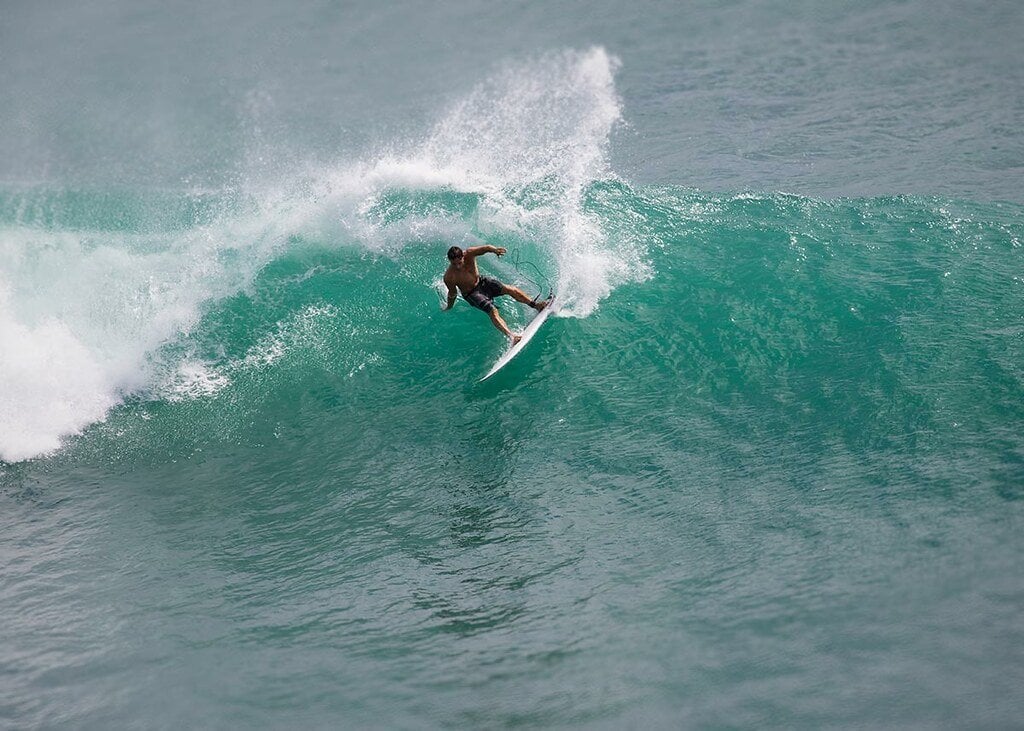
Photo: wavehavenbali (Flickr)
Best Surf Spots in Bali:
- Kuta – The original “surfer’s paradise” on Bali. Relatively gentle waves. Busy as fuck.
- Canggu – Offers waves for all skill levels. Barrels can be intense.
- Padang Padang – Located between Bingin and Uluwatu. Famous for its long, consistent barrels. More for experienced surfers but there are some gentle breaks.
- Uluwatu – Not only some of the greatest waves in Bali but some of the best scenery as well!
- Dreamland – Long stretches of sand that are great for surfers and bathers.
- Medewi – Some of the longest waves in Bali and a great spot for beginners.
Diving and Snorkelling
Bali, in addition to much of Indonesia, is a part of the greater Coral Triangle of the East Indies, which is one of the most ecologically diverse places on the entire planet. For this reason, scuba diving in Bali is world-class and will stun even the most seasoned of divemasters.
Common sightings diving in Bali include manta rays, mola-mola, sharks, turtles, and moray eels. The best diving is around Amed and Tulamben on the east coast, where the USS Liberty wreck is one of the best shore dives in Southeast Asia, and around Nusa Penida and Menjangan Island. Snorkelling is strong at Padang Bai’s Blue Lagoon and straight off the beach at Amed. Currents can be strong, particularly around Nusa Penida: check conditions before you get in.
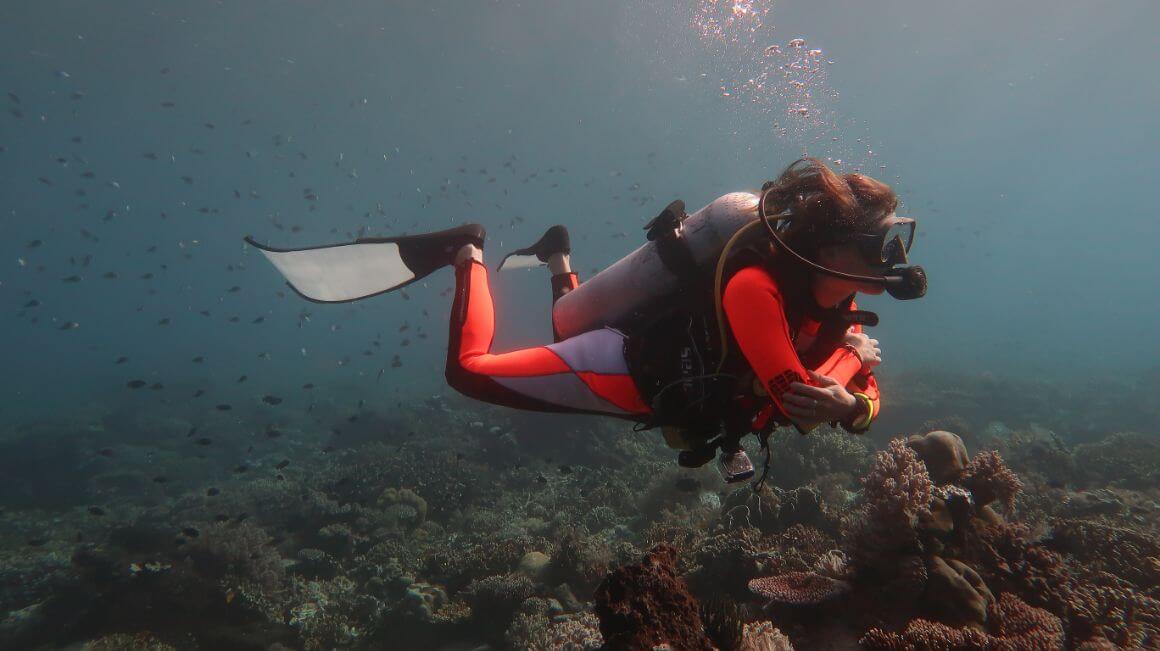
Best Dive Spots in Bali:
- Amed – Ground Zero for Bali’s diving culture. Offers a wide range of marine biology, conditions, and topography. Appropriate for all skill levels.
- Tulamben – Famous for the many shipwrecks that have now become marine menageries. Lots of coral. Good for snorkellers as well.
- Nusa Penida – A layover for several species of migrating marine life. Schools of manta rays and mola-mola are seen here. Careful: there are strong currents here.
- Menjangan Island – Renown for crystal clear water and ease of access. Lots of beautiful reefs and marine life.
- Padang Bai – Calm dive site with good visibility and marine diversity. Great snorkeling at the Blue Lagoon.
Temple ceremonies and festivals
Bali’s religious calendar runs year-round without much of a gap. Galungan, Kuningan, and Nyepi are the biggest events, but smaller ceremonies happen at the village and banjar level constantly. If one coincides with your visit, adjust your plans around it. They’re fucking cool to spectate and get involved with any way you can. Watch from a respectful distance, dress appropriately, and treat it as what it is: a genuine act of worship, rather than just a cultural exhibit for tourists.
Offerings and everyday ritual life
Canang sari appear on doorsteps, at intersections, and in shop entrances every single morning. It’s one of those things you stop noticing after a few days, which is a shame because it’s one of the most distinctive things about daily life in Bali. Pay attention to it. The island’s spiritual life isn’t confined to temples, and this is one of the most obvious examples.
Rice field walks and inland stays
The highlands around Ubud and Sidemen are where Bali looks like the postcards, but only if you go early and get off the main roads. Walk the Campuhan Ridge at dawn. Ride a scooter through the back roads between villages. Stay a night or two in Sidemen and wake up to Mount Agung on the horizon. This is the part of Bali that doesn’t require a ticket or a queue. It requires a little more effort, but feels like unlocking some of the most gratifying parts of Bali.
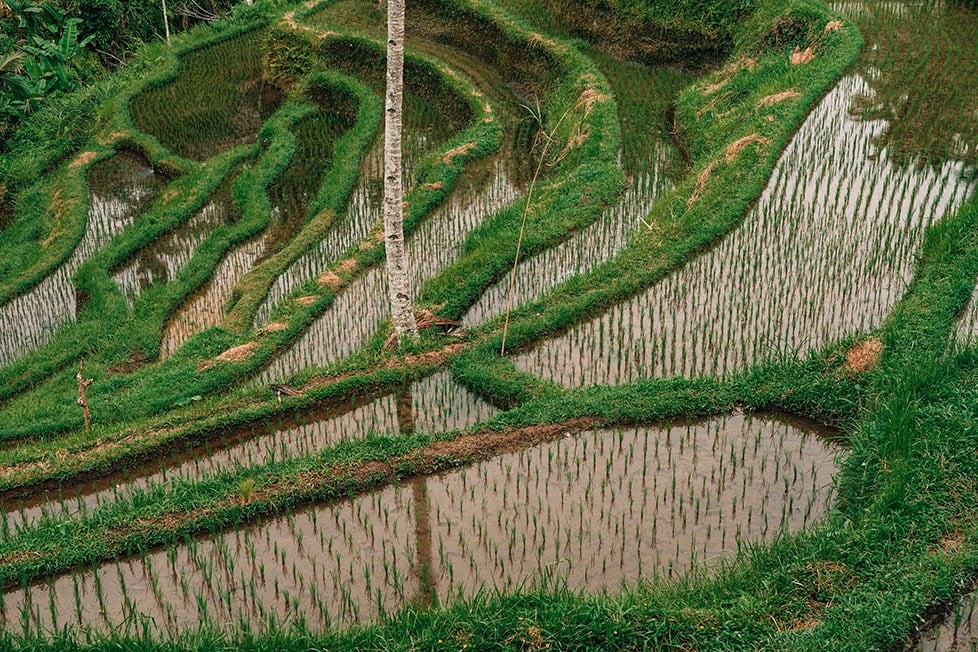
Image: Nic Hilditch-Short
Hire the Best Balinese Driver – Pak Edy
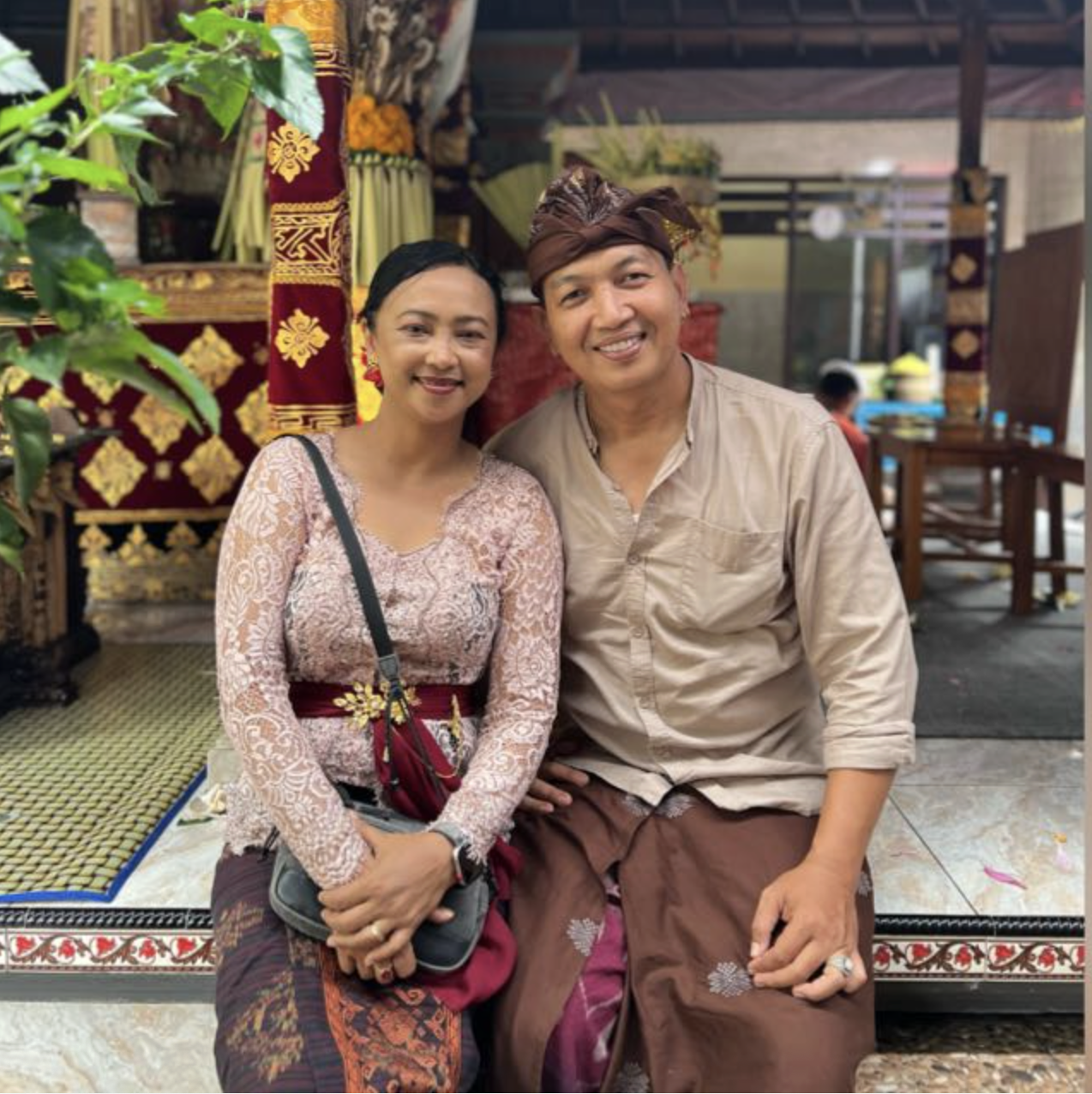
Hiring a driver literally takes all the guesswork and stress out of your trip. From knowing the best shortcuts that don’t result in parking in a rice paddy to planning out the most incredible Balinese adventure, Pak Edy has it covered.
With years of experience, Balinese local Edy knows the absolute best spots to visit on the island and how to tailor your adventure to your interests and needs. He also knows exactly where the most incredible and authentic food can be found in Bali.
Call or Text +62 812-3765-6124 on WhatsApp to book Pak Edy for your Balinese adventure.
Final Advice Before Visiting Bali
Bali is an awesome fucking place to be. It is also a place where all kinds of influencers, hustlers, and people who’ve come to find themselves congregate, cause chaos and blog about the process. It’s chaotic, commercial, overcrowded in parts, but something about it feels so addictive. It’s an island so genuinely beautiful, spiritually distinct, socially stimulating, and one of those places that has a way of making you extend your stay without quite deciding to.
The people who get the most out of Bali are the ones who stop trying to do all of it. The ones who pick a few bases, stay long enough to find a favourite warung, learn which roads to avoid at rush hour, and give themselves enough time to stumble across something that wasn’t in the itinerary. Bali rewards that approach.
If you take anything from this, know that respect goes a long way in Bali. Cover up at temples, wear a sarong when it’s expected, and dress modestly in villages, even when the influencers in Canggu have convinced you that anything goes. Stay calm and respectful in all situations. I know things here get a little hectic, and not everything works like clockwork, but that’s just Asia. The Balinese don’t respect anger, ever.
And for the love of God, DON’T drink and drive. Get a Grab, get a Gojek, walk if you have to. And wear your helmet. Every. Single. Time. The traffic here doesn’t care about the wind flowing through your goldilocks. Protect your precious noggin.
Bali has been written about, photographed, filtered, and overhyped for years. And it STILL lures people in with its unexplained magic. Go find out why.
Photo: @amandaadraper