My first trip to Spain was a brief cruise covering just Malaga and Valencia. But that was enough to whet my appetite and I came back for much more. Today I update this guide from Barcelona, where I enjoyed walking amongst locals enjoying a meal and a drink by tapas bars with a sleepy carefree energy.
And I’m barely scratching the surface here. Spain has a ton to offer. I could spend a year here and still have loads left to cover. I’ll be honest though, it’s no longer the budget-friendly bargain it once was. Still cheap compared to France or Italy, but not quite on Eastern Europe’s level in that regard.
Adventures in Spain start with lazy days on the beach, afternoon tapas, evening espressos, and fiestas all through the night. Somehow, you get up the next day to seek out Medieval and Moorish architecture, narrow cobblestone alleyways, and quaint, whitewashed villages.
Those that do venture outside the standard Barcelona/Madrid/Balearic Islands etc. are rewarded time and time again. I’m gonna cover both the popular regions and islands, plus lesser-known spots without the large crowds.
Travelling in Spain is WAY better when you start making your own itinerary and experiencing unique encounters. In this updated backpacking Spain travel guide, we’ll talk:
- Top travel tips for Spain, plus all the boring stuff like safety, SIM cards and getting around.
- Entry requirements, volunteering, working in Spain, and related topics.
- Travel costs, plus how much you can expect to spend in an average day here.
- And much more, including the best time to visit, and Spanish traditions to get your teeth into.
Whether you want to hike along the Camino de Santiago, or be a beach bum in Cadiz, we’ve got you! For food, nightlife, history, beaches, and regional variety, Spain is unmatched. Vale, amigos. Vamos a España!
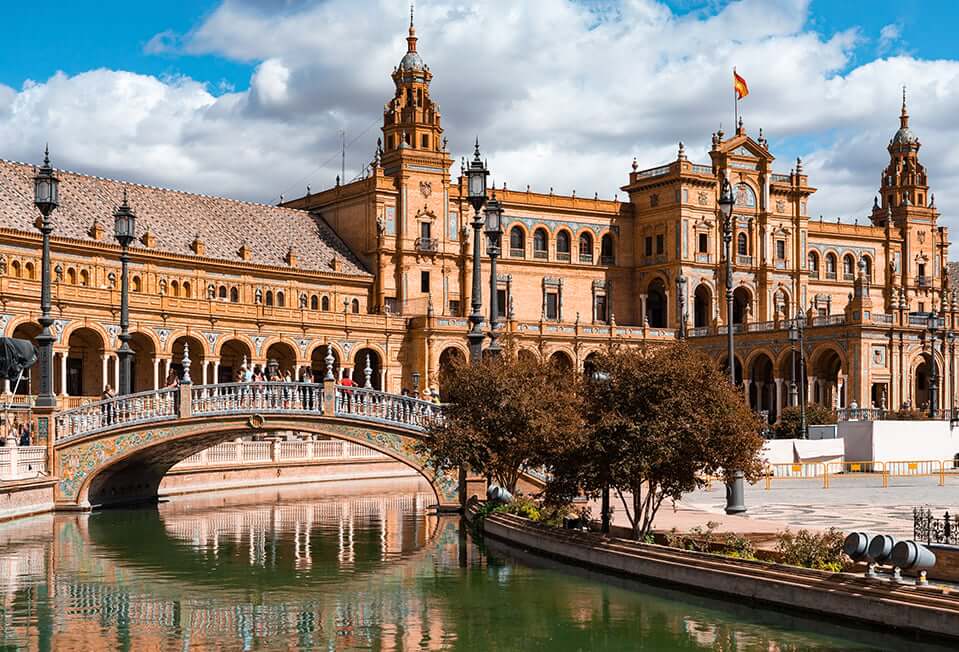
Photo: Nic Hilditch-Short
The Broke Backpacker is supported by you. Clicking through our links may earn us a small affiliate commission, and that's what allows us to keep producing free content 🙂 Learn more.
Why Go Backpacking in Spain?
If you’ve ever even considered travelling through Europe, Spain will almost certainly come up on your radar. This country has delight after delight for every kind of traveller.
You can laze on the beach, or maybe dip your dedos in the warm Mediterranean Sea. You can bounce around big cities where the days and nights blend into one, or explore history that’s deeply ingrained in the country from tip to toe. Hiking through the Sierra Nevada Mountains will allow you to explore Spain’s beauty from the skies, whilst small quaint towns pack a ton of charm.
The food is mind-blowingly delicious. The wine is rich, free-flowing, and cheap. Wine in its purest form is more commonly associated with Portugal or France, but down here we love a good sangria!
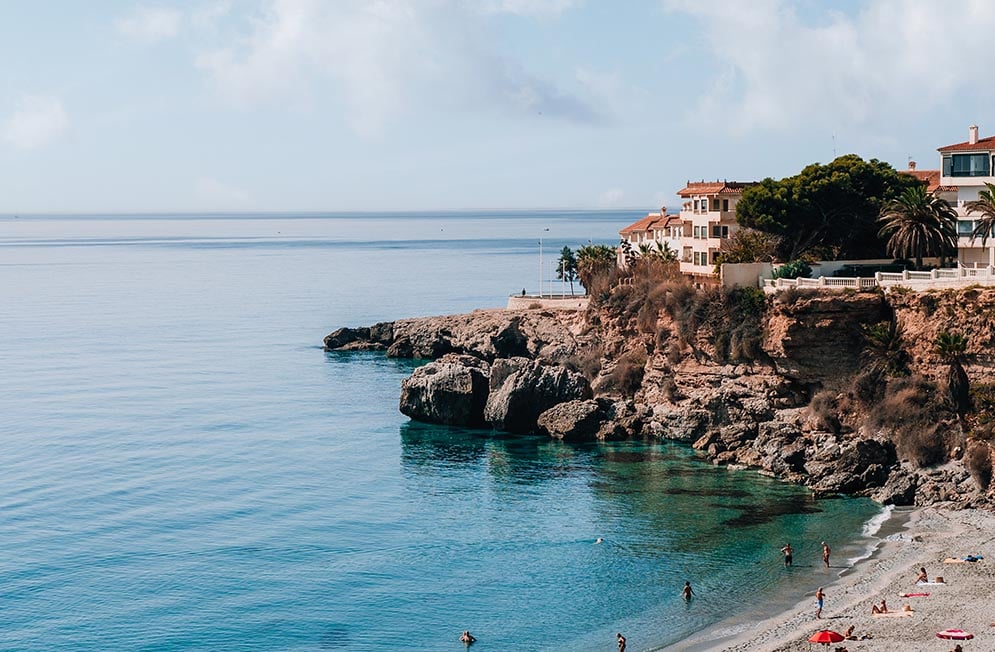
Image: Nic Hilditch-Short
I spent a lot of time on both mainland Spain and – luckily for me – Spain’s beautiful islands too. One thing that this country offers the most is the stunning diversity of the different regions. If you ask the Spanish too, many insist they are completely separate nations too, even speaking different languages.
Spain is a backpacker’s dream combining easy transport across the country, with endless hostels to choose from. It’s a great beginner destination well-suited to solo travellers and larger groups alike. I will say though that despite being cheap by Western European standards, Spain is pricy in the summer, especially in Barcelona, Madrid, Ibiza, Mallorca, and beach towns.
You should avoid peak season where possible, book accommodation ahead, and explore beyond the obvious tourist zones. Let’s dive into how best to explore this stunning and historical land.
- Best Travel Itineraries for Backpacking Spain
- The ULTIMATE Spain Tour
- Best Places to Visit in Spain
- 10 Top Things to Do in Spain
- Backpacker Accommodation in Spain
- Spain Backpacking Costs
- To Stay Connected… Get an eSIM For Spain
- Best Time to Travel to Spain
- Staying Safe in Spain
- How To Get Into Spain
- How To Get Around Spain
- What’s New for Backpacking in Spain?
- Working in Spain
- Spanish Culture
- What To Eat in Spain
- Some Unique Experiences in Spain
- Spain Is More Than Barcelona, Madrid, and Beaches
For travellers far and wide, it’s worth making the effort to visiting Spain’s varying regions. It’s a large country in comparison to other European countries. Yet, with reliable transport, you don’t need to stress much.
I have broken down some of the best backpacking routes for your Spain itinerary. If you’ve got less than 2 weeks, I recommend sticking to one area or a few cities and spending more time exploring it properly.
10-Day Travel Itinerary for Spain – Barcelona and Beaches
- Route: Barcelona > Girona > Figueres > Tossa de Mar > Tamariu > Sitges > Valencia
- Best For: Beach lovers, city breakers, history enthusiasts
- Time Needed: 10 days
- Main Stops: Barcelona, Girona, Tossa de Mar
- Works Best If Starting From: Barcelona
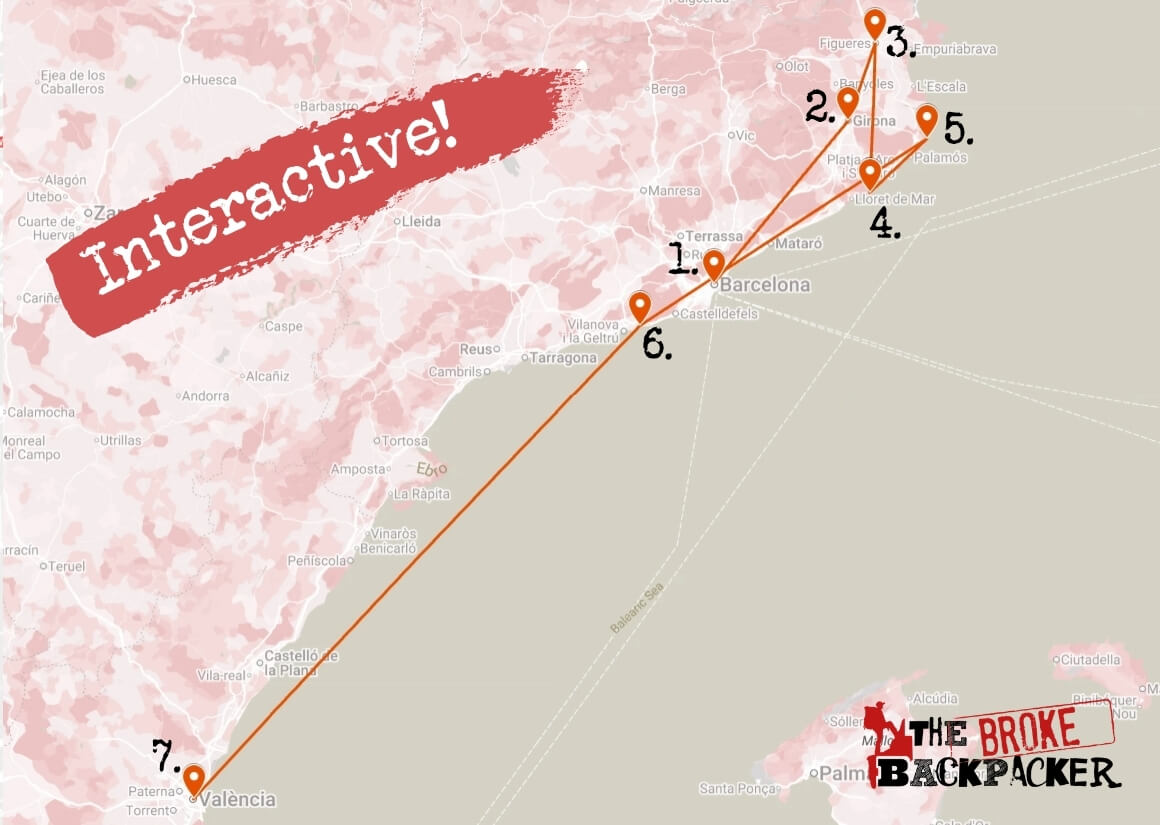
If you’re short on time, one of the most exciting regions to visit is Catalonia. Here we’ll stick to this region along the eastern coast. Barcelona makes an easy landing spot if you’re arriving by air. From there, you can head into surrounding beaches and mountain towns on day trips – or stay a while and get to know them.
Then, head up to visit Girona, a city full of Gothic churches and cobblestone lanes. You can easily visit Girona as a day trip from Barcelona too, but it’s worth spending a couple of days. Plus, there is a sick nightlife scene, and some solid restaurants.
For a spot of culture, I suggest stopping by Figueres for the Salvador Dalí Museum. This was the Spanish icon’s home. It’s an ideal
Within an hour of Barcelona, you can visit Tossa de Mar – a beautiful bay with a towering castle and yellow sand beaches, then Tamariu – a quaint coastal village. Make sure you leave yourself with plenty of time to explore Barcelona. There’s a lot to do here so plan your Barcelona itinerary well.
Barcelona is known for its beaches, but they’re mediocre compared to the rest of Costa Brava, and the Mediterranean islands. So, I suggest concentrating your time on the more unique places in Barcelona and save the beach for coastal towns.
If you have time on your itinerary, take the trip to Valencia. This jaw-droppingly beautiful city is worth making time for. You could stop by the fun beach town, Sitges, just 30 minutes south of Barcelona and home to nice seaside parties and some good, cheap accommodation options.
Don’t try adding Madrid or Andalucia to this itinerary unless you want to spend half the time on buses. I considered a combined 6-day Barca/Madrid trip when I returned from Andorra, but decided to stick to the city of Gaudi and Leo Messi after realising the logistics wouldn’t work well.
2-Week Travel Itinerary for Spain – Top to Bottom
- Route: Malaga or Cadiz/Tarifa > Seville > Cordoba > Granada > Madrid > San Sebastian
- Best For: Couples, history lovers and architecture enthusiasts
- Time Needed: 2 weeks
- Main Stops: Seville, Granada, Madrid
- Works Best If Starting From: Morocco or Portugal
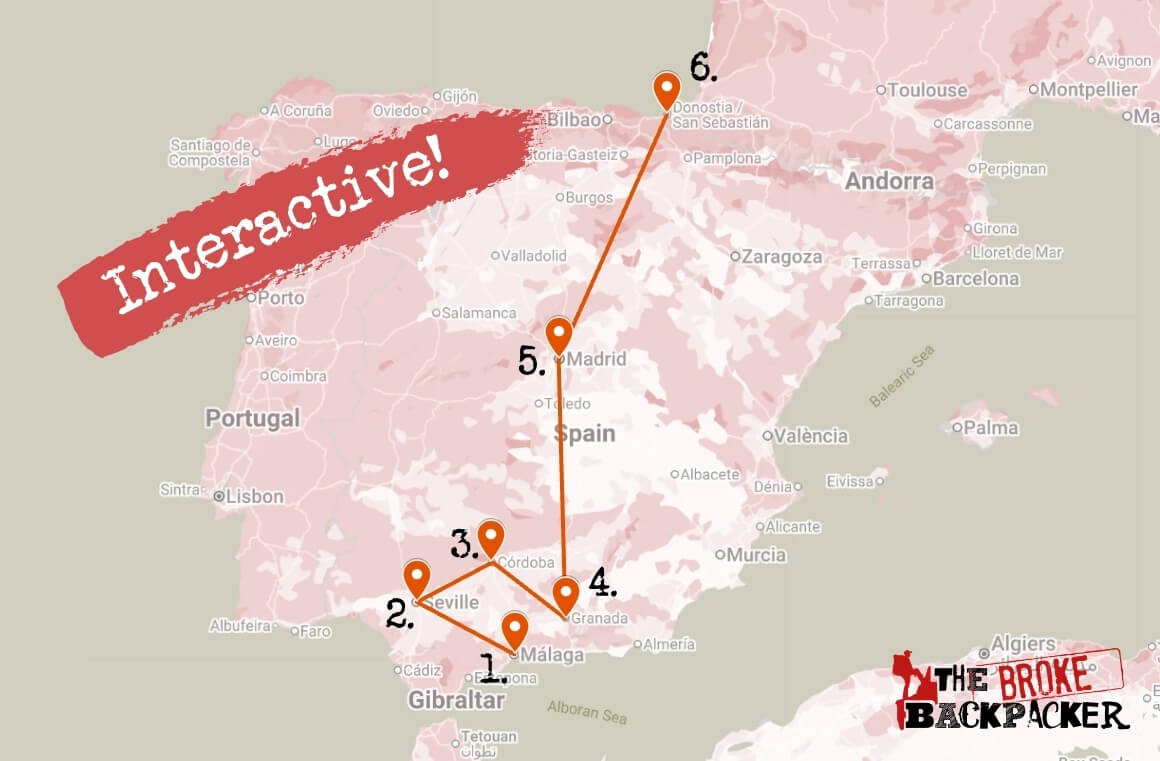
With 2 weeks, you’ve got enough time to quickly cross Spain from top to bottom, and stop in some insane travel destinations. One of the best backpacking routes kicks off in southern Spain. This is ideal if you’re backpacking Spain and Portugal, or you’re arriving from Morocco. It will take you through Andalucia, the capital Madrid, and up to the northern coast.
Start in Spain’s amazing southern cities. Visiting Málaga, the white city by the Mediterranean Sea, is convenient. It has the biggest airport in southern Spain, so this could be the easiest city to fly into. I flew here for my first ever Spain trip, and it was very easy to reach from England.
If you’re arriving on a boat from Morocco, you’re probably going to start your route by staying in in Cádiz. We spontaneously visited this city by the beach and it was a great surprise. Tarifa is famous for its kite surfing and has some awesome backpacker hostels to stay in.
Or, if you’re heading in by land from the south of Portugal, Seville could be your first stop. If your itinerary allows it, visit Ronda and the other whitewashed villages in this area.
You could do a quick stop in Córdoba. One day is probably not sufficient to see all the things to do here. Cordoba boasts the most UNESCO World Heritage Sites of any city in the world (4).
Visiting Granada for a few days is really worth it. There is so much to do and see, I recommend staying in a Granada hostel so you can soak it all in. Granada’s iconic Alhambra and Córdoba’s Mezquita are two must-see attractions in Andalucía. Get ready for beautiful views and free tapas!
Then, you’re ready to head to Madrid. You’ll want to set a few days aside for the capital city. From there, you’ve got one of the most well-connected airports in the world. So you can basically go wherever you want! If you’re heading onto France, San Sebastián will probably be your last stop for surf and sun.
If short on time, maybe skip some of the smaller stops. Target one entry point (Malaga, Cadiz or Seville), skip Tarifa and Ronda, and focus more on Cordoba, Granada, Madrid and San Sebastian instead.
2-Month Travel Itinerary for Spain – The Full Flamenco
- Route: San Sebastian > Bilbao > Cantabria/Asturias > Santiago de Compostela > Salamanca > Madrid > Cordoba > Sevilla > Granada > Malaga > Costa del Sol > Valencia > Barcelona > Balearic Islands/Canary Islands
- Best For: Slow backpackers, digital nomads, Camino walkers, or long-term Europe travellers
- Time Needed: 2 months minimum
- Main Stops: San Sebastian, Santiago de Compostela, Madrid, Cordoba, Granada, Costa del Sol, Barcelona, Balearic/Canary Islands
- Works Best If Starting From: France. Also Portugal if you shuffle things around and start in Santiago de Compostela
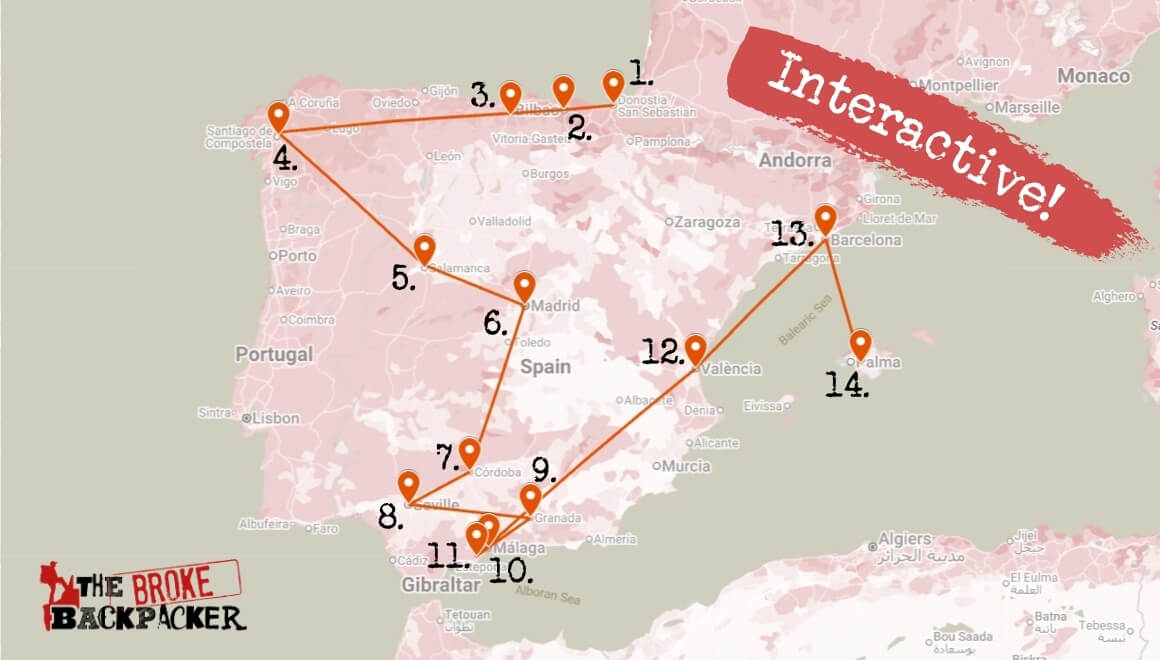
Now we’ve got some time on our hands, we can do a nice little circuit on this Spain itinerary. So it doesn’t matter where you start or which direction you go. You can pretty much combine the last two itineraries, and let’s throw in some other goodies too.
With more time, I highly recommend doing the Camino de Santiago – one of the most iconic hikes in the world. This is also great if you are backpacking Spain and Portugal or France. If you’re really serious, you could walk from Portugal or France!
So you could arrive in San Sebastían, walk through Bilbao, and arrive in the gorgeous Santiago de Compostela.
If you’re not walking from Bilbao, check out the beautiful town of Oviedo and stop by Santillana del Mar in Cantabria – a perfectly preserved mediaeval town. You can also take day trips and wine tours around the world in La Rioja, Spain’s most famous wine region!
If you visit Spain in the summer, set some time aside for the coast of Galicia. Check out Coruña and Costa da Morte. The Galician coast adds depth beyond the standard backpacking trail through Spain’s major cities, beaches and islands.
Stop in the magical city of Salamanca for a great vibe and nightlife, thanks to the university. It’s also a convenient stop on your way to Madrid.
Then, follow the last itinerary through Southern Spain, passing into Andalucía through Córdoba, Seville, and Granada. Spend some time on the golden beaches of Costa Del Sol.
Next, you can make your way up the Eastern coast to charming Valencia. Sample some paella for a few days and stay in one of Valencia’s cracking hostels. Then, take a train or bus to the energetic and bustling city of Barcelona.
If you have time, you can take a ferry to the Balearic Islands which are really closely connected to Barca, stay in Menorca for a while before you party hard in Ibiza.
Your goal with 2 months should be to really go in depth, and not just tick off major attractions in big cities. Spain is a country that would literally take months to fully explore. And I use the word “fully” very loosely, because it’s an endless plethora of beautiful attractions, beaches, people, food, culture, great weather, and so much more!
The ULTIMATE Spain Tour
If you want the logistics to be sorted for you, the best option is to book a tour. I went on this Best of Southern Spain, Madrid to Barcelona last year and it was without a doubt one of the highlights of my travels. Whether you’re new to travel or just want a trip with all the fun and none of the admin… this one is epic!!
- Number of days: 8 Days
- Group Size: Max 16, avg 12.
- Fitness required: Light
- Accommodation type: Comfortable tourist-class
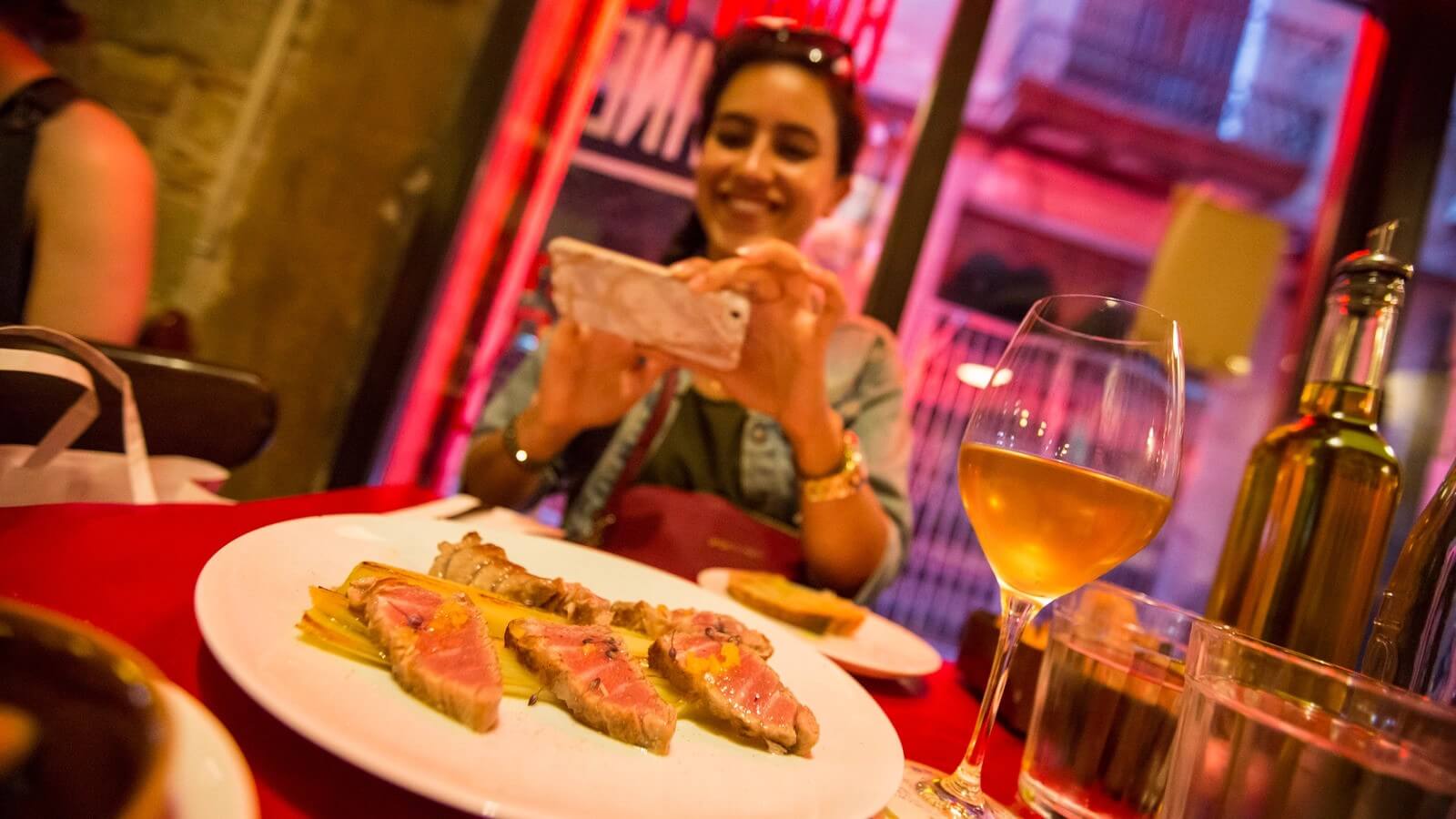
Spain is an absolute treat of a country for backpackers. It’s one of the best places to travel alone, as well as with your family, as a couple, or with friends!
We’re talking major cities, major chill-out locations, and all-day, all-night parties. We’ll talk about some of the popular destinations and top spots that have been drawing people to visit Spain forever. But for starters, I’ll give you a brief overview of where to target.
- Best for first-time visitors: Madrid, Barcelona, Seville, Granada, Valencia
- Best for food: San Sebastián, Galicia, Madrid, Granada, Valencia
- Best for nightlife: Madrid, Barcelona, Valencia, Ibiza, Granada
- Best for beaches: Costa Brava, Balearic Islands, Canary Islands, Galicia in summer, Costa del Sol
- Best for history: Córdoba, Granada, Seville, Toledo if added, Salamanca, Santiago de Compostela
- Best for hiking: Camino de Santiago, Picos de Europa, Pyrenees, Sierra Nevada, Canary Islands
- Best for budget travellers: Granada, Cádiz, Salamanca, smaller towns, off-season islands
Backpacking Madrid
Spain’s capital, Madrid is obviously one of its bustling major cities. You’re going to need to set aside at least a few days to appreciate it properly. It has a fantastic transport network including a metro that runs from 6am-2am daily. Plus it has an abundance of hostels, making it backpacker-friendly.
Travelling in Madrid doesn’t have the immediate grandeur of Paris and Rome. Nor does it have the might that Barcelona possesses in the form of Gaudi’s works, including the Sagrada Familia. But it does have the art scene, nightlife, and insane restaurants to easily compete. Puerta Del Sol is the plaza sitting proudly in the heart of the city centre.
Most of Spain’s best art museums are in Madrid, including Museo del Prado and El Centro de Arte Reina Sofía. Check out masterpieces by Pablo Picasso and Salvador Dalí.
El Rastro is Madrid’s famous Sunday flea market; go if you are visiting Madrid on a weekend. El Retiro is a great park to spend a sunny afternoon and take a break. Just watch out for annoying rollerbladers – unless you wanna take part – it’s less annoying then.
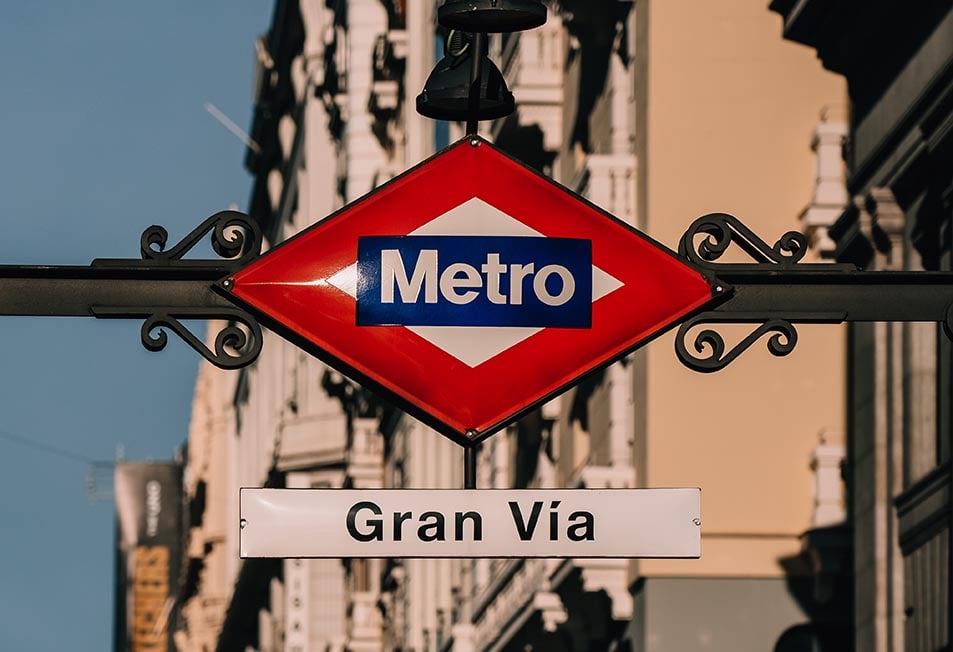
Image: Nic Hilditch-Short
Madrid’s nightlife doesn’t really start until 3 am. From live venues and wall-to-wall bars to multi-story clubs, there is always something going on. The best party districts in Madrid are Huertas, Chueca, and La Latina. There are also some insane party hostels in Madrid which are definitely worth getting involved u to get the party started.
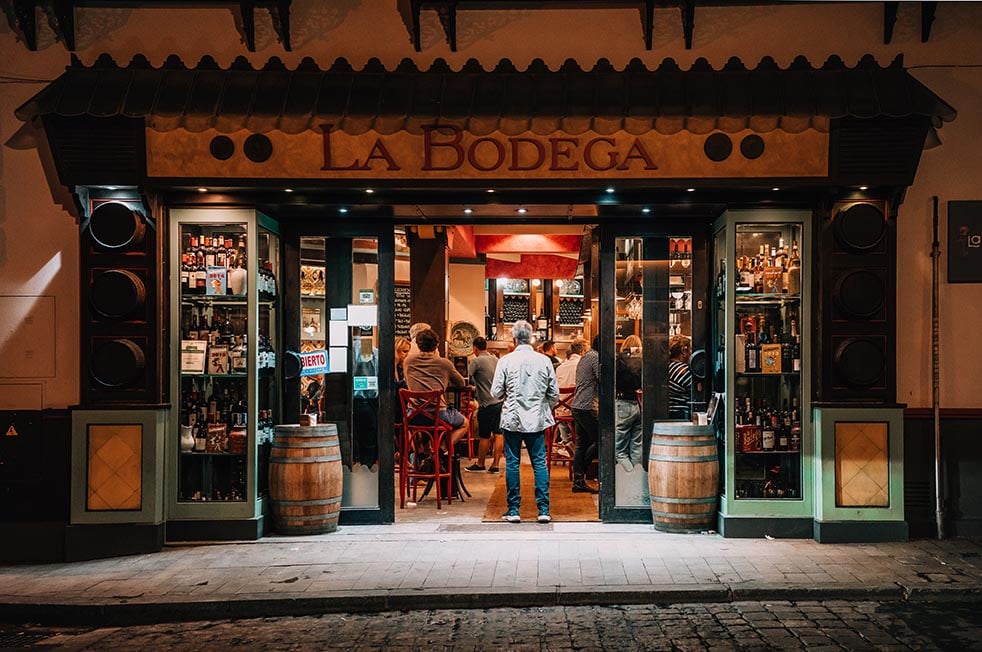
La Latina has restaurants and tapas bars galore. Malasaña is another neighbourhood with great cafés. Mercado de San Miguel is a fun market to taste different Spanish dishes and get wine drunk, but comes with tourist trap prices.
Sungate One hostel is one of my favourite places to stay in Madrid. This hostel draws me back again and again.
Madrid is better when you stop chasing sights and settle into neighbourhoods, bars, museums, and late-night life.
Backpacking Barcelona
I have a love/hate relationship with Barcelona. If you’re visiting Barcelona for a weekend, or you’re a city person, Barcelona is your jam. You’re gonna love this place.
You have a city with deep-rooted history and a modern mindset. Behind you are mountains and ahead, long golden beaches and Mediterranean Sea. How many other places have a claim like that?
There is an endless list of things to do here. Even the most busy-minded traveller need never rest.
Cobblestone lanes of the Gothic quarter, world-class architecture, dancing from bar to club. Rave all night long. Hang out at a beach club. I will say though, that Barca’s beaches pale in comparison to the Costa Brava or Spanish islands.
Watch a classical concert at the Palau de la Música Catalana. The Picasso Museum is supposed to be lovely, but I never made it for the queues. If you’re a footy head, watch a match or take a tour at Camp Nou. Check out the viewpoints for the sunset over Barcelona. I highly recommend Bunkers. Bring food and wine!
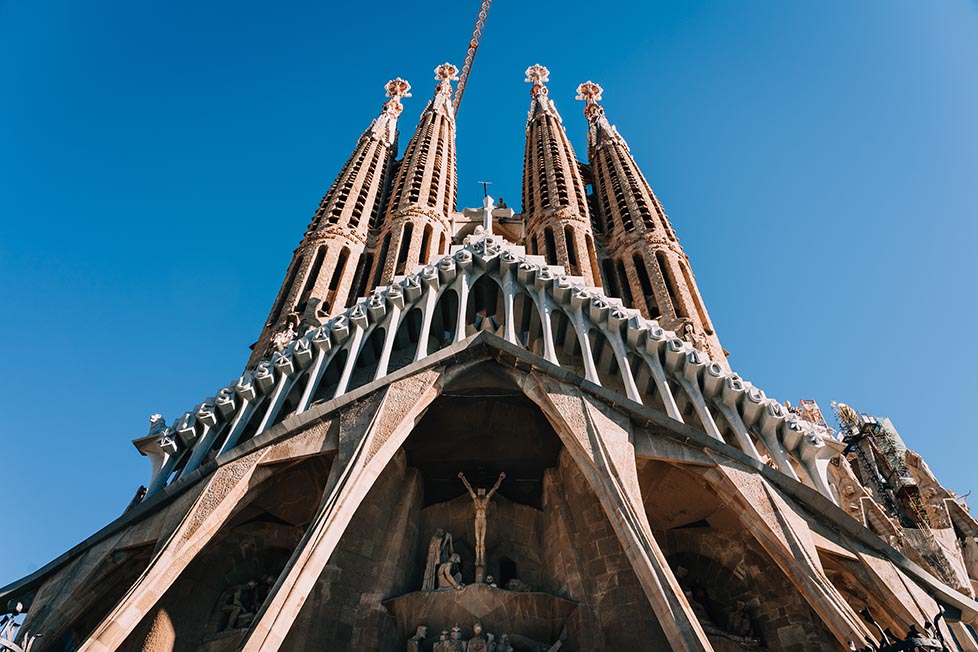
Image: Nic Hilditch-Short
And I have to mention Barcelona’s hero: Antoni Gaudi. His unique and inspiring creations are all across the city. Cast your eyes on the iconically ever-incomplete (until recently) La Sagrada Familia.
Park Güell lives up to its reputation! Parc de la Ciutadella is a beautiful park but – in my experience – it’s one of the most unsafe areas of Barcelona: pickpockets are RIFE! I also saw guys lurking around metro stations waiting for unsuspecting locals and tourists to enter the gates, before pushing behind them without paying.
My favourite neighbourhoods to stay in are the Born, Gothic Quarters, and Gracía. Ravel is rough around the edges but has cool vibes.
If you’re backpacking Spain on a budget, I recommend staying away from the famous La Rambla. It’s too touristy and overpriced. Barcelona is increasingly expensive, year after year. Now, when I visit, I Couchsurf to cut the insane accommodation costs. (Damn you, beautiful Airbnbs). If you are backpacking Spain during summer, it pays to plan ahead. It’s getting kinda mainstream and, therefore, expensive.
Barcelona has its own unique culture compared to other parts of Spain with a strong Catalan independence movement. If you’re interested in reading more about the history and culture of Barcelona, check out our list of the best books about Barcelona before you go.
Barcelona is brilliant, but it requires more caution and budget planning than many first-time visitors expect.
Day Trips from Barcelona
There are plenty of day trips you can take from Barcelona.
- Best for mountains: Montserrat. This place is known for its “sacred mountain.” Maybe you’ve seen the stairway into heaven? You can do it on your own or as part of a Barcelona Airbnb experience.
- Best for medieval streets: Girona. From the Jewish Quarter to Passeig de la Muralla, Girona has some incredible cobbled streets, and you can admire some of Europe’s longest historical walls.
- Best for Roman history: Tarragona. This is the oldest Roman settlement that can be found in Spain. UNESCO has recognised how awesome it is, and that tells you all you need to know!
- Best for beaches: Sitges, Tossa de Mar, Costa Brava towns. Barcelona has beaches, but if I’m honest, they’re pretty meh. Enjoy Barca for Gaudi’s greatness and the football team, but hit the Costa Brava for some cracking beaches.
- Best for art: Figueres. Home to the Dalí Museum. This guy’s a pure legend. Even if you’re not into surrealist art, you should go.
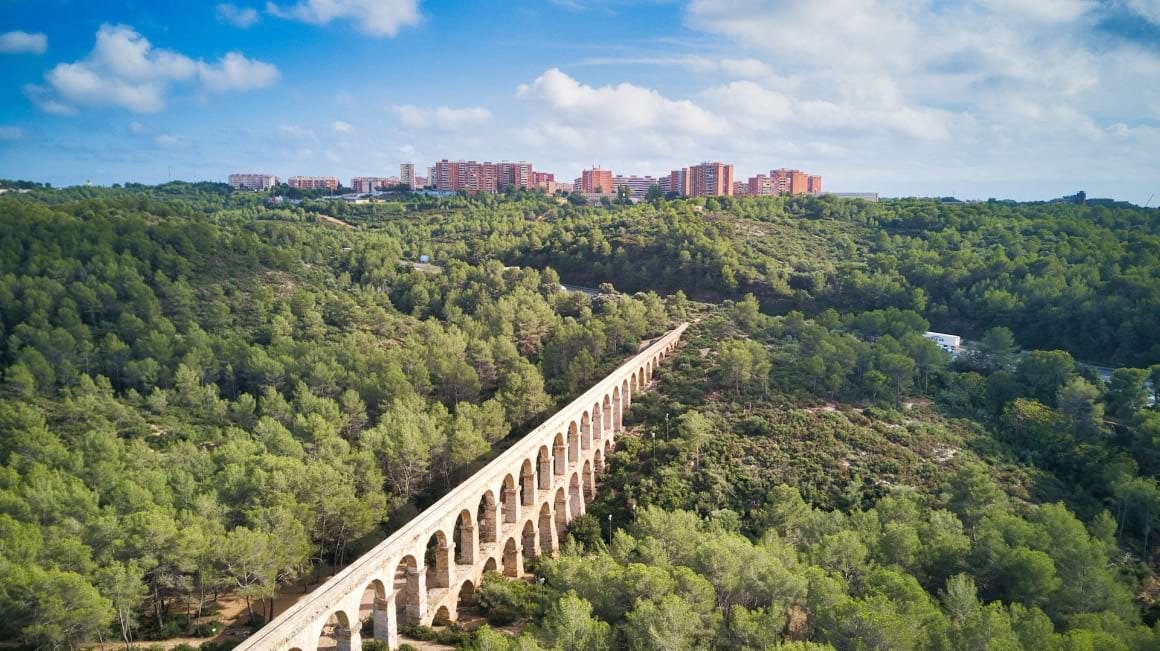
Some day trips are easy by train, while others are better with a car or organised tour. I recommend driving along the Costa Brava to stop at several fun beach spots.
Backpacking Córdoba
Córdoba is a city that is not usually very high on people’s Spain itinerary. But those that do visit are well rewarded. It is one of the nicest places to stay in Spain and Córdoba’s hostels are such a vibe!
One building alone should give you enough reason to travel to Córdoba. The mesmerizing Mezquita Catedral is a church that became a mosque before reverting back to a church. This building fuses both Gothic and Islamic architecture – two religions and two cultures under one roof.
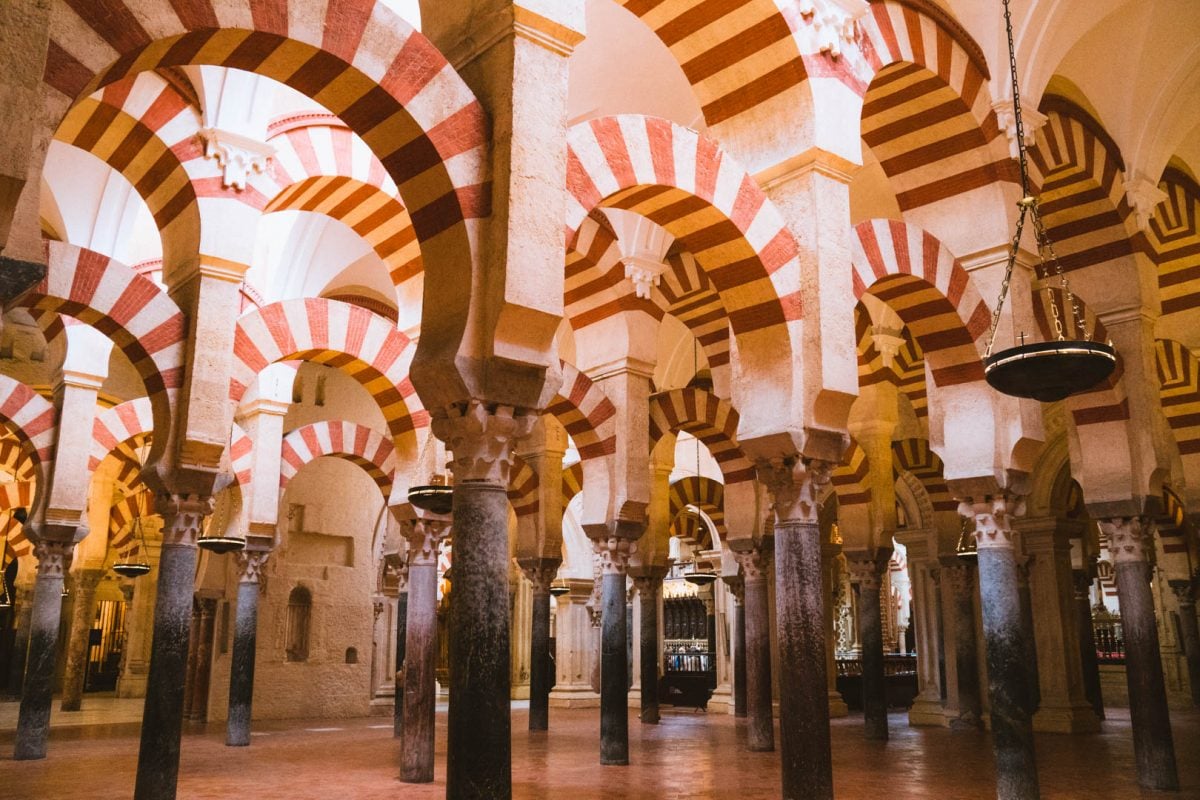
Photo: Ana Pereira
Aside from visiting the Mezquita, the city of Córdoba itself is beautiful (and photogenic) with plenty of shops, cafés, and winding foot streets. The neighbourhoods in Córdoba are really chill to stay in and get to know the locals. They even have a yearly Patio Festival in May where contestants compete for the prettiest flower-adorned courtyards, and open them up to the public.
Summers are scorching hot and crowded though. I much prefer planning a trip to Córdoba in spring or autumn. You can visit on a day trip, or spend a night here, but you don’t need much more than that.
Backpacking Seville
Seville encapsulates the essence of Southern Spain: narrow alleyways lined with small bars, large, open plazas and dramatic churches and palaces, and scorching hot summers… There are so many cafés and tapas bars to stop in.
Did I say that already? Oh, well, yeah: we’re in Spain.
I love the local vibe that staying in Seville gives you. Stroll around the Barrio (neighbourhood) Santa Cruz, and for an authentic tapas experience, eat at the Feria Market in the Macarena neighbourhood. Walk along Las Seta De Seville for spectacular views.
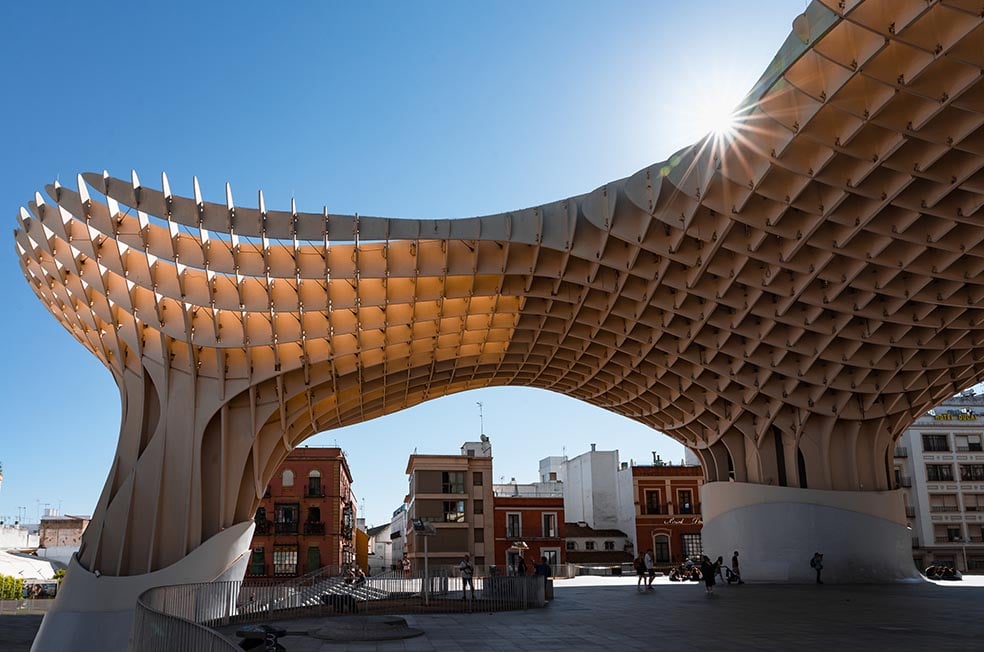
Image: Nic Hilditch-Short
The ordinary really seems extraordinary here. Most of the bars aren’t extraordinary, they’re always full of Spaniards enjoying life with a cafecito or cerveza. It’s a vibe. It does get ridiculously hot in the summer though, which makes it better to explore slowly.
Seville has tons to see during the day as well. In terms of sights, Seville has an impressive cathedral, but nothing compares to Seville’s Alcázar, which was built in the 1300s. Have you seen this before? Maybe. Game of Thrones shot the Dorne palace scenes here.
Seville is the place to watch an authentic flamenco performance, and you can’t go backpacking in this country without seeing a flamenco show. La Carbonería is a local favourite and a popular spot to watch an authentic flamenco show. Seville also doubles up as a great place to visit Ronda and the white villages.
Backpacking Málaga
Like most of the cities in the South of Spain, and especially along Costa Del Sol, staying in Málaga involves eating, drinking, and hanging out. These are all great things to do all day, every day. The plaza central (central plaza) is one of my favourite spots.
You have to spend some time in the old town. I also love the fact that Málaga is right on the beach. So after a lovely day of exploring historic cathedrals and Roman ruins, you can go and drink some cold ones on the coast. There are loads of great Airbnbs in Malaga too.
Don’t miss out on the Alcazaba, a fine example of Moorish architecture, built into the hillside as a fortress back when the Moors occupied Spain. At the base you even have a Roman theatre, which should be enjoyed at the same time.
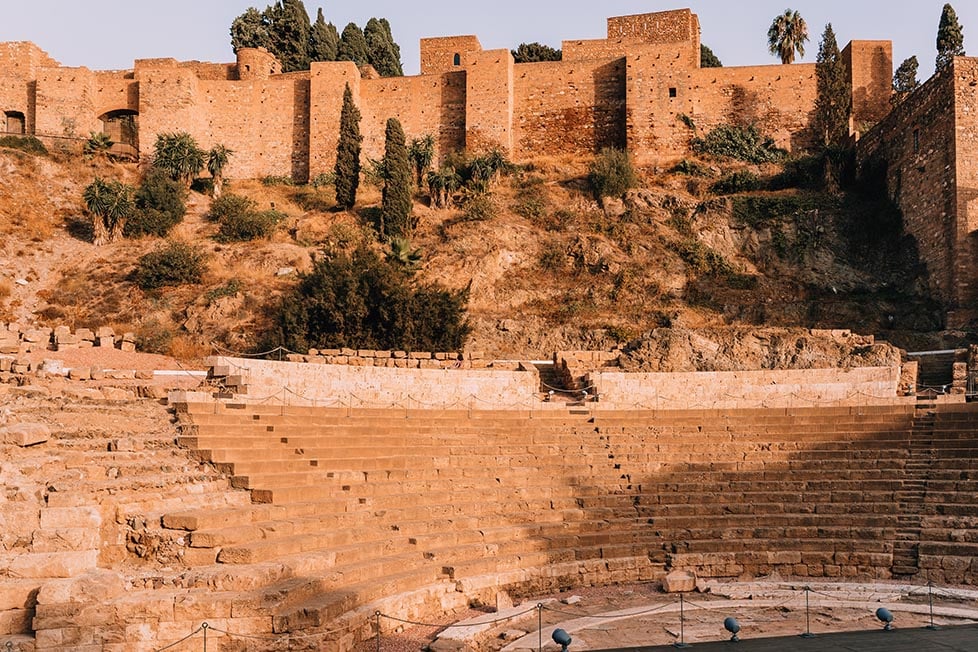
Image: Nic Hilditch-Short
Buy food and shop around Mercado Merced for nice prices and nice quality. There are a few nice museums in Málaga, like the Picasso Museum, but overall, my favourite and most memorable part about Málaga was simply hanging out at the beach, cafés, and restaurants in the plaza.
If you’re planning to visit Spain as a solo traveller, check out our favourite hostels in Málaga. They are so cool and a great place to meet people. I’d call this a top solo travel destination for that reason (and the fact it’s so fun).
The majestic mountaintop town of Ronda is a great day trip from Málaga (or Seville). Here you’ll see the photogenic Puente Nuevo bridge with views of the Ronda Mountains above a deep gorge. This bridge separates the new town from the Moorish old town.
Málaga is more than a package-holiday gateway if you stay in the old town and explore beyond the beach. I have fond memories of arriving here for a cruise during my first ever Spain adventure, and just wish I’d had the time to venture further.
Backpacking Granada
To truly experience the charm of my favourite city in Southern Spain, you have to peel back its layers. Luckily, my sister studied in Granada and took me to all of her favourite spots.
You can’t stay in Granada without visiting Alhambra palace: one of the most impressive places to visit in all of Spain. Book tickets in advance, especially in peak (summer) season. By the time I arrived in Granada, I was sick of looking at churches but the Granada Catedral and Grand Chapel are something else! Every time I walked by the Granada Catedral there was new music echoing across the courtyard from new musicians.
When you visit Granada, get lost among the ascending streets of el Barrio Albayzín, Granada’s prettiest neighbourhood. Barrio Sacromonte next door is great as well.
Granada is the only place left in Spain with free tapas. Free food with every drink you purchase! The more drinks you order, the bigger the dishes get. Reminds me of drinking in Italy, a sweet touch! Bar crawl in search of the best tapas and eat free dinner by drinking more beers. (Like a dream.)
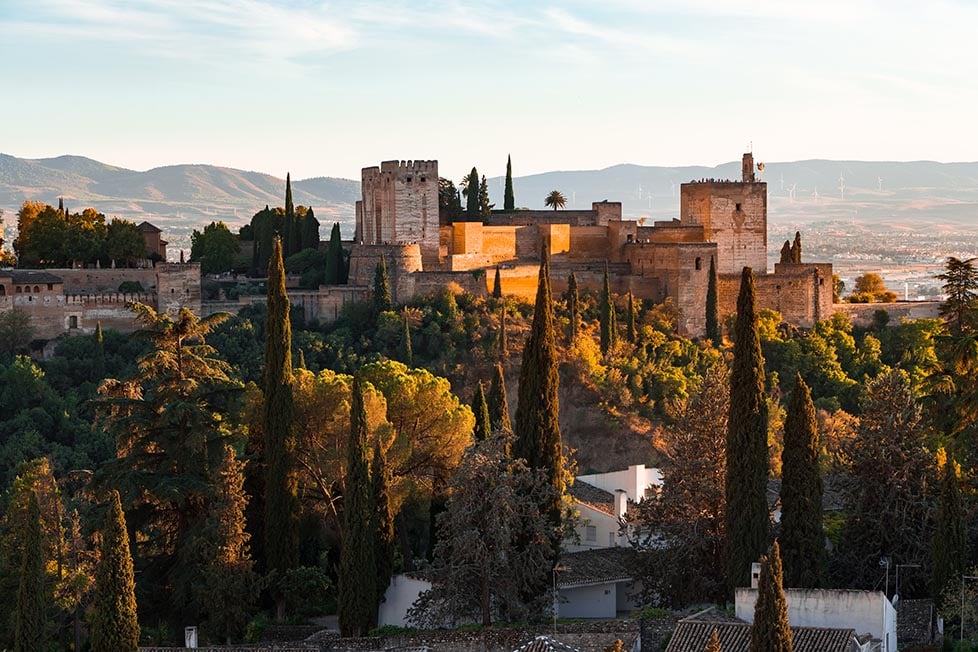
Image: Nic Hilditch-Short
Check out Calle Navas and Calle de Elvira for the best tapas bar hopping. Elvira and around the Bullring specifically have great cafés, bars, and tapas that touched my soul.
For great views of Granada, hike up to San Nicolás Mirador and Miguel. There are a lot of great parks sprinkled throughout the city as well.
If you are itching to spend some time outdoors and work off all of Andalucía’s tapas, the Sierra Nevada Mountains are right next door. Hiking is open for most of the year, although the height of summer is scorching. AND you can ski (quite affordably) during winter! In fact, you can sleep in a cave if you like around here.
Backpacking Valencia
I went to visit Valencia on a whim and ended up having one of the best weekends of my life. It’s famous for paella and beaches and I quickly found out it’s much more than that. There’s a solid balance between sangria-soaked beaches and aesthetically pleasing city scenery here.
The locals, for me, were the best part of Valencia. Choosing a private room in an Airbnb in this city is a great way to get to know them. Warm and inviting, we had the best parties and best paella with these cool ass people.
Grab desayuno (breakfast) at Plaza de la Virgen. Visit the Ancient Valencia Central Market for fresh fruit and produce; it’s a great way to immerse with the locals. Rent a bike and cruise around on the promenade by the beach.
Go ahead and try their local drink, Agua de Valencia (Valencia water). It’s anything but water: orange juice, cava, gin, and vodka… The best place to enjoy Valencia water is Café Madrid de Valencia, where the drink was invented!
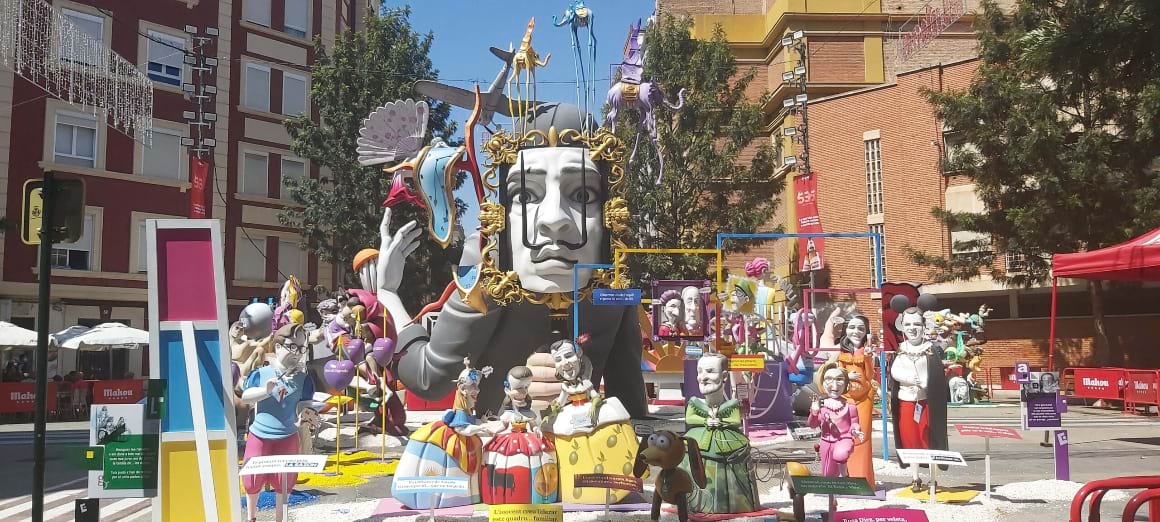
Photo: @Lauramcblonde
I (completely coincidentally) ended up in the city for the Las Falles Festival. It was one of the happiest accidents of my travels. This March event is one of Spain’s awesome festivals worth planning for. This is a week-long party with streets lined with people in beautiful traditional dresses and fireworks designed to be so loud and stimulating to give you an overwhelming sense of being here and present.
The central focus of the festival is each neighbourhood in Valencia spends a year creating a falla. These are insane works of art, incredibly beautiful, and some as big as buildings made completely out of paper mache. Then – here’s the kicker – at the end of the weekend, they set fire to all of them.
It’s one of the most breathtaking events you can see in Spain. The locals are really proud of it (rightly so) and really welcoming to visitors to get involved in the celebrations.
Valencia is one of the best stops in Spain for travellers who want Barcelona-style energy with a slightly calmer, more affordable feel and a solid social scene. Add fewer crowds to the mix, and you’re onto a winner here. There’s lots of great cheap accommodation too.
Backpacking San Sebastián
San Sebastián is a surfer town with a gorgeous crescent-shaped beach and lively nightlife. This is also a food lover’s paradise thanks to Basque ‘Pintxos’ the local speciality, similar to tapas in the south. Pintxos are small bites held together on a cocktail stick, which differentiates them from their more famous counterpart.
Find a good place to stay in San Sebastián and explore the many fun neighbourhoods. The locals here are really cool and you will be welcomed by making a little effort to get to know them.
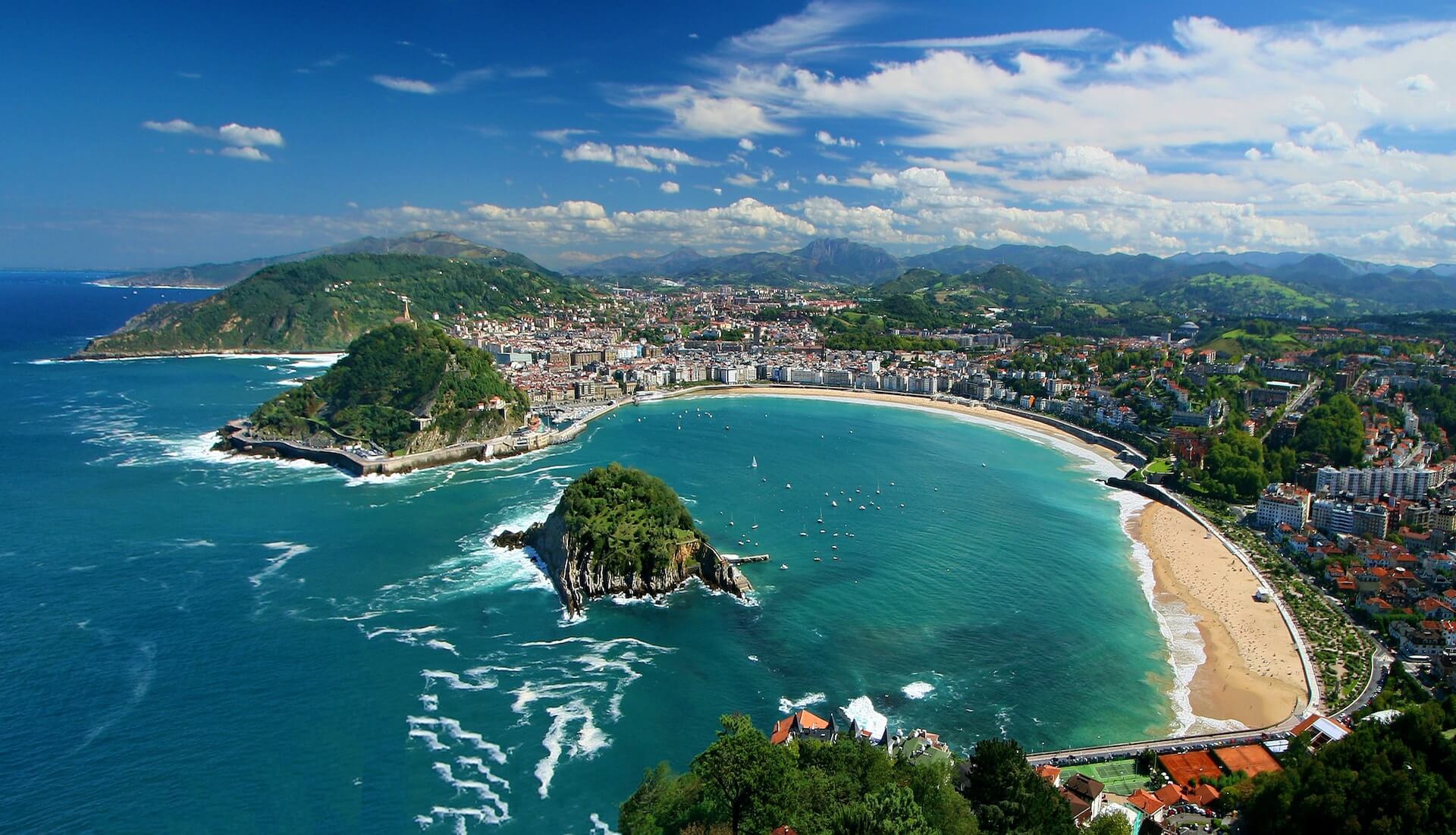
Go shopping (or window shopping) in Gros, a barrio lined with trees and stores stocked with creative local goods. La Playa de la Concha beach is great for sunbathing. Bar Zeruko and Bar Azkena are two of the top-rated pintxos bars in San Sebastián.
There are also a ton of cool hostels in San Sebastian here too. I met some cool travellers who were the best buddies to chill and appreciate with! Go bar hopping, take a stroll on the promenade along Zurriola Beach, or ride some waves on these sick surf beaches.
San Sebastián is beautiful but not the cheapest city in Spain. Budget travellers should plan for food and accommodation costs. You’re gonna be paying that coastal premium here.
Backpacking Galicia
The region of Galicia is located on the far western end of the coastline of northern Spain. Mystical Celtic religion and a rugged green coastline reveal its connections with the likes of Scotland, Wales, and Ireland.
Although all the locals speak Castillano (which we know as Spanish), their primary language is their regional Galician (Gallego). Many of them don’t even claim to be Spanish at all.
Though its reputation for being cold and wet is prominent across Spain, don’t let that deter you. I’m from the UK, so I can confirm, a little rain never hurt anyone. The best place to stay in Galicia – if you are interested in seeing the northern coast – is A Coruña.
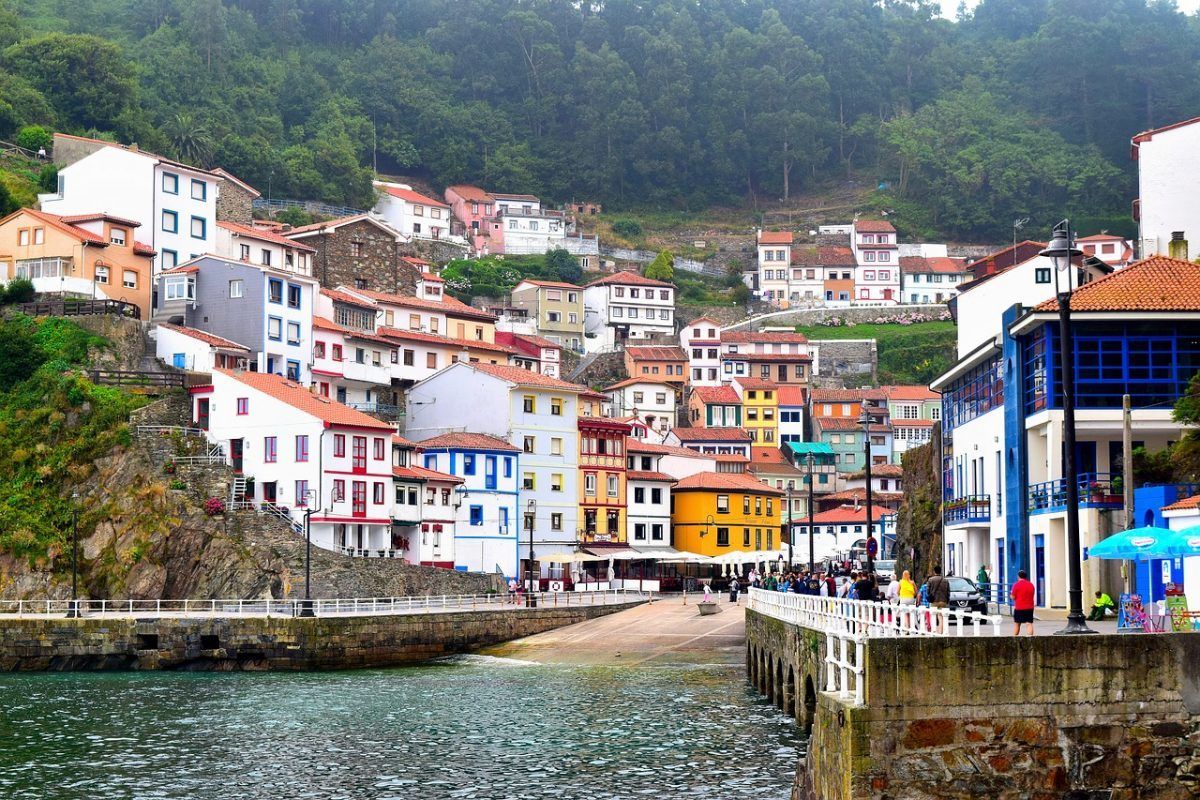
You should also definitely stay in Santiago de Compostela, one of Spain’s major cities and most famous tourist attractions. It’s home to the Catedral de Santiago, the end-point of one of the most popular pilgrimages in the world, Camino de Santiago, which you should attempt if you have a few weeks here, it’s a truly memorable experience even if you aren’t religious.
Along with admiring the architecture and art, be sure to walk around Rua del Franco (Franco Street) right off the main square. It’s bursting with seafood restaurants and bars that make you want to get your happy mode in full swing.
It’s a better summer destination if you want to focus on the coast. I found it to be pretty mild compared to the furnace-like central areas, and cooler with a nice sea breeze.
Backpacking Spain’s Islands
Spain’s beautiful islands are completely diverse, and full of natural wonder and sun-hungry Germans on holiday packages. Their reputation as a tourist trap is justified. Though don’t let that deter you.
Outside of the popular destinations, these pockets of goodness offer impressive landscapes, laid-back living, and pretty cheap travel. It’s a great idea to stretch your backpacking Spain budget.
Spain has two sets of islands: the Balearic Islands and the Canary Islands. I stayed in the Canary Islands for most of the pandemic. I felt damn lucky too; year-round nice weather, lower cost of living (tax-free alcohol!), and very laid-back atmospheres made lockdowns a breeze.
Balearic Islands
The Balearic Islands have infamous clubbing towns such as Magaluf and Palma Nova. Many people go when they are 18 to get hammered without a care in the world. Then there’s the wild techno summer parties of Ibiza which has some of my favourite hostels ever!
But there are plenty of laid-back areas too, with striking views and adventure sports to get tucked into, hidden sandy beaches and some of the best yoga retreats in Spain. Menorca and Formentera are the best alternatives in the Balearic Islands for white powdery beaches and turquoise blue waters.
Summer is crazy expensive. All the sun-starved Northern Europeans under 25 will be flocking down to “beefa” in their droves to drink themselves silly, so you’re gonna see mad crowds at this time of year. But maybe that’s part of the appeal.
You can get here by ferry from Barcelona or Valencia, or fly. There are also ferries from Toulon (France).
Canary Islands
The Canary Islands are set off the northwestern coast of Africa. These little volcanic islands are drastically different from one another.
From dry deserts in Lanzarote to humid forests in La Gomera, active volcanoes in La Palma, and even snow in the winter in Tenerife, the Canary Islands are seriously impressive. If you stay in Tenerife, make the trip to El Teide to see Jurassic views.
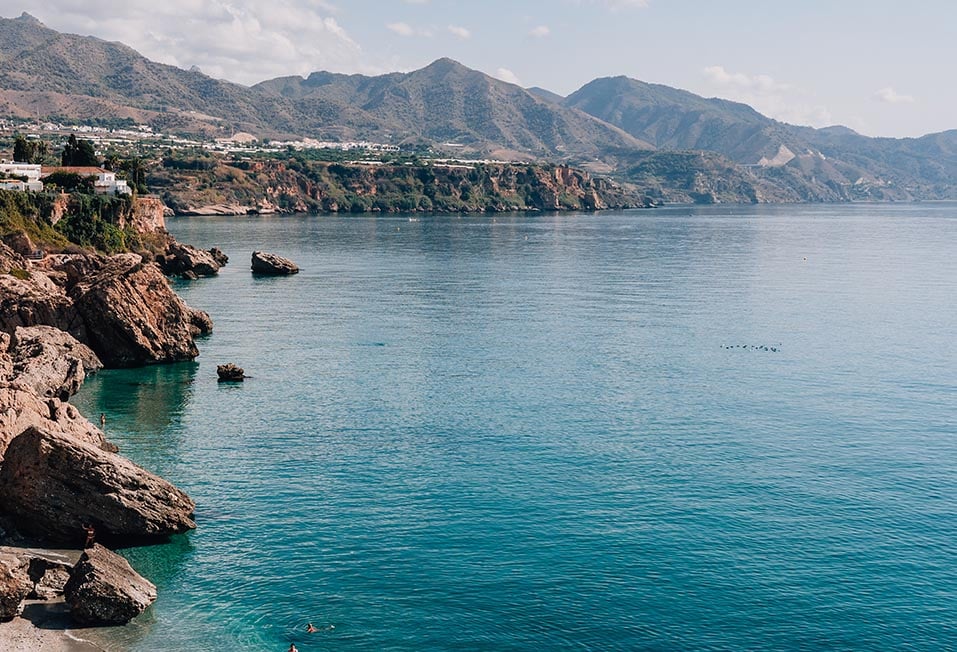
Image: Nic Hilditch-Short
You have great hiking opportunities around, especially near Tenerife and Gran Canaria. Fuerteventura and Lanzarote are top surf spots. Remote villages are also fun to visit here, I love them because they’re nice and peaceful without the huge tourist crowds.
Though, transport infrastructure isn’t great. Public transportation is inefficient and taxis are expensive. If you want to explore the islands properly it really helps to rent a car. The Canary Islands are definitely cheaper than the party-crazy Balearics from my experiences.
Getting Off the Beaten Path in Spain
Spain is one of the most popular countries to visit in Europe, and if you’re backpacking Spain in summer, it’ll be hard to get away from the crowds.
If you’re willing to venture off the beaten track though, I promise that you’ll find some incredible hidden European gems. You can visit some of Spain’s lesser-known regions, full of culture and beauty, like Galicia, Cantabria, and Asturias.
These regions offer sandy coves and beaches, sparkly green coastlines, and a stark, rugged contrast to the rest of Spain. They are best to visit in summer due to unpredictable rain and weather off-season.
Andalucia serves up spectacular Moorish architecture with a decent dose of sun year-round, whilst the Canary Islands are often overshadowed by the Balearics, but offer a more peaceful alternative, and appeal far more to more mature backpackers.
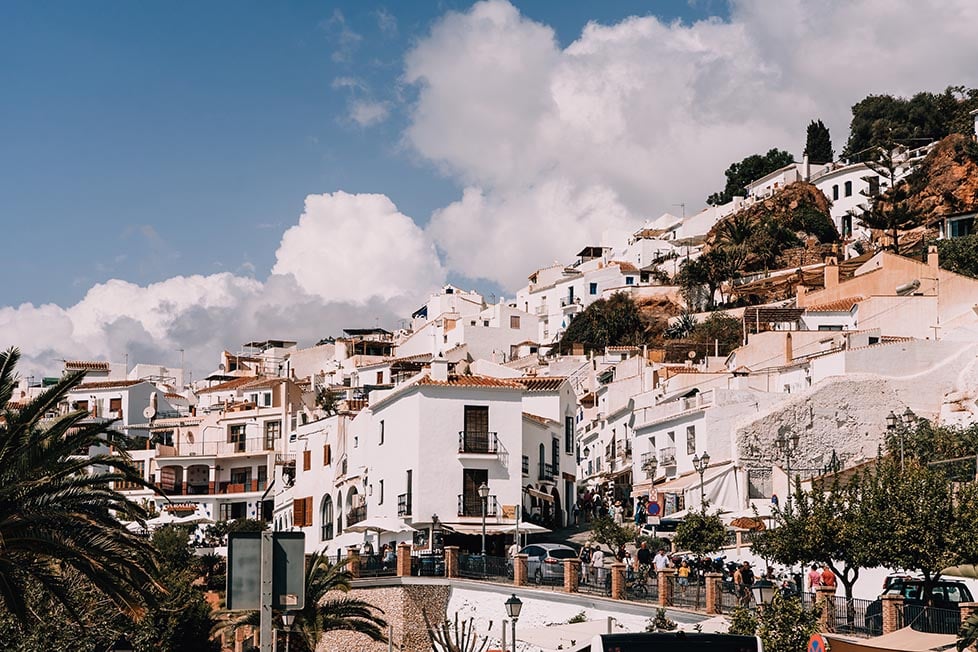
Image: Nic Hilditch-Short
Picos de Europa has some of Spain’s best hiking and most dramatic scenery, as well as arguably the best food. I’m talking full food coma from seafood and cheese.
Many people visit the popular and beautiful town of Salamanca, but backpackers love other charming villages in Castilla and León. This Northwest region is rich in history and cathedrals. Aragón, just west of Catalonia, offers plenty of quaint villages amongst the Pyrenees Mountains.
If you are into Roman history, and especially if you’re backpacking Spain and Portugal, check out Emerita Augusta. It’s got Spain’s best Roman site and some of Spain’s finest cured ham. And don’t sleep on La Rioja, home to the country’s finest wine.
One of the best ways to travel off-the-beaten-path is to hire your own wheels. If you can convince a few mates to join you, it can actually be pretty affordable… and a good time! Car rental is the best way to reach more rural parts of Spain, which don’t have such great bus/train networks.
10 Top Things to Do in Spain
On your way, you’re going to be greeted by many great places to visit in Spain. Below I have listed 8 things, uniquely Spanish, that you have to do when backpacking in this Iberian gem.
1. Go to a Fútbol Game
Spain is home to two of the most famous teams (and rivals) in the world: Réal Madrid and FC Barcelona. Even if you just manage to score cheap(ish) nosebleeds, the energy in these massive stadiums is a truly unique experience while backpacking here. I went to a game at Camp Nou to watch FC Barcelona and had a blast.
If you can bag tickets to El Clásico (a derby), be prepared for a crazy night out. Watching the game from a bar is still a vibe.
Budget Tip: Real Madrid is the famous one, but half of the locals support Madrid’s other team, Atlético Madrid. Watching Atlético is just as good a cultural football experience – for half the cost!
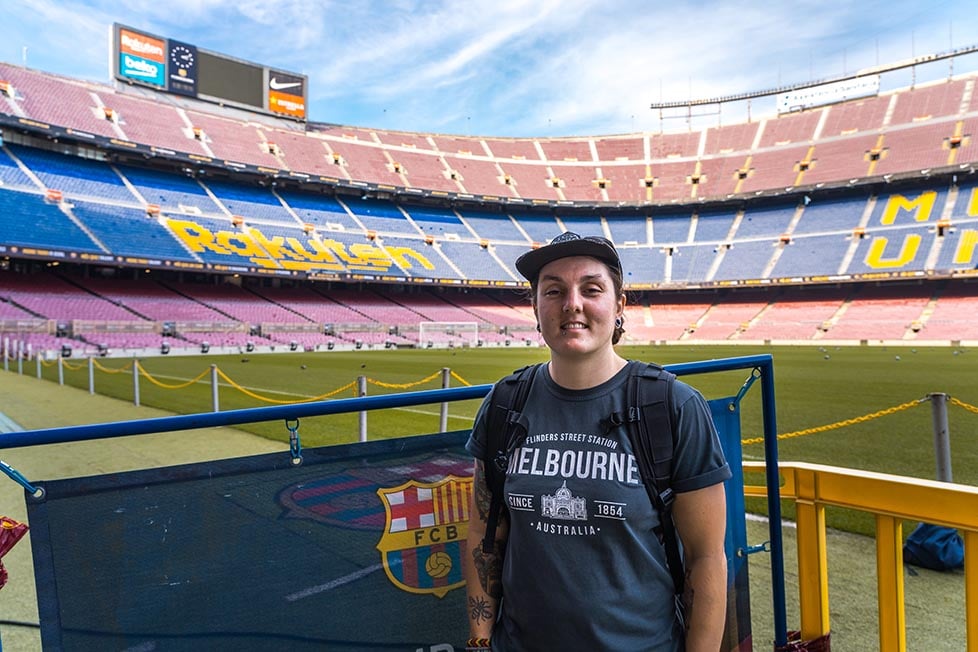
Image: Nic Hilditch-Short
2. Hike El Camino de Santiago
I don’t like to plug things that are full of tourists however, this is an exception. El Camino de Santiago has history rooted in medieval times and it’s really worth taking the trek yourself.
Follow in the footsteps of hundreds of thousands of pilgrims on this epic 500+ mile hike through charming villages and finishing in the cathedral in Santiago de Compostela. El Camino has many different starting points. The Pyrenees bordering France is the most popular one, but many people start this trek in Portugal.
This is not only a visually beautiful thing to experience, but the amount of people you get to meet is second to none. It’s a really special experience walking with so many people in the same direction, for the same goal. It opens up your heart.
3. Eat Tapas and Enjoy Pintxos Properly
Yeah, you’re going to visit Spain. Surely you’re going to be eating tapas at some point. But this is your free pass to go and eat your body weight. Say yes to all the olives, all the cheese, all the bread.
If you want a real tapas experience, visit Andalucía in the south of Spain. This is the real stuff, not just tapas for tourists. You can still get free tapas in Granada, Spain every time you order a drink. The tapas tend to get bigger with every round you order too.
And for something a little more bite sized, head to the Basque region and tuck into pintxos, little snacks served on a cocktail stick which are more of a local delicacy, unlike tapas which is more of a countrywide thing.
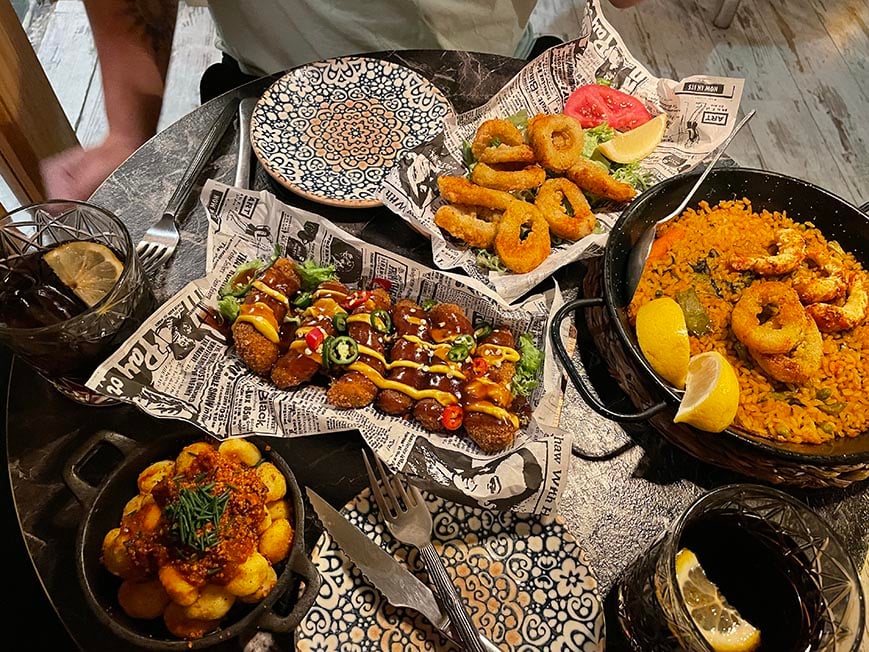
Image: Nic Hilditch-Short
4. Admire Gaudi’s Beautiful Architecture While Visiting Barcelona
This genius is all over Barcelona to this day. Gaudi’s art and architecture spread right across the city and you’d really be missing out if you didn’t at least go out of your way to see a few of them. I’ve been to over 100 countries, and these are amongst the coolest buildings I’ve ever seen. You’ll need to be up at the crack of dawn to view them without hordes of tourists though, they get busy.
Obviously, everyone knows La Sagrada Familia. I’ve seen a lot of churches in my time and this is easily the most beautiful. You’ve probably heard of Parc Güell too (or seen desperate photos on Instagram) but it is worth visiting.
Budget tip: If you’re on a really tight budget, Sunday Mass gets you inside La Sagrada Familia for free. Get there early – no dilly-dallying – or you won’t get in. You’re not allowed to take pictures and you definitely won’t see the whole building but it’s a good way to cast your eyes inside in case you really can’t squeeze the tour into your budget.
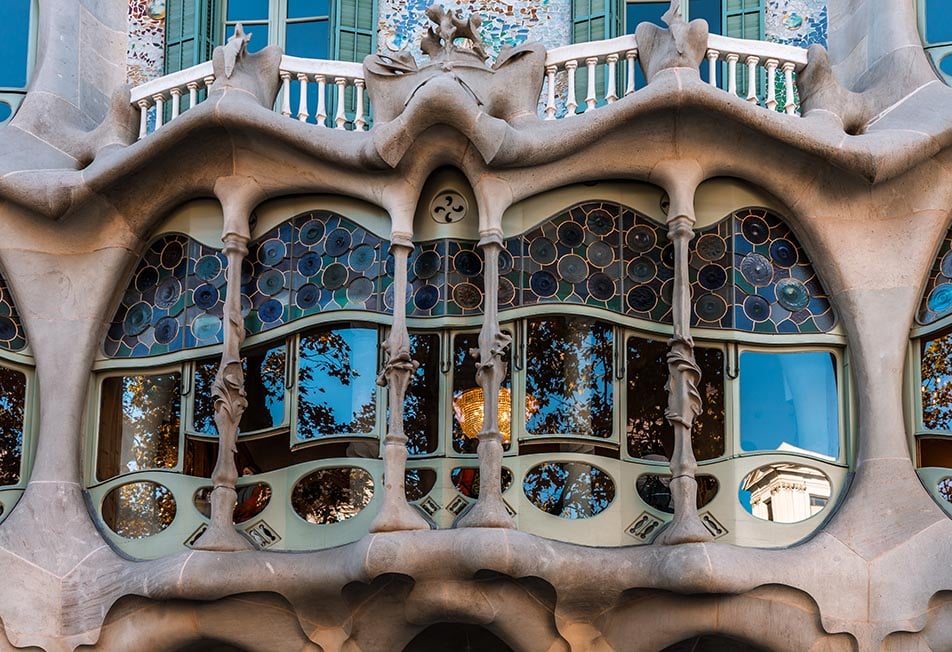
Image: Nic Hilditch-Short
5. Island Hopping
Spain has two chains of islands in the Mediterranean Sea: the Balearic and Canary Islands. They are super varied, and (some) are pretty budget-friendly. Either way, they are designed for visitors to have an absolute blast.
As well as Ibiza’s monster clubs and 24-hour parties, Gran Canaria has great outdoor activities, and Mallorca is simply paradise. However, staying on Fuerteventura, one of the lesser-known islands, is straight-up chill.
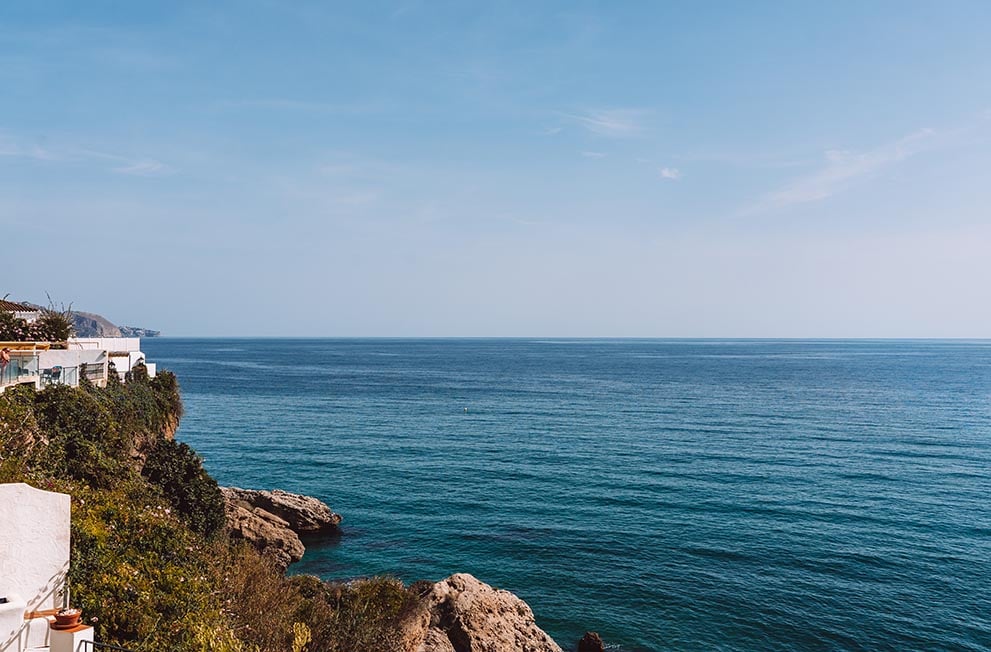
Image: Nic Hilditch-Short
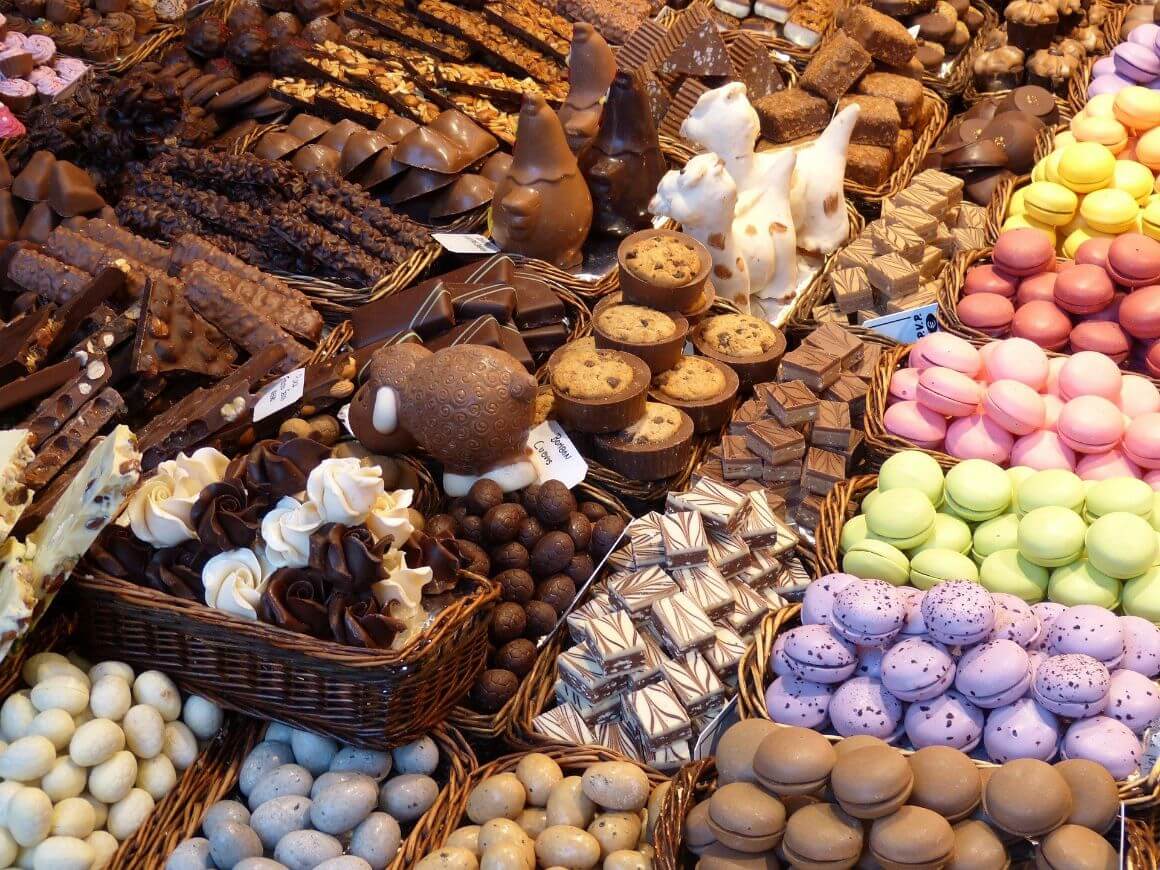
6. Explore Spain’s Regional Food Markets
Spain gets overlooked as a foodie destination, but it has a diverse range of cuisines to offer, and they differ greatly by region!
Mercado Central in Valencia is seriously impressive. You’ll quickly find it’s not just the French that tuck into snails when you come here. It’s also a great spot to find lots of yummy seafood! Mercado de la Ribera in Bilbao is a fine place to sample some pintxos. Barcelona’s La Boqueria is popular for all sorts including Catalan delicacies such as botifarra (pork sausage) and bolets (wild mushrooms).
My top tip is to arrive early in the morning. Spanish markets tend to die down by the afternoon, and the freshest meat and seafood is always found before the sun has fully risen.
7. Marvel at the Alhambra in Granada
This palace in Granada is perhaps the coolest Islamic building in the world! You can spend an entire day marvelling at the fortress and gardens. The view of Granada from the palace isn’t half bad either.
Be sure to book tickets in advance, otherwise you could end up disappointed, as it’s super popular and sells out fast, especially in the summer.
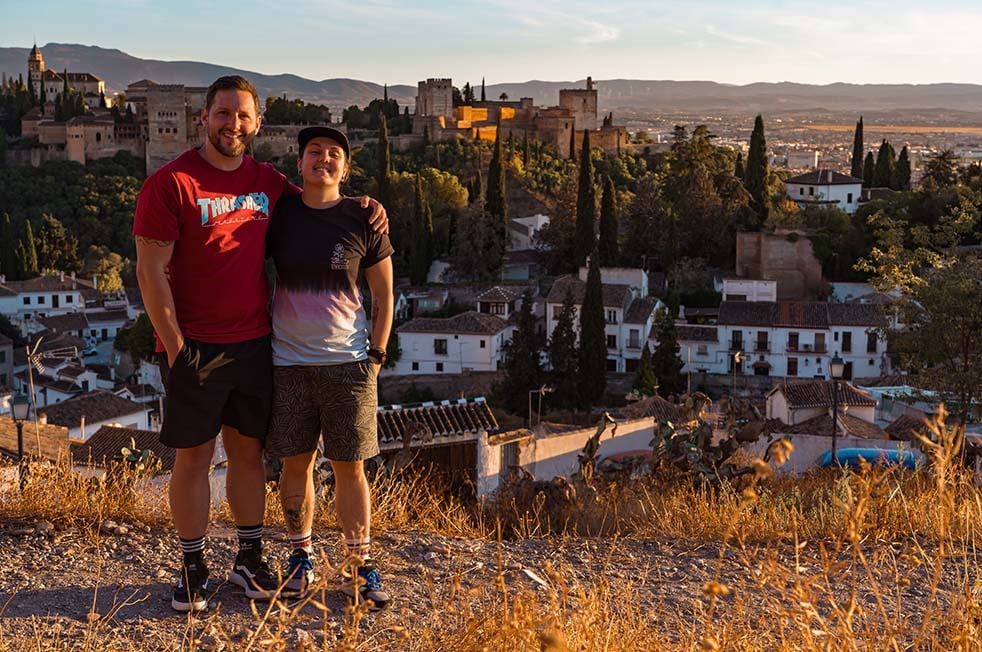
Image: Nic Hilditch-Short
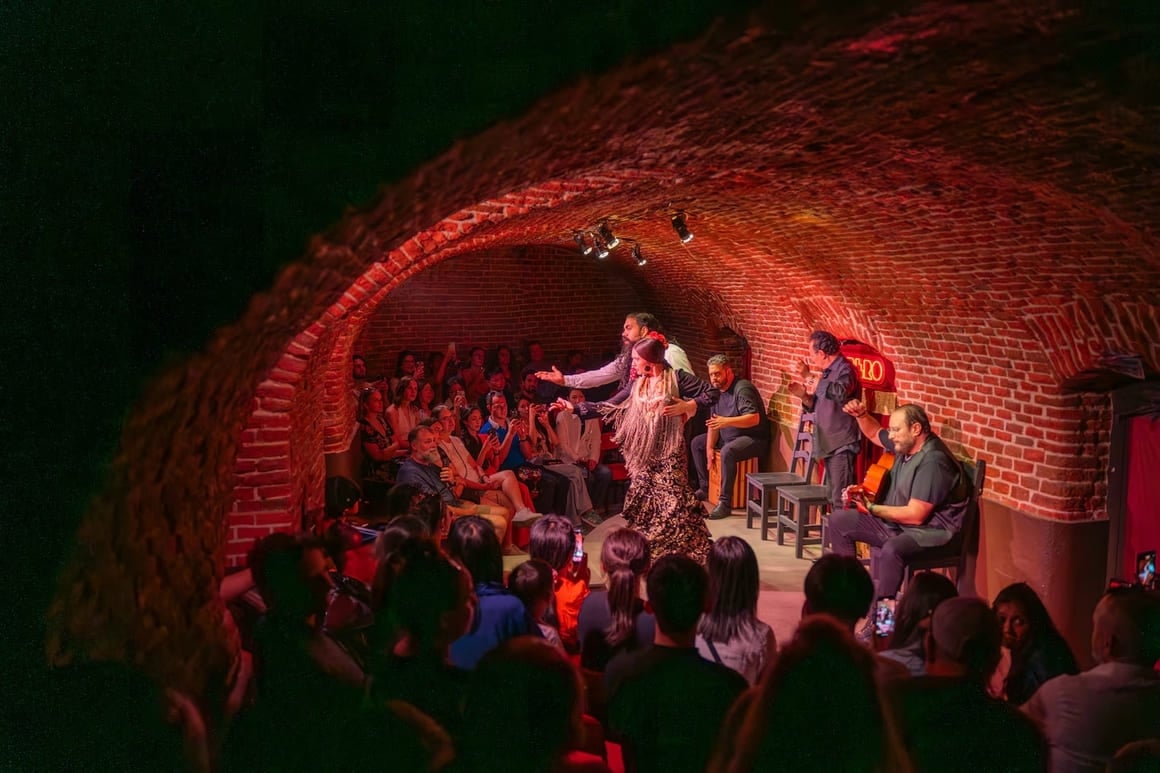
8. Go to a Flamenco Show
Flamenco is traditionally found in the south of Spain, most famously in Seville or Cádiz. Though they are scattered throughout the country too. Flamenco shows are passionate and full of culture.
While visiting Spain, you can peek into the souls of the Spanish a little bit through their flamenco dancing and music. Watch them pour their hearts out to you.
9. Party Until the Sun Comes up
When it comes to parties in Spain, you aren’t limited with choices. Barcelona or Madrid? Ibiza or Mallorca?
There’s no bad choice. You can find a party anywhere in Spain. From wall-to-wall bars to megaclubs, there is something for everyone… pretty much anywhere.
10. Take a Roadtrip Through Spain’s Coastlines, Villages and Mountains
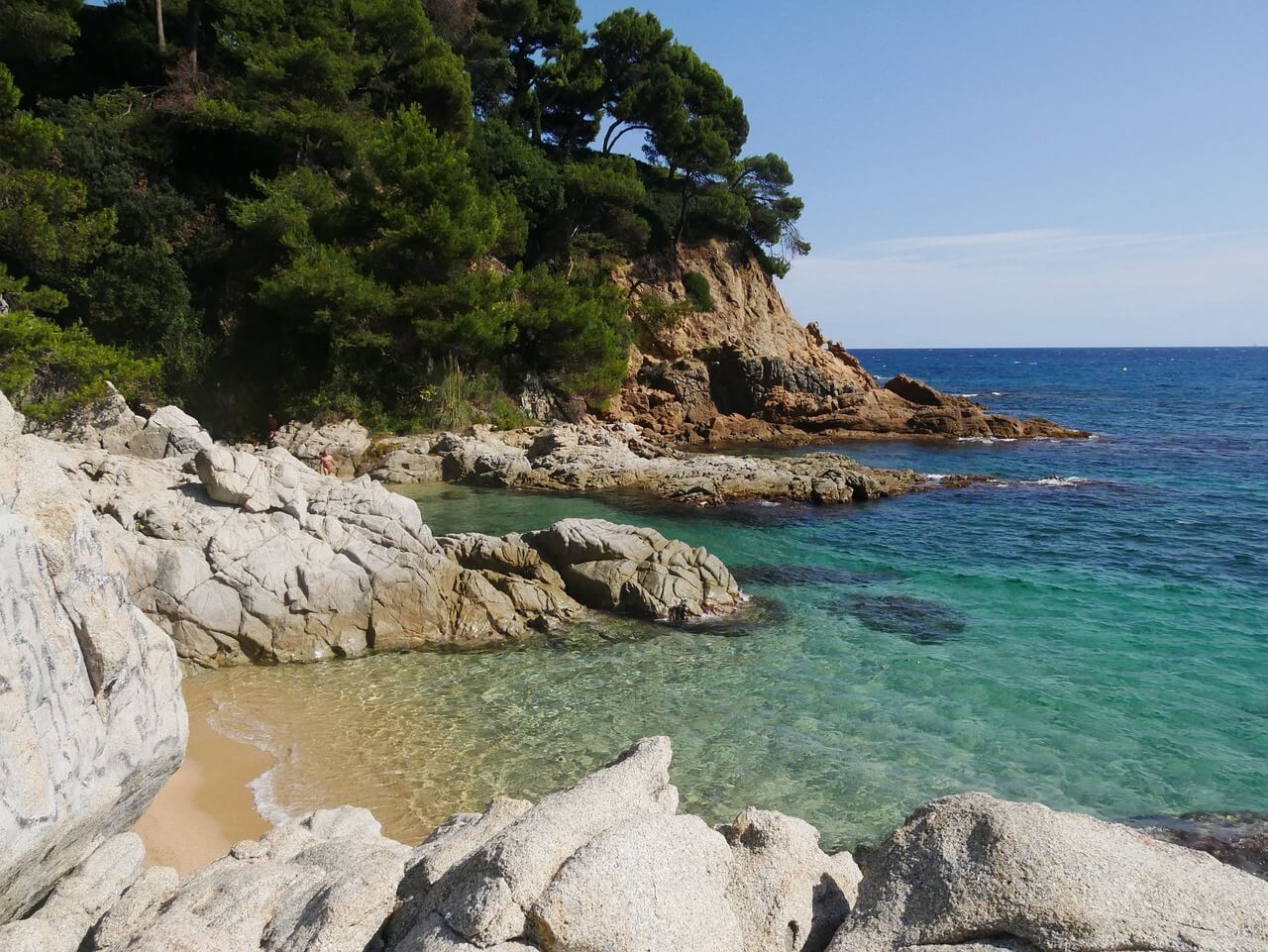
Spain is well-connected by trains and buses, but sometimes it’s best to take a road trip, get away from places with high tourist volumes, and enjoy the path less-travelled.
Where’s the best part of the country for this? Err, everywhere! But if you want more specific suggestions, the Costa Brava is top notch for beach lovers, whilst northern Spain has some wonderful mountains for you to traverse.
There are plenty of amazing hostels in Spain. The cities, towns, and villages are all no strangers to visitors. They know – as well as anyone – how to offer a homey and fun place to rest your head and meet cool people. If you want to see the best hostel options in Spain, I suggest using Hostelworld. You can even filter your personal travel needs and read reviews to find the perfect place for you.
There are three types of Spanish accommodation that need a little further explanation. A hostel is what you’d expect, a cheap place with shared dorm rooms. A hostal is more like a guesthouse or B&B, and may have private rooms or offer a bed in a family’s home. Then you have the albergue, this is a type of hostel found of the Camino de Santiago, sometimes with a pilgrim passport required to stay there.
If you’re walking the Camino de Santiago, make sure you book ahead in the summertime. This popular route books up fast. I suggest doing the same in Barcelona, Madrid, the Canary/Balearic islands, and anywhere ahead of a major festival.
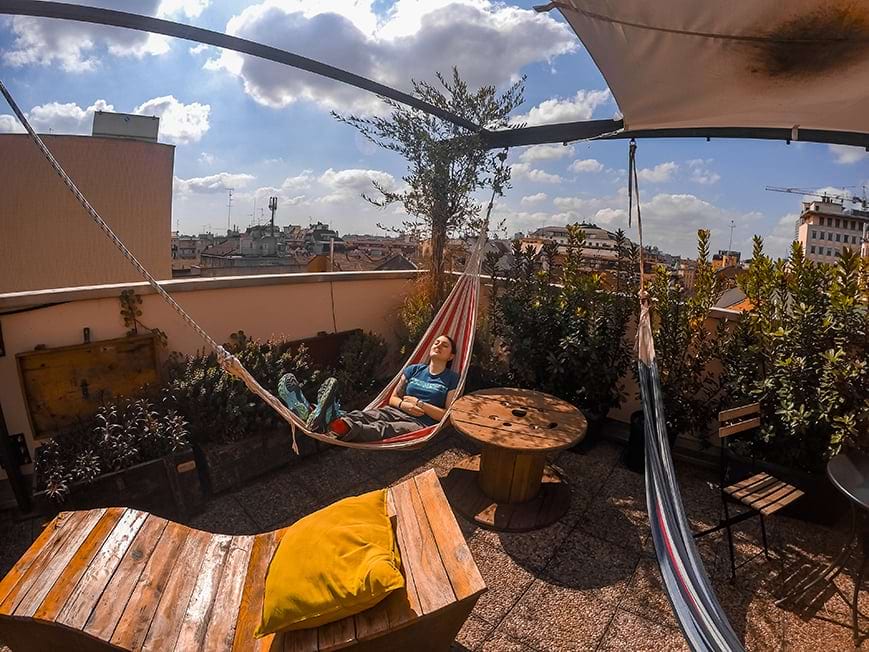
Image: Nic Hilditch-Short
Accommodation prices increase dramatically from June to August pretty much across the whole country, so plan ahead to get the best deals. During the summer, Couchsurfing is the best way to save money and meet locals, though it’s competitive. If you don’t have a strong reference portfolio on Couchsurfing, don’t bother wasting your time.
It’s always a good idea to ask a mate if they have a mate (of a mate?) if they have a place you can crash for a few nights. You’ll be surprised how often travellers want to help out other travellers. This could easily save you a few hundred dollars in peak season. Also keep in mind that “cheap” accommodation far from the centre can cost a lot in time and extra transport costs.
However, some of my favourite places to stay are the incredible Spanish Airbnbs. I love the variety and having my own place to come back to after wearing myself out in the city centre or draining my energy after doing nothing at the beach all day. Especially if you’re a couple or in a group, a private room on Airbnb can be as affordable as a hostel.
Best Places to Stay in Spain
When you visit Spain, you’re going to need to stay somewhere. So here are some of the absolute best places to stay.
| Destination | Why Visit! | Best Hostel | Best Private Stay |
|---|---|---|---|
| Madrid | Feast on budget-friendly tapas, explore charming streets, and enjoy free cultural gems in the vibrant multicultural capital. | The Central House Madrid Lavapiés | Plaza Mayor boutique room |
| Barcelona | Cosmopolitan city with architecture masterpieces, a famous church, Gaudi’s art, sunny beaches, and a never-ending nightlife. | Unite Hostel Barcelona | Private Space Las Ramblas |
| Cordoba | Middle Age city that mixes three ancient cultures: Roman, Jewish and Islamic. Great place if you love history and architecture. | Backpackers Al-Katre | Hotel Boutique Patio del Posadero |
| Seville | The city of parties, tapas, flamenco, and bullfights. And loads of Architecture with Arab and Christian influences. Such a nice vibe mate! | The Nomad Hostel | Andalusian space, terrace and pool. |
| Costa del Sol | Mediterranean coastline with 325 sunny days. Destination of many North Europeans. Paradise beaches with good food and welcoming people. | Veranera Hostel | Cozy Flat Simona |
| Granada | Place of the famous Alhambra, palaces, and courtyards. Insane stories about medieval times, tapas, bars, and a great street art culture. | Oripando Hostel | Casa Bombo |
| Valencia | The right mix of city and town near the sea. Astonishing history and architecture. Check the nightlife and, of course… try the paella. | Cantagua Hostel | Design&Relax |
| San Sebastián | A coastal city with beautiful beaches and is home to the oldest European culture alive. The mecca for foodies. From Michelin stars to pintxos bars. | Koba Hostel | Columba´s Homestay |
| Galicia | A mix of Spain and Portuguese culture. Unique food and folklore. Stunning cliffs, waves, and beach landscapes. Be prepared for the rain. | Albergue Milladoiro | Parador de Santiago – Hostal Reis Catolicos |
| Balearic Islands | Encantadoras coves and gorgeous sunsets. You can relax or party in the wild nightlife, there’s an island for each of us. | AMISTAT Island Hostel Ibiza | Blue House Mallorca |
| Canary Islands | 7 different Islands with mild temperatures. Ideal for natural wanderers and beach lovers. Volcano trekkings, loads of beaches, and breathtaking views. | Los Amigos Hostel Tenerife | La Finquita |
Especially compared to other Western European countries, Spain is pretty budget-friendly. It will help stretch your European travel budget a little further. However, it can still be expensive compared to pretty much anywhere in Eastern Europe.
That being said, Spain is a notable tourist destination full of famous tourist attractions. During the festivals and the summer months, prices soar.
Towns that seem semi-abandoned in the winter become flooded by families and newbie backpackers when the sun comes out. So bear this in mind when you’re deciding when you want to visit. Out of season, you can bag yourself some serious bargains with cheap flights and budget hostels for less than $35 a pop (or less) if you keep your eyes peeled.
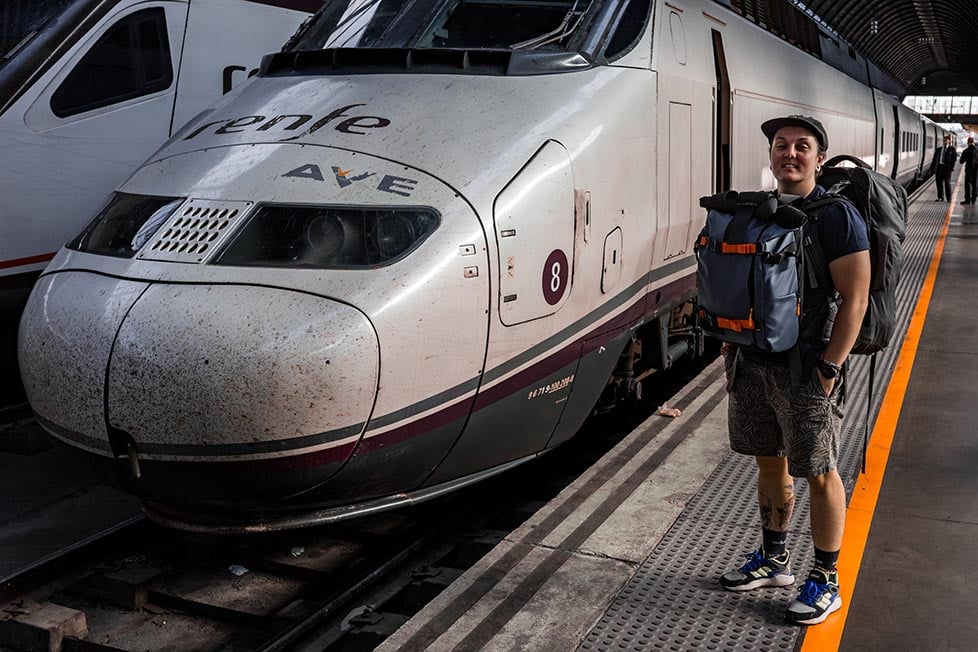
Image: Nic Hilditch-Short
You can backpack Spain for less than 60 euros a day, but if you want to spend half that, I suggest cooking your own food. Beer and wine are pretty cheap – you could get a pretty average bottle of wine for less than 5 euros. So yeah, I don’t drink out too often.
Barcelona is the most expensive city in Spain, followed closely by Madrid. The Balearic Islands, San Sebastian, and beach towns in the summer. Accommodation prices are no joke, but you can bag yourself a reasonably priced drink and food. If you like your luxury villas, you’re going to pay for them here.
The other tourist towns aren’t that expensive if you stay away from the areas near the main attractions. University towns, like Cádiz, Granada, Seville, etc. are affordable for students (and, therefore, me too).
A Daily Budget in Spain
Your Spain budget doesn’t need to be anything crazy. The cost of living in Spain is pretty low compared to other countries in Western Europe. Here’s a little round-up of what to expect.
- Broke backpacker assumes hostels, cooking, cheap tapas, buses, free activities, and limited paid attractions.
- Frugal traveller allows more museums, restaurants, and faster transport.
- Creature of comfort is realistic for private rooms, Uber, and more paid activities
| Expense | Broke Backpacker | Frugal Traveler | Creature of Comfort |
|---|---|---|---|
| Accommodation | $20-30 | $35-50 | $60+ |
| Food | $10-15 | $16-25 | $30+ |
| Transport | $3-7 | $8-15 | $16+ |
| Nightlife | $8-14 | $15-20 | $25+ |
| Activities | $0-10 | $11-20 | $21+ |
| Totals per day | $41-76 | $85-130 | $152+ |
Money in Spain
Spain’s currency is the Euro. Find out how much your money is worth today by using the up-to-date converter below.
ATMs are widely available everywhere in Spain, but you can expect a withdrawal fee (of varying amounts) for international bank cards, which is why I travel with a debit card that refunds me for transaction fees.
Visa and Mastercard are widely accepted in Spain. Always have cash on you when travelling around and visiting smaller, family-run places, markets or using buses.
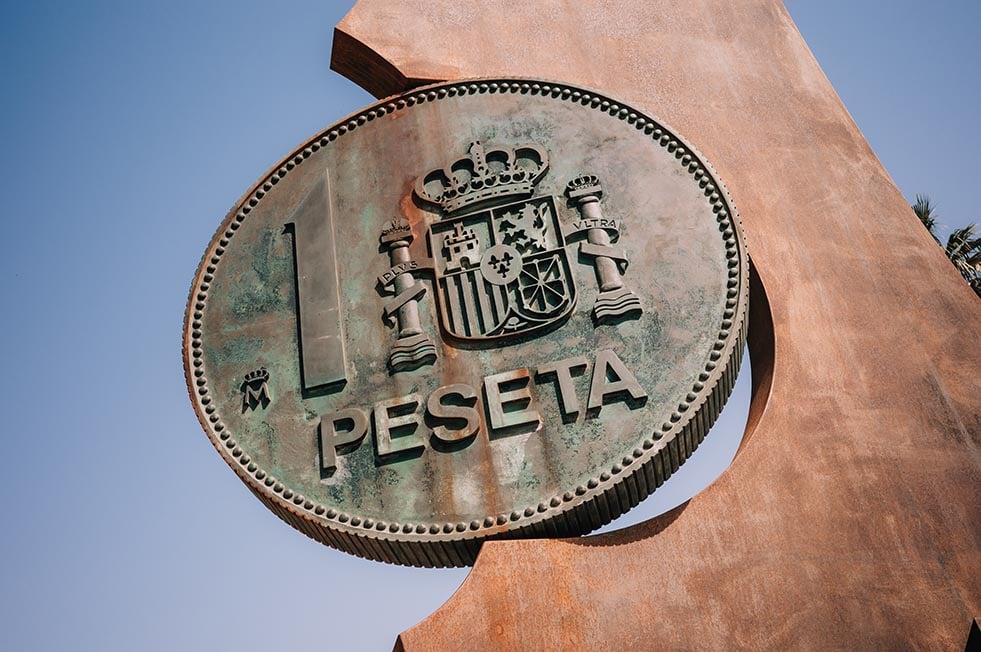
Image: Nic Hilditch-Short
For all matters of finance and accounting on the road, The Broke Backpacker strongly recommends Wise. Our favourite online platform for holding funds, transferring money, and even paying for goods, Wise is a 100% FREE platform with considerably lower fees than Paypal or traditional banks.
But the real question is… is it better than Western Union? Yes, it most certainly is.
Travel Tips: Spain on a Budget
If you are backpacking Spain on a budget, here are my top travel tips that you should know about.
Accommodation Tips
- Visit off-season: Aside from festivals like Las Fallas and Semana Santa, backpacking Spain during spring and autumn is the best time for lower prices.
- Book hostels early: In summer especially, the good ones and the cheap ones will sell out quickly.
- Use Couchsurfing: I couldn’t do this because Spain is popular and I have no references. But with a solid profile, you can save some serious cash.
- Compare hostels with private rooms: Hostels are the GOAT for solo budget travel, but couples and groups may want to compare them with hotels, apartments and hostals (not to be confused with hostels) as it may work out cheaper.
Food Tips
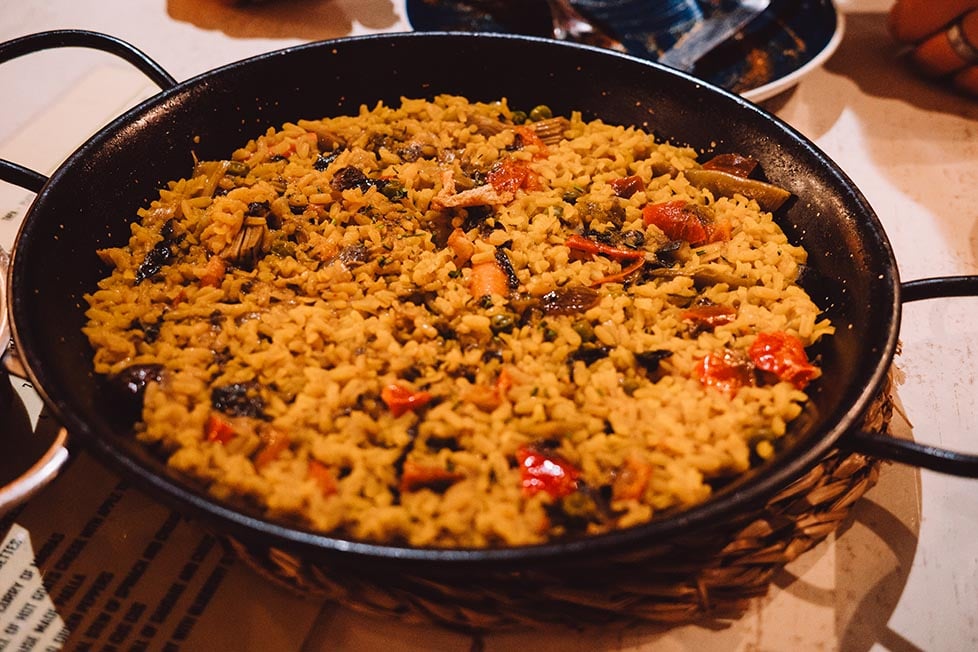
Image: Nic Hilditch-Short
- Look for menu del día: One of my favourite Latam budget hacks works in the epicentre of the Hispanic world too! Menu del dia is a cheap 3-course meal served at lunchtime where you receive a starter, main course and dessert.
- Cook some meals: If you book an Airbnb, supermarket meals can save you a lot of cash. This works in hostels too if you can brave a filthy kitchen full of degenerates who don’t know how to wash up after themselves…
- Use markets: Local markets also offer cheap scran in most towns and cities you’ll visit.
- Take advantage of free tapas in Granada and León: Buy a beer, get tapas for free. Buy ten beers, get ten… yep, you guessed it. Go out for a sesh and you won’t even have to spend a penny on food.
- Avoid restaurants beside major attractions: I walked near the Sagrada Familia recently, the restaurant prices there were enough to make me wince. Local residential streets are your best friend for cheap meals.
Transport Tips
- Book trains early: Prices go up nearer the day, so advance booking saves you cash.
- Compare buses, trains, BlaBlaCar, and budget flights: BlaBlaCar is like a paid hitchhiking service. Drivers have reviews, and it’s the cheapest form of paid transport I’ve used in Europe. Meanwhile, this is the land of Vueling, Ryanair and Easyjet, so without checked baggage, flights are crazy cheap.
- Use city travel passes: In some major hotspots, like Barca and Madrid, you can get a pass which combines activities with transport. If doing tons of paid activities, you’ll save good money. If not, this isn’t worth it.
- Avoid taxis when possible: The true broke backpacker does NOT take taxis in Spain! They are expensive (Uber is slightly better, but virtually everything else is better still).
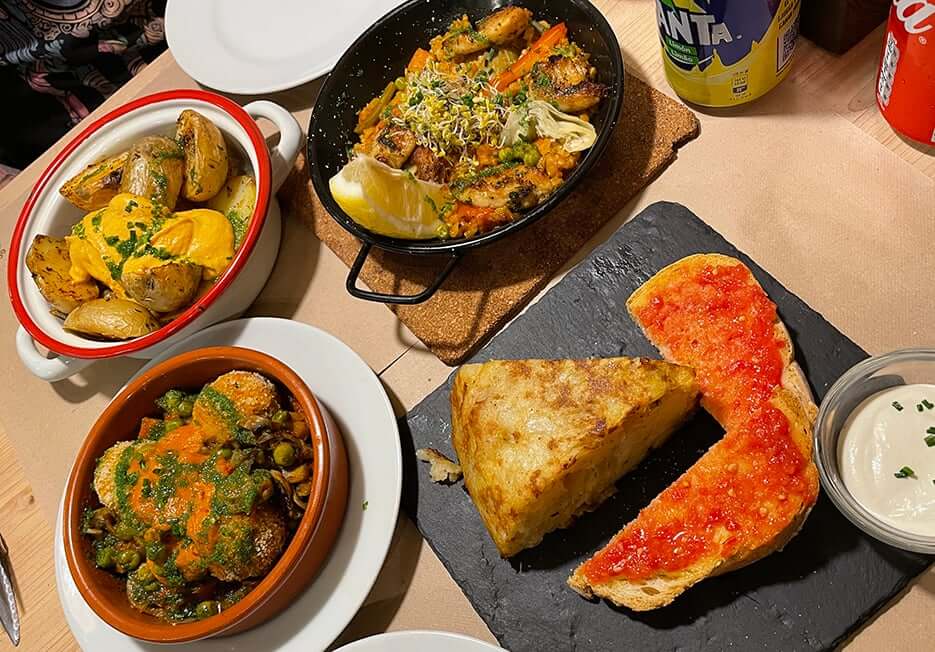
Photo: Nic Hilditch-Short
Activity Tips
- Use museum free days: May 18th, October 12th, December 6th and April 18th are key holidays during which most state-owned museums are free to enter. Other museums might have a free entry day, or free entry at a certain time. Check the website of whichever museums you plan to visit for specific details.
- Choose paid attractions carefully: The Sagrada Familia costs almost 30 euros. Yikes. That’s not Broke Backpacker friendly, so I didn’t go in… could appreciate it from the outside anyway.
- Spend more time in parks, beaches, markets, and neighbourhoods: I’ve done “Euro summer” for a few times now. Didn’t enjoy it when constantly bouncing between mega-expensive and ultra-crowded tourist spots. Loved it when I treated the tourist spots as secondary, and just pottered around quiet parks and small neighbourhoods with quaint tapas bars.
Sustainability Tips
- Drink tap water: It’s safe to drink in Spain and free!
- Carry a travel water bottle: I always do this. Best of all, Spain often has free water fountains, especially in many of the big cities and popular spots.
- Reduce plastic: I’m the kind of guy who will bash you for using plastic bags, they’re very useful at times. But I always keep them for several months until they become unusable. There’s no need to chuck them after every use.
To Stay Connected… Get an eSIM For Spain
You know those tiny pieces of plastic you used to use to connect yourself to the internet abroad? Sim Cards I think they were called? Well yeah, we’re ditching those.

These days, wherever you go in the world an eSIM is by far the best way to stay connected from the minute you land. You can download an eSim before you leave home and then activate it when you are still sitting on the plane waiting to disembark.
You skip all the hassle of trying to figure out different providers and navigating airport prices to make sure you’re not getting scammed.
Of all the many eSim providers out there, we suggest Jetpac. Jetpac works just like an app: you download it, pick your plan, and BOOM! You’re connected before the pilot says you can stand up.
JetPac eSim Packages For Spain
3GB – 7 Days – $7
5GB – 30 Days $10
10GB – 30 Days – $15
Best Time to Travel to Spain
The best time for backpacking Spain on a budget is shoulder season: March-May and September-November. Spain is more expensive during the summer and holiday season, and you have to book ahead and find creative ways to save cash. June-August are the hottest, most crowded, and most expensive months.
Plus, aside from too many tourists, Central and Southern Spain especially are unbearably hot in the summer. That being said, if you are trying to travel to Spain during the height of the parties on the beaches, like Barcelona and the Balearic Islands including Ibiza, then you’re going to want to visit Spain in June and July.
Many of the cities with thriving universities, like Granada, Seville, Cadíz and Salamanca, have more parties during the uni year as well. The most ideal time to head to Madrid is spring and autumn. Prices are lower and the weather is more temperate.
Personally, I love the rain but Galicia and Asturias region are also best visited in the summer when the days are warmer and sunnier. I think the best months for Barcelona are September or October. The heatwave has died off but it’s still beach weather.
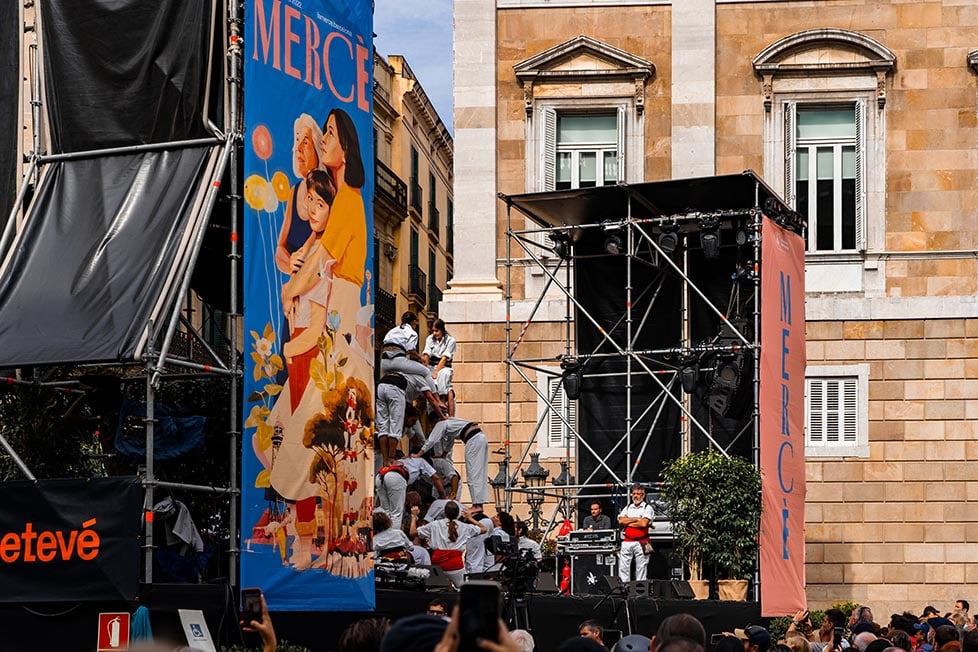
Image: Nic Hilditch-Short
The Canary Islands are decent all year round. These parts of Spain are geographically level with Morocco and Western Sahara, so they experience more African weather, which means lots of heat.
September 11 is Catalonia’s National Day, with cultural events and political demonstrations. You should check what is happening locally and avoid large protests if tensions rise.
Spain is one of the best countries to visit for festivals and cultural events. They are so fun and unique that it’s wise to plan your trip around a festival. There is something going on pretty much every month.
What to Pack for Spain
Packing for your trip isn’t particularly complex. A lot of items required are clothing, mostly for beach and mountain life. Comfortable walking shoes are a must, light clothes are important for summer (and layers for the rest of the year), and a rain jacket for Galicia, Asturias, Cantabria, and mountainous areas is essential. Then you’ll need swimwear, plus modest clothing for churches.
Other items to bring include sun protection (year-round), a small daypack with secure zips, a reusable bottle, and good hiking shoes. If staying in hostels, you gotta bring a lock to look after your stuff, and earplugs to block the noise out too.
Here are some other things I never go travelling without:

Ear Plugs
Snoring dorm-mates can ruin your nights rest and seriously damage the hostel experience. This is why I always travel with a pack of decent ear plugs.
Hanging Laundry Bag
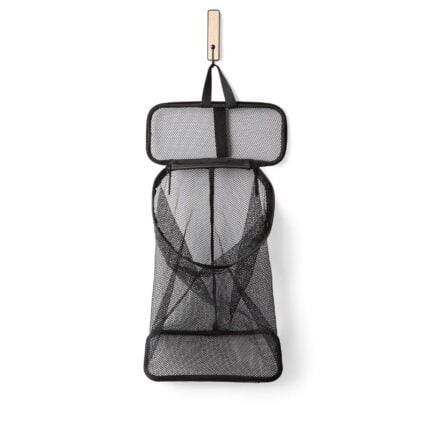
Trust us, this is an absolute game changer. Super compact, a hanging mesh laundry bag stops your dirty clothes from stinking, you don’t know how much you need one of these… so just get it, thank us later.
Sea To Summit Micro Towel
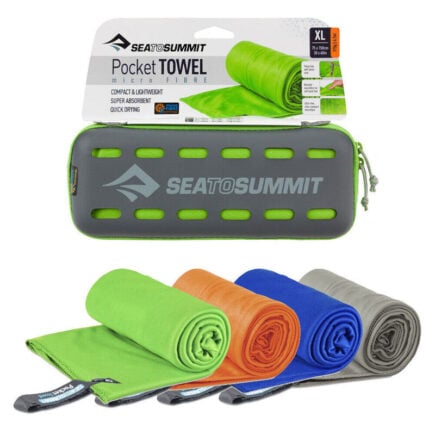
Hostel towels are scummy and take forever to dry. Microfibre towels dry quickly, are compact, lightweight, and can be used as a blanket or yoga mat if need be.
Grayl Geopress Water Bottle
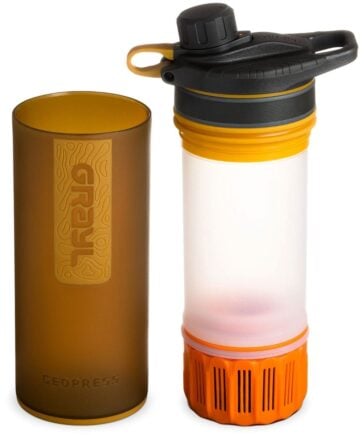
Always travel with a water bottle! They save you money and reduce your plastic footprint on our planet. The Grayl Geopress acts as a purifier AND temperature regulator. Boom!
Staying Safe in Spain
Spain is a fairly safe country to visit overall. But, always bear in mind, nowhere is 100% safe all the time. Always follow standard safety protocol, as you would anywhere else, and chances are you’ll be fine.
What you really need to be careful of is pickpocketing and petty theft. Madrid and Barcelona are notorious for these scumbags. Be wary of anyone around you who doesn’t seem either Spanish or a tourist. The country has a problem with Moroccan criminals in particular. Metros, beaches, cafes and popular tourist spots are common targets.
After countless warnings from locals, I still had my phone stolen out of my hand in Barcelona. I swear, it was gone so fast it was like a magic trick.
I’m not the only member of The Broke Backpacker team to have valuables stolen here either. I heard worse stories from locals about Spain’s safety in the big cities – so please take plenty of caution.
There’s a reason why people shamelessly wear their backpacks on the front here. You can never be too careful – especially in heavily touristed areas.
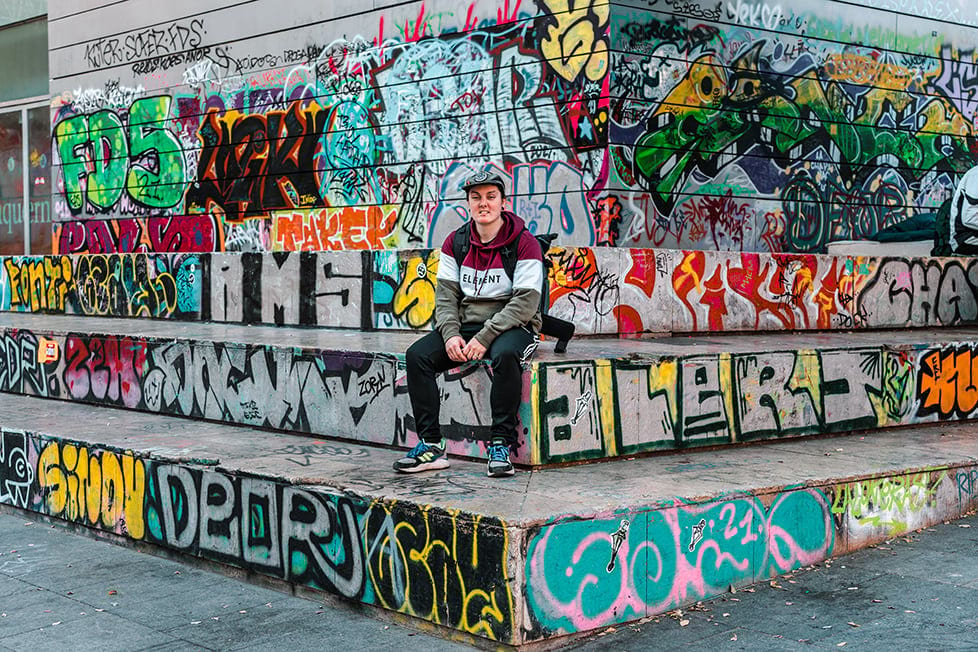
Photo: Nic Hilditch-Short
Be aware of your surroundings, and don’t carry a wallet in your back pocket (dur!). Watch out for strangers coming up to you with petitions and/or maps; this is usually just a distraction to steal your stuff, especially if you’re sitting at a café with your phone out, or walking around a touristy area.
Use a backpack or purse that is hard to get into and bury your valuables within it. Thieves also use knives to cut bags open and take anything out they can grab quickly. Also, never leave phones on tables.
Other worse crimes are less common – but not impossible. If you are renting a car, don’t leave any valuables inside the car.
Watch out in cities with metros for criminals refusing to pay for a ticket, waiting for you to go through, then pushing you forward quickly so they can enter the metro for free. I personally witnessed several guys doing this at Barcelona Sants. Be vigilant of your surroundings.
I don’t recommend walking around at night alone or in places you don’t know. Some places are okay but ask the locals first.
Sex, Drugs, and Rock ‘n’ Roll in Spain
All-night parties are a Spanish speciality. It’s easily one of the best party destinations in Europe with nightclubs, bars, and beach clubs stretching right across the country. Though there’s more going on in summer, there’s stuff going down all year. Note that parties start late here.
You won’t be disappointed by music festivals either. Two of my favourites are Primavera Sound and Benicàssim.
Barcelona, Madrid and Ibiza are some of the top spots to party. Mallorca, Valencia and Granada are solid options too. Ibiza especially gets absolutely wild. An introvert’s worst nightmare.
Unfortunately, drugs are common here, Spain doesn’t quite have the strict laws that have made Singapore or Saudi Arabia some of the world’s safest countries. Remember that drugs can be deadly, something that an old classmate of mine didn’t realise until it was too late…
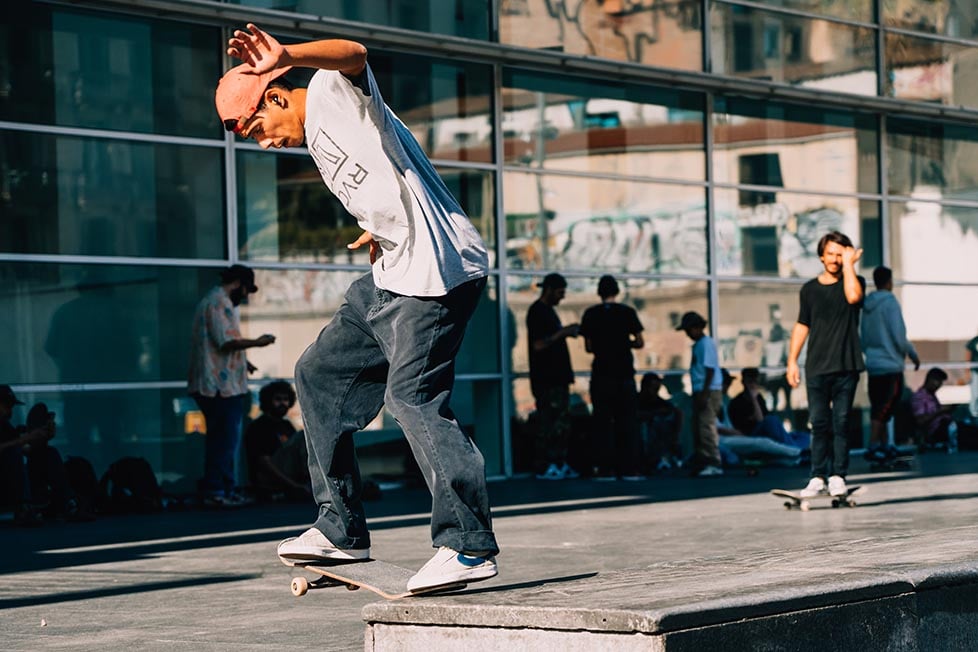
Image: Nic Hilditch-Short
Don’t buy from street dealers, aside from not knowing what you’re getting, you’re also funding violence against innocent people. The white powder you put up your nose is directly linked to innocent civilians being murdered in Central/South America. Be responsible.
Now for the sex. I mean, how much do you need to know? Just do it consensually and safely and don’t do it in shared hostels.
If you are visiting Ibiza to party, keep in mind the best time to visit Ibiza is definitely between May and September. Plan ahead to make sure you don’t miss any of the top clubs’ big nights of the week.
I will warn you too: Ibiza is expensive as hell. Clubs literally put salt in the bathroom sink water, so you have to buy a 10 euro bottle of water. Criminal.
Getting Insured BEFORE Visiting Spain
No ifs, ands, or buts, good travel insurance can be a lifesaver – literally. I know it feels like a waste of money for something you probably don’t use.
But believe me, if you need it, you’ll thank your lucky stars. I wouldn’t go anywhere without it.
Sort out your insurance before you go. There are several good options, but our overall pick is SafetyWing. Most of the Broke Backpacker team has used it at one point or another, and we’ve filed claims for rabies jabs in Bali, a hospital stay in Mexico, and a clinic visit for a stomach bug that wouldn’t quit. All paid out.
It’s month-to-month, no lock-in, no itinerary required, and you can buy it after you’ve already left. A little over $2 a day if you’re under 40.
New SafetyWing customers: use code BROKEBACKPACKER for 8 free weeks of electronics theft coverage. You have to scroll down and click the pink camera on their landing page to enter it, and you have to do it before creating your account.
How To Get Into Spain
There are two main international airports with flights arriving from all over Europe, North America, and Asia. You can fly into Madrid International Airport (Adolfo Suárez) and Barcelona International Airport (El Prat). I recommend checking both to find cheap flights into Spain. They also make great places to arrive into Europe for a wider backpacking trip.
If you’re arriving from other European countries, you won’t need to go through the country’s immigration department as Spain is a Schengen country. There are several airports that connect you to the rest of Europe: Sevilla, Málaga, Granada, and Alicante are just a few of them.
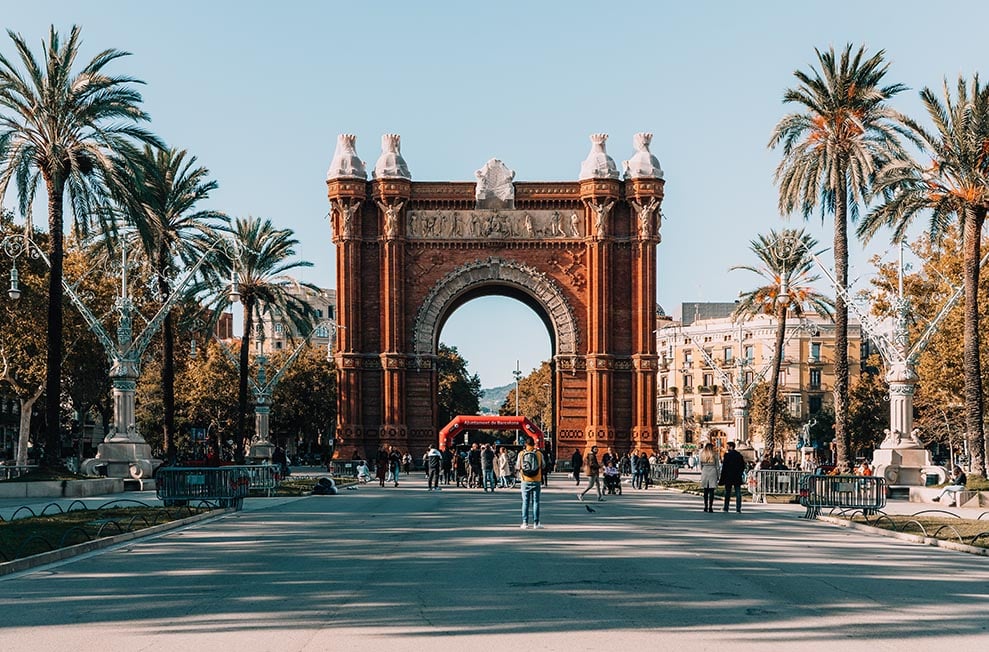
Image: Nic Hilditch-Short
If you use budget airlines, like RyanAir, make sure you check which airport they fly into! For example, Girona (90 minutes from Barcelona) has a small airport that airlines often list as “Barcelona.”
Spain is easy to combine with France, Portugal, Morocco, and other Schengen countries. Buses and trains are fantastic for getting around both Spain and wider Europe.
Entry Requirements for Spain
EU citizens have free movement within the Schengen Zone and require only their passport or ID for travel.
Citizens of visa-exempt countries (including the UK, US, Canada, Australia and others) will need to obtain online travel authorisation, ETIAS (European Travel Information and Authorisation System), before visiting European countries in the Schengen Area. A small fee will apply. It’s similar to the US ESTA.
The EES (Entry/Exit System) is the digital border system for non-EU visitors to the Schengen Area. The system records passport details, fingerprints and facial image, replacing traditional passport stamps. Travellers do not need to apply for anything in advance. Registration happens at the border. First-time registration can add time to border crossings, so it’s worth being aware of potential delays.
Other nationalities may require a visa.
Remember, visa-exempt travellers can only stay in Schengen Zone countries for 90 days out of every 180. You’ll need to get creative if you want to travel long-term in Europe.
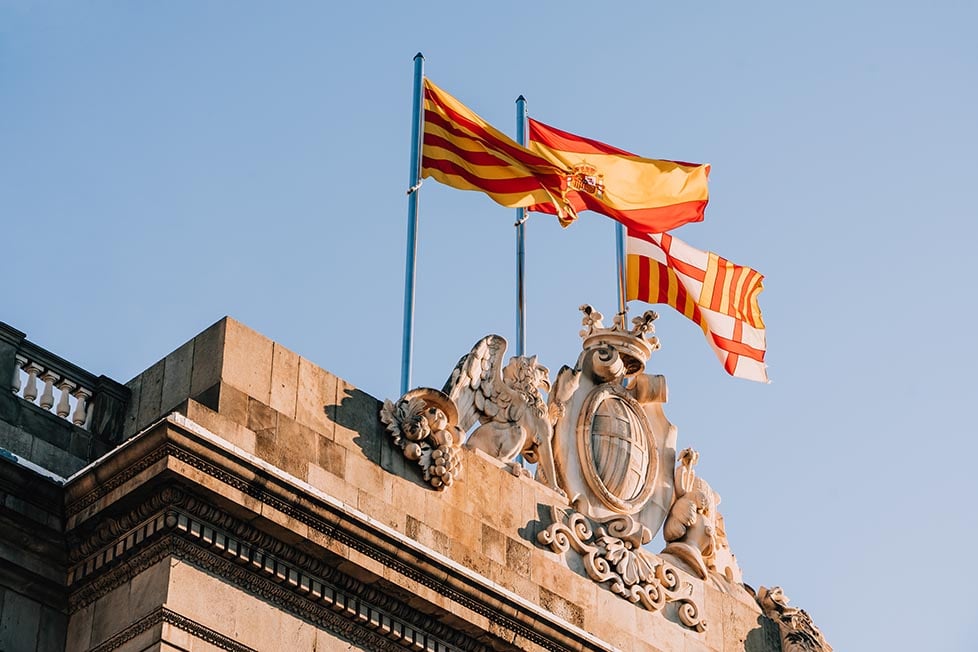
Image: Nic Hilditch-Short
How To Get Around Spain
Like most Western European countries, Spain is super easy to get around. Don’t bother with taxis. Uber is cheaper and safer, but still pales in comparison to these methods:
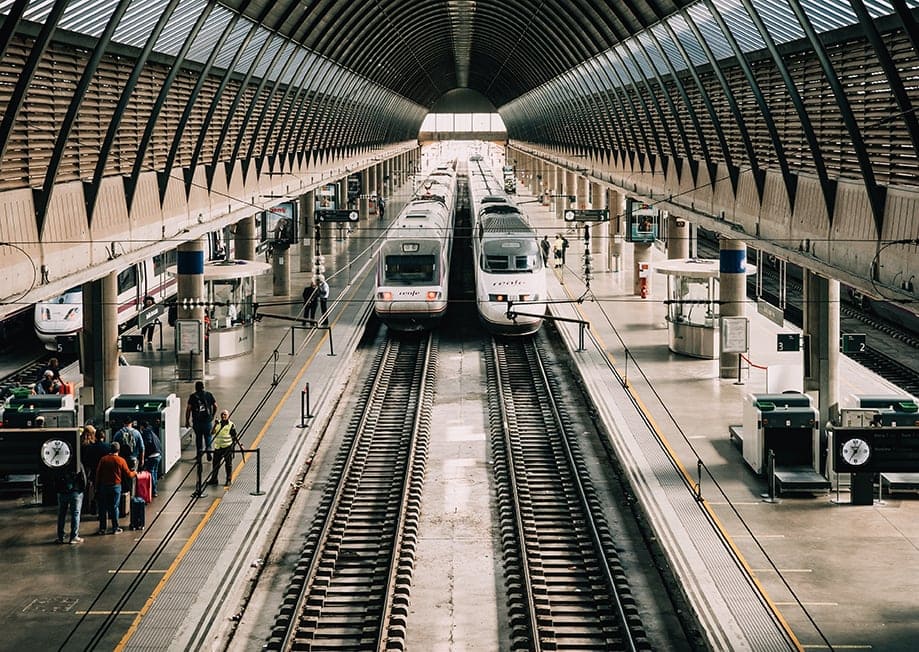
Image: Nic Hilditch-Short
Bus
Spanish buses are your budget buddy here. For short or long-distance, your options stretch pretty far here. They are clean and comfortable, and they have reclining seats for a decent siesta.
If you book in advance, you’ll get some really solid deals. Travelling by Flixbus is generally a sure bet.
Train
Spain’s trains (hey that rhymes!) are reliable, comfortable, and fast. They can be expensive though, so book early to get the best prices.
I’d say they’re best for long-distance trips. Consider a rail pass for Europe-wide trips. Interrail (for Europeans) is great, Eurail is the same thing for non-Europeans. They get you unlimited train travel within set time periods.
BlaBlaCar
While travelling around Spain last year, I used BlaBlaCar as my main mode of transportation. This car-sharing app has taken the world by storm – and it’s a great way to get around Spain cheaply and conveniently. It’s usually cheaper and faster than the bus and easy to book last minute.
Think of it as paid hitchhiking. It’s the cheapest form of “private” transport, whilst also being safer than actual hitchhiking as users are reviewed. It’s also a great way of socialising with new people, just make sure you clearly confirm pickup and drop-off points.
Metro
Madrid and Barcelona have great metro systems. Just watch out for pickpockets who love these networks…
They’re the cheapest way to travel quickly across these cities. You can even consider getting a city card which sometimes combines metro travel with attractions. I also saw metro tickets which were cheaper if you bought 10+ journeys at a time. I didn’t do this as I thought I wouldn’t need the metro often, came pretty close to that though.
Plane
Budget airlines sometimes offer cheap flights between big cities. If you’re heading out to the islands, flights are usually cheaper than ferries.
Baggage fees could tank the budget-friendliness of this method though. Sometimes they cost even more than the flight itself – crazy!
Car Rental
Renting a car is a great way to see Spain at your own pace, I only recommend it for rural areas though (you don’t need it in the cities). You can sort your car rental in just a few minutes.
Booking in advance is the best way to score the lowest price and your choice of vehicle. Often, the best car rental prices are a pick-up from the airport. Make sure you get travel insurance that covers this. Also check parking costs when you drive around.
Travelling in Spain by Campervan
No country does romantic vanlife like Spain. You can make the best beaches on the Costa Del Sol into your backyard, make a delicious breakfast with views of the mountains, or travel to all the cities in Spain with ease.
You don’t really need to plan ahead. The weather is generally great. Have I convinced you yet?
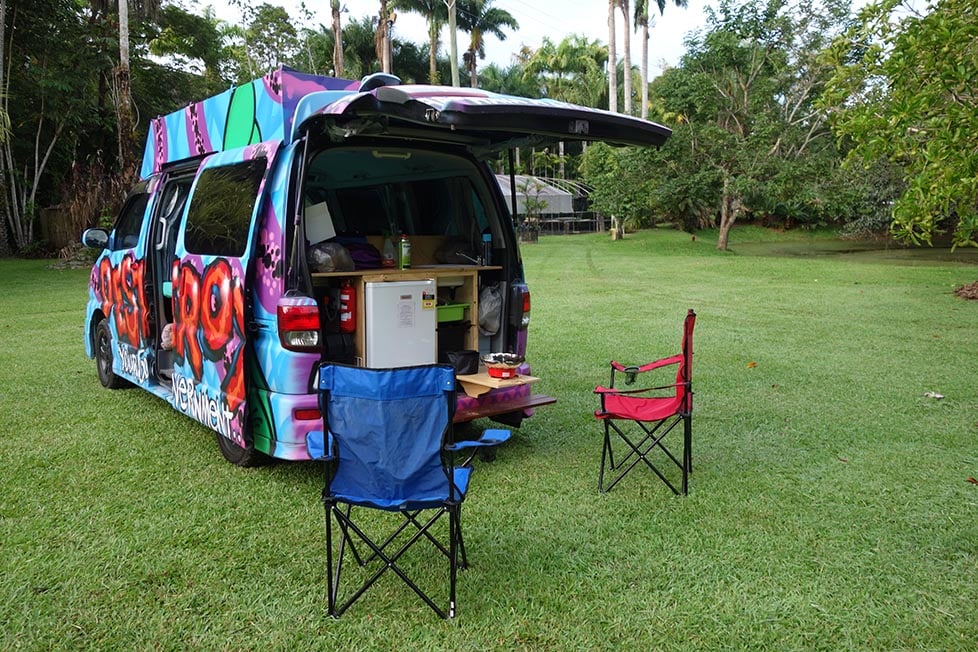
Image: Nic Hilditch-Short
Travelling here by campervan is a fantastic option. Renting a campervan certainly opens doors on your travel routes. I can’t think of a better way to spend a few weeks cruising around the country than in a campervan!
Northern Spain, Andalucían villages, and the Canary Islands are places where a campervan will really maximise your experience.
Check parking and overnight rules just to be on the safe side of things. And never leave valuables around, especially where visible. Also take high summer demand into account when purchasing or hiring a vehicle.
Hitchhiking in Spain
Hitchhiking is totally doable in Spain, though it’s not as common as in other European countries, like Germany or France. Don’t plan on covering more than 200-300km a day. Try to stick to service stations and get practising your Spanish! Avoid dangerous motorways.
Try to avoid hitchhiking during siesta hours (from 14:00 to 17:00) when there tends to be less traffic. In the summer, this time of day is way too hot to be waiting around anyway. Don’t try this if you’re in a rush.
What’s New for Backpacking in Spain?
The big talking point in Spain over the past few years has been the impact of overtourism. Widespread protests have taken place, which have led to tourist taxes rising sharply, heavy restrictions on Airbnbs, and overall travel costs rising a lot as a result of these. I paid over 6 euros a night in tourist taxes in Barcelona just to stay in a hostel. The Balearic Islands, Canary Islands and other popular places are major hotspots for this.
Like other Western European countries, Spain has also suffered from the impact of mass immigration in recent years. This has led to skyrocketing demand for properties, which in turn has driven up prices. This makes running a hotel or hostel far more costly these days, which is reflected in the costs we pay as tourists.
Elsewhere, Spain has cracked down on its famously hedonistic party scene. In 2014, an x-rated incident hit global headlines. Just Google “2014 Magaluf 24” if you really want to know the details. Ah, her mother must’ve been so proud…
Spain responded to this by clamping down on extreme drinking culture, happy hours, unlimited drinks packages, and promotions of wild bar crawls. It also introduced fines for tourists behaving a little too badly with acts such as public drunkenness, balcony jumping, public disorder, or disruptive behaviour.
Spain still has a fantastic party scene, particularly in the Balearic Islands, which include Ibiza and Mallorca (home to Magaluf). But they’re trying to move away from irresponsible tourism.
Working in Spain
Working in Spain has never been more popular. They generally offer a great work/life balance.
It is a very tempting place to live and work for travellers. Though, wages in Spain are not as high as other parts of Europe (northern Europe especially), yet living costs are pretty high in comparison, most notably in the larger cities.
If you have one of those EU or EEA passports, working in Spain is as easy as showing up. If you don’t, it’s a little trickier.
Image: Nic Hilditch-Short
It’s not impossible, but you’ll have a few hoops to jump through. Citizens of Latin American countries often have an easier time obtaining visas as a benefit of former colonial ties.
There are a number of different visa types available including seasonal, long-term, and Au Pair visas. If you’re looking for a shorter-term trip, the Spanish working holiday is a great offer.
There may be some options to work without a visa in Spain. You should avoid doing this. Remember, if you’re working illegally in a country, you’re taking a job from a struggling local. The exception would be if you work remotely for a foreign business, then you aren’t harming the locals by having a job here.
You’ll have considerably more options if you can speak Spanish too. Lucky for you Global Work and Travel offer the chance to study Spanish in Valencia. You can stay anywhere from 1 to 12 weeks and take your Spanish to the next level. Without good Spanish, you almost certainly won’t get a good job here. Well, maybe if you’re good enough to play for a top La Liga club…
The Digital Nomad Scene in Spain
Spain is actually one of the best countries for digital nomads in Europe. The internet is trustworthy, it’s much cheaper than other countries in Western Europe, and the weather is just generally better.
Popular bases include Barcelona, Madrid, Valencia, Málaga, Canary Islands, and Balearic Islands. I don’t recommend the Balearics though, they’re very party-centric and I wouldn’t call them a great environment to get work done.
Whether you’re a beach bum or a city person, you’ll have all your options open. Spain is even offering a digital nomad visa now, which means you can learn how to be a digital nomad. Popular places are tricky to base yourself in as a Broke Backpacker though, as they’re much more expensive.
There are great digital nomad-friendly hostels too so you can meet cool people at your new office.
Teaching English in Spain
Teaching English abroad is probably the number one job for ex-pat English speakers in Spain. I spent a few years teaching in different areas and although it was quite hard work, it’s actually a good job for this country, with a big market.
You don’t need a degree. Arguably it may help you but I don’t have one and here I am. Speaking Spanish helps, but isn’t essential.
Just make sure you’re aware of the latest visa rules, because they can change with little notice. And be aware of your work rights, otherwise you could get shafted hard. I learned this the hard way doing a similar job in South Korea…
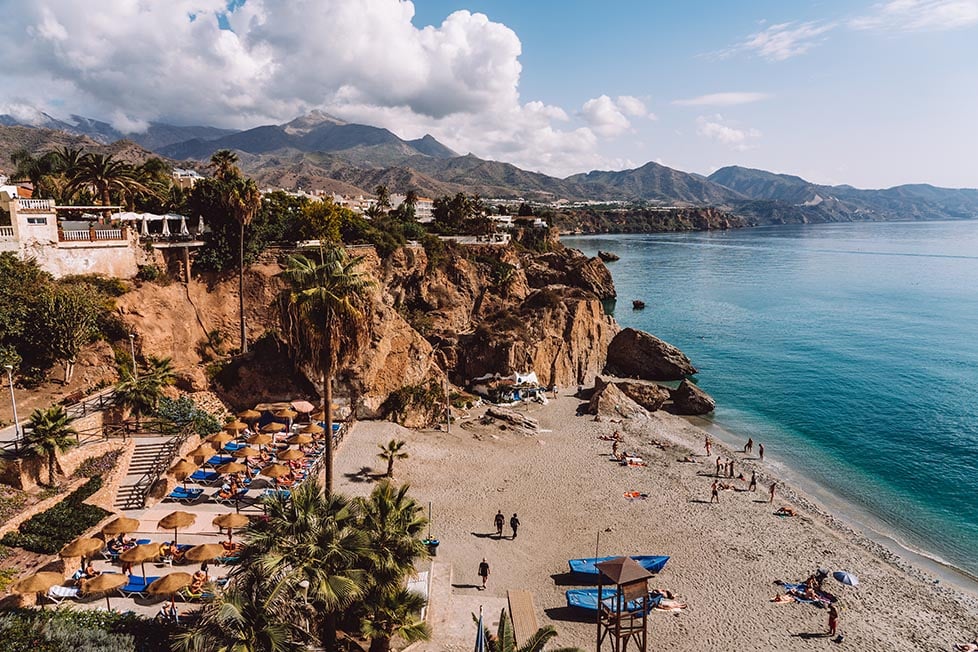
Image: Nic Hilditch-Short
A TEFL definitely will help you but, again, it’s not essential. I didn’t have one when I started – I completely blagged it – but after I got one my teaching abilities improved a lot. So yeah, I highly recommend it.
The best course is with MyTEFL. You learn so much and it helps you get on the ladder. The Broke Backpacker readers also get a really decent discount.
Government Language Assistant Programs (Auxiliares de Conversacion) are a common way in. You probably won’t work more than about 14-16 hours a week. Your role will be to work as a “cultural assistant” alongside a main teacher, and you’ll most likely be doing conversation work.
Volunteering in Spain
Volunteering in Spain is a great way to experience the culture and do some good in the world. There are lots of different volunteer projects ranging from animal care to agriculture to restoring medieval castles. Hostel work and language roles are options too.
Note that it’s sometimes necessary to have the right to work in Spain in order to volunteer. This depends on the place. Don’t just assume you can rock up and volunteer on a tourist visa.
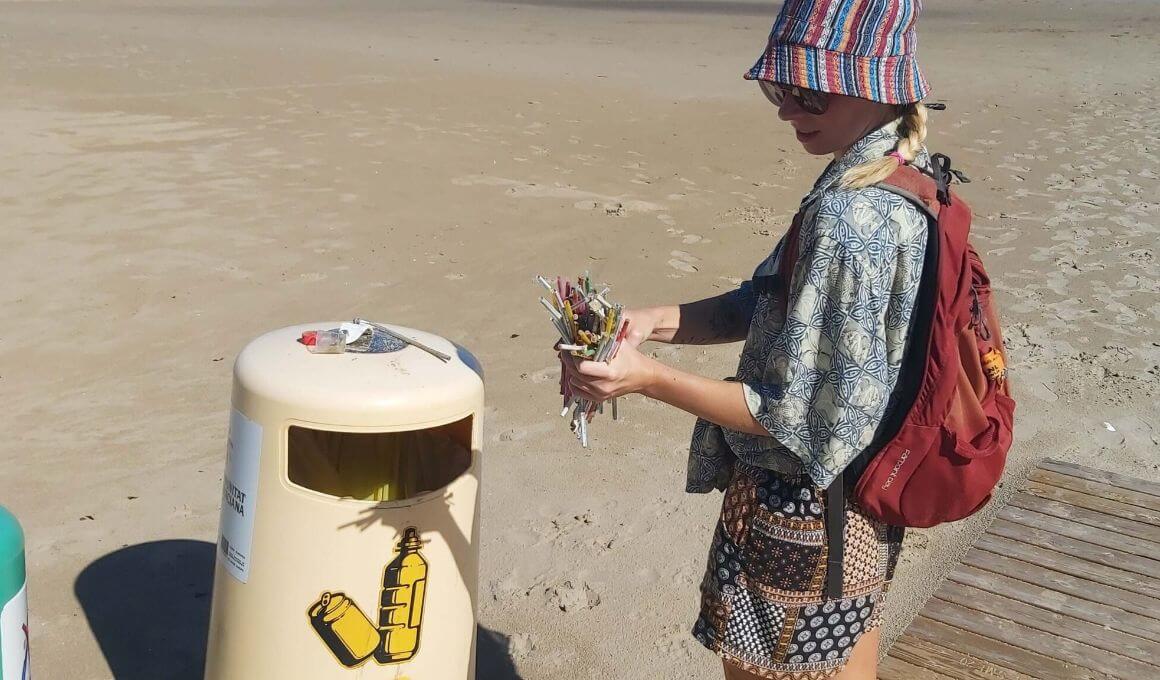
Photo: @Sebagvivas
I recommend using programs run through reputable work exchange programs. As well as having more options, it’s just generally safer. And they tend to play by the rules, so you should have less chance for trouble.
We personally recommend that you signup for Worldpackers. As a Broke Backpacker reader, you’ll also get a discount of $10. Just use the discount code BROKEBACKPACKER and your membership is discounted.
Spanish Culture
Spaniards are passionate and full of energy. Just go to a flamenco show or a football game and see for yourself. Spanish people work to live, not live to work.
They are mostly night owls too; they eat dinner after 10 pm and parties don’t start until after midnight. Most clubs don’t get going until 3-4 am. It’s pretty common for them to go to work with just a couple of hours sleep.
One time, after spending a night out, my friend and I were waiting for a bus around 6 am. Everyone else was chatting on the steps, so we figured they were waiting too.
We eventually realised they were just hanging out and waiting for the next party to start. Welcome to Spain!
And speaking of sleep, many Spaniards don’t really sleep during the siesta. Businesses close down between 13:00-16:00 and schools usually break for a few hours too. Outside of the big cities in Spain, you’ll need to plan your visit so you don’t have to wait around for several hours for places to open up again.
Likewise, it’s pretty common that places close on Sundays too. Those lovely whitewashed villages are pretty boring on Sundays.
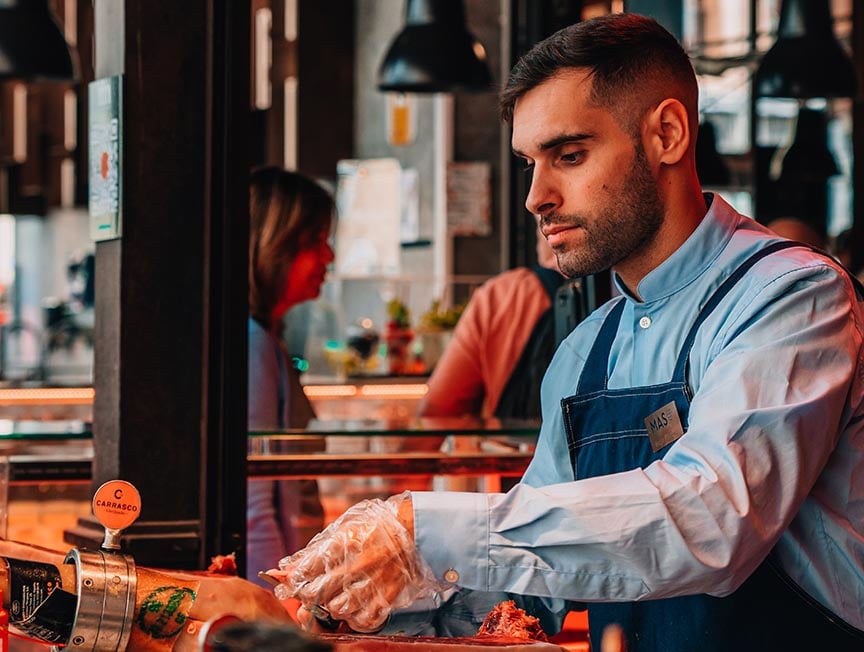
Image: Nic Hilditch-Short
Although it’s becoming less prominent, Spain is still quite a religious country. As well as a church on every corner, you’ll see little reminders everywhere.
Spaniards are very family-oriented, and it’s common for kids (or young adults) to live with their parents well into their 20s, and even until marriage. Spanish people enjoy eating big family dinners with everyone chipping in.
Useful Phrases For Travelling in Spain
In Spain, they speak Spanish (dur). But actually, much of Spain doesn’t speak Spanish as their first language.
There are 5 languages: Castellano (traditional Spanish), Catalan, Basque, Galician, and Occitan. Most schools teach both their regional language and Spanish, but many older people in these regions – especially in smaller towns and remote areas – may not speak Spanish. In these places, local languages matter. A simple “gràcies,” “eskerrik asko,” or “grazas” can go a long way.
That being said, you’ll get by everywhere with Spanish. Although you won’t have any trouble getting around Barcelona, Madrid, or other touristic areas with English – I strongly recommend that you practise your language skills. Their English isn’t the strongest, you shouldn’t expect people to speak English all the time, plus you’ll break a lot of barriers!
Hola – Hello
Buenos días – Good morning
Buenas tardes/noches – Good afternoon/night
Cómo estás? – How are you?
Vale – okay
Una cerveza por favor – A beer please
Dos cervezas, señor – Two beers, sir
(Muchas) gracias – Thank you (very much)
Qué hora es? – What time is it?
Donde esta el baño? – Where’s the bathroom?
Perdón – Excuse me/sorry
Me puedes ayudar? – Can you help me?
Sin bolsa de plástico – No plastic bag
What To Eat in Spain
Spanish food is famously meaty. Don’t be surprised to see pig legs hanging in shops, houses, petrol stations, garages, you name it. Their jamón (ham) is traditional – especially around the holidays.
Yes, it is possible to survive on jamón, olives, and tomatoes. They even claim (very boldly, I might add) that they have the best olive oil in the world. But there are many more culinary delights…
You already know the paella. You’re going to find the most traditional version in Valencia. If you’re in a notable tourist destination, you’re going to get the tourist version of Paella.
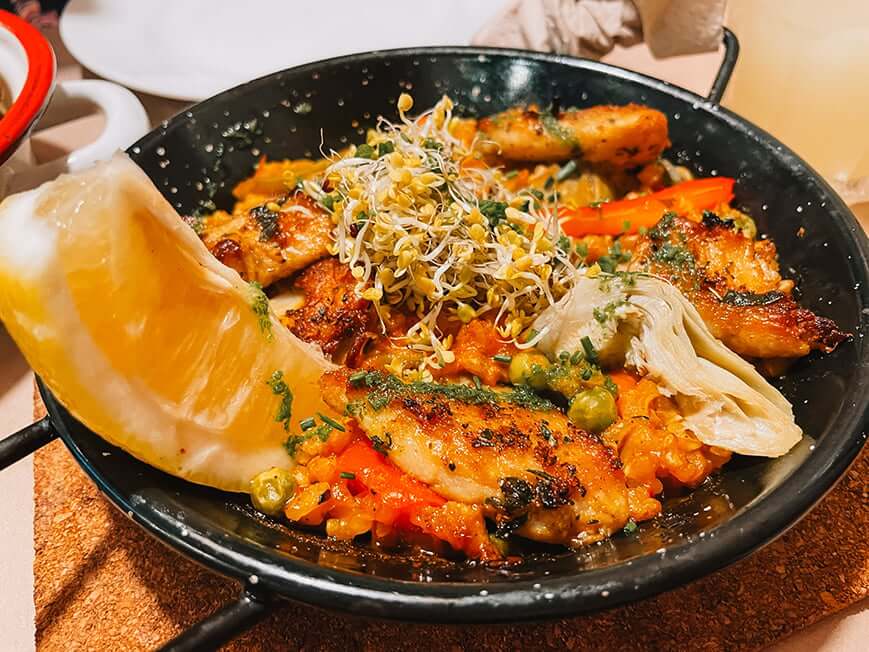
Photo: Nic Hilditch-Short
Across the whole country, but especially on the coast, the seafood is amazing and reasonably priced. While living in the Canary Islands, we had freshly caught seafood handed to us every day by local fisherpeople.
I’m also a huge fan of the menu del dia, a budget-friendly 3-course lunch consisting of a small starter, main meal, and a dessert. This concept has spread all over the Hispanic world, so you may be familiar with it if you’ve done a bit of Latin America travel. Local markets are another good way to save money, I found them far cheaper than restaurants across the country.
Must-Try Dishes in Spain
Paella – Spicey ricey dish.
Tapas – A little bit of everything.
Pintxos – Like tapas, but only served in Basque Country and better.
Patatas Bravas – Saucy potatoes.
Croquetas – Hot, crunchy, delicious abuela food.
Jamón ibérico – Cured ham from Iberian pigs – One of Spain’s most iconic dishes.
Churros con Chocolate – Deep fried deliciousness.
Tinto de Verano – The best way to get drunk in summer.
Rebujito – Another great way to get drunk.
Cured meats (jamón, chorizo, salchichón) – Who doesn’t love a bit of dried pig leg?
Pulpo a la Gallega – Boiled octopus + sides.
Tortilla Española – An omelette filled with eggs, potatoes, and usually onions.
While backpacking Spain, what you eat is almost as important as when you eat. Breakfast is eaten late and generally consists of a quick coffee and small snack, tostada, or maybe even a churro with chocolate. Lunch (the main meal) is eaten between 2 pm and 3 pm, and dinner from 10 pm onward.
Between 2pm and 4pm, most shops in Spain shut down the siesta means people can have lunch at home with their families. Most of Spain is unbearably hot at this time, and who wants to work in the heat!?
Most people will stay up late into the night – even children. It’s common to have dinner at midnight, especially on weekends.
A Brief History of Spain
While backpacking Spain, it’s important to be aware of Spain’s complex history. Here I’ll cover the main periods.
Ancient History
Iberians, the Phoenician Empire, and, later, the Celts came before Ancient Rome conquered Spain. Rome left four powerful elements: the Latin language, Roman law, the municipality, and the Christian religion. After the fall of the Roman Empire, at the beginning of the 8th century, the Arabs ruled for eight centuries.
Moorish Rule
You can’t miss the imprint of Muslim rule while backpacking Spain. Muslims (Moors from North Africa) colonised Spain from 711 AD, having invaded via Gibraltar. There are thousands of cool buildings in the south of Spain dating back to Moorish times, that you can still check out today.
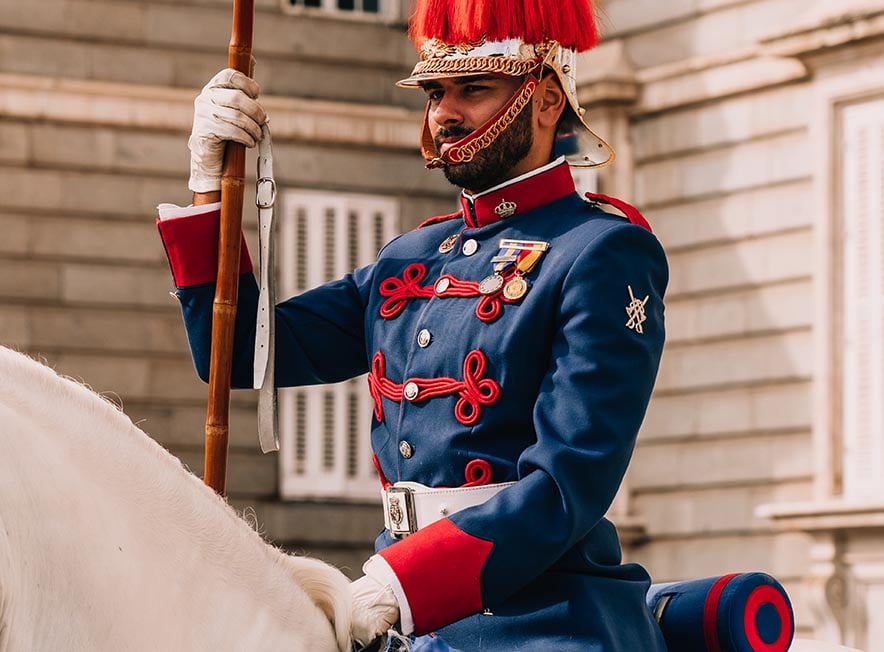
Image: Nic Hilditch-Short
Christian Revival, the Spanish Inquisition, and the Decline
In 1469, the marriage of Catholic Monarchs, Isabella of Castile and Ferdinand of Aragon, marked the beginning of Catholicism’s success over Spain. They conquered the last of the Arabs. The Christian Reconquest concluded in 1492 with the Moors defeated. The Golden Age began straight afterwards, where Spain reunified as a Catholic country, and began an era of economic and cultural prosperity. This is also when Christopher Columbus discovered the Americas.
Over the next two centuries, the Spanish Empire became a world power – and dominated nations. The Spanish Inquisition focused on removing Islam’s policies and converting Jews to Christianity. This is why pork and jamón have strong cultural connections in Spain. Hanging pig legs showed that you were not a Muslim or Jewish “traitor”. Fernando and Isabel eventually exiled all Jews who refused to convert – or killed them.
Their empire ended with a less-than-graceful fall from power in the 18th century. In the 19th century, Spain was divided between liberals and conservatives. Powers teetered with internal struggles and lost their colonies.
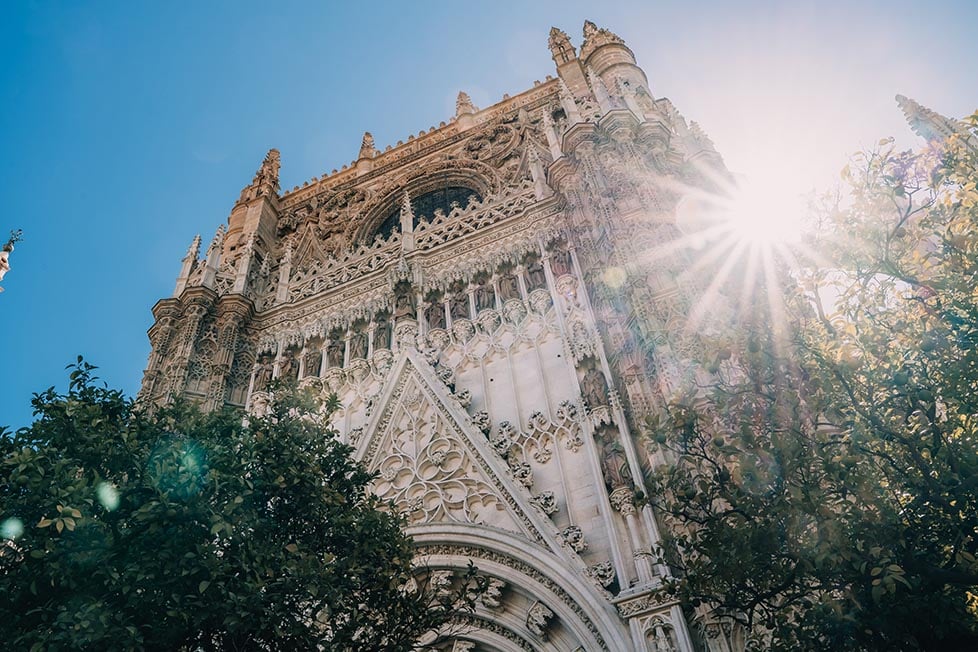
Image: Nic Hilditch-Short
20th Century: Civil War, a Dictatorship, and Democracy
A never-ending power struggle caused growing violence and social conflicts – leading to a military uprising and civil war. Both sides committed massacres and reprisals.
In 1936, General Franco became Spain’s new dictator. Despite Franco’s support of Hitler, Spain remained on the sidelines during WWII. Franco’s death in 1975 ended the era of this dictatorship and the monarchy returned. King of Spain, Juan Carlos I de Borbon y Borbon established a western-style democracy with free elections and no official religion in 1977.
Between 1980 and 1982, the Catalonia, Basque Country, Galicia and Andalucía regions approved statuses for self-government. In 1986, Spain joined what is now the EU.
Some Unique Experiences in Spain
While you’re at it, you should know of some special experiences while you visit Spain.
Trekking in Spain
With two main mountain ranges, hiking opportunities in Spain are strong! Trekking through the country, and walking the Camino de Santiago are life-changing experiences. The Picos de Europa, Sierra Nevada, Pyrenees and Canary Islands are all solid spots for a lengthy walk.
Spring (March-May) and Autumn (September-November) are prime time for hitting the trails, but summer can be decent too, especially in the Pyrenees.
Be sure to always check the weather, use AllTrails to plan, and book accommodation ahead in the high season (spring/autumn) before it sells out.
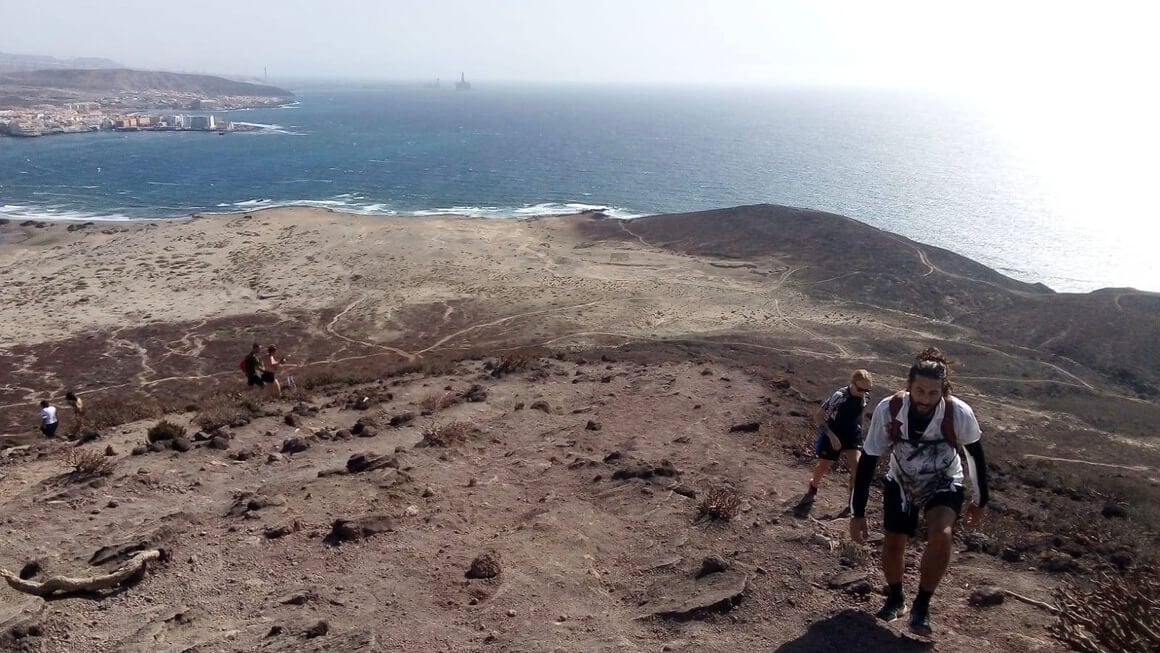
Photo: @Lauramcblonde
Walking El Camino de Santiago
What began as a pilgrimage trail hundreds of years ago is now also journeyed by travellers all over the world. It’s one of the world’s most famous walks. If you have the time, I highly suggest walking El Camino while backpacking Spain. The best times to hike it are May, June, September and early October. July and August are crowded and hot.
There’s very little technical walking on the main Camino routes – you’ll mostly be on well-maintained tracks or pavement – so you don’t need much. The most important thing to bring is a good pair of hiking boots (well broken in), a refillable water bottle, and layers – especially if you are hiking during shoulder season.
Otherwise, rain is rare. Before setting off, check out our beginner’s guide to hiking and aim to pack light, as you will stay and eat in towns along the way. Break in your shoes before doing this, otherwise you will experience levels of discomfort previously unknown to mankind!
The Camino is social and meaningful even for non-religious travellers. You can get a Pilgrim Passport online or at the beginning of the trail, and pick up stamps along the way at cafes, churches and albergues. At the end you’ll receive a Compostela (certificate) if you have collected the stamps to prove you’ve walked the trail!
El Camino Routes
- Camino Francés (the French Way): The Camino Francés starts in St Jean Pied-du-Port. It’s the most popular with varied scenery and good infrastructure.
- Camino Primitivo (the Original Route): The Camino Primitivo is the most direct route from Oviedo to Santiago (passing through Lugo). It rejoins the Camino Francés about 40 miles from Santiago. The walk is about 180 miles long and is quite challenging with hill climbing and erratic weather.
- Camino del Norte (the Northern Way): The 510 miles of pathway will take about 35 days. Distances between towns are reasonable but accommodation is sparse so book ahead. This route starts in Irún on the border with France and travels west through Bilbao, Santander, and Oveido.
- Camino Portugués (the Portuguese Way): Starting in Lisbon and passing through Porto and Pontevedra. it is 380 miles long, and reasonably flat. However, you will walk alongside motorways.
- Camino de Finisterre (the Finisterre Way): Instead of finishing your walk in Santiago, continue on to Finisterre, whose name literally translates to “end of the world”. The route adds on 55 miles with an optional extra 18-mile walk to Muxia afterwards.
Hiking in the Picos de Europa
Picos de Europa translates to Peaks of Europe. This national park is located in the Asturias region, so you can expect lush green scenery including its famous limestone peaks.
This part of Spain is famous for cuisine including some great seafood. Fabada Asturiana is particularly well known, a stew made up of beans, pork, and sausages.
It’s best to hike here in the summer, or early autumn. Just keep an eye on the weather, as Spain’s mountains can be unforgiving, and conditions change fast at times.
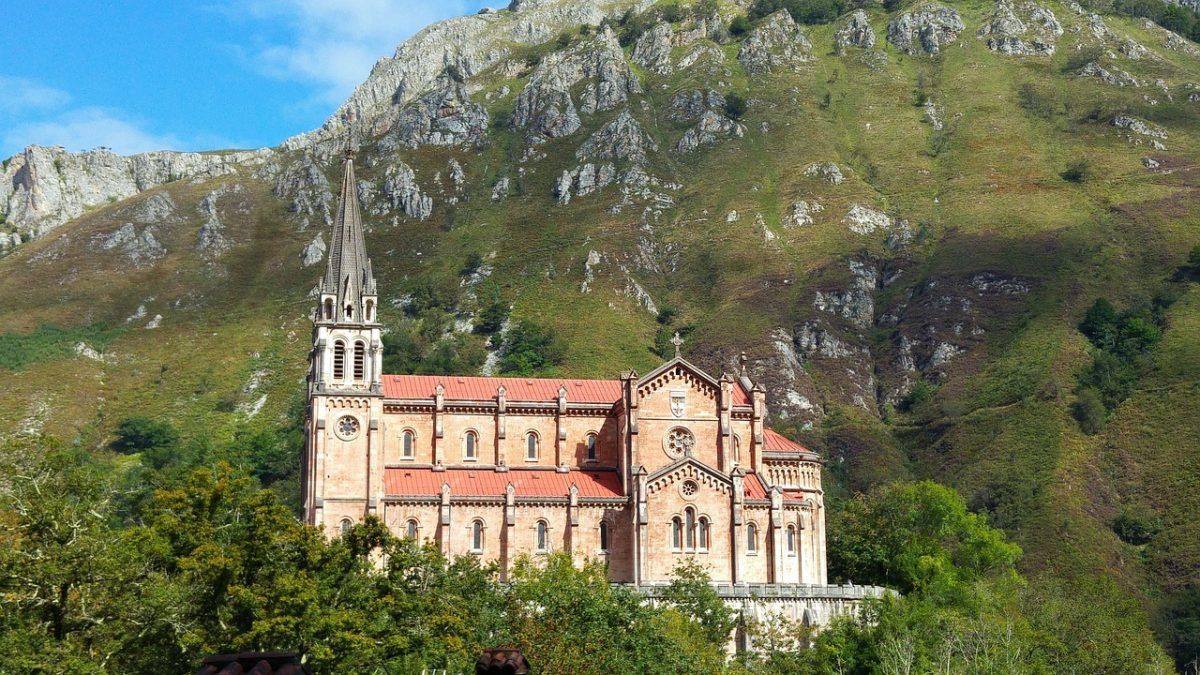
Hiking and Skiing in the Sierra Nevadas in the South of Spain
No, I’m not talking about the American pale ale beer. The original Sierra Nevada mountain range is located in the south of Spain.
On a clear day, you can see this snow-capped mountain range from Granada. This is the largest of Spain’s national parks, with plenty of hiking and climbing options during spring, summer and autumn. It gets hot in summer though until you reach the higher parts.
During winter you can also ski in the Sierra Nevadas for ridiculously affordable prices. A good nature stop whilst backpacking Andalucia.
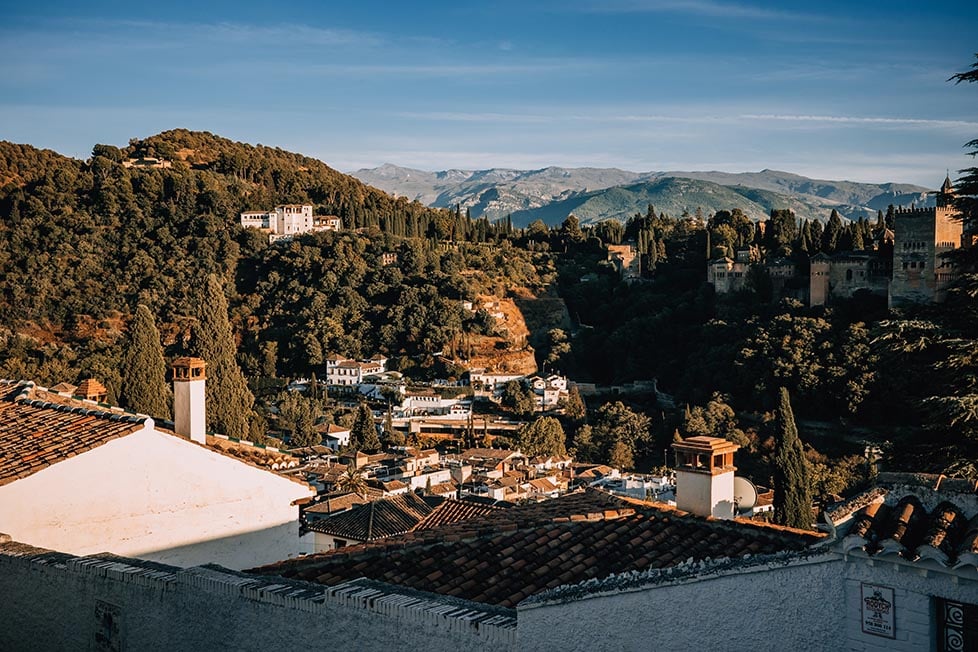
Hiking and Skiing in the Pyrenees of Spain
This mountain range is close to Barcelona and borders France. There are plenty of hiking and skiing opportunities here. Parque Nacional de Ordesa y Monte Perdido is full of limestone peaks and deep valleys.
I wouldn’t say this is the easiest place to reach by public transport, so consider a rental car to get here. If you make the effort though, the rewards are spectacular.
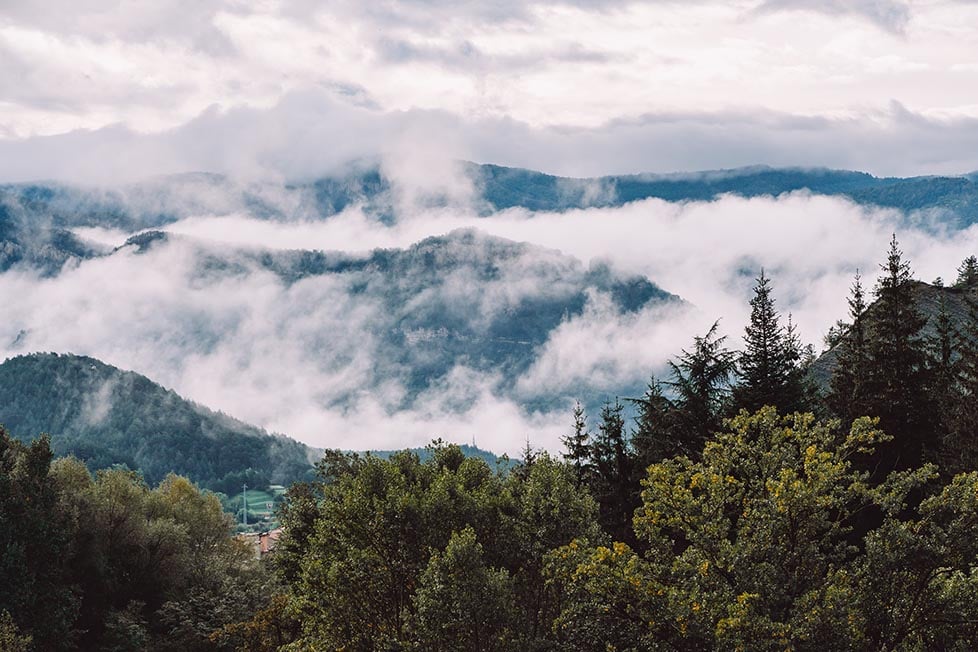
Image: Nic Hilditch-Short
Joining an Organised Tour in Spain
For most countries, Spain included, solo travel is absolutely sick. That said, if you are short on time, energy, or just want a little push to meet some other travellers, joining an organised tour is a good option.
The tours help you see a lot more of Spain quickly and without the effort that goes into planning a backpacking trip. However, not all tour operators are good – that is for sure.
But G Adventures is a solid down-to-earth tour company catering to backpackers just like you, and their prices and itineraries reflect the interests of the backpacker crowd. You can score some pretty sweet deals on epic trips in Spain for a fraction of the price of what other tour operators charge.
Spain Is More Than Barcelona, Madrid, and Beaches
If you haven’t noticed by now, I love Spain! I’ve been so well received there over my travelling years – and I’m far from seeing the last of it. I’m so happy to recommend it for every kind of traveller: old, young, new, solo, groups, lovers, digital nomads… you name it.
Backpacking Spain allures anyone who appreciates history and rich culture, a hearty tapas and drinking scene, plus year-round beautiful beaches and mountain ranges. I urge anyone who travels here to visit different regions and experience contrasting cultures. Andalucía, Basque Country, Galicia, Catalonia, Valencia, the islands, and northern Spain all feel different.
Although serious crime poses little risk, petty crime isn’t uncommon – especially in the big cities. Pickpockets are perhaps Spain’s biggest problem. There were wildfires when I went in the summer, but these are rarer and mostly in remote rural spots.
Try your best to speak Spanish. It will make all the difference in your experience. You’ll get to know the people and it’ll help you get around. Although if I spoke in Spanish in big cities, locals would often respond in English! No one expects foreigners to speak Basque or Catalán, but you’ll notice the light in the locals’ faces if you can even say a few words.
And if you party, don’t go too wild. Don’t become the type of tourist that makes the locals angry. Give Spain more than the obvious stops, travel slowly enough to feel its regional differences, and you will understand why so many travellers keep finding their way back.
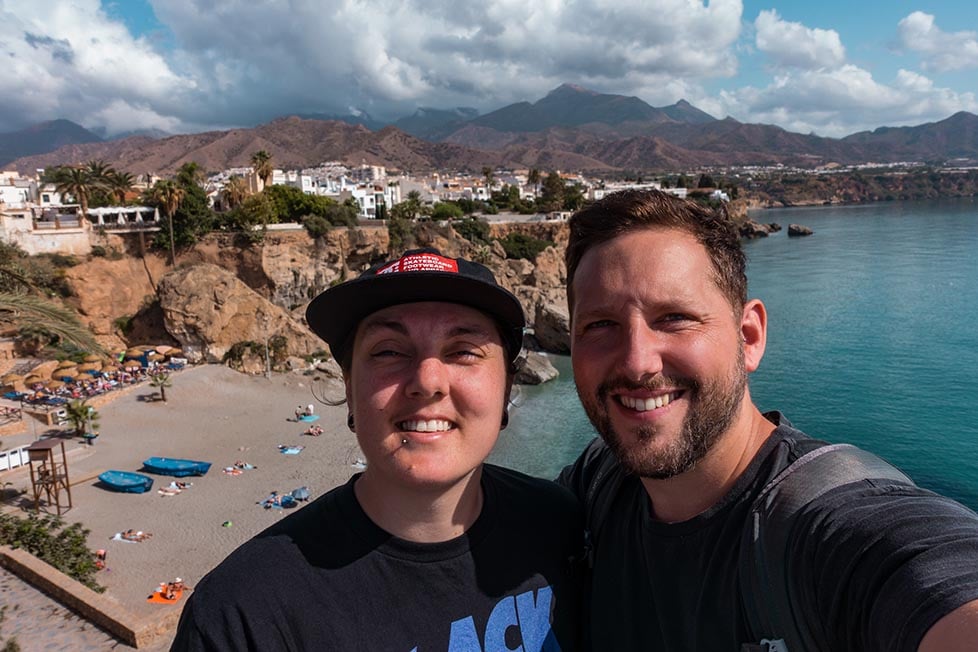
Image: Nic Hilditch-Short




So many great memories reading this. A few years ago we pretty much did the exact itinerary that you are suggesting for the North. Last year I also did another roadtrip down the west of the country following the Portugue boarder. I’ll be going back again soon I’m sure so will plan in your southern itinerary as it looks great!
Hot damn that’s a comprehensive guide! I only scratched the surface of what’s to explore in Spain, and definitely adding more destinations in my travel list after reading this meaty guide. Thanks for all the info!
Hi Ana,
Your blog has been extremely helpful and provides great details. Thank you for sharing all of this information with the readers.
I needed some opinion from you. I am confused if i should stay a night in Toledo or just do the day trip and head back to Madrid. By looking at the pictures, it looks magnificent at night and i would really want to witness that but also at the same time, i am not sure if staying back in Madrid at night and experiencing the nightlife there would be a better idea.
Also, i need to head to Cordoba and i could not find any direct trains or buses that leave directly from Toledo. I will have to head back to Madrid eventually to reach Cordoba. Since you mentioned use of BlaBla Cars, can you suggest if i will be able to easily get myself a rideshare if i stay back in Toledo for the night?
Thank you so much for your help. Cheers!!
Hi! I think you answered your question. Toledo will be beautiful at night and less touristy, but if it’s the raucous nightlife you’re after, then head back to Madrid. I’m not sure about the most recent schedules from Toledo to Cordoba. I took a bus to Cordoba from Granada. Blabla car has never failed me!
Good article, just a few corrections: Santillana del Mar isn’t in Asturias, and Oviedo isn’t in Galicia. Catalonia also doesn’t have an accent.
Thanks for the corrections! Though I am not sure where you see the tidbit about Catalonia. I only said that Spanish is not the first language spoken.
Great post about Spain, it really covered everything!
I suggest, though, to warn that hitchhiking in Spain is illegal everywhere and you should keep your thumb down if you see the cops. Fortunately, only Traffic road police can fine you, but I had a lot of experiences with Guardias Civiles stopping me to check all my documentation and making me wait for around an hour. Probably you can get by if you are a foreigner and don’t speak Spanish because the cops won’t speak English either.
Apart from Blablacar, you have Amovens.es. It’s the same idea but way cheaper because the fee that the company charges is maximum 1€.
In the festival section, I would add the Nochevieja universitaria de Salamanca. They have a huge party 15 days earlier New Year’s Eve for students and the whole city is a big party, packed from people coming from all over the country.
Hi, I’m planning to visit Spain and Portugal this winter. Can you guide me about the weather during January and what to wear during that time!? I’ve never visited Europe so I don’t have any idea.
Hi there! Apologies I never saw this until now, but the weather in winter is actually pretty comfortable for visiting cities in Spain or Portugal. Spain is pretty big, so it kind of depends where you are traveling, but I would plan for crisp, sunny days as well as overcast rainy ones. (I wouldn’t go to Northern Spain — Asturias/Galicia etc. in winter, but the rest of the country will be great for sightseeing.) Pack layers so you are ready for anything, and gloves/scarf is always essential for winter, but neither country is going to be NEARLY as cold as the rest of Europe.
As you probably know, winter is not good beach weather in either country, but the coastal cities will probably be comfortable walk around with a jacket and boots. Have a great time!
In the north, along the coast bordering the Atlantic Ocean (Basque Country, Cantabria, Asturias and Galicia) winter is mild and humid.
The interior of Spain , is largely occupied by a plateau, called Meseta, which has an average altitude of 700/800 meters (2,300/2,600 feet) and has colder winters.
I will be traveling to Spain and Morocco this summer! I found this information extremely valuable in trip planning! Thank you so much!
This article is awsome and full of great info. I’m not going to backpack, but visiting Spain is a life dream of mine. Thanks for all the good information. Greatly appreciated.